Repetition sneaks into writing quietly, and “again” is often the word responsible. It doesn’t feel wrong exactly, but it feels lazy. Flat. Like you’re wearing the same outfit twice to the same party.
The truth is, “again” is one of those words writers lean on without realizing it. And the problem isn’t just repetition. It’s that “again” carries almost no personality. It simply tells the reader something happened another time. It doesn’t tell them how it felt, why it matters, or what kind of repetition it was.
That’s the real reason you need better options — not just to avoid repetition, but to write with more intention.
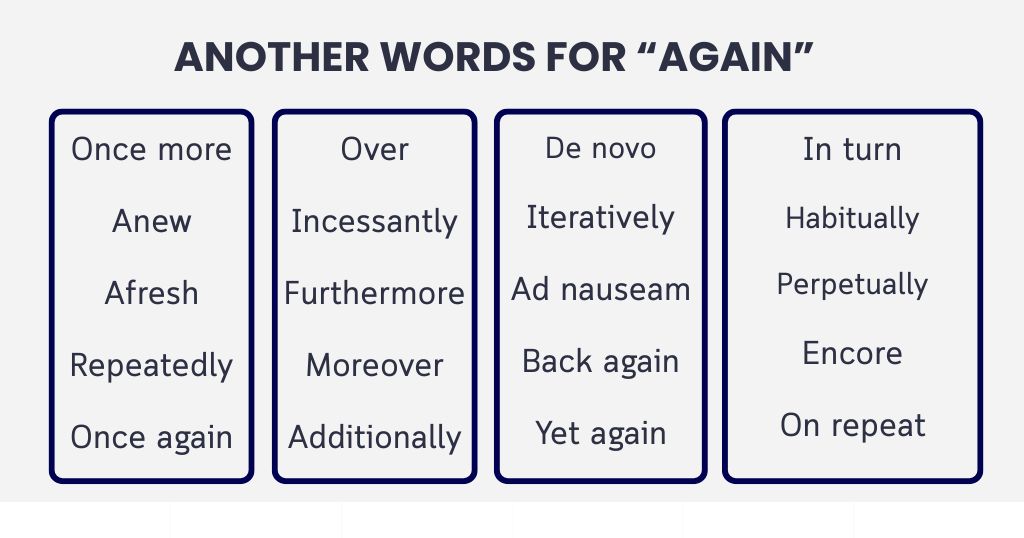
Quick Synonyms: 30 Another Word for Again, Organized by Use
| Word/Phrase | Tone | Best Used When | Example |
| Once more | Neutral/Formal | Simple, clean repetition | She read the letter once more. |
| Anew | Warm/Creative | Starting fresh with energy | He approached the work anew. |
| Afresh | Hopeful | After a setback, beginning again | They rebuilt afresh. |
| Repeatedly | Neutral | Emphasizing frequency | He asked repeatedly. |
| Once again | Slightly formal | Mild emphasis on return | Once again, nothing changed. |
| Over | Casual | Doing something from scratch | Do it over. |
| Time and again | Literary | Pattern of behavior | Time and again, she proved them wrong. |
| Incessantly | Negative / Critical | Annoying or irritating nonstop repetition | He complained incessantly. |
| Furthermore | Academic | Adding a new argument in essays | Furthermore, the data supports this. |
| Moreover | Formal/Essay | Strengthening a point | Moreover, this trend continued. |
| Additionally | Neutral/Essay | Simply adding a fact | Additionally, costs increased. |
| De novo | Formal/Legal | Starting completely from scratch | The case was reviewed de novo. |
| Iteratively | Professional | Repeating with improvement | The team tested iteratively. |
| Ad nauseam | Strongly Negative | Repeated until exhausting | The point was made ad nauseam. |
| Back again | Casual | Returning to a place or state | She was back again by morning. |
| Yet again | Frustrated / Negative | Repeating something unwanted or disappointing | Yet again, the plan fell apart. |
| In turn | Formal | Sequential or circular return | Each member spoke in turn. |
| Habitually | Neutral | Describing a regular pattern | He habitually returned to old habits. |
| Perpetually | Often Negative | Constant repetition, usually describing a problem | They were perpetually behind schedule. |
| Recurrently | Technical | Events that repeat over time | The issue arose recurrently. |
| In like manner | Academic | Mirroring a previous point | In like manner, the second group failed. |
| For the second time | Precise | When the count matters | For the second time, he missed the deadline. |
| Encore | Performance | A requested return or repeat | The crowd demanded an encore. |
| On repeat | Casual/Slang | Something happening constantly | Her apologies felt on repeat. |
| Back at it | Informal/Slang | Returning to a task or habit | Monday morning, back at it. |
| Run it back | Slang | Casual replay or redo | Let’s run it back and see what went wrong. |
| All over again | Emotional | Repeating something painful or full | It felt like starting all over again. |
| Day in, day out | Idiomatic | Exhausting, relentless repetition | Day in, day out, the routine never changed. |
| Correspondingly | Academic | Reflecting a parallel point | Correspondingly, the results matched. |
| Reiteratively | Very Formal | Deliberate repetition for emphasis | The argument was made reiteratively. |
What “Again” Actually Means
At its core, “again” means one more time returning to something that already happened. But look closer and you’ll find it does two different jobs. Sometimes it signals a fresh attempt (“try again”). Other times it signals continuation or addition (“and again, the results were the same”). Those two meanings need different replacements. Knowing which one you’re using is half the battle.
The Two Meanings You Need to Separate
Most synonym lists treat “again” as one word with one meaning. It isn’t.
Repetition “again” — something happens more than once. She called again. He failed again. The error appeared again. For this meaning, reach for: once more, repeatedly, yet again, time and again.
Additive “again” — you’re layering a new point on top of the last one. This is especially common in essays and arguments. Again, this proves the theory. Again, we see the same pattern. For this meaning, use: furthermore, moreover, additionally, in like manner.
Writers mix these up all the time, and it creates a tone problem. Using “repeatedly” when you meant “furthermore” sounds strange. Getting this distinction right instantly improves your writing.
Intensity Scale for “Again” Synonyms: From Gentle to Harsh
How you describe repetition changes how readers feel about it. Here’s how these words land emotionally:
Mild → Once more, anew, afresh, once again
Moderate → Repeatedly, time and again, yet again
Strong → Incessantly, perpetually, habitually
Extreme → Ad nauseam, day in, day out, all over again
If you’re describing something neutral like retrying a recipe “once more” works perfectly. If you’re describing a frustrating behavior that never stops, “incessantly” or “ad nauseam” hits the right note. Choosing the wrong intensity level sends a confusing signal to your reader.
Sentence Rewrites: See the Difference
Here are five weak sentences using “again,” each rewritten four ways.
Original: She made the same mistake again.
- Formal: She repeated the same error without correction.
- Casual: She messed up the same way, again.
- Academic: The subject demonstrated a recurrent pattern of identical errors.
- Creative: Like clockwork, the same mistake arrived at her door.
Original: He called me again even though I didn’t answer.
- Formal: He placed a second call despite receiving no response.
- Casual: He called back even though I hadn’t picked up.
- Academic: The behavior indicated persistent contact-seeking despite non-engagement.
- Creative: The phone rang again stubborn, hopeful, ignored.
Original: Again, the project was delayed.
- Formal: Once more, the project failed to meet its deadline.
- Casual: Yep, delayed again.
- Academic: Furthermore, project completion was obstructed for a second consecutive period.
- Creative: The deadline slipped again, like sand through an open hand.
Original: They fought again and again.
- Formal: Their conflicts recurred with notable frequency.
- Casual: They just kept fighting, over and over.
- Academic: The subjects engaged in repeated adversarial interactions across multiple instances.
- Creative: Their arguments had a rhythm now predictable, exhausting, familiar.
Original: I had to start again from the beginning.
- Formal: It became necessary to recommence from the outset.
- Casual: I had to start the whole thing over.
- Academic: The process was initiated de novo due to compounding errors.
- Creative: She erased everything and stepped back to square one, breathing slowly.
Formal vs. Informal: Where Each Word Belongs
Best for academic essays: Furthermore, moreover, additionally, correspondingly, in like manner, reiteratively these signal logical structure, not just repetition.
Best for professional emails: Once more, once again, for the second time clean and clear without sounding stiff.
Best for storytelling: Anew, afresh, all over again, time and again these carry emotion and rhythm.
Words to avoid in formal writing: Again and again, on repeat, back at it, run it back these are conversational and will lower your credibility in academic or business settings.
“Again” vs. “Against” Confusion
Search engines sometimes mix up “again” and “against” and so do some writers typing fast. They’re not related. “Against” means opposition or resistance. If that’s what you need, the right replacements are: opposed to, contrary to, counter to, averse to, in contravention of (legal contexts). Don’t borrow from the “again” list to fill an “against” situation. The meaning is completely different.
Common Mistakes Writers Make When Replacing “Again”
Using “anew” when you mean “once more.” “Anew” suggests a genuinely fresh start new energy, new approach. “Once more” just means one additional time with no change implied. Swapping them makes the sentence misleading.
Reaching for “repeatedly” in emotional writing. “Repeatedly” is clinical. It counts. But it doesn’t feel. In a personal essay or story, “time and again” or “again and again” creates more texture.
Overusing “once again” in emails. It sounds professional until it shows up four times in one message. Vary it with “as previously mentioned,” “returning to this point,” or simply restructuring the sentence so you don’t need a transition word at all.
Treating “incessantly” as neutral. It isn’t. “Incessantly” is almost always a criticism. If someone “checked in incessantly,” that reads as annoying. Use it consciously, not as a stylish synonym for “frequently.”
Related Words Near “Again” Worth Knowing
Recur — the verb form. Use it when events come back on their own. The headaches recurred every winter.
Persistent — describes something that keeps happening or won’t stop. Stronger than “repeated.”
Habitual — suggests a pattern tied to a person’s behavior or character.
Redundant — when something is repeated unnecessarily. Not a synonym for “again,” but connected to the idea of repetition adding no value.
Cyclical — repetition in a structured, predictable pattern. Good for describing trends, not personal actions.
The Real Takeaway
“Again” isn’t a bad word. It’s just overworked.
Before you replace it, ask two questions: Are you describing repetition, or are you adding a point? And how should the reader feel about that repetition — neutral, frustrated, hopeful, exhausted?
Once you know the answers, the right word becomes obvious. That’s not vocabulary work. That’s just clear thinking.

I’m Rowan, a language addict who loves exploring how words work in everyday communication. I’ve spent years studying English vocabulary and helping others express themselves more clearly. My goal is simple: make learning new words easy and practical. I focus on real-life examples that show when and how to use different terms. Through clear explanations and honest guidance, I help readers choose the right words for any situation with confidence.