There’s a moment most writers know well. You’ve written “gave up” three times in two paragraphs, and something feels off — not just stylistically, but emotionally. The phrase is flat. It doesn’t carry the weight of what actually happened.
Did the character surrender after a brutal fight? Walk away quietly? Let go on purpose? Those are completely different experiences, and “giving up” lumps them all together.
Word choice here isn’t just about variety. It’s about the truth.
What “Giving Up” Actually Means
At its core, giving up means stopping, ending your effort, releasing your hold on something, or accepting that a situation won’t change. But the emotional weight shifts dramatically depending on why someone stops and what they leave behind. That’s the gap most synonym lists never address.
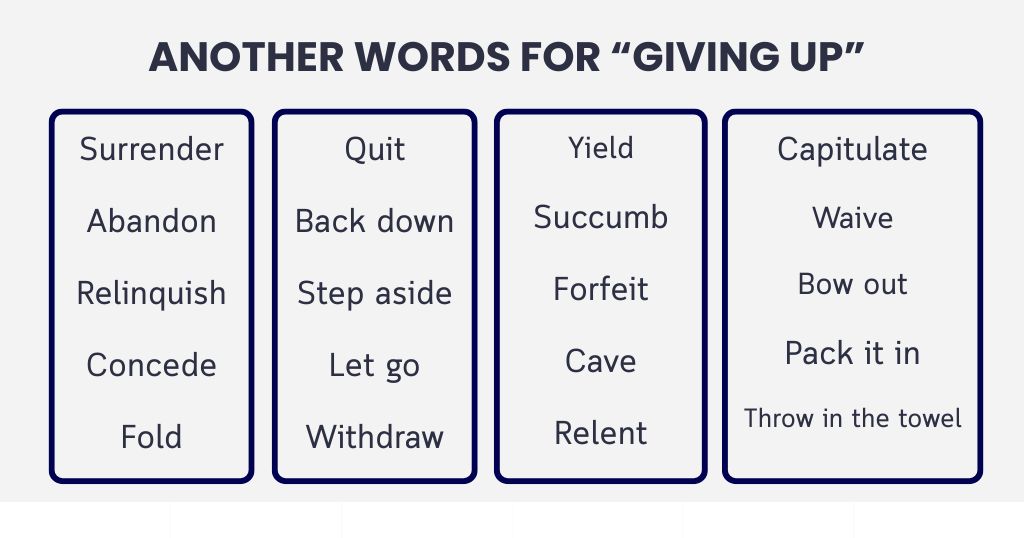
Another Word for Giving Up: 20 Synonyms Sorted by Tone and Context
| Word | Tone | Best Used When | Quick Example |
| Surrender | Formal / Heavy | After a long fight or struggle | She finally surrendered to exhaustion |
| Quit | Casual / Direct | Stopping a habit or job | He quit before things got worse |
| Yield | Moderate / Soft | Giving way under pressure | She yielded to their demands |
| Capitulate | Formal / Military | Accepting defeat officially | The team capitulated in the final round |
| Abandon | Emotional / Harsh | Leaving with no intention to return | He abandoned the project entirely |
| Relinquish | Formal / Reluctant | Giving up a right or role | She relinquished control of the company |
| Concede | Neutral / Logical | Admitting you were wrong or lost | He conceded the argument gracefully |
| Fold | Informal / Pressure | Giving in quickly when pressure becomes too strong | She folded under the pressure |
| Back down | Conversational | Retreating from a position | He backed down after the confrontation |
| Step aside | Professional | Giving up a role voluntarily | She stepped aside for the next generation |
| Let go | Gentle / Positive | Releasing something willingly | He let go of resentment after years |
| Withdraw | Neutral / Calm | Pulling back from involvement | The investor quietly withdrew support |
| Succumb | Emotional / Dark | Losing to illness, temptation, pressure | He succumbed to the stress eventually |
| Forfeit | Legal / Consequence-based | Losing something as a penalty | They forfeited the match by not showing up |
| Throw in the towel | Idiomatic / Casual | Admitting defeat informally | After three failed attempts, she threw in the towel |
| Cave | Informal / Sudden | Giving in quickly under pressure | Management caved to employee demands |
| Relent | Soft / Emotional | Softening a firm position | Her mother finally relented |
| Waive | Legal / Formal | Voluntarily giving up a right | He waived his right to appeal |
| Bow out | Polite / Graceful | Leaving voluntarily and respectably | She bowed out of the competition quietly |
| Pack it in | British Slang | Quitting with a tired, done attitude | After ten years, he packed it in |
The Clusters That Most Lists Miss
When Giving Up Is Forced
Some words carry the sense that a person had no real choice. Succumb belongs here. So does capitulate. These aren’t about weakness, they suggest a force that simply became too great. If you’re writing about someone who fought hard before losing, these words honor that fight better than “quit” ever could.
When Giving Up Is a Choice
Relinquish, waive, and step aside all describe deliberate, thoughtful release. There’s dignity in them. A CEO who steps aside is doing something different from a CEO who quits. The difference in word choice tells the whole story.
When Giving Up Is Actually Healthy
This is the gap almost no synonym article covers. Sometimes letting go is the right move, even the brave one. Words like let go, release, and bow out carry that quiet wisdom. They don’t suggest failure. They suggest maturity.
If you’re writing about someone who walked away from a toxic situation, “let go” is not a synonym for defeat. It’s the opposite.
Tone Intensity Scale for Giving Up Synonyms
Not all giving-up words carry the same emotional weight. Here’s a rough scale from softest to heaviest:
Let go → Yield → Back down → Relent → Concede → Quit → Fold → Abandon → Surrender → Capitulate → Succumb
Moving from left to right, the sense of struggle, resistance, or loss increases. Let go feels peaceful. Succumb feels tragic. Choose based on what your reader should feel, not just what happened.
Rewriting “Gave Up” in Real Sentences
Original: She gave up on her dream after the rejection.
- Formal: She relinquished her ambition following the rejection.
- Casual: She packed it in after hearing no.
- Emotional/Creative: Something inside her surrendered quietly, like a flag lowered at dusk.
- Academic: She disengaged from her long-term goal in response to external setback.
Each version changes what the reader feels about her. The academic version sounds clinical. The creative version makes you feel her loss. Neither is wrong; they serve different writing purposes.
Original: He gave up during the meeting.
- Soft: He backed down when challenged.
- Strong (informal): He folded the moment it got difficult.
- Neutral: He withdrew from the discussion.
Notice how folded implies weakness, while withdrew is almost respectful. One word changes your entire opinion of the man.
Picking the Right Synonym for Giving Up in Formal vs. Informal
For professional writing or formal essays: relinquish, concede, withdraw, capitulate, abdicate, waive
For storytelling and fiction: surrender, abandon, succumb, fold, crumble these carry emotional texture
For casual conversation or blogs: quit, cave, fold, throw in the towel, back down, pack it in
Words to avoid in formal contexts: cave, throw in the towel, pack it in these land awkwardly in serious writing
One common mistake is using capitulate in casual speech. It sounds stiff. Another is using quit in a professional resignation letter when step down or withdraw fits far better.
The Other Side: Words for Not Giving Up
Since giving up and not giving up live on the same spectrum, here’s what belongs on the other side.
Persevere steady effort over a long time, even when progress is slow. This is the formal, respected term.
Endure pushing through pain or hardship without breaking. Less about achievement, more about survival.
Press on moving forward despite obstacles. It sounds determined and grounded.
Hold firm refusing to change position or abandon something important.
Grit it out informal, raw, implies discomfort but continued effort.
For someone who never gives up no matter what, consider: relentless, ironclad, unshakeable, indomitable. These work well as descriptors in both fiction and personal writing.
Words From Other Languages Worth Knowing
English doesn’t own this conversation. Two words from other languages capture what English struggles to say in one word:
Sisu (Finnish) deep, stubborn courage when all rational hope is gone. It’s not optimism. It’s doing the hard thing anyway, with nothing left in the tank. There’s no clean English equivalent.
Ganbaru (Japanese) to persist and do your very best through difficulty. It carries cultural respect and duty. When a Japanese person says ganbatte, they’re not just saying “good luck.” They’re saying: see it through, no matter what.
These words are useful reminders that choosing not to give up can be a culturally rooted, deeply human act not just a personality trait.
Common Mistakes Writers Make With These Words
Confusing yield and surrender. Yielding can be temporary. Surrendering usually isn’t. You can yield ground in a negotiation and take it back later. Surrendering implies the fight is over.
Using abandon too loosely. Abandon carries a moral charge. When applied to people, not just projects it implies betrayal. Be careful.
Treating quit as always negative. Quitting a bad habit, a harmful job, or a toxic relationship is courageous. The word itself is neutral; the context gives it direction.
Overusing concede in emotional writing. It’s a debate term at heart. In fiction, it can make heartfelt moments feel argumentative.
Words Close to “Giving Up”: But Not Quite the Same
- Abdicate: Specifically for giving up power or responsibility, often used for royalty or leadership roles
- Recant: Giving up a belief or statement, often under pressure
- Forsake: Abandoning someone or something with emotional finality; stronger than “leave”
- Desist: Stopping an action, often in legal or formal commands (“cease and desist”)
- Resign: Stepping back from a role, usually professional, with some formality involved
Each of these overlaps slightly with “giving up” but serves a specific context. Swapping them carelessly can send the wrong signal entirely.
So Which Word Actually Fits Your Sentence?
Ask yourself three questions before settling on a synonym:
- Was this giving up voluntary or forced? Voluntary = relinquish, bow out, let go. Forced = succumb, capitulate, surrender.
- Is this a moment or a process? A single moment = fold, cave, crack. A long process = abandon, withdraw, relinquish.
- What should the reader feel? Tragedy = succumb, crumble. Dignity = bow out, step aside. Relief = let go, release.
The right word doesn’t just describe what happened. It tells the reader how to feel about it. That’s the real reason this matters.
Discover More Articles
Another Word for Vulnerability: 30+ Better Alternatives for Every Context
Another Word for Problem: The Right Synonym for Every Situation
Another Word for Division: 40+ Better Synonyms for Every Context

I’m Rowan, a language addict who loves exploring how words work in everyday communication. I’ve spent years studying English vocabulary and helping others express themselves more clearly. My goal is simple: make learning new words easy and practical. I focus on real-life examples that show when and how to use different terms. Through clear explanations and honest guidance, I help readers choose the right words for any situation with confidence.