You’re typing a message to a friend whose grandfather just passed away. You pause. “Dead” feels too harsh. “Deceased” sounds like you’re filling out paperwork. “Passed away” is gentle, but you’ve already used it twice this week. What now?
This moment of word-choice paralysis happens to all of us. Death is one of the few topics where our vocabulary truly matters—not just for accuracy, but for respect, tone, and connection. The English language has evolved hundreds of ways to talk about death, each carrying a different emotional weight. Some words belong in courtrooms. Others fit poems. Some make us laugh nervously. A few make us cringe.
This guide helps you choose the right word based on what you’re actually trying to say, who you’re saying it to, and what feeling you want to create.
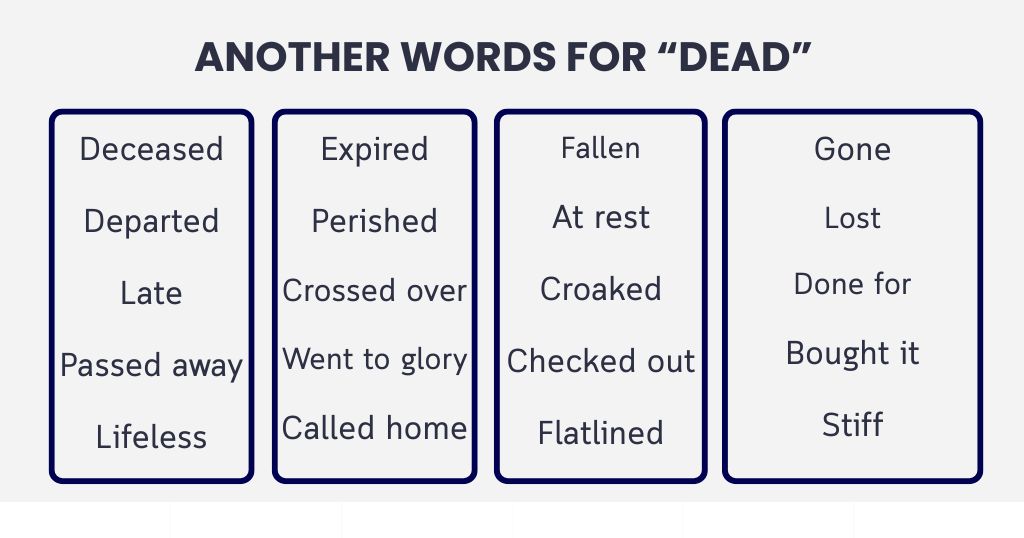
Quick 35 Alternatives Another Word for Dead
Here’s what you’re looking for organized by situation, not alphabet:
| Word | Tone | Best Used When | Quick Example |
| Deceased | Respectful, formal | Legal papers, obituaries | The deceased left no will |
| Departed | Gentle, spiritual | Funeral programs | We honor the departed today |
| Late | Traditional, attached | Referring to relationships | My late uncle was a carpenter |
| Passed away | Soft, common | Condolence messages | She passed away peacefully |
| Lifeless | Physical, neutral | Describing bodies or objects | The lifeless form lay still |
| Expired | Clinical, medical | Hospital records | The patient expired at 3 AM |
| Perished | Tragic, dramatic | Disasters, accidents | They perished in the fire |
| Fallen | Heroic, military | War, sacrifice | We remember the fallen soldiers |
| At rest | Peaceful, comforting | Gravestones, memorials | Here lies John, at rest |
| Gone | Simple, emotional | Personal loss | Dad’s been gone five years now |
| Lost | Personal, grieving | Close relationships | We lost him too soon |
| No longer with us | Euphemistic, gentle | Group announcements | Sarah is no longer with us |
| Kicked the bucket | Humorous, irreverent | Dark humor contexts | He finally kicked the bucket |
| Pushing up daisies | Visual, casual | Informal conversation | Old Frank’s pushing up daisies now |
| Bit the dust | Action-oriented, slang | Stories, casual talk | The villain bit the dust |
| Croaked | Crude, blunt | Very informal | Heard he croaked last week |
| Bought the farm | Old-fashioned slang | Military, vintage | Pilot bought the farm on landing |
| Six feet under | Literal, grim | Dark humor | He’s six feet under already |
| Crossed over | Spiritual, New Age | Religious contexts | She’s crossed over to the other side |
| Met their maker | Religious, traditional | Faith-based discussions | He’s met his maker now |
| Gave up the ghost | Biblical, old-fashioned | Literary writing | The old man gave up the ghost |
| Breathed their last | Dramatic, final | Historical narratives | The king breathed his last breath |
| Shuffled off this mortal coil | Literary, Shakespearean | Academic or poetic | To shuffle off this mortal coil |
| Went to glory | Religious, positive | Church services | Brother James went to glory |
| Called home | Religious, comforting | Faith communities | The Lord called her home |
| Resting in peace | Traditional, hopeful | Epitaphs | RIP carved in stone |
| In eternal sleep | Poetic, peaceful | Creative writing | She lies in eternal sleep |
| Checked out | Modern, casual | Informal conversation | Dude checked out in his sleep |
| Flatlined | Medical, technical | Hospital settings | He flatlined twice before we revived him |
| Done for | Colloquial, final | Everyday speech | After that fall, he was done for |
| Sleeping with the fishes | Mafia, violent | Crime references | Vinny’s sleeping with the fishes |
| Took a dirt nap | Crude humor | Very casual | Taking a permanent dirt nap |
| Cashed in their chips | Gambling metaphor | Informal storytelling | Old Joe cashed in his chips |
| Bought it | Military slang | War stories | Corporal bought it during the raid |
| Stiff | Extremely blunt | Crime scenes, dark humor | Found the stiff in the alley |
What Does “Dead” Really Mean?
Dead describes something that once had life but doesn’t anymore. The word itself is blunt—a hard “d” sound on both ends, no softness, no escape. It’s the baseline term we all understand, but it’s not always the best choice.
The core meaning is simple: no longer living. But the emotional meaning? That depends entirely on context. “My phone is dead” is practical. “My father is dead” is devastating. Same word, completely different impact.
Understanding the Emotional Layers for Dead
Not all words for death work the same way. Here’s what separates them:
The Comfort Words: Passed away, departed, at rest, gone, lost. These create emotional distance. They’re designed to hurt less. Use these when someone is actively grieving or when you’re announcing bad news to a group.
The Clinical Words: Deceased, expired, lifeless, perished. These remove emotion entirely. Perfect for paperwork, medical records, news reports. They help professionals maintain composure in tough situations.
The Coping Words: Kicked the bucket, bit the dust, croaked, pushing up daisies. Humans invented these because sometimes the only way to talk about death is to laugh. Doctors, soldiers, and paramedics use dark humor to survive repeated exposure to loss.
The Meaning Words: Fallen, sacrificed, martyred, lost. These add purpose to death. They transform “dead soldier” into “fallen hero.” The death becomes part of a larger story.
Intensity Scale for Dead Another Words: From Whisper to Shout
Words carry different volumes. Here’s the scale from softest to harshest:
Whisper Level: At rest, sleeping, slipped away
These barely acknowledge death happened. Maximum gentleness.
Soft: Passed away, departed, gone, lost
Standard comfort language. Safe for most situations.
Neutral: Died, deceased, dead
Factual. No emotion added or removed.
Firm: Perished, expired, lifeless
Clinical and clear. Used when precision matters.
Loud: Killed, murdered, slaughtered
Active violence. Death had a cause and someone responsible.
Shout: Stiff, corpse, cadaver, carcass
Maximum bluntness. Often disrespectful unless in specific professional contexts.
The further right you move, the more you risk hurting someone. The further left, the more you risk sounding vague.
Saying “Dead” Differently Depending on Who’s Listening
Same death, different words based on who’s listening:
To a grieving widow:
“I’m so sorry about your husband. He’ll be deeply missed.”
Not: “Sorry your husband’s dead.”
In a police report:
“The victim was deceased upon arrival.”
Not: “The victim had passed away.”
At a military memorial:
“We honor those who fell defending our freedom.”
Not: “We honor those who died.”
In a biology textbook:
“The organism was no longer viable.”
Not: “The organism passed away.”
Among close friends:
“Can’t believe he’s gone, man.”
Not: “Can’t believe he has departed.”
Notice how the relationship and setting completely dictate word choice? That’s the secret. There’s no “best” word—only the best word for this specific moment.
Rewriting: Five Different Ways to Express Another Word for Dead
Let’s transform the same basic sentence five ways:
Original: “My grandmother is dead.”
For a sympathy card: “My grandmother passed away last Tuesday. We’re holding a small service for family.”
For a legal document: “The decedent, Mrs. Eleanor Walsh, died on March 4, 2026.”
For a close friend: “Gran died yesterday. I’m not doing great, honestly.”
For a historical record: “Eleanor Walsh (1942-2026) is survived by three children.”
For a story you’re writing: “She found her grandmother lifeless in the armchair, book still open on her lap.”
Each version communicates the same fact but creates an entirely different emotional experience. That’s the power of synonym selection.
Professional vs Personal Language Words for Death
Here’s where words split into two worlds:
Professional (hospitals, courts, newspapers):
- Deceased
- Decedent (legal term for the person who died)
- Expired
- The late Mr./Mrs.
- Fatality
- Casualty
- Remains
Personal (friends, family, everyday life):
- Passed away
- Gone
- Lost
- No longer with us
- Left us
- Isn’t here anymore
You’ll sound strange if you mix these up. “My decedent father” sounds like you’re a lawyer talking about a client. “The casualty’s remains” sounds clinical. “Grandpa expired” sounds like a parking meter.
Match the word to the relationship, not just the situation.
Words That Sound Similar But Aren’t
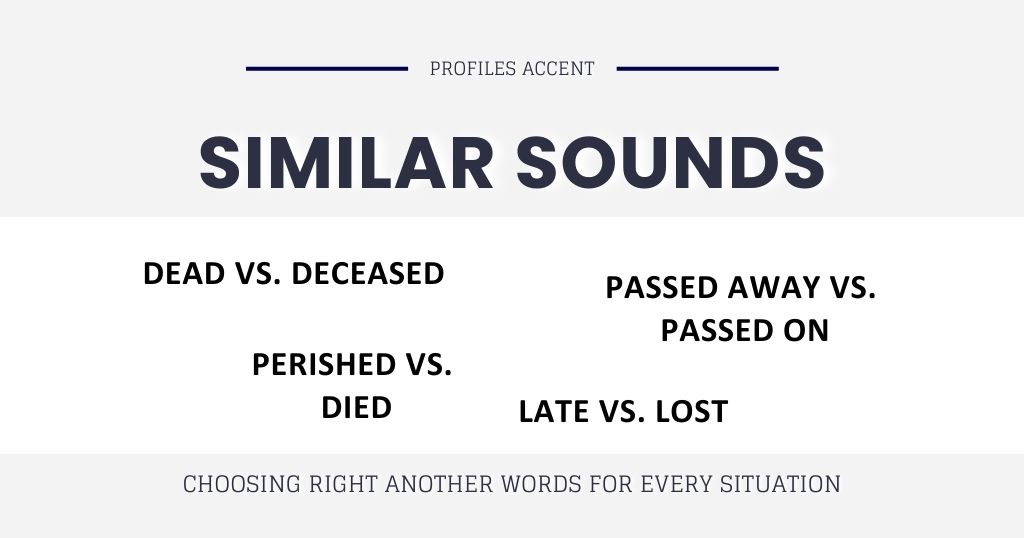
These trip people up constantly:
Dead vs. Deceased
Dead is an adjective describing a current state. “The bird is dead.”
Deceased is a formal past-tense word and a noun. “The deceased was 87 years old.”
You can’t casually say “My cat is deceased” without sounding like a veterinary report.
Passed away vs. Passed on
Passed away is standard American English.
Passed on implies moving to an afterlife—more spiritual.
“She passed on” suggests belief in what comes next.
Late vs. Lost
Late attaches to the person’s title: “my late husband.”
Lost expresses the survivor’s feeling: “We lost him.”
You can’t say “I lost my late father”—pick one.
Perished vs. Died
Died is neutral—any cause.
Perished implies harsh conditions or disaster: fire, cold, starvation, accident.
“He perished in the wreck” works. “He perished of old age” doesn’t.
When Not to Use Certain Death Terminology
Some situations require careful word selection:
Avoid humor terms when:
- Speaking to someone actively grieving
- Writing condolence messages
- Announcing a death publicly
- Talking about children or sudden deaths
Avoid clinical terms when:
- Comforting someone
- Writing personally
- Speaking at funerals
- Texting friends about a loss
Avoid vague euphemisms when:
- Recording facts (genealogy, journalism)
- Writing history
- Filing reports
- Seeking clarity
Be especially careful with:
- Suicide (never say “committed suicide”—say “died by suicide”)
- Children (avoid harsh terms entirely)
- Recent losses (wait before using any humor)
- Cultural differences (some communities prefer direct language)
The Slang Side of Death Language
These range from mildly irreverent to genuinely offensive:
Mostly Harmless:
- Kicked the bucket
- Bit the dust
- Bought the farm
- Pushing up daisies
Use with Caution:
- Croaked
- Checked out
- Took a dirt nap
- Assumed room temperature
Only Among Close Friends:
- Stiff
- Worm food
- Belly up
- Toes up
Potentially Offensive:
- Whacked (implies murder)
- Offed (suggests killing)
- Wasted (violent)
- Snuffed out (cold)
Know your audience. What’s funny among paramedics will horrify a grieving parent.
Classical Terms: How Latin Described the Dead
These show up in literature, mottos, and formal inscriptions:
Mortuus – Dead (the root of mortuary, mortality)
Defunctus – Finished, deceased
Obitus – Natural death
Requiescat in pace – Rest in peace (RIP)
In literature:
“Memento mori” (remember you must die) appears in art and philosophy.
“Vitam exhalare” means to breathe out life.
These work for creative writing, academic work, or adding gravitas. Don’t use them in normal conversation unless you enjoy being that person.
Beautiful Language: Poetic Alternatives for Dead
Writers choose words that create atmosphere:
For peaceful death: Slumbering, resting, sleeping, at peace, in repose, silent
For dramatic death: Fell, perished, extinguished, snuffed out, cut down
For mysterious death: Vanished, departed this world, crossed the veil, slipped through our fingers
For heroic death: Sacrificed, gave their life, laid down their life, made the ultimate sacrifice
For tragic death: Taken too soon, lost before their time, cut down in their prime
Shakespeare gave us “shuffled off this mortal coil.” Dylan Thomas wrote “do not go gentle into that good night.” These phrases become immortal because they transform the hardest human experience into art.
Common Mistakes Writers Make When Writing About Death
Mistake 1: Using “deceased” as an adjective in casual writing.
Wrong: “My deceased grandmother loved gardening.”
Right: “My late grandmother loved gardening.”
Mistake 2: Mixing formal and informal registers.
Wrong: “The decedent kicked the bucket at midnight.”
Right: Choose one tone and stick with it.
Mistake 3: Over-euphemizing until meaning disappears.
Wrong: “He transitioned to the next phase of his journey.”
Right: “He died” or “He passed away” (clear and kind).
Mistake 4: Using “committed suicide.”
Wrong: This language implies crime.
Right: “Died by suicide” (neutral, respectful).
Mistake 5: Assuming one word fits all situations.
“Passed away” works for most contexts, but not all. Legal documents need “deceased.” Military honors need “fallen.” Science reports need “expired” or “non-viable.”
Words Near “Dead” That Mean Something Else
Dying: The process, not the result. “She is dying” vs. “She is dead.”
Moribund: Near death but not yet dead. Often used metaphorically. “The company is moribund.”
Inanimate: Never had life. A rock is inanimate, not dead.
Lifeless: Could mean dead or lacking vitality. “The party was lifeless” doesn’t mean everyone died.
Terminal: Describes a condition that will cause death, not death itself. “Terminal illness” comes before “death.”
Mortality: The condition of being able to die. We discuss human mortality as a concept.
The Psychology Behind Our Many Death Synonyms
Psychologists call this the “taboo deformation effect.” When a word feels too painful to say, we invent softer versions. Over time, those softer versions absorb the original pain, so we invent new ones. This cycle has been running for centuries.
“Die” felt too harsh, so we said “pass away.”
“Pass away” started feeling harsh, so we said “pass on.”
“Pass” started implying death, so we said “lost.”
“Lost” can sound unclear, so we’re back to “died.”
The wheel keeps spinning. Every generation needs its own vocabulary for the hardest moments.
We also create death words for control. Naming something scary makes it less scary. Soldiers say “bought the farm” because laughing at death helps them face it daily. Doctors say “expired” because emotional distance helps them keep working. Poets say “eternal sleep” because beauty softens grief.
Three Questions to Pick Your Best Alternative for Dead
Ask yourself three questions:
1. Who am I talking to?
Family member grieving → gentle words
Professional colleague → neutral words
Close friend who appreciates honesty → direct words
2. What’s my goal?
Comfort → soft euphemisms
Inform → clear factual terms
Honor → meaningful elevated language
Record facts → clinical precise terms
3. What’s the relationship to the deceased?
Speaking about your own loss → personal choice, any word that helps
Speaking about someone else’s loss → follow their lead
No personal connection → stick to respectful neutral terms
If all three questions point to the same category of word, use it confidently. If they conflict, lean toward kindness.
Finding the Right Words When It Matters Most
English gives you dozens of ways to talk about death because death requires dozens of different conversations. Sometimes you need the hard truth of “dead.” Sometimes you need the soft landing of “passed away.” Sometimes you need the dark humor of “kicked the bucket” just to get through the day.
The right word isn’t the fanciest or the longest. It’s the one that matches your meaning, respects your audience, and feels honest in your mouth. When in doubt, ask yourself: am I trying to comfort, inform, or record? Then choose accordingly.
Language exists to connect us, especially during the times when connection feels impossible. Use these words wisely, and they’ll help you say what needs to be said—whether that’s “I’m sorry for your loss” or simply, honestly, “He died, and I miss him.”
Discover More Articles
Another Word for Again: 30 Synonyms with Tone, Context & Real Examples
Another Word for Division: 40+ Better Synonyms for Every Context

I’m Rowan, a language addict who loves exploring how words work in everyday communication. I’ve spent years studying English vocabulary and helping others express themselves more clearly. My goal is simple: make learning new words easy and practical. I focus on real-life examples that show when and how to use different terms. Through clear explanations and honest guidance, I help readers choose the right words for any situation with confidence.