Some words carry more weight than they should. “Loss” is one of them.
Writers reach for it constantly — in sympathy cards, financial reports, news headlines, personal essays, and it holds up just fine. But sometimes a fine isn’t enough. Sometimes you need a word that says grief-without-cure, or gradual-disappearance, or strategic-sacrifice. “Loss” can’t do all of those jobs equally well.
This guide helps you find the right word for the right moment, not just a list of swappable alternatives.
What “Loss” Actually Carries
At its core, loss means something once present is now absent. But the emotional weight it carries depends entirely on context. Losing a client feels different from losing a parent. Losing control of a narrative is nothing like losing control of a vehicle. The word spans all of it which is both its strength and its limitation.
30 Quick Synonyms for Loss: Organized by Tone and Context
Here are 30 carefully chosen alternatives, grouped by tone and situation:
| Word | Tone | Use When | Example |
| Bereavement | Formal, empathetic | Death of a loved one | She returned to work after bereavement leave. |
| Grief | Emotional, raw | Deep personal pain | His grief resurfaced at the memorial. |
| Deprivation | Clinical, heavy | Something essential is missing | Years of emotional deprivation shaped her choices. |
| Absence | Neutral | Something simply isn’t there | The absence of sound felt louder than noise. |
| Void | Poetic, existential | An emptiness that lingers | Nothing filled the void she left behind. |
| Deficit | Technical | Finances, budgets | The project ran a $40,000 deficit. |
| Shortfall | Business-friendly | Gap between expected and actual | A shortfall in quarterly revenue triggered cuts. |
| Attrition | Corporate | Gradual loss of people or assets | Customer attrition rose 12% after the rebrand. |
| Forfeiture | Legal | Loss as punishment | Forfeiture of the deposit was written in the contract. |
| Shrinkage | Retail-specific | Inventory loss | Shrinkage accounts for 2% of annual stock loss. |
| Defeat | Competitive | Lost a contest or battle | The defeat stung more than they expected. |
| Setback | Mild, optimistic framing | Temporary failure | The delay was a setback, not a disaster. |
| Failure | Direct, harsh | Something didn’t succeed | The campaign’s failure surprised everyone. |
| Casualty | Military, formal | Person killed or injured | The conflict resulted in heavy casualties. |
| Fatality | Statistical, legal | Death from accident or disaster | Road fatalities dropped by 8% last year. |
| Passing | Euphemistic, gentle | Death, in soft contexts | We mourned the passing of a kind woman. |
| Demise | Formal, literary | Death or end of something | The demise of the company shocked investors. |
| Erosion | Gradual, figurative | Slow decay of something abstract | Years of broken promises caused an erosion of trust. |
| Decline | Neutral, measurable | Gradual decrease | A visible decline in engagement followed the update. |
| Diminution | Academic | Reduction in value or quality | The diminution of her authority was intentional. |
| Ruin | Dramatic, permanent | Total destruction | The fire left the building in complete ruin. |
| Devastation | Emotional, large-scale | Massive or overwhelming loss | The flood brought devastation to the entire valley. |
| Depletion | Scientific, practical | Resources running out | Soil depletion threatens crop yields globally. |
| Capitulation | Formal, conflict | Surrendering control | Their capitulation came after weeks of pressure. |
| Relinquishment | Formal, voluntary | Giving up willingly | Her relinquishment of the title was unexpected. |
| Privation | Literary, severe | Extreme lack | The refugees endured months of privation. |
| Sacrifice | Purposeful | Chosen loss for a higher goal | The sacrifice of short-term profit paid off later. |
| Dispossession | Sociopolitical | Being stripped of ownership | Generational dispossession shaped the community’s mistrust. |
| Dissolution | Formal | End of a partnership or structure | The dissolution of their partnership was mutual. |
| Perishment | Rare, literary | Death or ruin of something fragile | The perishment of old traditions follows every migration. |
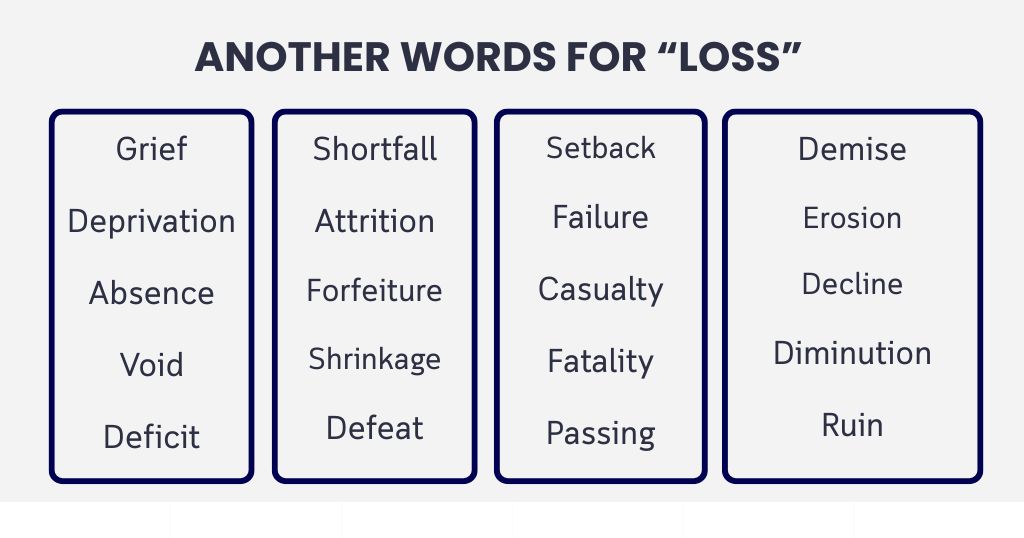
Meaning Clusters: Where the Real Differences Hide
When the Loss Involves a Person
This is the territory most synonym lists handle worst. They list “passing” and “bereavement” side by side as if they’re equal, but they’re not.
Bereavement is a state. It describes where someone is emotionally and legally after a death — “bereavement leave,” “in bereavement.” It respects the ongoing nature of grief.
Passing softens the event itself. It belongs in sympathy cards and eulogies, not in legal documents or clinical notes.
Grief belongs to the person experiencing the loss. Mourning is what they show the world.
Casualty is for public, statistical, or military contexts. Using it for a personal loss feels cold — “my father was a casualty” is grammatically fine but emotionally jarring.
If you’re writing to someone who just lost a parent, “I’m sorry for your loss” works. But “I know this bereavement is difficult” shows you understand it’s not just a moment it’s a period they’re living through.
Business Synonyms for Loss: Beyond “Deficit”
“Deficit” and “loss” are not the same thing in accounting. A deficit is a gap between income and expenditure. A loss is the outcome on a profit-and-loss statement. They often overlap but serve different audiences.
Attrition describes gradual loss customers drifting away, staff quietly leaving. It implies no single dramatic event, just slow erosion.
Forfeiture carries a punitive edge. You don’t just lose something you lose it because of something you did or didn’t do.
Shrinkage is a retail industry term almost never used outside that context. Drop it into a general business conversation and people pause.
One gap most articles miss: the concept of strategic loss. A loss leader, a product priced below cost to attract buyers is a deliberate loss, not a failure. The word “loss” alone doesn’t capture that intent. “Investment,” “sacrifice,” or “calculated deficit” does a better job.
Gradual vs. Sudden: Why This Distinction Changes Everything
This distinction matters more than most writers realize.
Sudden loss: defeat, collapse, destruction, casualty Gradual loss: erosion, attrition, decline, depletion, diminution
If you write “the erosion of his career happened overnight,” you’ve created a contradiction. Erosion takes time. It implies water wearing down stone slow, cumulative, quiet. Use it for trust that crumbles over years, not for a single firing.
Depletion works best for resources energy, water, attention, money that drain rather than disappear at once.
Collective Loss Has Its Own Language
Most synonym lists focus on personal loss. But some of the most powerful writing involves losses that belong to a group a community, a culture, a generation.
For collective loss, consider: decimation, displacement, dispossession, dissolution, erosion, devastation.
Dispossession carries historical and political weight that “loss” doesn’t. When entire communities lose land, language, or identity, “loss” feels inadequate. Dispossession names the mechanism.
Dissolution works for the end of institutions: a church community, a political party, a neighborhood that no longer exists as it once did.
The Same Sentence, Four Different Rewrites for Loss
Original: She experienced a great loss.
- Formal: She endured a profound bereavement that altered her daily life.
- Casual: She went through something that really broke her.
- Academic: Her deprivation of primary attachment contributed to long-term emotional disruption.
- Creative: What she lost didn’t leave, it became the silence in every room.
Original: The business reported a loss this quarter.
- Formal: The company recorded a net deficit of $2.3 million in Q3.
- Casual: They finished the quarter in the red.
- Academic: Operational expenditure exceeded revenue, resulting in a negative margin.
- Creative: The numbers came back hollow not failure exactly, but not survival either.
Original: They lost control of the situation.
- Formal: The team experienced a breakdown in operational oversight.
- Casual: Things quickly spiraled beyond anyone’s grasp.
- Academic: Systemic capitulation to external variables led to organizational disarray.
- Creative: The situation didn’t just slip it walked away from them.
How Intense Do You Need to Go? A Tone Scale for Loss Synonyms
Some moments need a whisper. Others need something heavier. Here’s how these words line up by emotional intensity:
Mild → Absence, Shortfall, Setback, Decline
Moderate → Deficit, Defeat, Attrition, Erosion, Relinquishment
Strong → Grief, Deprivation, Failure, Forfeiture, Dissolution
Extreme → Devastation, Ruin, Bereavement, Dispossession, Privation
Moving up this scale changes how the reader feels, not just what they understand. “The company faced a shortfall” reads as manageable. “The company faced ruin” ends the story.
Formal vs. Informal: Which Word Goes Where

For essays or academic writing: bereavement, deprivation, diminution, attrition, forfeiture, decimation
For professional emails: shortfall, deficit, decline, setback, attrition
For storytelling and creative work: void, erosion, ruin, dissolution, privation, absence
For sympathy or personal writing: grief, passing, bereavement, absence, void
Words to avoid in formal writing: passing (too soft), devastation (too dramatic for minor situations), shrinkage (too industry-specific without context)
When Certain Words for Loss Can Do Harm
A few synonyms carry weight that casual usage can undermine.
Casualty and fatality are clinical terms. Using them in personal contexts — “my grandfather was a fatality” — can feel dehumanizing, even if technically accurate.
Dispossession has deep ties to colonialism and forced removal. Using it lightly, such as calling a minor inconvenience “dispossession,” dilutes its meaning and disrespects the communities it accurately describes.
Privation implies severe, often poverty-related suffering. Don’t use it metaphorically for inconveniences.
Common Mistakes When Replacing the Word Loss
Treating defeat and failure as identical. Defeat requires an external opponent. Failure can be entirely internal; no one beats you; you simply didn’t succeed. Mixing them up misrepresents what actually happened.
Using “erosion” for sudden events. Erosion is inherently gradual. Apply it only to processes that unfold over time.
Assuming “bereavement” and “grief” are synonyms. Bereavement is the circumstance. Grief is the response. Someone can be in bereavement without visibly showing grief.
Reaching for “void” in professional writing. It’s a powerful word, but it belongs to creative or personal registers. A quarterly business report has no business using it.
Confusing diminution with elimination. Diminution means a reduction, not a complete end. “The diminution of his influence” means he still has some just less.
Words That Live Near Loss: But Mean Something Slightly Different
Nostalgia: Not exactly loss, but a longing for what’s gone. Softer, tinged with warmth.
Absence: Describes the state after loss without naming what caused it. Neutral, flexible.
Sacrifice: Voluntary loss with purpose. The loss was chosen, not suffered.
Deprivation: Loss that creates need. Implies the missing thing was necessary, not just wanted.
Dissolution: Loss of structure or form, not just an object or person.
The Antonyms Worth Using
“Gain” is the obvious opposite but often the wrong one.
- For financial loss → profit, surplus, return
- For personal loss → recovery, reunion, restoration
- For loss of control → mastery, authority, stability
- For gradual decline → retention, preservation, reinforcement
The antonym that most writers overlook is retention, the act of keeping what you have. It’s the quiet opposite of loss, and in business, healthcare, and relationships, it’s often the more important word.
Choosing the Right Word for Loss Comes Down to One Question
You don’t need a bigger vocabulary. You need to slow down and ask what kind of loss you’re actually describing. Is it sudden or gradual? Personal or institutional? Chosen or suffered? Once you answer that, the right word usually surfaces on its own.
The table above isn’t a replacement for judgment, it’s a tool to sharpen it.
Discover More Articles
Another Word for Again: 30 Synonyms with Tone, Context & Real Examples
Another Word for Vulnerability: 30+ Better Alternatives for Every Context
Another Word for Problem: The Right Synonym for Every Situation

I’m Rowan, a language addict who loves exploring how words work in everyday communication. I’ve spent years studying English vocabulary and helping others express themselves more clearly. My goal is simple: make learning new words easy and practical. I focus on real-life examples that show when and how to use different terms. Through clear explanations and honest guidance, I help readers choose the right words for any situation with confidence.