The word “greater” shows up everywhere in reports, essays, headlines, and everyday conversation. It gets the job done. But sometimes it flattens what you’re really trying to say. “Greater responsibility” and “heavier responsibility” feel completely different — one sounds official, the other sounds personal. That’s the power of word choice.
This guide goes beyond a simple list. You’ll learn which synonym fits which situation, which ones to avoid in formal writing, and how small changes can shift the entire tone of a sentence.
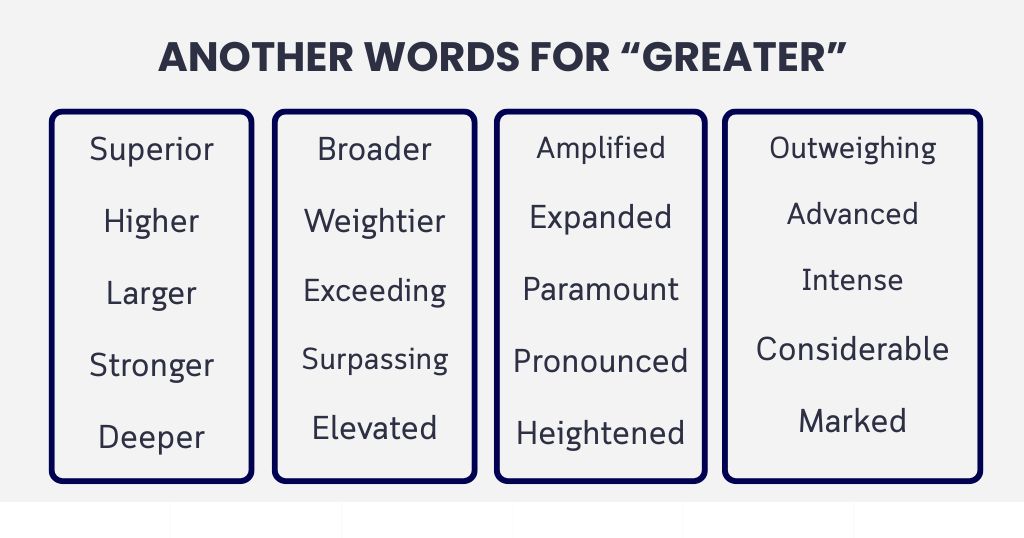
25 Quick Synonyms: Another Word for Greater
| Word | Tone | Best Used When | Example |
| Superior | Formal | Comparing quality or rank | A design superior to the previous model |
| Higher | Neutral | Comparing levels or degree | Higher standards |
| Larger | Casual/Neutral | Comparing size or amount | A larger budget |
| Stronger | Neutral | Comparing intensity or force | Stronger evidence |
| Deeper | Reflective | Comparing understanding or feeling | A deeper connection |
| Broader | Academic | Comparing range or scope | Broader knowledge |
| Weightier | Formal | Comparing seriousness | A weightier decision |
| More significant | Formal | Comparing importance | A more significant role |
| Exceeding | Professional | Going beyond a limit | Exceeding expectations |
| Surpassing | Formal | Going past a standard | Surpassing previous records |
| Elevated | Formal/Creative | Comparing rank or status | An elevated position |
| Amplified | Creative | Comparing intensity | Amplified pressure |
| Expanded | Neutral | Comparing reach or size | Expanded coverage |
| Paramount | Formal | Highest in importance | Paramount concern |
| Pronounced | Academic | Clearly more noticeable | A pronounced difference |
| Heightened | Neutral | Stronger awareness or feeling | Heightened tension |
| Outweighing | Formal | When one thing dominates another | Benefits outweighing risks |
| Advanced | Neutral | Higher level of skill or stage | Advanced understanding |
| Intense | Casual/Creative | Stronger in emotional or physical force | More intense focus |
| Considerable | Formal | Notably more than expected | Considerable effort |
| Marked | Academic | Clearly noticeable difference | A marked improvement |
| Extensive | Neutral | Wider in reach or coverage | More extensive research |
| Acute | Formal | Sharper or more urgent | An acute awareness |
| Dominant | Neutral | More powerful in comparison | The dominant factor |
| Magnified | Creative | Made visibly larger or stronger | Magnified concerns |
So What Does “Greater” Actually Mean?
“Greater” is the comparative form of “great.” It compares two things one being more than the other in size, importance, intensity, or rank. It can describe anything measurable, from physical size to emotional weight. The tricky part? It wears many hats, and not every synonym can wear all of them.
How “Greater” Splits Into Different Meanings
This is where most synonym articles let you down. They hand you a list and walk away. But “greater” behaves differently depending on what you’re comparing.
When You’re Talking About Size or Amount
Here, “greater” means physically or numerically more. Words like larger, more extensive, and expanded work well. “Vaster” suits things without clear borders oceans, time, uncertainty. “Larger” stays grounded and concrete.
When You’re Talking About Importance or Rank
This is where superior, paramount, and weightier come in. “Superior” often sounds competitive as if one option clearly performs better than another. “Paramount” signals that nothing else comes close. “Weightier” carries a sense of burden, something that presses down on a decision.
When You’re Comparing Feeling or Intensity
Emotional comparisons need words like deeper, heightened, or amplified. Saying someone has a “deeper respect” for something lands differently than saying they have “greater respect.” The first sounds earned. The second sounds measured.
The Math and Technical Case
If you’re writing code, data reports, or math explanations, none of the emotional synonyms apply. Stick with: above, exceeding, in excess of, or over. These are precise and carry no opinion.
From Gentle to Forceful: The Intensity Scale
Not all synonyms carry the same weight. Here’s how they land on a scale from gentle to forceful:
Mild → Larger, Higher, Broader
Moderate → Considerable, Pronounced, Significant
Strong → Superior, Surpassing, Dominant
Extreme → Paramount, Exceeding, Transcending
If you’re writing a casual email, don’t reach for “paramount.” If you’re drafting a business report, “bigger” will sound too light. Match the word to the moment.
Watch the Sentence Transform
Original: She had a greater role in the project.
- Formal: She held a more significant position within the project’s core team.
- Casual: She was way more involved in the project than anyone else.
- Academic: Her contribution carried considerably more weight than that of other participants.
- Creative: The whole project ran through her hands she wasn’t just involved, she was essential.
Original: There is a greater need for change.
- Formal: The demand for systemic change has grown considerably.
- Casual: We really need change now, more than ever.
- Academic: The urgency surrounding structural reform has reached a pronounced level.
- Creative: The cracks in the old system aren’t asking for repair anymore. They’re demanding something new.
Original: He showed greater understanding.
- Formal: He demonstrated a markedly deeper comprehension of the subject.
- Casual: He got it better than most people in the room.
- Academic: His cognitive grasp of the material surpassed that of his peers.
- Creative: Something had shifted in him. He no longer just heard the words; he felt what was underneath them.
Notice how each version shifts the reader’s emotional experience, not just the vocabulary.
Formal vs. Informal: Choosing Your Lane
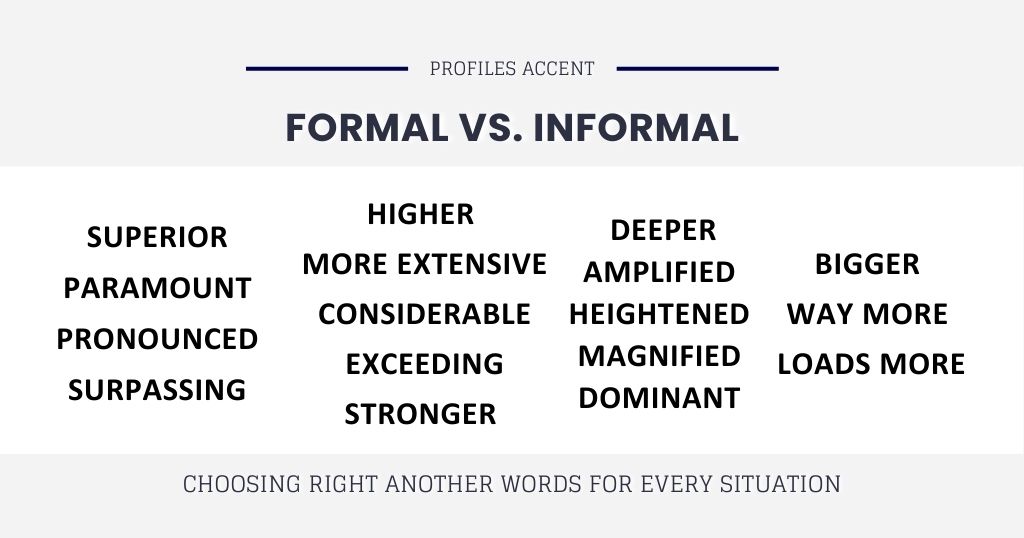
Best for essays and academic writing: Superior, paramount, pronounced, surpassing, considerable, elevated, more significant
Best for professional emails: Higher, more extensive, considerable, exceeding, stronger, advanced
Best for storytelling and creative writing: Deeper, amplified, heightened, magnified, dominant
Avoid in formal writing: Bigger, way more, loads more, huger these read as too casual and weaken professional tone.
The Geography Exception Nobody Talks About
When “Greater” appears before a city named Greater London, Greater Chicago it doesn’t mean “better” or “larger in quality.” It refers to the central city plus its surrounding towns and administrative areas. In this case, no single synonym fully replaces it. The closest phrases are metropolitan area, urban region, or city-wide district. This is a completely different usage that most synonym guides ignore entirely.
Mistakes Writers Make When Replacing Greater
Using “more greater”
This is a double comparative and it’s grammatically wrong. “Greater” already means “more great.” You don’t need both. Write much greater or far greater instead.
Swapping in “great” when you mean “greater”
These aren’t interchangeable in comparisons. “This plan is great than the other” makes no sense. “Great” describes; “greater” compares.
Picking a synonym that fits the meaning but not the grammar
“Superior” needs to, not than. You write “superior than the last model,” not “superior than.” Swap carelessly and the grammar breaks.
Using “paramount” loosely
It means something is more important than everything else, not just more important than one other thing. Overusing it dilutes the word fast.
Antonyms of Greater
| Context | Antonym |
| Size or amount | Smaller, lesser, reduced |
| Importance or rank | Minor, inferior, lower |
| Intensity or degree | Weaker, milder, diminished |
| Scope or reach | Narrower, limited, restricted |
The most direct opposite is lesser just as “greater” elevates, “lesser” pulls down.
Words Close to Greater: But Not Quite the Same
Grander: Focuses on scale and impressiveness, often visual. “A grander entrance” is about spectacle, not necessarily importance.
Supreme: Means no comparison exists. It’s the final level, above all others. Use it only when nothing ranks higher.
Predominant: Means most common or most noticeable, not necessarily the best.
Eminent: Reserved for people of high distinction. You wouldn’t call a building “eminent.”
Exceptional: Suggests something is unusual and stands out, not just that it compares favorably to one other thing.
Pick the Right Word, Every Time
Before you replace “greater,” ask yourself two things: What am I comparing? and What feeling do I want to leave?
Size comparisons call for larger or more extensive. Rank and importance call for superior or paramount. Emotional depth calls for deeper or heightened. Technical contexts need exceeding or above.
The right synonym doesn’t just mean the same thing it says it better.
Discover More Articles
Another Word for Problem: The Right Synonym for Every Situation
Another Word for Again: 30 Synonyms with Tone, Context & Real Examples
Another Word for Giving Up: 20+ Synonyms That Actually Fit Your Sentence

I’m Rowan, a language addict who loves exploring how words work in everyday communication. I’ve spent years studying English vocabulary and helping others express themselves more clearly. My goal is simple: make learning new words easy and practical. I focus on real-life examples that show when and how to use different terms. Through clear explanations and honest guidance, I help readers choose the right words for any situation with confidence.