You know that feeling. Someone walks in with exactly the life you wanted. Or your partner laughs a little too long at someone else’s joke. Or your coworker lands the project you worked harder for.
You reach for the word “jealous” and it fits, but barely. It flattens the feeling. It says everything and nothing at once.
Here is the truth: jealous is a lazy word when used by default. Not because it is wrong, but because the English language has far more precise tools sitting right next to it, most of which go completely unused. This article helps you find the right one, whether you are writing a story, a message, a paper, or just trying to understand your own emotions better.
What “Jealous” Is Really Saying (And Where It Falls Short)
At its core, jealous describes the fear of losing something you already have to someone else. That is its original, precise meaning. A jealous partner is not someone who wants what others have. They are someone afraid of what they might lose.
This is different from envy, which is about wanting what you do not have. The two feelings live next door to each other but they are not the same room. Mixing them up quietly changes the meaning of your sentence.
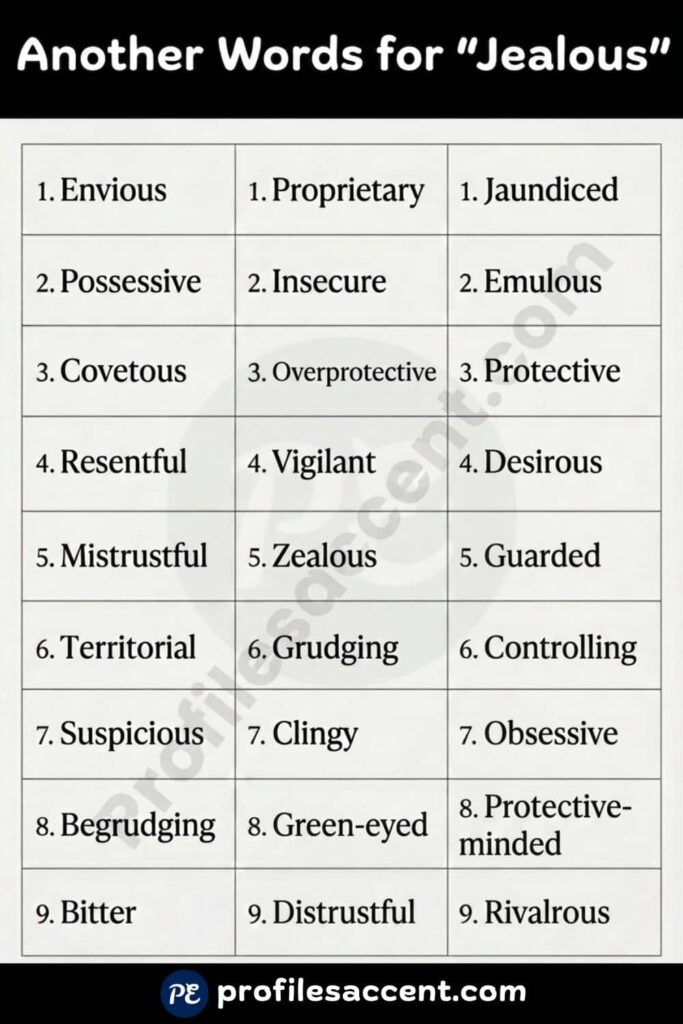
Another Word for Jealous: Quick 20+ Synonym Table
Use this table to find the right word fast. Each one carries a slightly different emotional weight.
| Word | Tone | Best Used When |
| Envious | Descriptive | Wanting what someone else has |
| Possessive | Negative | Guarding a person or relationship |
| Covetous | Formal/Strong | Deep desire for another’s belongings |
| Resentful | Bitter | Feeling unfairly treated |
| Mistrustful | Cautious | Doubting loyalty |
| Territorial | Informal | Protecting space or relationships |
| Suspicious | Wary | Watching for signs of betrayal |
| Begrudging | Mild negative | Giving credit unwillingly |
| Bitter | Emotional | Lasting hurt over a perceived loss |
| Proprietary | Formal | Treating a person like a possession |
| Insecure | Psychological | Root-level fear driving the feeling |
| Overprotective | Parental/Relational | Shielding excessively |
| Vigilant | Neutral/Positive | Careful watchfulness over something valued |
| Zealous | Positive | Deeply devoted or protective |
| Grudging | Mild | Reluctant admiration |
| Clingy | Informal | Emotionally dependent and guarded |
| Jaundiced | Literary | Distorted view caused by bitterness |
| Emulous | Archaic/Positive | Wanting to equal someone in a good way |
| Protective | Positive | Shielding what you love from harm |
| Desirous | Mild/Formal | Mild longing for what another has |
One Feeling, Four Different Roots
Not all jealousy feels the same. Grouping synonyms by what is actually happening inside helps you pick the right word.
When the Fear of Losing Takes Over
This is pure, original jealousy. The words here all carry that protective edge. Possessive, territorial, and proprietary all belong here. The difference?
- Possessive is personal and emotional.
- Territorial is behavioral, often used when someone is physically marking their space or relationship.
- Proprietary is colder and more intellectual, like someone who treats a person the way a company treats a patent.
When You Want What Someone Else Has
This is actually envy, though people often call it jealousy. Covetous, envious, and desirous all live here.
- Covetous carries more weight and moral history.
- Envious is direct and neutral.
- Desirous is the softest of the three, almost without resentment.
When the Hurt Has Turned Stale
Resentful, begrudging, and bitter do not always start with jealousy but they often end there. If the feeling has been sitting a long time, these words show that. They carry a staleness that “jealous” does not.
When It Is Really About Doubt
Suspicious, mistrustful, and leery focus on the doubt itself rather than the emotion underneath it. These are better choices when you want to describe how someone acts, not just how they feel.
How Strong Is the Feeling? A Tone Scale for Jealous Synonyms
This scale shows how the emotion builds from a quiet flicker to a consuming force.
- Mild: Desirous, Admiring, Emulous
- Moderate: Envious, Covetous, Begrudging, Vigilant
- Strong: Possessive, Resentful, Mistrustful, Territorial
- Extreme: Bitter, Proprietary, Covetous (in obsessive use), Jaundiced
The softer end of this scale is where a lot of writers get stuck. If a character is just “a little jealous,” words like admiring or emulous say that without making them a villain.
The Same Sentence, Four Different Words for Jealous
Sometimes the best way to understand a synonym is to see a sentence transform.
Original: She felt jealous watching her friend get promoted.
- Formal: She watched her colleague’s promotion with a quiet, grudging admiration she could not entirely suppress.
- Casual: She was lowkey bitter when her friend got the role she had been going for.
- Academic: The observation triggered a covetous response rooted in unmet professional expectation.
- Creative: Something sharp and green twisted in her chest as the applause began.
Each version changes how the reader understands the character. Bitter suggests history. Covetous suggests desire. The creative version avoids the label entirely and lets the emotion live in the image.
Original: He was jealous of his partner talking to strangers.
- Formal: His behavior toward his partner’s social interactions had become noticeably proprietary.
- Casual: He was weirdly territorial whenever she talked to anyone new.
- Psychological: His reactions pointed to deep-seated insecurity around attachment and trust.
Notice how proprietary makes him seem controlling and calculated. Territorial makes it almost animal. Insecure makes him sympathetic.
Word choice shapes perception. Always.
Another Word for Jealous in a Good Way: The Synonyms Nobody Talks About
Here is what almost no thesaurus will tell you. The word jealous once carried a largely positive meaning. Being jealous of your reputation meant protecting it carefully. Being zealous for truth meant defending it passionately.
The word zelous and jealous actually share the same linguistic root. Zeal, fervor, vigilance, and protective care all live in that older layer of meaning.
So if you are looking for “another word for jealous in a good way,” these are your best honest choices:
- Protective says you guard something because it matters deeply to you.
- Vigilant says you watch over something with careful attention.
- Zealous says you are passionately devoted, often used in spiritual or purposeful contexts.
- Solicitous says you show deep concern and attentiveness for someone’s wellbeing.
These words rescue the feeling from negativity without pretending the feeling is not real.
Slang Synonyms for Jealous That Feel Actually Human
Sometimes formal words do not fit the voice. Here are current informal options that feel natural in real conversation:
Pressed means visibly bothered by someone else’s situation or success. It carries a hint of trying to hide it and failing.
Salty means irritated or bitter, usually over something that stings more than it should.
Hating or “being a hater” means criticizing someone primarily because their success triggers your own discomfort.
These work well in fiction dialogue, social media captions, or casual writing. They would not survive in a professional email or academic paper.
When the Bible Uses “Jealous,” It Means Something Else Entirely
The word jealous appears in religious texts in a way that surprises many readers. When God is described as jealous in the Hebrew scriptures, it has nothing to do with insecurity or envy.
The Hebrew word behind it carries the idea of righteous protectiveness, a burning devotion to a covenant relationship. It is closer to what we might call fierce loyalty or sacred guardianship than to the way we use jealous in modern conversation.
In this context, the better synonyms would be: zealous, fervent, fiercely devoted, or righteously protective. Each of these honors the original weight without importing modern emotional baggage.
Formal or Casual? Picking the Right Jealous Synonym for the Right Place
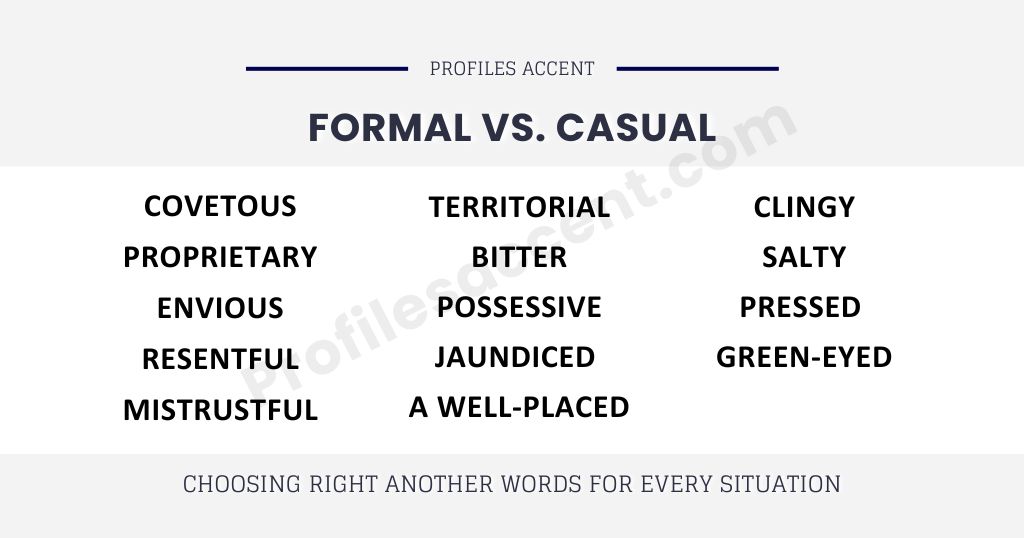
For a formal essay or literary analysis, reach for: covetous, proprietary, envious, resentful, or mistrustful.
For storytelling or fiction, the richest options are: territorial, bitter, possessive, jaundiced, or a well-placed image that shows the feeling without naming it.
For professional writing, avoid: clingy, salty, pressed, or green-eyed. These pull tone downward in contexts that call for precision.
For children’s writing or simple emotional vocabulary work, the clearest choices are: envious, wanting, and wishing. Four letters, easy to understand, zero confusion.
Three Mistakes People Make When Replacing the Word Jealous
Jealous and envious are not always interchangeable. If your character fears losing something they already have, jealous is correct. If they want something they do not have yet, envious is the right word. Swapping them blurs the emotional reality of what you are writing.
Possessive does not always mean jealous. Someone can be possessive about objects, time, or habits without romantic jealousy being involved at all.
Resentful is not a synonym for jealous, though they often appear together. Resentment is about perceived unfairness. Jealousy is about fear of loss. A person can feel one without the other.
Bitter describes a state, not always a cause. Someone bitter might never have been jealous. They might have simply been hurt repeatedly. Using bitter as a direct synonym for jealous strips away that history.
Words That Live Near “Jealous” But Mean Something Different
Envy sits closest to jealous but points outward, toward what others have rather than what you fear losing.
Insecurity is often the root of jealousy rather than the feeling itself. Knowing the difference helps diagnose a character or situation more honestly.
Compersion is the direct emotional opposite of jealousy: the genuine joy you feel when someone you love is happy, even when you are not the cause. English borrowed this from relational psychology, and it has no common synonym, which is exactly why it is worth learning.
Mudita comes from Buddhist philosophy and means vicarious joy, taking pleasure in someone else’s happiness with no resentment attached. It is the feeling you want when jealousy is gone.
Rivalry holds jealousy inside it but adds a competitive edge. A rival wants to surpass. A jealous person wants to protect or possess.
Now You Can Stop Settling for “Jealous”
If you are writing about fear of losing a relationship, possessive, mistrustful, and territorial will serve you best.
If you are writing about longing for someone else’s life or success, envious and covetous are more honest choices.
If you want the feeling to read as sympathetic, insecure and vigilant soften the edges.
If you want the feeling to read as toxic or threatening, proprietary, bitter, and jaundiced do that work.
The word jealous is not broken. It just does not always fit exactly right. Now you have the options to match the emotion precisely to the moment. That precision is what separates forgettable writing from writing that lands.
Discover More Articles:

I’m Rowan, a language addict who loves exploring how words work in everyday communication. I’ve spent years studying English vocabulary and helping others express themselves more clearly. My goal is simple: make learning new words easy and practical. I focus on real-life examples that show when and how to use different terms. Through clear explanations and honest guidance, I help readers choose the right words for any situation with confidence.