Writers often default to the word “controlling” when describing difficult personalities. It works, but it also flattens important differences between behaviors that are actually very different.
There is a real difference between someone who micromanages a team out of fear and someone who dominates a relationship through threats. Both are controlling. But they are not the same thing, and the wrong word choice blurs that line.
This guide helps you find the word that actually matches the behavior, the tone, and the context you have in mind.
What “Controlling” Actually Captures
At its core, controlling describes any attempt to direct, limit, or manage someone else’s choices, actions, or emotions beyond what is reasonable or welcome. It carries a negative weight in most social contexts, but in professional or self-directed settings, control can be a neutral or even positive force. The tone shifts entirely based on who is controlling, why, and how.
Another Word for Controlling: 20+ Quick Synonym
| Word | Tone | Best Used When | Short Example |
| Domineering | Strongly negative | Describing a bully or aggressive personality | A domineering coach who silences every idea |
| Overbearing | Mildly to moderately negative | A parent or boss who goes too far | Her overbearing attitude pushed people away |
| Authoritarian | Formal, negative | Describing rigid rule-based control | An authoritarian leader who banned questions |
| Manipulative | Negative, psychological | Covert, sneaky influence tactics | He used manipulative guilt-tripping constantly |
| Possessive | Negative, relationship-focused | Jealousy-driven control in relationships | A possessive partner who checked every message |
| Coercive | Formal, serious | When threats or pressure are involved | Coercive tactics that left no room for choice |
| Dictatorial | Strong, formal | Power without accountability | A dictatorial manager who dismissed all input |
| Imperious | Literary, formal | Arrogant entitlement to command | She spoke in an imperious tone |
| Intrusive | Mild to moderate | Crossing personal boundaries | His intrusive questions made everyone tense |
| Suffocating | Emotional, vivid | Describing a relationship with no space | A suffocating friendship that drained her energy |
| Paternalistic | Neutral to negative | Controlling “for your own good” framing | A paternalistic boss who overruled every choice |
| Micromanaging | Workplace, specific | Detail-obsessed oversight | A micromanaging supervisor who rewrote every email |
| Tyrannical | Very strong, negative | Cruel, fear-based authority | A tyrannical ruler who punished dissent |
| Smothering | Emotional, informal | Overprotective or clingy behavior | Smothering affection that felt more like a cage |
| Oppressive | Serious, political or personal | Systemic or sustained control | An oppressive household with unspoken rules |
| Regulating | Neutral | Systems and processes | A regulating body that oversees food safety |
| Supervising | Positive/neutral | Legitimate workplace oversight | The manager spent the day supervising the team |
| Orchestrating | Positive, skillful | Coordinating complex efforts | She excelled at orchestrating large events |
| Directing | Neutral to positive | Leading with purpose and clarity | He spent years directing the department’s growth |
| Peremptory | Formal, negative | Demanding immediate obedience with no room for discussion | A peremptory demand that shut down the conversation |

Why the Controlling Synonym You Pick Changes Everything
Most synonym lists hand you a pile of words and leave you guessing. What actually separates these words is the reason behind the control. Here are the four core patterns.
Fear-based control comes from someone whose inner world feels unstable. They control others to manage their own anxiety. Words like compulsive, hypervigilant, or smothering often fit here. These people are not cruel by nature; they are scared.
Power-based control is about dominance. The person wants to be in charge because it gives them status or satisfaction. Think domineering, imperious, dictatorial. The motivation is ego, not fear.
Strategic control is quieter. This is manipulation: shaping outcomes through guilt, silence, charm, or misdirection. Words like manipulative, calculating, and coercive belong here.
Structural control is built into roles and systems. A regulating agency, a supervisor, a director: these words describe control that is legitimate, expected, and often necessary.
When you know which type you are describing, the word becomes much clearer.
How Strong Is the Word? A Tone Scale for Controlling Synonyms
Not every controlling person deserves the same word. Here is how intensity climbs:
Mild Intrusive → Possessive → Overbearing
Moderate Domineering → Paternalistic → Coercive
Strong Authoritarian → Oppressive → Tyrannical
Extreme Dictatorial → Abusive
Calling a boss “tyrannical” just because they ask for daily updates is an exaggeration. Using “intrusive” for someone who controls through threats understates the harm. Match the word to the actual severity.
Saying It Differently: Sentence Rewrites in Action
These rewrites show how swapping one word changes the entire feeling of a sentence.
Original: He was controlling at work.
- Formal: His authoritarian style left little room for independent decision-making.
- Casual: He micromanaged every little thing and it wore people down.
- Creative: Every meeting felt like walking into his carefully arranged world where no one else had a say.
Original: She was controlling in the relationship.
- Formal: Her behavior was coercive, limiting her partner’s social and financial independence.
- Emotional/storytelling: She called it love. Her partner called it a slow disappearing act.
- Clinical: The relationship showed patterns of possessive and isolating behavior.
Original: The teacher was controlling.
- Neutral: The teacher kept a strictly regulated classroom.
- Negative: Her overbearing presence made students afraid to speak.
- Positive: She ran a disciplined, structured environment where expectations were crystal clear.
Notice that the same behavior can sound reasonable or alarming depending on the word and the framing. That is the power of choosing precisely.
Another Word for Controlling in Formal vs. Everyday Writing
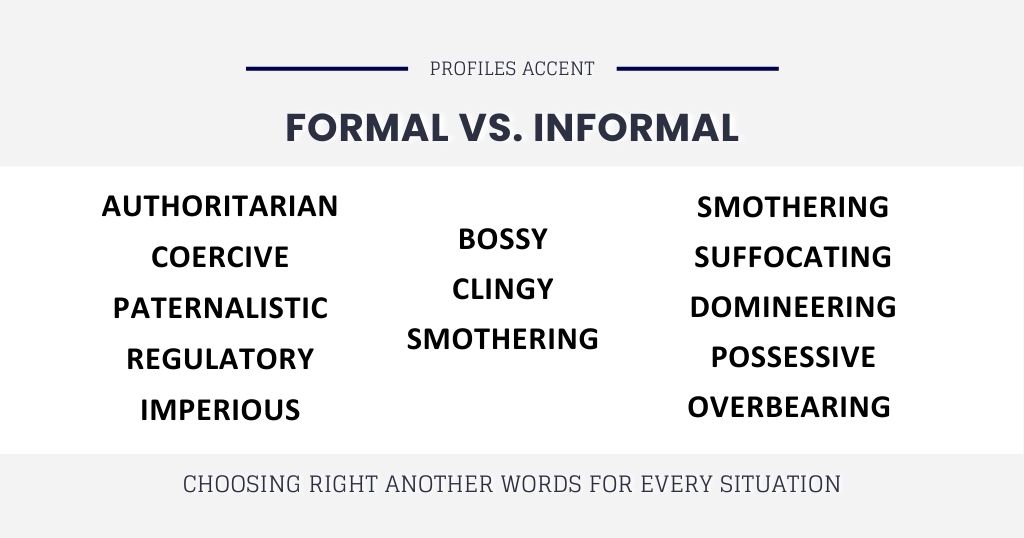
For professional writing or academic essays: Use authoritarian, coercive, paternalistic, regulatory, imperious, peremptory. These carry weight and precision without sounding casual.
For personal essays, fiction, or storytelling: Smothering, suffocating, domineering, possessive, and overbearing carry emotional texture that connects with readers.
For workplace feedback or HR contexts: Micromanaging and intrusive are specific enough to describe behavior without sounding accusatory. They keep the focus on actions, not character.
Words to avoid in formal writing: Bossy, clingy, smothering. These read as informal or emotionally charged, and in professional settings, they can undermine your credibility.
Words That Can Do Harm If Used Carelessly
A few usage notes worth keeping in mind:
“Bossy” gets applied to women and girls far more often than to men showing the same behavior. If you are describing assertive leadership that crosses a line, “domineering” or “overbearing” works for anyone, regardless of gender. The behavior itself should drive the word choice, not the person’s gender.
“Possessive” in a relationship context often signals something more serious than jealousy. In therapeutic and recovery language, it links to patterns of emotional control and isolation. Use it with accuracy, not just as a casual descriptor.
“Abusive” should not be used interchangeably with “controlling.” Controlling behavior can become abusive, but not all controlling behavior has reached that point. Be precise about what you actually mean.
“Regulatory” and “supervising” should not appear in emotionally charged personal contexts. They belong in professional and systemic discussions. Using them to describe a relationship dynamic sounds cold and misaligned.
Mistakes Writers Make When Replacing “Controlling”
Mixing up domineering and manipulative. Domineering is visible. It is loud, direct, and forceful. Manipulative is hidden. A manipulative person often appears agreeable while quietly pulling strings. These are opposite styles of control and should not be used interchangeably.
Using “possessive” too lightly. Saying someone is possessive about their coffee mug is fine. Applying it to a relationship requires care, because the word implies patterns of jealousy-driven restriction that go beyond mild preferences.
Reaching for “tyrannical” in low-stakes situations. Tyranny implies cruelty and fear as a sustained environment. A strict teacher or a demanding parent may be overbearing, but tyrannical is a different level entirely.
Overusing “controlling” itself. If you have used it three times in two paragraphs, none of the instances land. Cycle through specific alternatives based on what the person is actually doing.
Words That Live in the Same Neighborhood
Rigid: Describes inflexibility in thinking and rules rather than active control over others. A rigid person may not try to control you, but their stubbornness shapes every interaction.
Territorial: Control focused on space, roles, or ownership rather than behavior. A territorial colleague guards their projects; a territorial partner guards their relationships.
High-handed: Acting as though your authority is beyond question, often in a dismissive way. It carries a tone of superiority without necessarily being aggressive.
Stifling: Less about personality and more about effect. Something stifling blocks growth or expression. It can describe a culture, a rule system, or a relationship dynamic.
Overprotective: Control that comes from genuine love but goes too far. It is softer in intent than domineering but can cause the same damage to someone’s sense of independence.
Flip It: The Opposite of Controlling
When you need the antonym, “permissive” is usually the first word that surfaces, but it is only part of the picture.
If the context is relationships, the opposite is trusting or empowering. If the context is parenting, it is autonomy-supportive. If the context is leadership, it is delegating or collaborative. If the context is personal behavior, it is easygoing, flexible, or laid-back.
The opposite depends on what kind of control you started with.
So, Which Synonym for Controlling Should You Actually Use?
Here is a simple filter before you write:
Is the control visible and forceful? Use domineering, dictatorial, or overbearing.
Is it quiet and psychological? Use manipulative, coercive, or possessive.
Is it work-related and detail-focused? Use micromanaging or intrusive.
Is it structurally legitimate? Use supervising, regulating, or directing.
Is it causing emotional harm? Use suffocating, oppressive, or stifling.
The right synonym does not just replace a word. It tells the reader exactly what is happening, who holds the power, and how it feels to be on the receiving end.
Discover More Articles
Another Word for Problem: The Right Synonym for Every Situation
Another Word for Greater: Find the Exact Synonyms You’ve Been Missing
Another Word for Empathy: 25 Synonyms That Actually Say What You Mean

I’m Rowan, a language addict who loves exploring how words work in everyday communication. I’ve spent years studying English vocabulary and helping others express themselves more clearly. My goal is simple: make learning new words easy and practical. I focus on real-life examples that show when and how to use different terms. Through clear explanations and honest guidance, I help readers choose the right words for any situation with confidence.