The sentence looks fine at first: “The two methods work differently.”
But in writing, “fine” often means forgettable. The word differently does its job, yet it rarely adds precision or personality to a sentence. It is too vague to carry real weight in an essay, too bland for creative writing, and too simple for formal reports.
The good news? English has a rich set of alternatives. Each one carries its own shade of meaning. Knowing which word to use, and when, is what separates careful writers from careless ones.
What “Differently” Actually Means
“Differently” is an adverb. It describes how something is done, not what something is. It tells your reader that an action happened in a way that is not the same as another. Simple enough. But that simplicity is exactly why it gets overused.
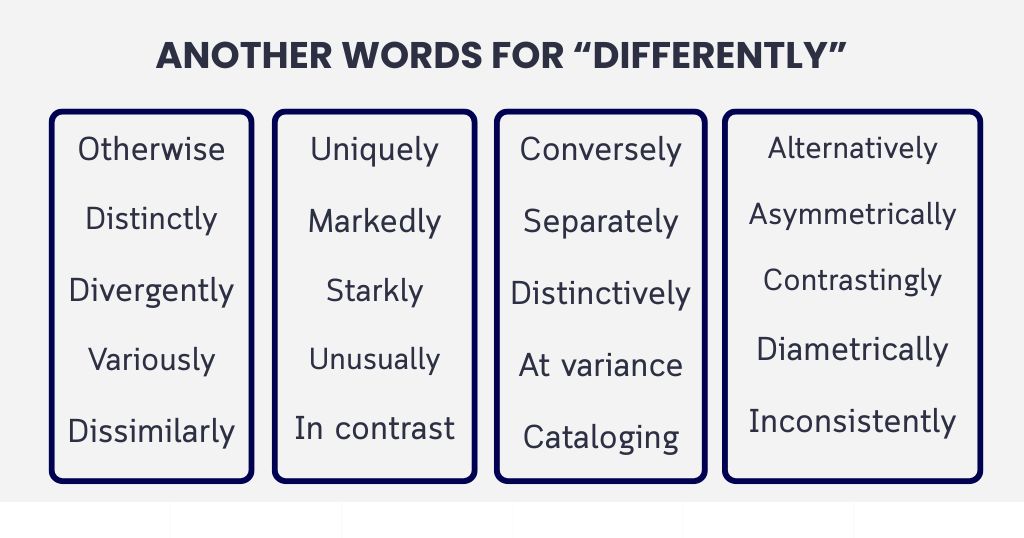
20+ Quick Synonym: Which Fits Another Word for Differently
| Word | Tone | Best Used When | Example |
| Otherwise | Formal | Contrasting two situations | “The data suggests otherwise.” |
| Distinctly | Neutral/Strong | A clear, noticeable gap exists | “They reacted distinctly.” |
| Divergently | Academic | Ideas or paths split apart | “The studies concluded divergently.” |
| Alternatively | Casual/Formal | Offering another option | “Alternatively, try this method.” |
| Dissimilarly | Formal | Comparing unlike things | “The groups behaved dissimilarly.” |
| Variously | Neutral | Multiple differing versions exist | “It has been variously interpreted.” |
| Asymmetrically | Technical | Imbalance or uneven comparison | “Power was distributed asymmetrically.” |
| Contrastingly | Academic/Essay | Direct opposition in comparison | “Contrastingly, Group B improved.” |
| Uniquely | Creative | Something is one of a kind | “She approaches problems uniquely.” |
| Markedly | Moderate/Strong | A significant, visible difference | “Results improved markedly.” |
| Starkly | Strong | A shocking or sharp contrast | “The two outcomes clashed starkly.” |
| Diametrically | Very Strong / Formal | Complete opposites | “The two ideologies are diametrically opposed.” |
| Inconsistently | Negative | Lack of reliability or pattern | “He performed inconsistently.” |
| Unusually | Casual | Outside the norm | “She responded unusually.” |
| In contrast | Formal/Essay | Comparing two opposite points | “In contrast, the second team won.” |
| In another way | Conversational | Casual reframing | “Let me explain it in another way.” |
| Conversely | Academic | Turning a point to its opposite | “Conversely, the trend reversed.” |
| Separately | Neutral | Two things not combined | “They handled it separately.” |
| Distinctively | Creative/Neutral | Has a signature quality | “She writes distinctively.” |
| At variance | Formal/Legal | In disagreement or conflict | “Their accounts were at variance.” |
From Mild to Extreme: A Tone Intensity Scale
How strong is the difference you want to show? This scale helps you pick the right weight.
Mild: otherwise, alternatively, separately
Moderate: distinctly, variously, inconsistently
Strong: markedly, divergently, contrastingly
Very Strong: starkly, antithetically, at variance, diametrically
Moving up this scale changes how the reader feels. “the results were otherwise” barely raises an eyebrow. “The results were starkly at variance” demands attention. Pick based on how much contrast your writing actually contains.
How the Meaning Shifts Depending on Context
Not all synonyms for “differently” mean the same thing. They fall into four natural groups.
When the method changes: Words like alternatively and otherwise fit here. You are telling the reader that a different path was chosen. “We could handle it otherwise” means a different approach exists or was taken.
When the gap is large: Use starkly, markedly, or diametrically when the difference is big and hard to miss. “The two cities developed in starkly different ways” tells the reader this is not a small variation. Something significant separated them.
When ideas or directions split: Divergently and contrastingly are built for this. In essays, when two arguments move in opposite directions from the same starting point, these words capture that motion better than “differently” ever could.
When uniqueness is the point: Uniquely and distinctively say that something stands apart not just from one thing, but from everything. Use these when the difference is not just notable, it is defining.
Watch What Happens When You Swap the Word
Original: “She thinks differently from her colleagues.”
- Formal: “Her thinking diverges noticeably from her colleagues’ views.”
- Academic: “Her cognitive framework stands in contrast to the prevailing approach within her team.”
- Creative: “Where her colleagues see a straight line, she sees a spiral.”
- Casual: “She just doesn’t see it the way everyone else does.”
Original: “The two systems work differently.”
- Formal: “The two systems operate through distinct mechanisms.”
- Academic: “The operational frameworks of both systems diverge at the core level.”
- Creative: “One runs like a clock. The other runs like a river.”
- Casual: “They’re built in totally different ways.”
Original: “He responded differently than expected.”
- Formal: “His response deviated from the anticipated outcome.”
- Academic: “The subject’s reaction was inconsistent with the projected behavioral model.”
- Creative: “No one saw that answer coming.”
- Casual: “He surprised everyone with what he said.”
See how each rewrite changes not just the word, but the entire feel of the sentence? That is the real skill here.
Finding a Better Word for “Differently” in Essays
Students often write “the characters acted differently” when something sharper is available. Try shifting from the adverb to a stronger verb entirely.
Instead of: “The two leaders acted differently during the crisis.”
Try: “The two leaders’ responses diverged sharply when the crisis hit.”
The second version removes “differently” completely and replaces it with a verb (diverged) that carries the contrast inside it. This is called upgrading to a stronger verb, and it is one of the cleanest moves in academic writing.
Other essay-friendly options:
- Disparately (when two things are so different they almost cannot be compared)
- Contrastingly (for direct comparison in analytical writing)
- Asymmetrically (when the difference involves imbalance, often in social or political writing)
“Different” vs. “Differently”: The Mistake Most Writers Make
This trips up a lot of people, including experienced writers.
Different is an adjective. It describes a noun. “She has a different approach.” (Describes the noun “approach.”)
Differently is an adverb. It describes a verb. “She approaches it differently.” (Describes the verb “approaches.”)
A quick test: find the word you are modifying. If it is a thing, use different. If it is an action, use differently.
You will also notice phrases like “Think Different” (the Apple slogan) floating around. That breaks the grammar rule, but it works as a slogan because short, punchy commands often drop the “-ly.” In casual speech, this is common. In formal writing, stick with differently.
“Differently From” or “Differently Than”? Here Is the Answer
This small grammar point almost never shows up in synonym articles. Both are used, but they are not equal.
“Differently from” is preferred in British English and in formal writing. “Differently than” is common in American English, especially before a clause.
Examples:
- British/Formal: “She writes differently from her peers.”
- American/Informal: “She writes differently than I expected.”
Neither is wrong in everyday use. But if you are writing for an academic or international audience, “differently from” is the safer choice.
Words That Look Like Good Swaps but Aren’t Always
A few caution points worth knowing:
“Unusually” suggests something odd or unexpected. Do not use it simply to mean “in a different way.” It carries a slight judgment.
“Inconsistently” has a negative tone. It implies a problem, not just a difference. Using it to describe variation in a neutral situation can come across as critical when you did not mean to be.
“Antithetically” is very formal. In a casual email or spoken conversation, it sounds stiff and out of place. Save it for philosophical or academic writing.
“Uniquely” is positive. It implies the difference is special or admirable. Do not use it when describing something neutral or negative.
A Few Related Words That Round Out Your Options
Deviation: A noun. Refers to a move away from a standard. “The deviation from the expected pattern was significant.”
Divergence: Also a noun. The act of moving in different directions from a shared starting point. More dynamic than simply saying something is “different.”
Contrast: Works as both a noun and a verb. Powerful in writing because it actively compares.
Alternative: An adjective or noun. Points to a second option. “An alternative method was proposed.”
Distinction: A noun meaning a point of difference. “There is a clear distinction between the two.”
Which Synonym for Differently Should You Actually Use?
Before you write “differently,” pause for one second and ask: what kind of difference am I describing? A different method? A different outcome? A sharp contrast? A subtle deviation?
Once you answer that, the right word becomes obvious. “Otherwise” for quiet contrast. “Markedly” when the gap is big and visible. “Divergently” when two ideas split apart. “Antithetically” when you want full formal weight.
The goal is never to sound impressive. The goal is to be precise. The right word does not dress up your sentence. It completes it.
Discover More Articles

I’m Rowan, a language addict who loves exploring how words work in everyday communication. I’ve spent years studying English vocabulary and helping others express themselves more clearly. My goal is simple: make learning new words easy and practical. I focus on real-life examples that show when and how to use different terms. Through clear explanations and honest guidance, I help readers choose the right words for any situation with confidence.