“Division” is one of the most overused structural words in English writing.
It appears in math, politics, business, and personal storytelling — but it rarely fits every context equally well.
Choosing a sharper alternative can instantly make your sentence clearer, more precise, and more professional.
The word “division” often becomes a default placeholder when a more specific term would communicate better. But depending on what you’re dividing—people, numbers, organizations, or ideas—the word you choose changes everything. Pick the wrong one, and your math homework sounds like a corporate memo. Pick the right one, and suddenly your writing clicks.
This guide will show you exactly which word to use when, why it matters, and how to avoid the mistakes that make your writing sound repetitive or robotic.
Breaking Down What Division Really Means
Division is the act of separating something into parts or groups. It can describe splitting numbers in math, breaking organizations into departments, separating people into categories, or creating disagreement between groups.
The emotional weight changes completely based on context. Mathematical division feels neutral. Social division feels heavy and painful. Understanding this difference is the first step to choosing better words.
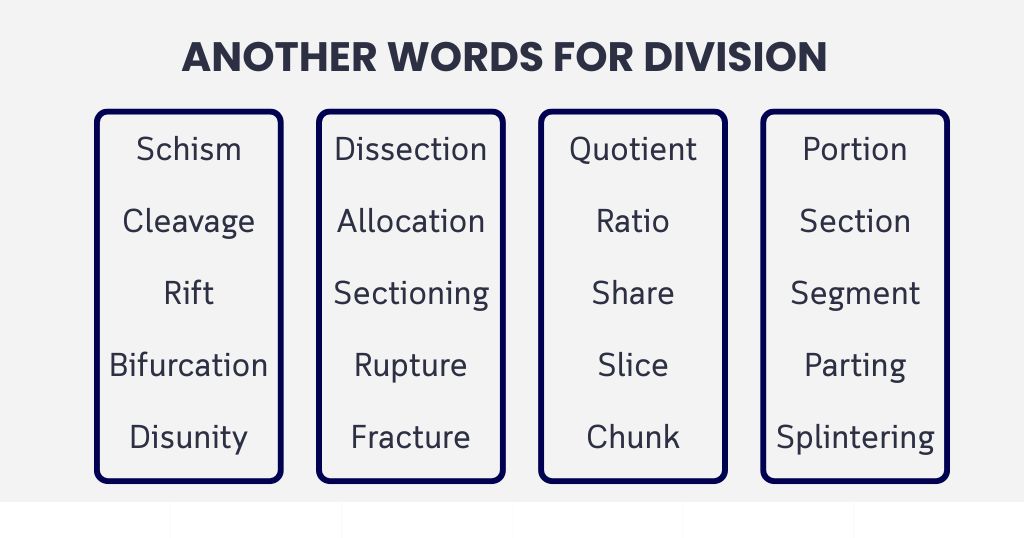
40 Smart Synonyms of Division at Your Fingertips
| Word | Tone | Best Used When | Example |
| Separation | Neutral | Physical or emotional splits | The separation of church and state |
| Split | Casual | Informal contexts, quick breaks | Let’s split the bill |
| Partition | Formal | Organized, planned divisions | The partition of India in 1947 |
| Segmentation | Professional | Business or data analysis | Market segmentation by age group |
| Fragmentation | Negative | Something breaking apart badly | Political fragmentation weakened the movement |
| Distribution | Neutral-Positive | Spreading things out evenly | Distribution of resources across teams |
| Classification | Academic | Organizing by categories | Classification of animal species |
| Segregation | Heavy/Negative | Forced separation, often unfair | Racial segregation in schools |
| Breakdown | Technical | Analyzing parts of a whole | Cost breakdown by department |
| Compartmentalization | Psychological | Keeping things mentally separate | She compartmentalized work from home life |
| Rift | Emotional | Relationships breaking apart | A rift between the two friends |
| Schism | Formal/Religious | Major ideological splits | The schism within the church |
| Cleavage | Scientific | Natural lines of splitting | Social cleavage along economic lines |
| Bifurcation | Technical | Splitting into exactly two parts | The bifurcation of the river |
| Disunity | Negative | Lack of togetherness | Disunity among voters |
| Dissection | Academic | Detailed analysis or cutting apart | Dissection of the argument’s logic |
| Allocation | Business | Assigning resources to groups | Budget allocation for projects |
| Apportionment | Legal/Formal | Official distribution | Apportionment of congressional seats |
| Demarcation | Boundary-focused | Setting clear lines between things | Demarcation of duties between departments |
| Divergence | Gradual | Things slowly moving apart | Divergence of opinions over time |
| Factionalism | Political/Negative | Groups fighting within a larger group | Factionalism hurt the party’s chances |
| Polarization | Modern/Negative | Extreme opposing sides forming | Political polarization in America |
| Sectioning | Neutral | Creating organized sections | Sectioning the report into chapters |
| Subdivision | Real estate/Planning | Smaller divisions within divisions | Housing subdivision development |
| Branching | Organic | Natural splitting like a tree | Branching of career paths |
| Rupture | Dramatic | Sudden, painful breaking | A rupture in diplomatic relations |
| Fracture | Medical/Serious | Breaking with damage | Fracture in the coalition |
| Disbanding | Group-focused | A group breaking up permanently | Disbanding of the committee |
| Quotient | Math-only | The answer in division problems | The quotient of 20 divided by 4 is 5 |
| Ratio | Math/Comparison | Showing proportional relationships | Student-to-teacher ratio |
| Share | Casual/Positive | Personal portion of something | Everyone gets an equal share |
| Slice | Informal/Visual | Physical or metaphorical pieces | A slice of the profits |
| Chunk | Very casual | Large, rough pieces | Breaking the project into chunks |
| Portion | Neutral | Measured parts | A portion of the budget |
| Section | Neutral | Organized parts | The history section of the library |
| Segment | Professional | Clean, defined parts | Market segments |
| Component | Technical | Individual parts of a system | Components of the engine |
| Parting | Emotional | Saying goodbye or separating | The parting of ways between partners |
| Splintering | Negative | Breaking into many small pieces | Splintering of the opposition |
| Disintegration | Severe | Complete falling apart | Disintegration of the alliance |
You might also like it: Another Word for Problem: The Right Synonym for Every Situation
Context Changes Everything: Matching Words to Situations
Not all divisions are equal. The word you need depends on what is being divided and why it matters.
Calculating With Clarity: Math Division Alternatives
In mathematics, you’re dealing with precision. Your word choice should match that clarity.
Best choices:
- Quotient – The actual answer in a division problem
- Ratio – Comparing two numbers proportionally
- Split – Casual way to describe dividing numbers evenly
- Distribution – Spreading amounts across groups
Example transformation:
❌ Weak: “Do the division of 48 by 6”
✅ Better: “Find the quotient when you divide 48 by 6”
✅ Casual: “Split 48 into 6 equal groups”
Building Better Structure: Words for Organizational Splits
When talking about companies, schools, or governments, you want words that sound organized and intentional.
Best choices:
- Department – Common, clear, neutral
- Branch – Suggests connection to a main trunk
- Sector – Large-scale, strategic
- Unit – Smaller, functional teams
- Subdivision – Smaller divisions within larger ones
- Segmentation – Dividing by specific criteria
Example transformation:
❌ Weak: “Our company has many divisions”
✅ Better: “Our company operates through six distinct departments”
✅ Professional: “We’ve implemented market segmentation to target customers more effectively”
Navigating Sensitive Territory: Social Division Language
When people are being divided—by race, class, politics, or beliefs—your word choice carries moral weight.
Light to heavy scale:
- Difference (neutral, just not the same)
- Separation (neutral, physical or social distance)
- Division (starting to feel negative)
- Polarization (strong opposing sides)
- Segregation (forced separation, historically loaded)
- Schism (complete ideological break)
Example transformation:
❌ Insensitive: “The division of races in the city”
✅ Better: “Racial segregation in housing patterns”
✅ Modern: “Growing polarization between urban and rural communities”
Warning: Never use “segregation” casually. It carries the weight of historical injustice, particularly in American contexts regarding race. Similarly, “schism” is often reserved for religious or major ideological splits.
Elevating Your Academic Voice: Essay-Ready Alternatives
Academic writing needs words that show you’re analyzing, not just listing.
Best choices:
- Classification – Organizing by shared traits
- Categorization – Grouping by type
- Breakdown – Analyzing component parts
- Dissection – Deep, detailed analysis
- Partition – Formal, planned separation
- Delineation – Showing clear boundaries
Example transformation:
❌ Too simple: “This essay divides the topic into three parts”
✅ Better: “This analysis breaks down the issue into three key components”
✅ Academic: “Through systematic classification, we can examine each category separately”
From Gentle to Devastating: The Intensity Spectrum
Division words exist on a spectrum from neutral to destructive. Choosing the right intensity level prevents you from sounding overdramatic or too casual about serious topics.
Mild (Almost No Negative Feeling):
- Difference
- Distinction
- Separation
- Split
Moderate (Noticeable But Manageable):
- Division
- Gap
- Disconnect
- Divergence
Strong (Serious Problem):
- Rift
- Fragmentation
- Polarization
- Fracture
Severe (Crisis Level):
- Schism
- Rupture
- Disintegration
- Splintering
Example in action:
Describing a couple’s disagreement:
- Mild: “They have some differences in parenting style”
- Moderate: “There’s a growing gap between their views on discipline”
- Strong: “A serious rift has formed in their relationship”
- Severe: “Their marriage is facing complete disintegration”
Notice how the same situation sounds increasingly serious just by changing one word? That’s the power of understanding intensity.
Watch These Words Transform Weak Sentences
Let’s take boring sentences with “division” and make them work harder.
Example 1: Math Context
Original: “The division problem on the board is hard.”
Casual: “That split they’re asking us to do on the board is tricky.”
Formal: “The quotient calculation presented requires careful analysis.”
Creative: “The numbers on that board don’t want to break apart evenly.”
Why it changes: “Split” makes it conversational. “Quotient” shows you know proper terminology. The creative version makes math feel less intimidating.
Example 2: Workplace Context
Original: “The division of tasks between teams isn’t working.”
Professional: “Current task allocation across departments creates inefficiency.”
Direct: “How we’ve segmented responsibilities between teams is causing problems.”
Solution-focused: “We need to redesign the distribution of work to improve collaboration.”
Why it changes: “Allocation” sounds strategic. “Segmented” shows analytical thinking. “Distribution” implies fairness and system design.
Example 3: Social Context
Original: “There is division between the two groups.”
Academic: “Significant polarization exists between these demographic segments.”
Journalistic: “A deep rift separates the two communities.”
Diplomatic: “Recent divergence in perspectives has created tension between the groups.”
Why it changes: “Polarization” suggests research and data. “Rift” is vivid and emotional. “Divergence” sounds less accusatory and more observational.
Example 4: Personal Writing
Original: “The division in our family is painful.”
Raw: “The rupture between us hurts every day.”
Hopeful: “The gap in our family is something we’re working to bridge.”
Reflective: “This fracture in our relationships didn’t happen overnight.”
Why it changes: “Rupture” is visceral and honest. “Gap” suggests something fixable. “Fracture” implies damage that needs healing.
Matching Your Audience: When to Go Formal or Casual
The same concept needs different words depending on who’s reading.
Best for Academic Essays:
- Classification
- Partition
- Segmentation
- Categorization
- Delineation
- Demarcation
- Apportionment
These words signal analytical thinking and formal education.
Best for Professional Emails:
- Distribution
- Allocation
- Breakdown
- Segmentation
- Department
- Branch
These sound competent without being stuffy.
Best for Creative Writing:
- Split
- Rift
- Fracture
- Rupture
- Parting
- Splintering
- Chasm
These create emotional impact and visual imagery.
Words to Avoid in Formal Contexts:
- Chunk (too casual)
- Slice (too informal)
- Split (too conversational for academic work)
- Carve up (too colloquial)
Seven Mistakes That Make Your Writing Sound Amateur
Mistake 1: Using “Separation” and “Segregation” Interchangeably
One common misuse is treating “separation” and “segregation” as interchangeable. They are not.
“Separation” is neutral, while “segregation” carries heavy historical implications, particularly in American racial history.
Mistake 2: Overusing “Split” in Formal Writing
The problem: “Split” is great for conversation but sounds too casual in professional contexts.
❌ Awkward: “The budget split across divisions requires board approval”
✅ Better: “Budget allocation across divisions requires board approval”
Mistake 3: Using Math Words for People
The problem: Treating humans like numbers sounds cold and dehumanizing.
❌ Insensitive: “The quotient of workers per manager is too high”
✅ Better: “The ratio of workers to managers creates management challenges”
✅ Best: “Each manager oversees too many employees for effective supervision”
Mistake 4: Confusing “Fraction” with “Fracture”
The problem: A fraction is a math term (1/2, 3/4). A fracture is a break or crack.
❌ Wrong: “The fracture of votes went to the opposing candidate”
✅ Right: “A fraction of votes went to the opposing candidate”
Mistake 5: Making Everything Sound Like a Crisis
The problem: Using intense words for minor disagreements inflates problems.
❌ Overdramatic: “The team faces complete disintegration over which software to use”
✅ Proportional: “The team has differing opinions on software selection”
Untangling Similar Terms: Division vs Its Close Cousins
Division vs Separation
Division often implies creating distinct parts that remain part of a whole (dividing a company into departments). Separation suggests moving things apart completely (separating oil from water).
Division vs Fraction
Division is the action or process. Fraction is a piece that results from dividing (eating a fraction of the pie).
Division vs Distribution
Division focuses on the act of splitting. Distribution emphasizes spreading things out fairly or strategically.
Division vs Partition
Partition is always intentional and planned (partitioning a hard drive). Division can happen naturally or by force.
Segmentation vs Fragmentation
Segmentation is organized and purposeful (market segmentation). Fragmentation suggests messy breaking apart (fragmentation of attention).
Rift vs Gap
Gap is missing space or distance. Rift is an active breaking or tearing apart. Gaps can exist without conflict; rifts imply damage.
Spotting Division Keywords Hidden in Math Problems
When you see these words in math problems, they’re telling you to divide:
- Split – “Split 30 cookies among 6 children”
- Shared – “12 pencils shared equally by 4 students”
- Divided – “45 divided into groups of 5”
- Each – “If 24 apples are given and each person gets 3…”
- Per – “60 miles per 2 hours means…”
Pro tip: “Per” is division in disguise. Miles per hour means miles divided by hours.
Bringing Things Together: What’s the Opposite of Division?
Sometimes you need to express the opposite idea—bringing things together instead of splitting them apart.
Direct opposites:
- Unity – Everyone together as one
- Union – Official joining of groups
- Integration – Combining into a functioning whole
- Consolidation – Merging for strength
- Unification – Process of becoming one
- Multiplication (math only) – Making something larger instead of smaller
- Cohesion – Natural sticking together
Example:
“Rather than facing division, the community chose unity.”
“After years of fragmentation, the organization underwent consolidation.”
Three Questions That Lead You to the Perfect Word
Precision in language is not about sounding complex — it’s about choosing the word that reflects the exact type of separation you’re describing.
When the tone matches the context, your writing immediately feels more intentional and credible.
Your answer to these three questions will point you to the exact right word. And that precision—that’s what makes writing feel professional, thoughtful, and clear.

I’m Rowan, a language addict who loves exploring how words work in everyday communication. I’ve spent years studying English vocabulary and helping others express themselves more clearly. My goal is simple: make learning new words easy and practical. I focus on real-life examples that show when and how to use different terms. Through clear explanations and honest guidance, I help readers choose the right words for any situation with confidence.