Most writers reach for “empathy” and stop there. It fits, so why change it? But here’s the thing: the word you choose doesn’t just describe a feeling. It shapes how your reader receives it.
“She showed empathy” lands flat in a personal essay. “She carried his grief like it was her own” hits differently. Even in formal writing, swapping “empathy” for the right synonym can shift your tone from clinical to genuinely human.
This isn’t about replacing a word for the sake of variety. It’s about precision knowing when “compassion” is stronger, when “understanding” is actually weaker than you think, and why “sympathy” isn’t the safe swap most people assume it is.
Quick 25 Another Words for Empathy , Organized by Context
| Word | Tone | Best Used When | Quick Example |
| Compassion | Warm, action-leaning | You want to show care that moves toward helping | Her compassion led her to stay |
| Understanding | Neutral, cognitive | Acknowledging perspective without deep emotion | He offered quiet understanding |
| Fellow-feeling | Literary, archaic | Creative writing, classic literature style | A rare fellow-feeling passed between them |
| Sensitivity | Gentle, observational | Describing someone who notices emotional shifts | Her sensitivity read the room immediately |
| Solicitude | Formal, attentive | Professional or caregiving contexts | The nurse’s solicitude was unmistakable |
| Affective resonance | Academic, precise | Essays, psychology writing | Affective resonance deepened the connection |
| Perspective-taking | Cognitive, clinical | Research, formal analysis | Perspective-taking reduces conflict |
| Warmth | Soft, approachable | Casual or storytelling contexts | His warmth put everyone at ease |
| Tenderness | Emotionally close | Intimate relationships, personal writing | She spoke with unexpected tenderness |
| Open-heartedness | Spiritual, gentle | Mindfulness or reflective writing | Open-heartedness requires real courage |
| Attunement | Psychological, precise | Therapy contexts, emotional intelligence pieces | Attunement between parent and child matters deeply |
| Kinship | Relational, humanizing | When shared experience creates connection | A quiet kinship grew between them |
| Emotional intelligence | Professional | Business, leadership, workplace writing | Emotional intelligence defines great managers |
| Vicarious experience | Academic | Essays exploring shared emotional states | The novel creates vicarious experience for the reader |
| Humanity | Broad, moral | When referring to universal human decency | He acted with basic humanity |
| Receptivity | Open, passive | Describing willingness to receive others’ emotions | True receptivity means listening without fixing |
| Interpersonal sensitivity | Clinical | Psychology, academic essays | Interpersonal sensitivity is measurable and trainable |
| Connection | Relational | When the bond itself is the focus | Their connection went beyond words |
| Consideration | Mild, respectful | Formal emails, professional settings | Please act with consideration for others |
| Affinity | Natural, effortless | When connection feels instinctive | An immediate affinity formed between them |
| Insight | Intellectual | When understanding comes from observation | Her insight into his mood was striking |
| Congruence | Therapeutic, precise | When emotional responses mirror another’s | Congruence builds trust in therapy |
| Ubuntu | Cultural, communal | African philosophy, collective humanity | Ubuntu reminds us: a person is a person through others |
| Humaneness | Ethical, formal | Moral or philosophical writing | The policy lacked basic humaneness |
| Active presence | Modern, mindful | Coaching or counseling contexts | She offered active presence, not advice |
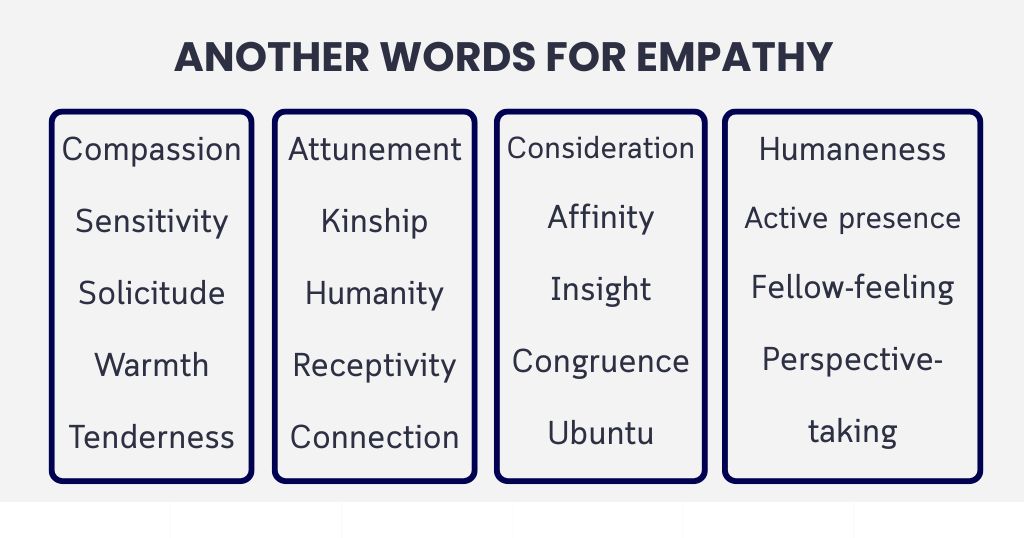
What Empathy Actually Means (Without the Dictionary Version)
Empathy is the act of stepping inside someone else’s emotional experience — not watching from a distance, but genuinely feeling alongside them. It carries warmth, but also weight. It implies you’re not above the other person’s pain. You’re level with it.
That equality is what separates empathy from most of its so-called synonyms.
The Meaning Clusters You Need to Know
Not all empathy synonyms mean the same thing. Grouping them by what they actually do helps you choose smarter.
Emotional Synonyms: Words that prioritize feeling compassion, tenderness, warmth, and fellow-feeling all sit in this group. They suggest the writer or character is emotionally moved. Use these when the feeling itself is the point.
Cognitive Synonyms words that prioritize understanding perspective-taking, insight, understanding, and attunement describe the mental act of grasping another’s experience. These work well in essays, therapy writing, or analytical pieces. They’re cooler in tone not cold, just more considered.
Action-Oriented Synonyms words that suggest a response Compassion crosses into action. So does solicitude. These words imply the feeling leads somewhere a choice, a gesture, a commitment. Strong for professional writing or narratives where a character is proactive.
Relational Synonyms words about connection Kinship, affinity, and connection focus on what’s built between two people. Use these when the relationship is the subject, not just one person’s internal state.
Tone Intensity Scale
Some synonyms are gentle. Others carry real emotional weight. Here’s how they stack up:
Mild → Consideration → Understanding → Warmth → Sensitivity → Compassion → Tenderness → Attunement → Affective Resonance → → Strong
- “Consideration” barely scratches the surface. It’s polite, not deep.
- “Warmth” is pleasant but light.
- “Compassion” starts to ache a little.
- “Tenderness” is intimate.
- “Attunement” and “affective resonance” suggest two emotional systems genuinely synchronized.
The higher you climb, the more emotionally committed the word becomes. Choose according to the depth your context actually calls for.
Rewriting “Empathy” in Different Contexts
Original: She showed empathy toward her colleague.
- Formal: She demonstrated genuine attunement to her colleague’s situation.
- Casual: She really got what her colleague was going through.
- Academic: Her interpersonal sensitivity shaped how she responded to her colleague’s distress.
- Creative: She sat with him in it not fixing, just present.
Each version does something different. The academic version signals professional awareness. The creative version shows, rather than tells. The casual version is warm but brief.
Original: The doctor needed more empathy.
- Formal: The physician would have benefited from greater solicitude in his approach.
- Academic: A stronger capacity for perspective-taking might have improved patient outcomes.
- Creative: Somewhere between the clipboard and the diagnosis, he’d forgotten the person.
Notice how swapping the word also changes what’s being criticized.
- “Solicitude” frames it as professional conduct.
- “Perspective-taking” makes it cognitive.
The creative version skips the label entirely and lands harder because of it.
For Essays Specifically
Students often default to “understanding” in formal essays, but it’s one of the weakest options available. It reads as vague and too broad to carry real analytical weight.
Better choices for academic writing:
- Vicarious experience when discussing literature or psychology
- Affective resonance when analyzing emotional response
- Perspective-taking when the cognitive process is the focus
- Interpersonal sensitivity in clinical or sociological arguments
If you’re writing about a character’s empathy in a novel, “fellow-feeling” carries literary gravity. If you’re analyzing it in a social science paper, “cognitive empathy” is precise and credible.
Avoid “sympathy” in essays unless you’re specifically distinguishing it from empathy; because they’re not the same thing, and using them interchangeably signals a misunderstanding.
Sympathy vs. Empathy: The Distinction That Actually Matters
This is one of the most common mix-ups in writing, and it’s worth being direct about it.
Sympathy is watching someone struggle from a safe emotional distance. You feel for them. It carries a subtle hierarchy: you’re not in the pain, you’re observing it.
Empathy means climbing into the experience with them. You feel alongside them. There’s no hierarchy. There’s proximity.
Compassion is the next step: empathy combined with the impulse to act. You feel what they feel, and you move toward helping.
If your essay or story calls for depth and equality, empathy is right. If someone is offering support without full emotional involvement, sympathy fits better. Mixing them up doesn’t just weaken your writing, it changes the relationship dynamic you’re describing.
The Opposite of Empathy (It’s Not What Most Lists Say)
Many sites list “hatred” as empathy’s opposite. That’s inaccurate. Hatred is still a form of intense emotional engagement. The true opposite is the absence of feeling entirely.
- Apathy, no emotional response at all; the complete withdrawal of care
- Indifference, awareness without concern; you know, but don’t feel
- Disdain, a step further; feeling that someone’s pain is beneath your attention
- Objectification, the most extreme form; reducing a person to a problem or a function
Is apathy the opposite of empathy? Psychologically, yes it’s the most direct opposite, because it represents the total absence of what empathy requires. Where empathy demands engagement, apathy is the refusal to engage at all.
Common Mistakes Worth Avoiding “Empathy”
Using “sympathy” and “empathy” as synonyms.
They overlap in everyday speech, but in careful writing essays, therapy contexts, literature analysis treating them as interchangeable causes real confusion.
Overusing “compassion” when you mean empathy.
Compassion implies action. If your character or subject only understands without doing anything about it, compassion isn’t quite right.
Reaching for “kindness” as a substitute.
Kindness is behavioral; it describes actions, not emotional states. Someone can be kind without being empathetic at all.
Using “sensitivity” in clinical writing.
It’s too soft for formal academic contexts. “Interpersonal sensitivity” works; plain “sensitivity” reads as informal.
Treating “emotional intelligence” as a direct synonym.
EQ is a skill set that includes empathy but it also includes self-regulation, social awareness, and more. Using it as a simple swap oversimplifies both terms.
Related Words That Sharpen Your Vocabulary
Altruism: Concern for others expressed through selfless action. Altruism can exist without empathy, though the two often travel together.
Resonance: When one person’s emotional state seems to vibrate in another. More metaphorical than clinical, but powerful in creative writing.
Rapport: The surface-level result of empathy working well. You build rapport through empathetic behavior, but rapport itself is relational, not emotional.
Benevolence: Goodwill toward others, but without necessarily feeling what they feel. Calmer and more formal than compassion.
Mirroring: A psychological term for unconsciously reflecting someone’s emotional state. Related to attunement, but more automatic and less intentional.
How to Choose the Right Synonym for “Empathy”
Here’s the practical part. Ask yourself three questions before you replace “empathy”:
1. Am I describing a feeling or an action?
Feeling → use compassion, tenderness, warmth, attunement.
Action → use compassion (it bridges both), solicitude, humanity.
2. What’s the formality level?
Academic/formal → affective resonance, perspective-taking, interpersonal sensitivity, vicarious experience.
Professional → emotional intelligence, attunement, consideration.
Casual/creative → warmth, kinship, fellow-feeling, active presence.
3. Is equality or distance implied?
If the person is emotionally with someone → empathy synonyms like attunement, resonance, kinship.
If the person is emotionally above someone → you may actually mean sympathy, not empathy.
Getting this right isn’t just about vocabulary. It’s about understanding the relationship dynamic you’re writing and choosing the word that reflects it accurately.

I’m Rowan, a language addict who loves exploring how words work in everyday communication. I’ve spent years studying English vocabulary and helping others express themselves more clearly. My goal is simple: make learning new words easy and practical. I focus on real-life examples that show when and how to use different terms. Through clear explanations and honest guidance, I help readers choose the right words for any situation with confidence.