You’re writing an email to your boss and you’ve used “problem” three times already. It sounds repetitive, almost lazy. Or maybe you’re trying to describe a tough situation in your life, but “problem” feels too small for what you’re going through. You need a better word, but which one?
Choosing the right alternative isn’t just about avoiding repetition. The word you pick changes how people see the situation. Call something a “challenge” and people think you’re confident you can handle it. Call it a “crisis” and suddenly everyone’s attention shifts to urgency. Understanding these differences helps you communicate with precision, whether you’re writing a school essay, talking to a friend, or presenting to your team at work.
What “Problem” Actually Means
A problem is any situation that creates difficulty, requires a solution, or blocks you from reaching a goal. It carries a slightly negative weight—problems demand attention and action.
The word works in almost any context, from “math problem” to “family problem,” which is exactly why it gets overused. When you replace it with a more specific synonym, you’re not just changing the word—you’re clarifying what type of difficulty you’re facing and how serious it is.
Quick Reference: 25 Strong Alternatives For “Problem”
| Word | When to Use It | Example |
| Issue | Neutral situations needing discussion | “We have a scheduling issue to resolve.” |
| Challenge | When you want a positive, growth-focused tone | “This project presents an exciting challenge.” |
| Obstacle | Something physically or mentally blocking progress | “His fear became an obstacle to success.” |
| Difficulty | General trouble that requires effort | “She faced difficulty adjusting to the new city.” |
| Dilemma | Two equally difficult choices | “I’m in a dilemma: stay or leave?” |
| Complication | Something that makes a situation more complex | “His illness added a complication to our plans.” |
| Hurdle | A temporary barrier you can overcome | “It’s just a small hurdle before we launch.” |
| Snag | A minor, unexpected problem | “We hit a snag with the printer.” |
| Predicament | An uncomfortable or embarrassing situation | “He found himself in an awkward predicament.” |
| Setback | Progress that gets reversed | “The failed test was a major setback.” |
| Crisis | An urgent, serious problem demanding immediate action | “The company faced a financial crisis.” |
| Conflict | Opposing forces or disagreements | “There’s conflict between the two departments.” |
| Trouble | General negative situation, often with consequences | “She got into trouble for missing the deadline.” |
| Concern | A worry or matter needing attention | “Safety is our primary concern.” |
| Matter | A formal way to describe a topic or situation | “This is a serious matter requiring review.” |
| Quandary | Confusion about what to do | “I’m in a quandary about which college to choose.” |
| Barrier | Something that prevents movement or progress | “Language was a barrier to communication.” |
| Hardship | Long-term difficulty causing suffering | “The family endured financial hardship.” |
| Mishap | An unlucky accident or mistake | “A small mishap delayed the ceremony.” |
| Hitch | A temporary interruption or problem | “The wedding went off without a hitch.” |
| Pitfall | A hidden danger or common mistake | “Avoid the pitfall of procrastination.” |
| Constraint | A limitation that restricts options | “Budget constraints affected our choices.” |
| Dispute | A disagreement between people | “They’re in a dispute over property boundaries.” |
| Friction | Ongoing tension between people or groups | “There’s friction between management and staff.” |
| Glitch | A technical or system error | “The software had a glitch that crashed it.” |
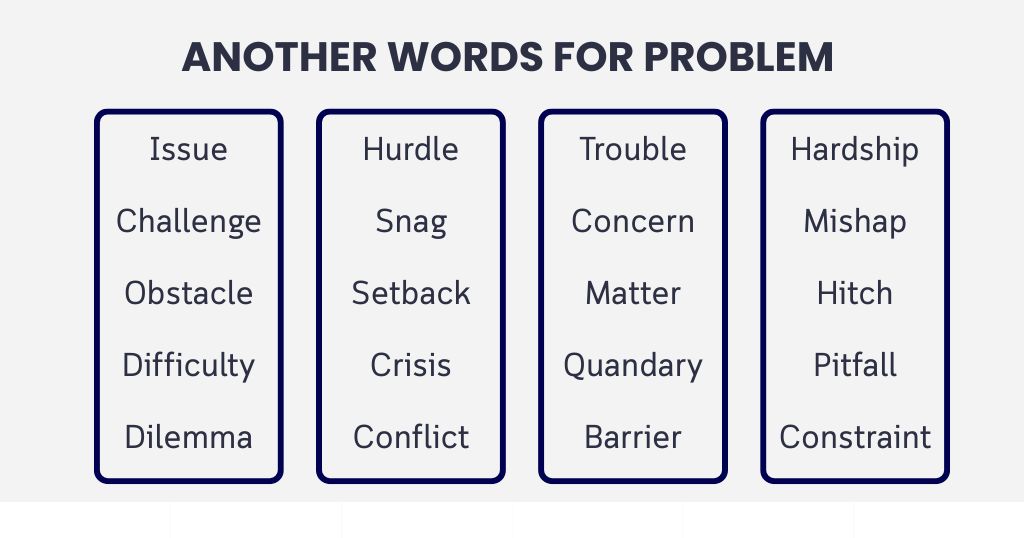
Understanding Intensity Levels
Not all problems are equal. The word you choose signals how serious the situation is.
Minor Issues (Light Weight)
These words suggest the problem is manageable and won’t derail everything:
- Snag: “We hit a minor snag but fixed it quickly.”
- Hitch: “There was one small hitch during the presentation.”
- Hiccup: “Just a hiccup in the process, nothing major.”
Use these when you want to reassure people or keep panic low.
Moderate Problems (Medium Weight)
These indicate real difficulty but not disaster:
- Obstacle: “We encountered several obstacles during development.”
- Complication: “Her injury was a complication we hadn’t planned for.”
- Setback: “Losing funding was a serious setback.”
These words acknowledge difficulty without sounding dramatic.
Serious Problems (Heavy Weight)
These signal urgency and severity:
- Crisis: “The company is facing a leadership crisis.”
- Catastrophe: “The data breach was a complete catastrophe.”
- Calamity: “The flood was a calamity for the entire region.”
Only use these when the situation truly demands immediate, serious attention. Overusing them makes you sound like you’re exaggerating.
Choosing Words Based on Control
Here’s something most synonym lists miss: some words suggest you have power to fix things, while others suggest you’re stuck.
You Have Agency (Can Fix It)
- Challenge: Implies you’re capable of overcoming it
- Hurdle: Suggests it’s temporary and jumpable
- Task: Reframes the problem as work to complete
- Puzzle: Makes it sound solvable with the right thinking
Example shift: “We have a problem with customer retention” sounds negative. “We have a puzzle to solve with customer retention” sounds like an opportunity.
You’re Stuck (Limited Control)
- Predicament: You’re trapped in awkward circumstances
- Bind: You’re caught between bad options
- Plight: You’re suffering and need outside help
- Quagmire: You’re sinking deeper the more you struggle
Example: “I’m in a predicament” tells people you need help, while “I’m facing a challenge” tells them you’ve got it handled.
Context Matters: Different Situations Need Different Words
Personal Life Problems
When talking about your own struggles, specific words capture different experiences:
- Hardship: Long-term difficulty that tests you (poverty, illness)
- Tribulation: Intense suffering that shapes character
- Adversity: Bad circumstances you must push through
- Ordeal: A painful or difficult experience with an end point
- Struggle: Ongoing effort against difficulty
“I’m going through hardship” sounds more serious than “I’m dealing with an issue.” Choose based on how much you want others to understand the weight of what you’re experiencing.
Problems With Other People
Interpersonal conflicts need careful wording:
- Friction: Small, ongoing irritations—”There’s some friction between us lately.”
- Tension: Noticeable discomfort in the relationship—”You could feel the tension in the room.”
- Discord: Lack of harmony or agreement—”There’s discord in the team.”
- Dispute: A formal disagreement or argument—”They’re in a dispute over the contract.”
- Clash: Two strong personalities or ideas hitting head-on—”Their management styles clash.”
- Rift: A serious break in the relationship—”The argument created a rift between them.”
Never say “I have beef with him” in a professional email, but it works fine when texting a friend. Context determines whether informal options like “beef” or “bad blood” are appropriate.
Business and Work Problems
Professional settings prefer words that sound solution-focused:
- Bottleneck: One point slowing down the entire process
- Pain point: A specific frustration customers experience
- Gap: Something missing that needs to be filled
- Inefficiency: Wasted time or resources
- Risk: Potential future problem
- Constraint: Limitation on what you can do
Notice how “We have budget constraints” sounds more professional than “We have money problems.” The first acknowledges reality without sounding desperate.
Academic Writing
Essays and research papers need formal, precise language:
- Paradox: A contradiction that seems impossible but exists
- Anomaly: An unexpected result that doesn’t fit the pattern
- Impediment: A formal obstruction to progress
- Complexity: Interconnected difficulties
- Controversy: Disputed issue with multiple viewpoints
Academic writing avoids casual words like “snag” or “hassle.” Instead of writing “The main problem in the study,” try “The primary impediment to the research” or “The central controversy surrounding the findings.”
Rewriting Examples: Watch the Tone Shift
Original (Weak): “The company has a problem with employee morale.”
- Formal: “The organization faces a significant challenge regarding employee engagement.”
- Casual: “There’s some tension around morale at work.”
- Urgent: “We’re in a crisis with employee satisfaction.”
- Neutral: “Employee morale presents a concern that requires attention.”
See how each version changes what action feels necessary?
Original (Weak): “I have a problem making decisions.”
- Growth-focused: “Decision-making is a challenge I’m working to improve.”
- Honest: “I struggle with making decisions under pressure.”
- Professional: “I encounter difficulty when multiple viable options are present.”
- Casual: “I get stuck when I have to choose between things.”
The “Issue” vs “Problem” Confusion
People often use these interchangeably, but there’s a useful distinction:
Problem = Something wrong that needs fixing. It’s negative and demands a solution.
- “The car has a problem.” (Something is broken)
- “We have a problem with the budget.” (Something is wrong)
Issue = A matter up for discussion or a concern that might not be strictly negative.
- “The main issue at the meeting is resource allocation.” (Topic, not necessarily bad)
- “There’s an issue we should address.” (Softer, less blaming)
Use “issue” when you want to sound less accusatory or when the situation is debatable rather than clearly wrong. “We have an issue to discuss” sounds more collaborative than “We have a problem.”
Words to Avoid in Formal Writing
Some alternatives work in conversation but look unprofessional in writing:
- Hassle: Too casual for business or academic contexts
- Mess: Unprofessional and vague
- Disaster: Exaggerated unless literally true
- Nightmare: Too dramatic and subjective
- Pain: Too informal (“This is such a pain”)
Save these for texts with friends, not emails to professors or clients.
The Danger of “Challenge”
Corporate environments love the word “challenge” because it sounds positive and proactive. But overusing it creates what people call “toxic positivity”—pretending everything is an opportunity when some things are just genuinely hard.
“We’re facing challenges with layoffs” can sound dismissive to people losing their jobs. Sometimes you need to call a problem a problem, not disguise it as a growth opportunity. Use “challenge” when the situation truly can lead to growth, not when you’re trying to sugarcoat bad news.
Opposite Words: When Problems Disappear
Standard lists usually only mention “solution,” but here are better opposites:
- Resolution: The problem is fully resolved
- Answer: The solution you were searching for
- Remedy: Something that fixes the problem
- Ease: Smooth progress without problems
- Blessing: The opposite in terms of fortune
- Advantage: What helps instead of hurts
- Benefit: A positive outcome instead of negative
- Boon: An unexpected good thing
Knowing opposites helps you write clearer contrasts: “What seemed like a crisis turned into a blessing.”
Problem-Solving Alternatives
If you keep writing “problem-solving” on your resume or reports, try these:
- Troubleshooting: Finding and fixing technical issues
- Resolution: Bringing conflicts or issues to closure
- Mitigation: Reducing damage even if you can’t fully solve it
- Remediation: Correcting systematic errors
- Critical thinking: The analytical approach to challenges
- Conflict resolution: Specifically for people-related problems
“Strong troubleshooting skills” sounds more specific than “good at problem-solving.”
Common Mistakes People Make
Mistake 1: Using “dilemma” for any problem A dilemma is specifically when you’re torn between two difficult choices. Don’t say “I have a dilemma with my printer” unless you mean “Should I fix it or buy a new one?”
Mistake 2: Overusing “issue” to avoid saying “problem” If something is genuinely broken or wrong, calling it an “issue” can sound like you’re minimizing it. Sometimes “problem” is the honest word.
Mistake 3: Using “crisis” for minor inconveniences Save “crisis” for truly urgent situations. “I have a wardrobe crisis” sounds dramatic and unprofessional unless you’re joking with friends.
Mistake 4: Mixing formal and informal in the same piece Don’t write “The primary impediment is that we’re in a pickle.” Stick to one tone level.
Related Words That Aren’t Quite Synonyms
- Question: A problem that needs answering intellectually, not fixing practically
- Mystery: A problem you don’t understand yet
- Puzzle: A problem that requires figuring out, with a definite solution
- Concern: A worry about a potential problem, not an actual one yet
- Difficulty: The quality of being hard, not the situation itself
- Situation: Neutral word for circumstances, not inherently problematic
Your Quick Decision Guide
Ask yourself three questions:
- How serious is it? Minor = snag/hitch. Moderate = obstacle/setback. Serious = crisis/catastrophe.
- What’s the context? Personal = struggle/hardship. Professional = constraint/bottleneck. Academic = impediment/paradox.
- What tone do I want? Positive = challenge. Neutral = issue/matter. Negative = problem/trouble.
The right synonym isn’t about sounding smart—it’s about communicating clearly what you’re actually facing. When you say “We’ve hit a snag,” people understand it’s fixable. When you say “We’re in a crisis,” they know to act fast. Use that power wisely. Follow profiles accent if you want more helpful information.

I’m Rowan, a language addict who loves exploring how words work in everyday communication. I’ve spent years studying English vocabulary and helping others express themselves more clearly. My goal is simple: make learning new words easy and practical. I focus on real-life examples that show when and how to use different terms. Through clear explanations and honest guidance, I help readers choose the right words for any situation with confidence.