The word “thinking” shows up everywhere in writing. Essays use it, emails use it, stories use it. The problem is that it tries to cover too many mental states at once, so the sentence often ends up sounding flat.
That happens because “thinking” is doing too much work. It covers worry, wonder, daydreams, logic, grief, and genius all at once. When you swap it for the word that actually fits, the sentence wakes up.
This guide helps you find that word.
Why Another Word for Thinking Actually Matters in Writing
At its core, thinking means the mind is active. But the emotional weight behind it shifts constantly. Thinking about a math problem feels nothing like thinking about someone you miss. The word stays the same. The experience doesn’t.
That gap is where better writing lives.
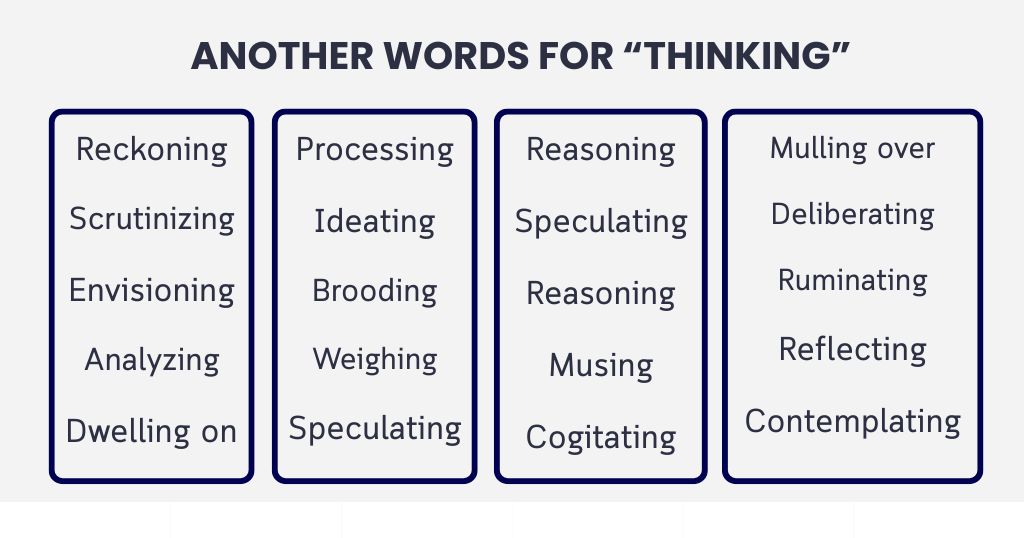
Quick 15+ Synonyms: Organized by Tone & Context
Pick by tone, context, and intensity. Every word here earns its place.
| Word | Tone | Use It When | Quick Example |
| Pondering | Calm, open | Weighing a big decision | She pondered the job offer for days |
| Contemplating | Focused, deep | Studying something vast | He contemplated the consequences |
| Reflecting | Warm, backward-looking | Looking at past events | I reflected on that summer |
| Ruminating | Heavy, repetitive | Overthinking or worrying | She kept ruminating over the argument |
| Deliberating | Formal, careful | Making a formal decision | The team deliberated before voting |
| Cogitating | Scholarly, serious | Intense intellectual effort | He sat cogitating the problem |
| Musing | Light, dreamy | Casual wondering | I was musing about the weekend |
| Reasoning | Logical, structured | Problem-solving or essays | His reasoning was surprisingly clear |
| Speculating | Curious, uncertain | Guessing without full facts | We speculated about the outcome |
| Weighing | Balanced, practical | Comparing options | She weighed the risks carefully |
| Brooding | Dark, emotional | Troubled, heavy feelings | He brooded in silence all evening |
| Ideating | Creative, modern | Brainstorming new ideas | The team spent an hour ideating |
| Processing | Neutral, modern | Absorbing new information | Give me a moment, I’m still processing |
| Mulling over | Informal, relaxed | Thinking it through slowly | I’m still mulling it over |
| Dwelling on | Slightly negative | Staying stuck on something | Stop dwelling on what they said |
| Analyzing | Precise, academic | Breaking a topic into parts | She analyzed every angle |
| Envisioning | Hopeful, visual | Imagining a future or person | He envisioned a better outcome |
| Scrutinizing | Sharp, intense | Examining something closely | The editor scrutinized every line |
| Reckoning | Practical, honest | Calculating or concluding | By my reckoning, it makes sense |
| Wrestling with | Vivid, effortful | Struggling through a hard idea | He wrestled with the moral question |
Going Beyond the Basics: How These Words Really Split Apart
Not all synonyms belong in the same bucket. Here is how they actually split.
When the Thinking Feels Like a Weight
Some thoughts press down. They circle. They come back at 2 a.m.
Ruminating sits here. It comes from the Latin word for a cow chewing cud. That image says it all: the same thought, chewed over and over. Therapists use this word for a reason. It carries weight.
Brooding goes darker. It is not just repetitive. It is emotional. A character who broods is not simply thinking. They are sitting inside the feeling.
Dwelling on is the everyday version. Less dramatic, but still a sign that the mind cannot let go.
Use these when the thinking feels like a burden, not a choice.
When the Thinking Has a Job to Do
Musing is the opposite of ruminating. It is soft, wandering, almost pleasant. Someone musing is not worried. They are just… floating through thoughts.
Speculating is lighter too, but more curious. There is a question attached. The mind is playing, not suffering.
Daydreaming belongs here also. The mind drifts without a destination.
When the Thinking Has a Purpose
Deliberating means thinking toward a decision. Courts deliberate. Committees deliberate. The outcome matters.
Analyzing breaks something apart to understand it. It is structured. Intentional.
Reasoning is similar but more conversational. It shows the path from question to answer.
Strategizing is thinking aimed at a plan. Common in business, sports, and competitive contexts.
Another Word for Thinking Hard: The Intensity Scale
This is something most synonym lists skip entirely. Intensity matters.
Soft end: Musing, wondering, considering
Middle ground: Reflecting, pondering, weighing, contemplating
High effort: Deliberating, analyzing, reasoning, scrutinizing
Maximum load: Cogitating, wrestling with, agonizing, obsessing
If your character is casually curious, “musing” fits. If they are pulling their hair out over a decision, “agonizing” is more honest.
The same sentence with a swapped word can feel completely different. “She considered the offer” is calm. “She agonized over the offer” is exhausted and human.
Watch What Happens When You Swap the Word
Original: He was thinking about the mistake he made.
- Formal: He deliberated over the error in judgment.
- Casual: He kept mulling over what went wrong.
- Academic: He engaged in prolonged reflection on the incident.
- Creative: He turned the moment over in his mind like a stone he could not put down.
Original: She was thinking about her next move.
- Formal: She carefully reasoned through her options.
- Casual: She was weighing what to do next.
- Academic: She engaged in strategic ideation before proceeding.
- Creative: She mapped each possibility in the quiet space behind her eyes.
Original: I’ve been thinking about you a lot.
- Warm and personal: You have been on my mind constantly.
- Supportive: I have been holding you in my thoughts.
- Romantic: You keep finding your way into every quiet moment.
- Worried: I have been preoccupied with how you are doing.
Notice how the emotion shifts with the word, not just the sentence.
Another Word for Thinking in an Essay vs. Everyday Writing
For essays and academic writing: Use reasoning, analysis, reflection, deliberation, or intellection. These signal structured, evidence-based thought.
Avoid: musing, mulling over, chewing on. They read as too casual in academic work.
For professional emails and reports: Weighing, considering, evaluating, and assessing all work well. They sound measured without being stiff.
For storytelling and fiction: This is where the full range opens up. Brooding, wrestling with, ruminating, envisioning, pondering. Emotional texture is the goal here.
For modern business and tech contexts: Iterating, processing, synthesizing, and ideating feel current. “I’m still parsing that” works in a startup meeting. It would confuse a poetry reader.
Another Word for Thinking About Someone
This is where single words often fall short. Phrases carry the feeling better.
If you care and they are going through something hard: “You have been in my thoughts” or “I have been holding you in my thoughts.”
If it is casual and affectionate: “You have been on my mind.”
If it is romantic: “I keep thinking of you” works, but “you keep drifting into my thoughts” feels more vivid.
If it is worried: “I have been preoccupied with how you are doing.”
The difference between these is not grammar. It is the relationship.
Mistakes People Make When Choosing a Synonym for Thinking
Using “ruminating” as a positive word. It is not neutral. It usually implies worry or mental looping. Saying someone “ruminated on a beautiful memory” feels off.
Swapping “pondering” and “deliberating” freely. Pondering is open-ended. Deliberating is aimed at a decision. They are not twins.
Using “cogitating” in casual writing. It is a good word, but it sounds stiff outside of formal or lightly humorous contexts.
Overusing “reflecting.” It is a safe word, which means it becomes invisible fast. Reserve it for moments that genuinely look backward.
Treating “musing” as deep thought. It is light. Using it for a serious moment undersells what the character is going through.
Thinking Antonyms: The Other Side of the Coin
Sometimes you need the opposite of thinking to make your point sharper.
Mindlessness: Acting without any awareness or intention.
Recklessness: Moving forward without thinking about consequences.
Ignorance: Not thinking because the information was never considered.
Thoughtlessness: A lack of care in thinking, especially about how others are affected.
Inattention: The mind was present but not engaged.
These are useful in contrast. “He acted with complete thoughtlessness” hits harder when the previous sentence described careful deliberation.
Words That Live Near “Thinking” But Mean Something Different
These words live near “thinking” but do something slightly different.
Cognition is the scientific term for the whole system of thought, including memory and perception. Use it in academic or medical writing.
Intellect refers to the capacity for thought, not the act itself. Someone can have strong intellect but still be overthinking.
Awareness is adjacent but focuses on noticing, not processing.
Insight is what happens after good thinking. It is the result, not the act.
Intuition is thinking that skips the conscious steps. It feels like knowing without reasoning.
Picking the Right Word for Thinking
Ask yourself two things before you choose.
First: how heavy is this thought? Light and wandering or grinding and painful?
Second: what is the purpose? Is the person deciding, remembering, worrying, creating, or connecting?
Answer those two questions and the right word usually becomes obvious. “Thinking” is not wrong. It just rarely does the full job. The more specific word does.
Discover More Articles

I’m Rowan, a language addict who loves exploring how words work in everyday communication. I’ve spent years studying English vocabulary and helping others express themselves more clearly. My goal is simple: make learning new words easy and practical. I focus on real-life examples that show when and how to use different terms. Through clear explanations and honest guidance, I help readers choose the right words for any situation with confidence.