You’re revising an essay and notice you’ve used “vulnerability” four times in two paragraphs. It sounds repetitive. Or maybe you’re describing someone’s courage to open up, but “vulnerability” feels too clinical. Perhaps you’re writing about cybersecurity risks, and you need a sharper, more technical term.
The word you choose reshapes how readers interpret the situation. The same concept shifts meaning dramatically depending on whether you’re discussing emotional honesty, system weaknesses, or social inequality. Using “fragility” when you mean “openness” can accidentally insult someone. Using “weakness” when you mean “exposure” can muddy your argument.
This guide helps you pick the exact word that matches your tone, context, and intention—whether you’re writing an academic paper, a personal essay, or a professional report.
Here’s What the Word Actually Means
Vulnerability describes being open to harm, attack, or emotional injury. It can mean a physical weakness that invites damage, an emotional state that allows connection, or a system flaw that creates risk.
The word carries contradictory weight: in relationships and therapy, vulnerability often signals courage and authenticity. In security reports or medical contexts, it signals danger and risk. Your synonym choice needs to honor this distinction.
Quick 30 Strong Synonyms for Vulnerability
| Word | Tone | Best Used When | Example |
| Openness | Positive | Describing emotional honesty | “Her openness about past mistakes built trust.” |
| Weakness | Negative | Pointing out flaws or risks | “The network’s weakness allowed the breach.” |
| Exposure | Neutral | Describing unprotected positions | “The company’s exposure to market shifts increased.” |
| Susceptibility | Clinical | Medical or psychological contexts | “His susceptibility to stress required management strategies.” |
| Fragility | Neutral-Negative | Describing delicate systems or emotions | “The ecosystem’s fragility became obvious after the drought.” |
| Defenselessness | Negative | Emphasizing lack of protection | “The child’s defenselessness moved the judge.” |
| Authenticity | Positive | Celebrating genuine self-expression | “His authenticity made the speech powerful.” |
| Transparency | Positive | Professional or leadership contexts | “The CEO’s transparency during the crisis calmed investors.” |
| Receptiveness | Positive | Learning or growth situations | “Her receptiveness to feedback improved the project.” |
| Liability | Negative | Legal or business risk discussions | “Ignoring safety standards created serious liability.” |
| Sensitivity | Mixed | Can be positive (empathy) or negative (oversensitivity) | “His sensitivity to others’ feelings strengthened the team.” |
| Precariousness | Negative | Describing unstable situations | “The family’s economic precariousness worsened yearly.” |
| Candidness | Positive | Honest communication | “Her candidness about the challenges was refreshing.” |
| Insecurity | Negative | Emotional or physical lack of safety | “The region’s political insecurity displaced thousands.” |
| Permeability | Neutral | Technical descriptions of penetrability | “The membrane’s permeability allowed rapid absorption.” |
| Unguardedness | Neutral-Positive | Describing dropped defenses | “His unguardedness in the interview was disarming.” |
| Frailty | Negative | Physical or structural weakness | “Age brought increasing physical frailty.” |
| Approachability | Positive | Making yourself accessible to others | “The manager’s approachability improved team morale.” |
| Exploitability | Negative | Security or manipulation contexts | “The software’s exploitability posed serious risks.” |
| Tenderness | Positive | Gentle emotional quality | “She approached the topic with tenderness.” |
| Helplessness | Strongly Negative | Complete lack of power or control | “The disaster created widespread helplessness.” |
| Porousness | Neutral | Describing easy penetration | “The border’s porousness allowed illegal crossings.” |
| Emotional availability | Positive | Psychology or relationship contexts | “His emotional availability deepened their connection.” |
| Brittleness | Negative | Things that break easily under pressure | “The alliance’s brittleness showed during the first crisis.” |
| Marginalization | Negative | Social justice or policy contexts | “The community’s marginalization limited access to resources.” |
| Expressiveness | Positive | Open sharing of feelings | “Her expressiveness made her a compelling speaker.” |
| Delicacy | Neutral | Requiring careful handling | “The negotiation’s delicacy required expert diplomacy.” |
| At-risk status | Neutral | Social services or public health | “Programs target youth with at-risk status.” |
| Rawness | Mixed | Unfiltered emotion, can be positive or uncomfortable | “The memoir’s rawness made some readers uncomfortable.” |
| Instability | Negative | Lacking firm foundation | “The government’s instability threatened economic growth.” |
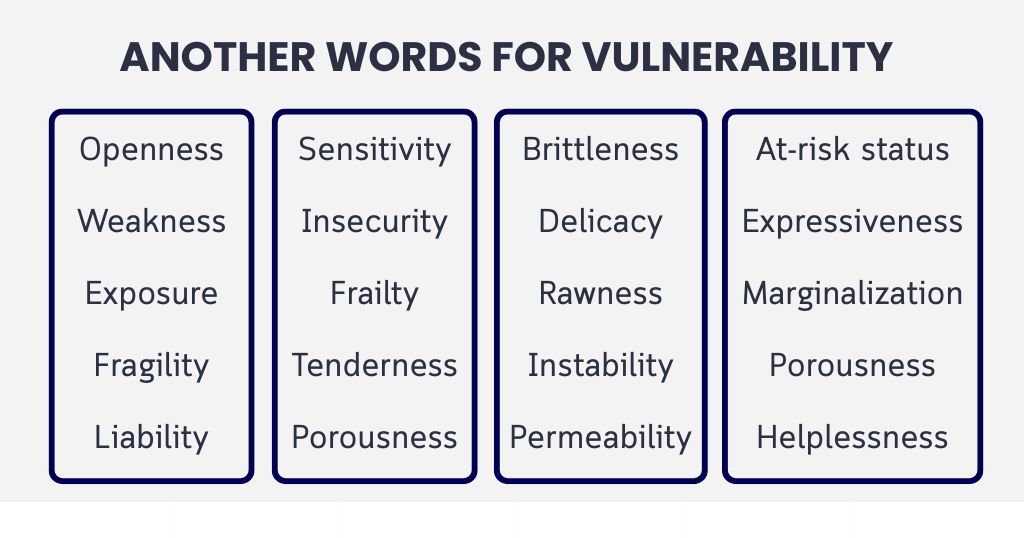
Understanding Different Shades of Meaning
Emotional Courage & Self-Disclosure
Some situations call for words that honor bravery and self-disclosure:
Openness works when someone chooses to share difficult truths. “His openness about his struggles inspired others to seek help.”
Authenticity elevates vulnerability to a virtue. Use it when someone refuses to hide behind a mask. “Her authenticity on social media attracted genuine followers.”
Transparency fits professional settings where honesty builds trust. “The company’s transparency about losses prevented rumors.”
Candidness highlights honest, direct communication. “Her candidness about the project’s risks helped the team prepare.”
These words reframe vulnerability from weakness to strength—crucial for psychology essays, leadership discussions, or stories about personal growth.
You also like it: Another Word for Division: 40+ Better Synonyms for Every Context
When Vulnerability Means Danger or Risk
Different synonyms capture threat and exposure:
Weakness identifies specific flaws that can be attacked. “The fortress had a structural weakness in the eastern wall.”
Exposure emphasizes being unprotected from harm. “The soldiers faced exposure to chemical weapons.”
Susceptibility works for medical or psychological risk. “Teens show increased susceptibility to peer pressure.”
Liability fits legal, financial, or business contexts. “The outdated equipment became a major liability.”
Exploitability describes security flaws. “The app’s exploitability made it a hacker target.”
These words carry warning tones—perfect for risk assessments, security reports, or critical analyses.
When Vulnerability Describes Fragile Systems
Some synonyms capture delicate structures that break easily:
Fragility describes systems under stress. “The economy’s fragility became clear during the recession.”
Brittleness suggests something that shatters suddenly. “The treaty’s brittleness surprised diplomats.”
Precariousness emphasizes unstable, dangerous situations. “The climbers faced the cliff’s precariousness.”
Instability describes lack of solid foundation. “Political instability drove emigration.”
Use these for academic writing about ecosystems, economies, social structures, or relationships under strain.
When Vulnerability Involves Social Position
Certain words capture unequal power dynamics:
Marginalization describes groups pushed to society’s edges. “The policy increased marginalization of immigrant communities.”
Defenselessness emphasizes lacking protection. “The refugees’ defenselessness required international intervention.”
At-risk status works in social services or public health. “The program serves children with at-risk status.”
Precariousness captures economic or social instability. “Gig workers face employment precariousness.”
These terms matter in social justice writing, policy discussions, or humanitarian contexts where dignity and accuracy both count.
Why Intensity Levels Matter More Than You Think
Not all vulnerabilities carry equal weight. Here’s how severity increases:
Mild → Moderate → Strong → Severe
Sensitivity (mild) → Susceptibility (moderate) → Weakness (strong) → Defenselessness (severe)
Example progression:
- “She has sensitivity to criticism” (easily hurt but functional)
- “He shows susceptibility to manipulation” (at risk but not helpless)
- “The system has a critical weakness” (significant danger)
- “The victims faced complete defenselessness” (no protection whatsoever)
Permeability (mild) → Porousness (moderate) → Exploitability (strong) → Fragility (severe)
Example progression:
- “The fabric has permeability to water” (allows some through)
- “The border’s porousness concerns officials” (too easily crossed)
- “The network’s exploitability attracted hackers” (actively dangerous)
- “The infrastructure’s fragility caused collapse” (broke under pressure)
Matching intensity to reality prevents exaggeration or understatement. Don’t call mild sensitivity “complete helplessness.” Don’t downgrade serious exploitability to “slight permeability.”
See How One Sentence Changes Across Four Versions
Original: “The teenager’s vulnerability made therapy challenging.”
- Positive/Growth tone: “The teenager’s openness made therapy productive.” (reframes as willingness)
- Clinical tone: “The teenager’s emotional fragility required careful intervention.” (emphasizes delicate handling)
- Strength-based tone: “The teenager’s authenticity accelerated therapeutic progress.” (celebrates honesty)
- Risk tone: “The teenager’s defenselessness against bullying necessitated protection.” (highlights danger)
Notice how each version tells a different story. The facts don’t change—the framing does.
Original: “The company’s vulnerability to cyberattacks increased.”
- Technical tone: “The network’s exploitability created security risks.” (specific, actionable)
- Business tone: “The company’s exposure to cyber threats grew.” (professional, neutral)
- Crisis tone: “The system’s critical weakness invited frequent breaches.” (urgent, alarming)
- Analytical tone: “The infrastructure’s susceptibility to attacks required assessment.” (measured, diagnostic)
Each version serves different audiences: IT teams need “exploitability,” executives need “exposure,” board members need “critical weakness.”
Original: “His vulnerability in relationships caused problems.”
- Psychology tone: “His emotional unavailability created distance.” (professional diagnosis)
- Everyday tone: “His walls kept people out.” (conversational, metaphorical)
- Positive reframe: “His unguardedness sometimes led to oversharing.” (acknowledges both sides)
- Growth tone: “His developing openness improved connections gradually.” (shows progress)
The right version depends on whether you’re writing clinical notes, giving friendly advice, or documenting personal growth.
Matching Words to Your Writing Situation: Formal vs. Casual
Best for Academic Essays
When writing formal papers, choose words that sound analytical, not emotional:
- Susceptibility (not “being hurt easily”)
- Exposure (not “being wide open”)
- Fragility (not “being breakable”)
- Liability (not “weak spot”)
- Precariousness (not “shakiness”)
Example: “Climate change increased coastal regions’ susceptibility to severe flooding events” sounds scholarly. “Climate change made beaches super vulnerable to big storms” doesn’t.
Best for Professional Writing
Business contexts need neutral, clear terms:
- Exposure works for risk discussions
- Transparency fits leadership communication
- Liability belongs in legal or compliance contexts
- Weakness works for strategic analysis
- At-risk describes populations or assets
Example: “Quarterly reports revealed the company’s exposure to supply chain disruptions.” Clear, professional, actionable.
Best for Creative or Personal Writing
Stories and memoirs need words with emotional texture:
- Rawness captures unfiltered emotion
- Tenderness suggests gentle vulnerability
- Unguardedness describes dropped defenses
- Openness feels warm and inviting
- Authenticity celebrates genuine expression
Example: “She approached her past with startling rawness, holding nothing back.” This creates intimacy that clinical terms can’t.
Words to Avoid in Formal Contexts
Some synonyms sound too casual or too judgmental for academic or professional writing:
- Helplessness sounds overly dramatic unless describing genuine powerlessness
- Frailty can seem patronizing when describing people
- Brittleness works for materials, not usually for human emotions in formal papers
- Defenselessness can sound accusatory or pitying
Choosing Language That Respects People
When Writing About People
If you’re describing individuals or groups as vulnerable, word choice affects dignity:
Better: “at-risk populations,” “individuals facing exposure,” “communities experiencing marginalization”
Avoid: “helpless people,” “weak individuals,” “defenseless victims” (unless factually accurate and respectful)
Context matters enormously. A child facing abuse genuinely experiences defenselessness. A person choosing to share feelings experiences openness, not helplessness. Don’t conflate powerlessness with courage.
Mental Health Contexts
When discussing emotional or psychological topics:
“Emotional fragility” suggests someone breaks easily—use carefully. It can sound dismissive.
“Sensitivity” is neutral to positive when describing empathy, but “oversensitivity” becomes criticism.
“Openness” or “receptiveness” honor someone’s willingness to engage emotionally.
If someone sought therapy and opened up about trauma, calling this “weakness” or “fragility” misses the courage involved. “Emotional honesty” or “vulnerability” (yes, sometimes the original word fits best) respects their choice.
Technical vs. Human Contexts
“Exploitability” fits software and security discussions perfectly but sounds dehumanizing when describing people.
“Liability” works for business risk but sounds callous when referring to individuals.
Keep technical language for technical subjects. Keep humanizing language for people.
Five Ways Writers Get This Wrong
Mistake 1: Mixing Tones Carelessly
Problem: “The patient’s exploitability to depression increased after surgery.”
Why it fails: “Exploitability” describes security flaws, not human health conditions.
Better: “The patient’s susceptibility to depression increased after surgery.”
Mistake 2: Using Positive Synonyms in Negative Contexts
Problem: “The city’s openness to flooding caused billions in damage.”
Why it fails: “Openness” sounds positive; flooding is destructive.
Better: “The city’s exposure to flooding caused billions in damage.”
Mistake 3: Overusing Strong Words
Problem: “The website’s catastrophic defenselessness against minor bugs…”
Why it fails: “Defenselessness” is too extreme for minor bugs.
Better: “The website’s susceptibility to minor bugs required patches.”
Match intensity to reality. Save strong words for genuinely severe situations.
Mistake 4: Forgetting Context Shifts Meaning
Problem: Using “weakness” when praising someone’s emotional courage.
Better: Recognize that what feels like vulnerability to the person sharing might be strength to observers. Choose words that match your intended message: “Her willingness to be open about her past showed remarkable courage.”
Mistake 5: Assuming All Synonyms Are Interchangeable
Just because two words appear in the same thesaurus entry doesn’t mean they work in the same sentence.
- “The steel beam showed brittleness” ✓ (physical property)
- “The steel beam showed defenselessness” ✗ (beams don’t have agency)
- “His authenticity was refreshing” ✓ (personal quality)
- “His exploitability was refreshing” ✗ (wrong meaning entirely)
Always check: does this word fit the specific context, not just the general concept?
Related Words That Aren’t Quite Synonyms
Resilience
This is often considered vulnerability’s opposite, but they actually work together. Resilience means bouncing back after harm; vulnerability means being open to harm in the first place. You can be both vulnerable and resilient—in fact, that combination creates healthy emotional strength.
Sensitivity
This overlaps with vulnerability but emphasizes awareness and response rather than exposure. Someone can be highly sensitive (noticing emotional nuances) without being particularly vulnerable (at risk of harm).
Risk
Risk is broader—it’s the possibility of loss or danger. Vulnerability is one factor that increases risk, but risk also involves probability, severity, and other elements. “The investment carries risk” doesn’t necessarily mean “The investment is vulnerable.”
Weakness
All vulnerabilities are weaknesses in some sense, but not all weaknesses create vulnerability. A weak argument in a debate doesn’t make you vulnerable to attack in the way a weak immune system does.
Exposure
Exposure means being unprotected or visible to potential harm. It’s very close to vulnerability but emphasizes the environmental aspect—what you’re exposed to—while vulnerability emphasizes your internal state or condition.
Fragility
Fragility specifically means breaking easily. It’s a type of vulnerability focused on structural or emotional brittleness. Not all vulnerable things are fragile—some bend without breaking.
Three Questions That Lead You to the Right Choice
When you’re revising and need to replace “vulnerability,” ask yourself three questions:
1. What tone do I need? Positive (openness, authenticity), negative (weakness, liability), or neutral (exposure, susceptibility)?
2. What’s my context? Academic essay, security report, personal story, business memo, or psychology paper?
3. What exactly am I describing? Emotional courage, system weakness, social inequality, physical frailty, or strategic risk?
The answers guide you to the precise word. A cybersecurity report needs “exploitability,” not “openness.” A therapy reflection needs “authenticity,” not “liability.” An economics paper might need “exposure,” not “fragility.”
If you’re refining your vocabulary further, explore related word guides to sharpen your phrasing even more.

I’m Rowan, a language addict who loves exploring how words work in everyday communication. I’ve spent years studying English vocabulary and helping others express themselves more clearly. My goal is simple: make learning new words easy and practical. I focus on real-life examples that show when and how to use different terms. Through clear explanations and honest guidance, I help readers choose the right words for any situation with confidence.