There is a moment when “grief” starts to feel too small. Too flat. You are trying to write something real, something that honors a weight that does not have clean edges, and the word just sits there on the page doing nothing.
Or maybe you are searching for a word because what you feel does not match what “grief” sounds like. Grief sounds quiet. What you feel is louder. Or stranger. Or older.
This guide is for both of those people. Writers looking for precision. And anyone trying to name something hard.
What Grief Really Means Before You Replace It
Grief is the internal response to loss. Not the crying at the funeral. Not the silence after. The actual interior weight that follows when something or someone is gone. It carries emotional density that words like “sadness” simply cannot hold. That is why finding the right synonym matters. The wrong word changes the entire tone of what you are trying to say.
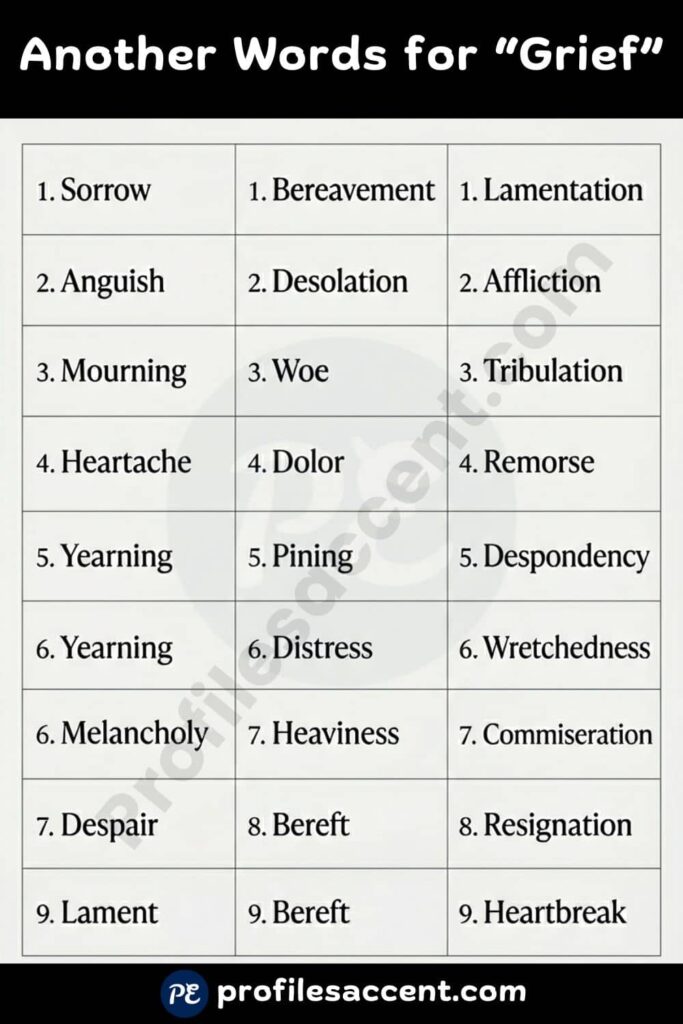
Quick 20+ Synonym Table: Another Word for Grief at a Glance
| Word | Tone | Best Used When | Short Example |
| Sorrow | Soft, formal | Loss feels deep but quiet | She carried sorrow like a second skin |
| Anguish | Intense, raw | Pain feels sharp and physical | His anguish was visible in every step |
| Bereavement | Clinical, specific | Someone has died | The bereavement left her hollow |
| Mourning | Formal, public | Grief expressed outwardly | A city in mourning after the tragedy |
| Heartache | Warm, personal | Loss of someone deeply loved | The heartache never fully left |
| Desolation | Heavy, spiritual | Total emptiness after loss | The house felt full of desolation |
| Lamentation | Loud, expressive | Grief that cannot stay silent | Her lamentation echoed through the room |
| Woe | Literary, old | Deep misfortune with injustice | A life marked by woe and hardship |
| Dolor | Poetic, rare | Slow, enduring emotional pain | His writing was steeped in dolor |
| Affliction | Weighted, burdening | Grief that feels like illness | Grief became his longest affliction |
| Yearning | Tender, longing | Missing someone still alive in memory | The yearning hit hardest at dinner time |
| Pining | Quiet, persistent | A soft continuous missing | She spent years pining for what was lost |
| Distress | Urgent, immediate | Grief mixed with panic or stress | The news sent her into visible distress |
| Tribulation | Enduring, spiritual | Grief as a prolonged trial | They endured years of tribulation |
| Remorse | Guilt-heavy | Grief tied to regret | He lived with remorse, not just sadness |
| Despondency | Sunken, passive | When grief kills motivation | A deep despondency settled over him |
| Heaviness | Physical, felt | When grief lives in the body | There was a heaviness she could not shake |
| Bereft | State of being | Immediate aftermath of loss | She was completely bereft |
| Wretchedness | Dark, broken | Total emotional collapse | The wretchedness in her eyes said everything |
| Melancholy | Slow, thoughtful | Quiet, ongoing sadness | A gentle melancholy colored her days |
| Commiseration | Shared, collective | Grief felt together | Their commiseration brought unexpected comfort |
| Resignation | Quiet, accepted | Grief that has settled into acceptance | He spoke with the resignation of someone done fighting |
| Despair | Deep, philosophical | When hope is fully lost | The despair was too thick to speak through |
| Lament | Expressive, literary | A voiced or written cry of grief | The poem was a lament for his father |
| Heartbreak | Intimate, shattering | Loss of a loved one, especially close | The heartbreak came in waves |
The Type of Loss Changes the Word: Grief Is Not One Thing
Not all grief looks the same. This is the part most synonym lists skip entirely.
The grief of a sudden loss feels like a cut, not a bruise. It is sharp, disorienting, and physical. Words like anguish, lamentation, or laceration (figuratively speaking) come closer than anything gentle.
The grief of a slow loss, watching someone fade over months or years, carries a different texture. Heaviness, pining, and desolation live in this space. There is no shock. Just the long weight of knowing.
The grief of regret is its own category. Losing someone while carrying unfinished words or unmended relationships. Remorse and tribulation hold this better than “sadness” ever could.
The grief of a place or era, the feeling that a version of your life is gone forever, has a Welsh word that English cannot fully match: Hiraeth. It mixes grief with nostalgia, loss with beauty. There is sweetness in it, which makes it harder, not easier.
Collective grief, when a community loses together, is commiseration. It is shared weight, which makes it both heavier and, somehow, more bearable.
How Heavy Is the Word? A Tone Scale for Grief Synonyms
If you are writing and need to calibrate emotional weight, here is a loose scale.
- Mild: Wistfulness, melancholy, pining
- Moderate: Sorrow, heartache, yearning, despondency
- Strong: Anguish, lamentation, affliction, bereft
- Extreme: Despair, wretchedness, desolation, devastation
The difference between melancholy and despair is enormous in a sentence. Melancholy is a candle burning low. Despair is the room going dark. Choose based on what the moment actually needs.
Same Sentence, Different Word: See the Difference Yourself
Here are real rewrites showing how synonym choice reshapes tone.
Original: He felt grief after his father died.
- Formal: His bereavement after losing his father reshaped everything he knew about himself.
- Casual: The heartache hit him in small moments, not the big ones.
- Creative: Something like desolation moved into his chest and never fully unpacked.
- Academic: The subject reported profound anguish consistent with complicated loss.
Original: She was grieving over her old life.
- Formal: She experienced a deep sense of loss for the life she had left behind.
- Casual: There was a quiet pining for who she used to be.
- Creative: It was less grief, more hiraeth, a longing for a version of herself she could not revisit.
Each rewrite shifts not just the word but the reader’s emotional position. That is the real work of a synonym.
Grief Synonyms for the Right Setting: Formal, Casual, and Creative
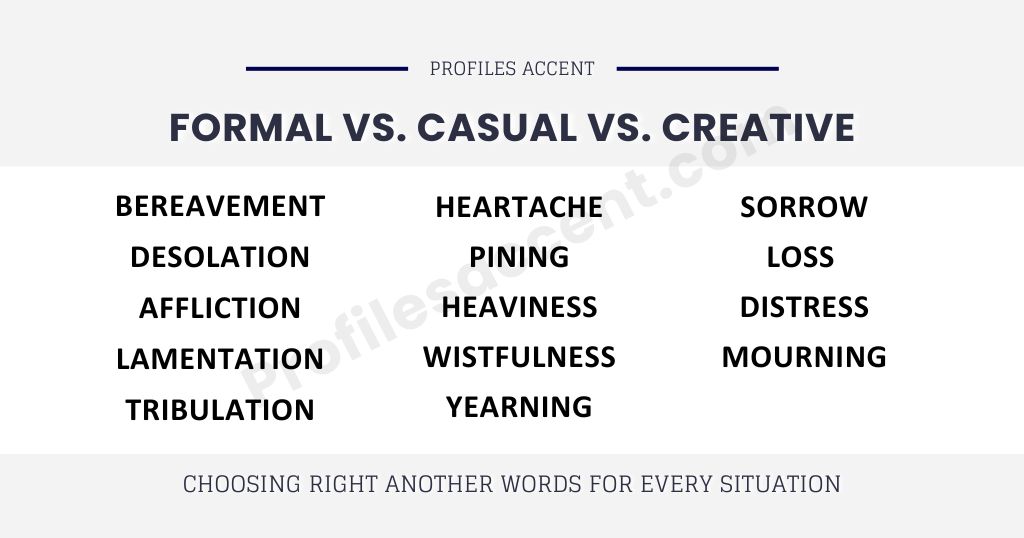
Use in essays or academic writing: Bereavement, desolation, affliction, lamentation, tribulation
Use in personal writing or storytelling: Heartache, pining, heaviness, wistfulness, yearning
Use in professional or sensitive communication: Sorrow, loss, distress, mourning
Avoid in formal contexts: Wretchedness (too theatrical), woe (sounds archaic), dolor (too obscure for general readers)
Words That Feel Like Grief Synonyms But Will Mislead You
This is where most writers make real mistakes.
Grief vs. Mourning
Grief is internal. Mourning is external. You grieve privately. You mourn publicly, at a service, with a community. They overlap but they are not the same.
Sorrow vs. Despair
Sorrow can coexist with hope. Despair cannot. If your character still has something to hold onto, they feel sorrow. If everything is gone, despair.
Heartbreak vs. Anguish
Heartbreak is intimate. It belongs to close personal bonds. Anguish is broader and more physical. A soldier feels anguish. A widower feels heartbreak. Both are valid, both are very different in a sentence.
Bereavement vs. Bereft
Bereavement is the condition. Bereft is the state of being. “She is bereft” means she has had something taken. “She is in bereavement” means she is in the period following death. Do not swap them casually.
Melancholy vs. Depression
In writing, melancholy implies a slow, often beautiful sadness with reflective quality. It is not a clinical term. Depression is. Be careful using either loosely when discussing real mental health.
Writing About Real Loss: When to Slow Down and Choose Carefully
Grief is not just a literary concept. When writing about real loss, especially in professional or support contexts, word choice carries weight.
Avoid using despair or wretchedness in direct communication with someone who is grieving. These words, while accurate emotionally, can amplify pain rather than acknowledge it. Words like sorrow, loss, and pain stay more open.
Bereavement is appropriate in formal and clinical settings. It is specific and respectful. In personal letters or messages, heartache or sorrow feel warmer.
If you are writing about grief that touches on trauma, addiction, or mental illness, the word affliction may unintentionally medicalize the experience. Use it carefully.
Words That Sit Opposite Grief (And Actually Useful Ones)
Most lists give you joy or happiness. Those are technically correct and practically useless for writers.
The more useful opposites:
Resilience – not the absence of grief but the active capacity to move through it. If you are writing a character who is healing, resilience is the right frame.
Solace – the direct counterpart to grief in emotional writing. Where grief empties, solace fills.
Peace – grief resolved. Not forgotten, but no longer cutting. A character who finds peace has not lost the memory. They have changed their relationship with it.
Serenity – a step beyond peace. Emotional stillness that grief cannot easily break.
Words That Live Near Grief Without Meaning the Same Thing
Trauma – grief’s deeper, more complex cousin. Trauma lingers in the body in ways grief does not always.
Nostalgia – grief’s gentler relative. Nostalgia misses the past without the full weight of loss.
Longing – grief that is still reaching toward something. It has not surrendered yet.
Absence – the physical and emotional space that loss leaves behind. Sometimes the most honest word of all.
The Takeaway
The word you choose shapes how much the reader feels. Sorrow and anguish are not interchangeable. Mourning and grief point in different directions. Bereft hits harder than sad in almost every sentence.
Before you default to “grief,” ask: is this quiet or loud? Physical or philosophical? Shared or private? Is there anger in it? Regret? Longing?
The answer will tell you the exact word you are looking for.
Discover More Articles

I’m Rowan, a language addict who loves exploring how words work in everyday communication. I’ve spent years studying English vocabulary and helping others express themselves more clearly. My goal is simple: make learning new words easy and practical. I focus on real-life examples that show when and how to use different terms. Through clear explanations and honest guidance, I help readers choose the right words for any situation with confidence.