You’ve written the word “throughout” three times in two paragraphs. You notice it. Your reader notices it too. But when you open a thesaurus, you get a jumbled pile of options with zero guidance on which one actually fits your sentence.
That’s the real problem. Not finding a replacement. Finding the right one.
“Throughout” does two very different jobs. Sometimes it talks about time. Sometimes it talks about space. Mix those up, and even a well-written sentence falls apart. This guide cuts through the noise and gives you a word for every situation you’ll actually face.
What “Throughout” Actually Means (And Why It’s Tricky to Replace)
It signals complete coverage. No gaps. No exceptions. Whether that’s a place (“signs were posted throughout the building”) or a stretch of time (“she stayed calm throughout the trial”), the word means: from one end to the other, nothing left out.
That completeness is what makes it hard to replace casually. A weaker synonym changes the meaning. The goal here is to match that same sense of total coverage, just with fresher language.
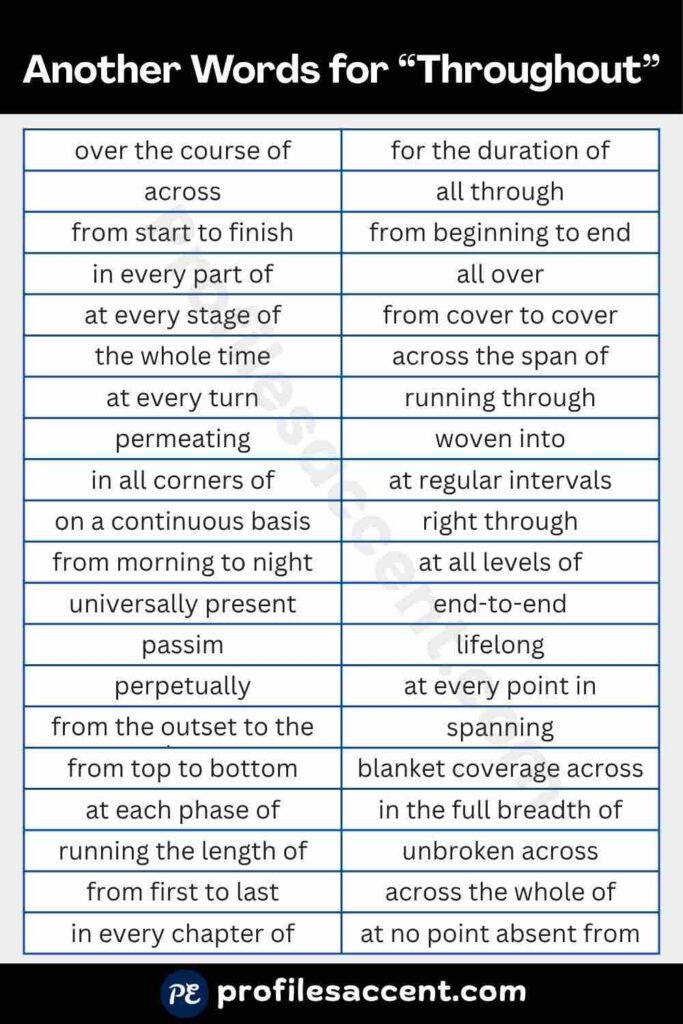
Another Word for Throughout: 45+ Quick Throughout Synonyms Table
Here are 45+ alternatives, organized by context so you can find the right fit fast.
| Word / Phrase | Tone | Best For | Example |
| over the course of | neutral/formal | time periods | over the course of the project |
| for the duration of | formal | extended time | for the duration of the trial |
| across | neutral | space, regions | across all departments |
| all through | casual | time and space | all through the night |
| from start to finish | conversational | narratives, stories | gripping from start to finish |
| from beginning to end | neutral | processes, stories | consistent from beginning to end |
| in every part of | clear, direct | physical spaces | in every part of the building |
| all over | casual | locations | all over the country |
| at every stage of | formal | life, careers, growth | at every stage of her career |
| from cover to cover | vivid | books, reading | read it from cover to cover |
| the whole time | conversational | time, situations | he was nervous the whole time |
| across the span of | formal | time, careers | across the span of two decades |
| at every turn | literary | stories, journeys | challenges appeared at every turn |
| running through | literary | themes, ideas | a motif running through the text |
| permeating | strong/vivid | themes, emotions | anxiety permeating every chapter |
| woven into | literary | stories, ideas | loss woven into the fabric of the story |
| in all corners of | emphatic | large spaces | visible in all corners of the city |
| at regular intervals | technical | repeated events | hydrate at regular intervals |
| on a continuous basis | formal | professional writing | reviewed on a continuous basis |
| right through | direct | emphasis | slept right through the storm |
| from morning to night | vivid | daily life | on her feet from morning to night |
| at all levels of | professional | organizations | applied at all levels of the company |
| universally present | academic | research, analysis | the pattern was universally present |
| end-to-end | technical/business | systems, processes | audited the system end-to-end |
| passim | academic | citations, texts | this theme appears passim |
| lifelong | concise | life contexts | a lifelong commitment |
| perpetually | formal | ongoing states | perpetually striving forward |
| at every point in | precise | timelines | at every point in the process |
| from the outset to the close | literary/formal | narratives | tension held from the outset to the close |
| spanning | neutral | time, distance | spanning three decades |
| from top to bottom | vivid | structures, systems | reviewed from top to bottom |
| blanket coverage across | business | policy, reach | blanket coverage across all regions |
| at each phase of | formal | projects, life | addressed at each phase of development |
| in the full breadth of | emphatic | scope, coverage | captured in the full breadth of the work |
| running the length of | vivid | physical objects | a scar running the length of his arm |
| unbroken across | formal | continuity | standards unbroken across ten years |
| from first to last | literary | stories, experiences | captivating from first to last |
| across the whole of | emphatic | time and place | consistent across the whole of the study |
| in every chapter of | literary | books, life metaphors | grief appears in every chapter of the memoir |
| at no point absent from | academic | analysis | the tension is at no point absent from the text |
Time or Place? The Split That Breaks Most Throughout Synonyms
This is where writers go wrong. “Throughout” works in two lanes, and its replacements don’t always cross between them.
When “throughout” means time:
The focus is on duration. Something that started and didn’t stop until the end. Words like for the duration of, from start to finish, spanning, and over the course of belong here. They carry that same sense of completeness across a time frame.
Don’t use all over or across here. “She stayed calm all over the meeting” sounds wrong because those words live in the space lane.
When “throughout” means space:
Now you’re talking about physical coverage. A place. A region. An object. Words like across, all over, in every part of, and in all corners of work cleanly. They signal that nothing was missed, no area was left out.
Don’t drag for the duration of into spatial sentences. It simply doesn’t fit.
A quick test: ask yourself, “Is this about time passing or about a place being covered?” That one question will eliminate half your bad choices immediately.
How Strong Is Your Throughout Synonym? An Intensity Scale
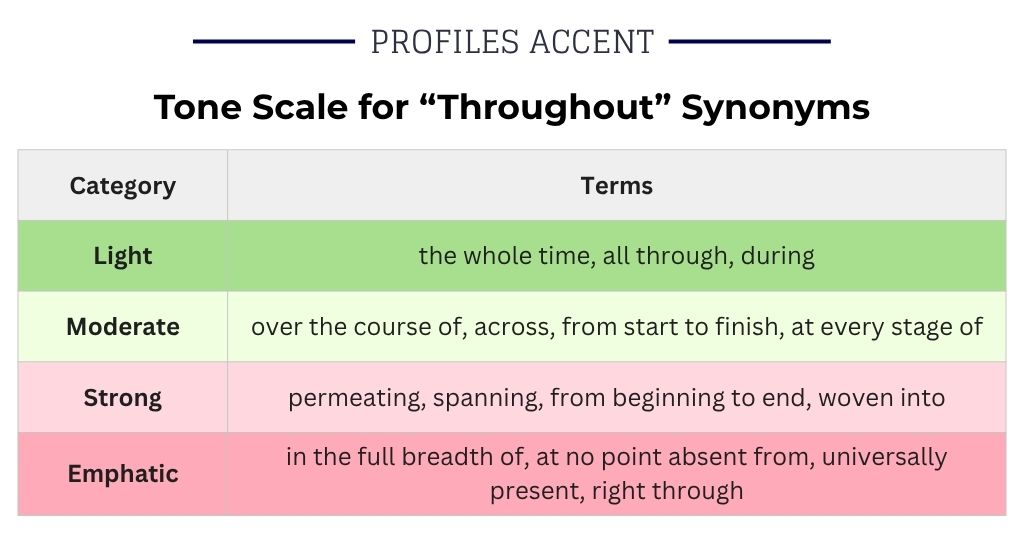
Not every synonym carries the same weight. Here’s how they land on the scale from mild to strong:
- Light: the whole time, all through, during
- Moderate: over the course of, across, from start to finish, at every stage of
- Strong: permeating, spanning, from beginning to end, woven into
- Emphatic: in the full breadth of, at no point absent from, universally present, right through
When you’re writing something casual, reaching for an emphatic phrase makes your writing sound stiff. When you’re writing something formal or literary, staying in the “light” zone makes it feel thin. Match the weight of your word to the weight of your sentence.
Synonyms for Throughout in Action: Real Sentence Rewrites
These rewrites use the same idea but shift the tone based on word choice.
Original: “She worked hard throughout her career.”
- Formal: “She maintained consistent effort across the span of her career.”
- Conversational: “She worked hard the whole time, from her first job to her last.”
- Literary: “Dedication ran like a thread through every chapter of her working life.”
- Professional: “Her commitment remained strong at every stage of her professional journey.”
Original: “Tension appeared throughout the novel.”
- Academic: “Tension permeates the text, present at no point absent from its structure.”
- Casual: “The tension never really lets up from beginning to end.”
- Literary: “A current of unease runs through the novel from its opening lines to its final page.”
Original: “He checked his phone throughout the day.”
- Neutral: “He checked his phone at regular intervals all day.”
- Vivid: “From morning to night, his phone rarely left his hand.”
Notice how permeates hits harder than appears throughout. And from morning to night paints a picture that “throughout the day” simply doesn’t.
The Best Throughout Synonyms for Essays and Academic Writing
If you’re writing a research paper or formal essay, your synonym choices matter more than anywhere else. “Throughout” is actually acceptable in academic writing. But when it appears four times in a single page, you need alternatives.
Good academic swaps:
- For the duration of signals formal precision.
- Passim appears in citations only. It means an idea shows up in multiple places across a source. You’d write “see Smith (2021), passim” to signal the idea isn’t tied to one page.
- Permeates or pervades works as a verb when you’re analyzing a text. “This conflict pervades the novel” is stronger than “this conflict is found throughout the novel.”
- Universally present and at no point absent from work well in analytical writing when you want to emphasize that something holds true without exception.
One thing to avoid in academic writing: slang alternatives. Phrases like “wall-to-wall” or “the whole shebang” belong in conversation, not in a thesis.
Another Word for Throughout in Life, Career, and Story Contexts
- Another word for throughout life: Use at every stage of life, across a lifetime, or lifelong (when it’s a noun phrase like “a lifelong habit”). From cradle to grave works in literary or reflective writing.
- Another word for throughout my career: Try over the span of my career, at every point in my professional life, or across my years in the field. These sound natural in a resume, cover letter, or LinkedIn bio.
- Another word for throughout the story / book: Use running through the narrative, woven into the text, from cover to cover, or permeating the work. These feel like real literary language, not just synonyms.
- Another word for throughout the day: From morning to night, at regular intervals, across the day, or the whole day through all work depending on whether the action was constant or repeated.
Another Word for Throughout Starting with R: The Honest Answer
Here’s the honest answer:
There’s no single-word synonym for “throughout” that starts with R. What exists are related options depending on your sentence:
- Right through is the closest prepositional match. “He slept right through the ceremony” mirrors “he slept throughout the ceremony.”
- Relentlessly fits when something happened continuously from start to end, but it adds a quality of intensity that “throughout” doesn’t carry.
- Recurring works when something showed up repeatedly across a timeline. “A recurring theme” captures what “a theme throughout the work” means.
Match the R word to your actual sentence, not just to the desire to start with that letter.
Three Mistakes Writers Make When Replacing Throughout
Swapping “throughout” for “during” without thinking. They aren’t the same.
- “I was anxious during the speech” means at some point during it.
- “I was anxious throughout the speech” means from the first word to the last.
That gap in meaning matters.
Using “all the time” as a direct swap. “All the time” implies constant, unbroken action. “Throughout the meeting” just means at various points within it. They feel similar but they’re not equal.
Picking formal words for casual sentences. “For the duration of our road trip” sounds stiff. “All through the trip” sounds natural. Register matters.
Words Related to Throughout (And How They Differ)
- Consistently – Focuses on uniformity, not coverage. Use it when the quality stayed the same, not when the presence was complete.
- Persistently – Implies effort or continuation against resistance. “She persistently showed up” is not the same as “she showed up throughout.”
- Comprehensively – About thoroughness, not time or space. Good for coverage of a topic, not a location or period.
- Continuously – Means without interruption. “Throughout” allows for small gaps. “Continuously” does not.
- Universally – Means across all people or groups. It’s a synonym only in very specific cases, such as “universally applied.”
Choosing the Right Throughout Synonym: Final Guidance
Before you pick a synonym, answer two things: Is this about time or place? And what tone does your sentence need?
- Time plus formal writing: for the duration of, over the course of, spanning.
- Space plus vivid writing: in every corner of, running the length of, all over.
- Literary or story analysis: permeates, woven into, at every turn.
- Career and life writing: at every stage of, across the span of, lifelong.
That’s the whole decision. Pick the lane, match the tone, and your sentence will be sharper for it.
Discover More Articles:

I’m Rowan, a language addict who loves exploring how words work in everyday communication. I’ve spent years studying English vocabulary and helping others express themselves more clearly. My goal is simple: make learning new words easy and practical. I focus on real-life examples that show when and how to use different terms. Through clear explanations and honest guidance, I help readers choose the right words for any situation with confidence.