Your professor circles it in red. Your editor flags it. Even you, reading your own draft, feel a quiet cringe when you see it sitting there at the top of your final paragraph: In conclusion.
It is not wrong. It is just tired. Overused to the point where readers skim past it before your actual point even lands. The problem is not the phrase itself. The problem is that most writers reach for it on autopilot, without asking whether it actually fits the moment.
Choosing the right closing phrase changes how your writing feels. It controls whether you sound like a confident researcher, a sharp professional, or someone who just finished their high school essay. This guide gives you real alternatives, organized by situation, with honest guidance on when each one works and when it does not.
What Does “In Conclusion” Really Signal to Your Reader?
It signals one thing: this is where everything wraps up. It tells the reader to prepare for a final thought, a summary, or a call to action. The emotional weight is neutral. The tone is formal-to-neutral. And its biggest weakness is that it has no personality. It does not tell your reader whether you are summarizing evidence, making a last appeal, or landing a philosophical point.
That is where the alternatives below earn their place.
Quick Table: Synonyms for “In Conclusion” Organized by Tone and Use
| Phrase | Tone | Best For | Quick Example |
| Ultimately | Formal/Neutral | Essays, arguments | Ultimately, the data supports early intervention. |
| In summary | Formal | Reports, research | In summary, three key factors shaped the outcome. |
| To sum up | Semi-formal | Presentations, blogs | To sum up, the plan needs revision. |
| All things considered | Neutral | Balanced arguments | All things considered, both sides have merit. |
| On the whole | Neutral | General writing | On the whole, the project succeeded. |
| In essence | Formal | Distilling a core idea | In essence, trust drives every sale. |
| As the evidence shows | Academic | Research papers | As the evidence shows, early screening saves lives. |
| Taking everything together | Academic | Essays, case studies | Taking everything together, the pattern is clear. |
| The core takeaway is | Professional | Business writing | The core takeaway is cost reduction. |
| To bring this full circle | Creative/Formal | Storytelling, speeches | To bring this full circle, we return to where we began. |
| At its heart | Reflective | Opinion pieces | At its heart, this is a question of fairness. |
| When all is said and done | Conversational | Casual writing | When all is said and done, effort matters most. |
| To close | Semi-formal | Speeches, emails | To close, I want to thank the team. |
| In closing | Formal | Presentations, letters | In closing, this report recommends immediate action. |
| The final point is | Direct | Structured essays | The final point is often the most overlooked. |
| What this tells us | Analytical | Academic, research | What this tells us is that assumptions were wrong. |
| Drawing from all of this | Analytical | Case studies | Drawing from all of this, one solution stands out. |
| Looking at the full picture | Balanced | Reports, analysis | Looking at the full picture, risks outweigh rewards. |
| To put it plainly | Casual/Clear | Blog posts, opinions | To put it plainly, the system is broken. |
| In short | Informal | Quick summaries | In short, it did not work. |
| To wrap this up | Casual | Blog posts, talks | To wrap this up, here is what to do next. |
| At the end of the day | Conversational | Informal writing | At the end of the day, results speak loudest. |
| As a final thought | Reflective | Speeches, essays | As a final thought, kindness costs nothing. |
| The bottom line | Professional | Business, finance | The bottom line is profitability dropped. |
| What stands out most | Emphasis-driven | Analysis, opinion | What stands out most is the speed of change. |
| By extension | Academic | Research, philosophy | By extension, these findings apply globally. |
| In the grand scheme | Reflective | Big-picture writing | In the grand scheme, small habits win. |
| On balance | Analytical | Reports, debates | On balance, the benefits are greater. |
| To state it simply | Clarity-focused | Explainers, guides | To state it simply, less is more. |
| Stepping back | Reflective | Analysis | Stepping back, the trend becomes obvious. |
| This all points to | Logical | Research writing | This all points to a need for reform. |
| What emerges clearly | Analytical | Academic, essays | What emerges clearly is a gap in policy. |
| To seal the argument | Persuasive | Debates, essays | To seal the argument, consider the numbers. |
| The evidence points to | Research-driven | Academic papers | The evidence points to a single cause. |
| To leave you with this | Personal | Speeches, storytelling | To leave you with this: change starts small. |
| After weighing all of this | Balanced | Reports, opinions | After weighing all of this, one path makes sense. |
| With all of this in mind | Forward-looking | Proposals, plans | With all of this in mind, we recommend a pilot program. |
| The larger truth is | Philosophical | Opinion, essays | The larger truth is that systems resist change. |
| Pulling it all together | Practical | Guides, tutorials | Pulling it all together, here is the process. |
| So, where does this leave us? | Engaging | Speeches, blogs | So, where does this leave us? Hopeful but cautious. |
| This makes one thing clear | Confident | Research, argument | This makes one thing clear: the old model failed. |

Same Phrase, Different Jobs: How Closing Words Split Into Meaning Groups
Writers often treat these phrases as identical. They are not. Each one does a slightly different job.
Phrases that summarize what you already said:
“In summary,” “To sum up,” and “Pulling it all together” are backward-looking. They recap. Use them when your reader needs a quick mental review before the article ends.
Phrases that point to a single big truth:
“Ultimately,” “At its heart,” and “The larger truth is” do something different. They do not recap. They extract. They lift one essential idea from everything you wrote and present it as the lasting takeaway.
Phrases that build toward action:
“With all of this in mind,” “What this tells us,” and “This makes one thing clear” feel forward-looking. They do not close the door. They push the reader toward a next step.
Phrases that feel personal or warm:
“To leave you with this,” “As a final thought,” and “To bring this full circle” carry emotional weight. They suit speeches, personal essays, and reflective writing where connection matters more than logic.
Using a backward-looking phrase when your conclusion is actually a call to action is one of the most common structural mistakes in writing. The phrase and the purpose must match.
From Gentle to Forceful: A Tone Scale for “In Conclusion” Alternatives
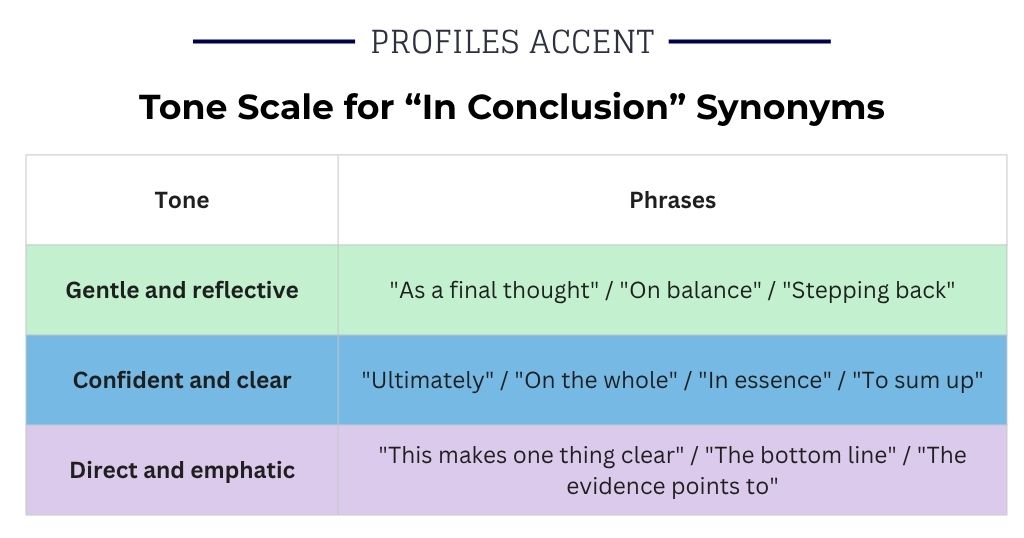
Some closing phrases are soft. Others land hard. Here is how they sit on the spectrum:
- Gentle and reflective: “As a final thought” / “On balance” / “Stepping back”
These ease the reader toward the end. Good for sensitive topics or balanced arguments where you do not want to sound forceful.
- Confident and clear: “Ultimately” / “On the whole” / “In essence” / “To sum up”
These feel settled and assured. No aggression, but no hesitation either.
- Direct and emphatic: “This makes one thing clear” / “The bottom line” / “The evidence points to”
These hit with weight. Use them when your conclusion is a firm verdict, not an open question.
- Engaging and conversational: “So, where does this leave us?” / “To put it plainly” / “When all is said and done”
These keep the reader in the conversation rather than announcing the end. Great for blogs and spoken presentations.
Sentence Rewrites Using Other Ways to Say “In Conclusion”
Here is where theory becomes practical. Take one weak sentence and watch how the phrase transforms the entire tone.
Original (flat and generic): In conclusion, social media affects mental health in young people.
- Academic tone: What the research consistently shows is a measurable correlation between heavy social media use and declining emotional wellbeing in adolescents.
- Professional tone: The bottom line is that unmonitored platform use among teens carries real psychological costs that businesses and schools can no longer ignore.
- Reflective/essay tone: At its heart, this is not a technology problem. It is a question of what we decide to value in the years our children are still forming who they are.
- Conversational/blog tone: So, where does this leave us? Aware of the problem, armed with the research, and responsible for doing something about it.
Notice how the same idea lands completely differently. The phrase sets the entire emotional register for your final thought.
Formal or Casual? Matching Your “In Conclusion” Synonym to the Right Context
For academic essays and research papers:
- Reach for “As the evidence shows,” “Taking everything together,” “What this tells us,” or “By extension.” These phrases respect the formal register without sounding stiff.
For business reports and professional emails:
- “The core takeaway is,” “With all of this in mind,” and “The bottom line” work well. They are direct. They respect the reader’s time.
For blog posts and casual writing:
- “To wrap this up,” “To put it plainly,” and “In short” fit naturally. They match the conversational flow most online readers expect.
Phrases to keep out of formal academic writing:
- “At the end of the day,” “When all is said and done,” and “Long story short” will weaken an academic argument. Professors and reviewers notice these immediately as a tone mismatch.
The Pro-Level Trick: Concluding Without Any Transition Phrase at All
Here is something most articles will not tell you. The most skilled writers often conclude without any transitional phrase at all.
Instead of announcing that the end has arrived, they simply let the final sentence carry that weight structurally. The verb choice, the scope of the statement, and the rhythm of the sentence signal closure without a label.
Compare these two:
With a signpost: “In conclusion, consistent practice is what separates good writers from great ones.”
Without a signpost: “Writers who show up daily, even when the draft is bad, are the ones who eventually produce something worth reading.”
The second version does not need to announce itself. The language does the work. This takes more skill, but it creates a much cleaner, more confident ending.
Mistakes Writers Make When Swapping Out “In Conclusion”
Mixing tone levels without noticing. Using “In a nutshell” in a graduate thesis or “As has been demonstrated” in a casual blog creates friction. Your reader feels it even if they cannot name it.
Choosing a summary phrase when you need an insight phrase. “In summary” tells people you are about to repeat yourself. If your conclusion contains a new insight rather than a recap, that phrase actually undersells your ending.
Using “Finally” when nothing has been listed. “Finally” implies a sequence. If your conclusion is not the last item in a numbered list, this word confuses structure. Use “Ultimately” or “As a closing thought” instead.
Stacking phrases. Writing “To wrap things up, in summary, the bottom line is…” is a real thing people do. One closing phrase is enough. Two sends the message that you are not sure how to land the plane.
Words That Live Near “Conclusion”: Related Terms Worth Knowing
- Culmination (noun): Use in place of the word “conclusion” when referring to a high point or final achievement. “The project reached its culmination in the third quarter.”
- Resolution (noun): Signals a problem has been solved. Better than “conclusion” when closure involves a decision. “The dispute found its resolution in mediation.”
- Synthesis (noun): Specifically means combining separate ideas into one coherent whole. Useful in academic and analytical writing.
- Verdict (noun): Carries a tone of judgment. Good for argumentative writing, reviews, and opinion pieces where you are declaring a winner or an outcome.
So Which One Should You Actually Use? A Fast Decision Guide
Ask yourself three quick questions before writing your closing phrase.
First: Am I summarizing, or am I landing a final insight? Summary phrases look backward. Insight phrases extract meaning.
Second: What is my writing context? Academic, professional, casual, or creative? The context narrows your choices fast.
Third: Does my conclusion need warmth, authority, or clarity? Warmth needs reflective phrases. Authority needs direct ones. Clarity needs simple, clean options.
Match those answers to the table above, and you will find the right phrase in under a minute. The goal is not to sound sophisticated. The goal is to make your reader feel that the ending was earned, and that it meant something.
Discover More Articles:

I’m Rowan, a language addict who loves exploring how words work in everyday communication. I’ve spent years studying English vocabulary and helping others express themselves more clearly. My goal is simple: make learning new words easy and practical. I focus on real-life examples that show when and how to use different terms. Through clear explanations and honest guidance, I help readers choose the right words for any situation with confidence.