You probably don’t think twice about the word “is.” It just sits there, doing its quiet job. But open any first draft and you’ll see it everywhere. “The result is important.” “The problem is widespread.” “She is confident.”
Nothing is technically wrong with those sentences. But nothing is memorable about them either. The verb “to be” in all its forms, especially “is,” has a way of draining energy from your writing without you noticing. The fix isn’t always swapping one word for another. Sometimes it’s rethinking the sentence entirely.
This guide will show you both approaches.
What “Is” Actually Does
“Is” is the third-person singular present tense of the verb to be. Grammatically, it functions as a linking verb, connecting a subject to a description, identity, or state. It carries almost no emotional weight on its own.
That’s the problem. It’s neutral to the point of being invisible. Your writing deserves something more precise.
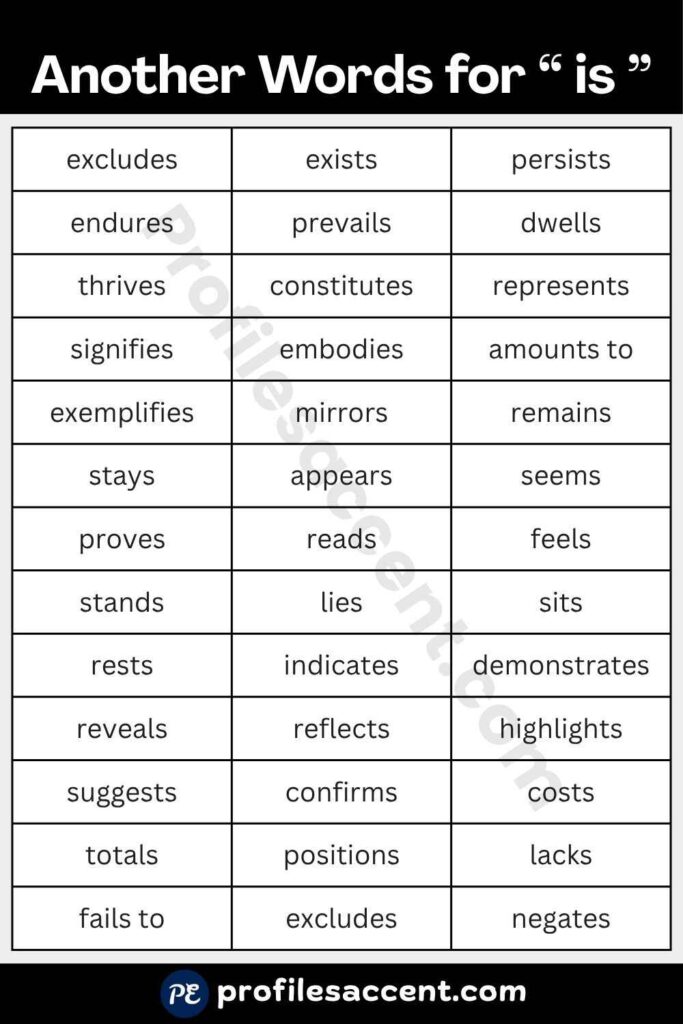
Another Word for Is: 40+ Quick Synonym Table
| Word / Phrase | Tone | Best Used When | Example |
| exists | Neutral | Stating something is present or real | “A gap exists between policy and action.” |
| persists | Emphatic | Something continues despite resistance | “The confusion persists across teams.” |
| endures | Literary | Long-lasting presence | “Her legacy endures decades later.” |
| prevails | Formal | Something dominant or victorious | “Skepticism prevails among analysts.” |
| dwells | Literary | Abstract or poetic existence | “Hope dwells in unexpected places.” |
| thrives | Vivid | Active, growing presence | “Innovation thrives in open environments.” |
| constitutes | Formal | Defining something precisely | “This constitutes a breach of trust.” |
| represents | Neutral | Standing in for something larger | “This figure represents total revenue.” |
| signifies | Formal | Symbolic meaning | “The shift signifies a new direction.” |
| embodies | Literary | Something personifying a quality | “She embodies resilience.” |
| amounts to | Neutral | Summing up what something equals | “This amounts to a policy failure.” |
| exemplifies | Formal | Showing a quality by example | “This case exemplifies the pattern.” |
| mirrors | Creative | Reflecting or paralleling something | “Her progress mirrors the industry trend.” |
| remains | Neutral | Unchanged state continuing | “The outcome remains uncertain.” |
| stays | Casual | Informal persistence | “The team stays motivated.” |
| appears | Neutral | Observation or perception | “The solution appears straightforward.” |
| seems | Casual | Tentative personal impression | “This approach seems workable.” |
| proves | Strong | Confirmed after testing or experience | “The method proves effective under pressure.” |
| reads | Creative | Perceived tone or impression | “The tone reads as defensive.” |
| feels | Casual | Sensory or emotional state | “The atmosphere feels tense.” |
| stands | Neutral | Physical or symbolic position | “The building stands at the edge of town.” |
| lies | Neutral | Position, often geographic | “The village lies south of the river.” |
| sits | Casual | Informal placement | “The café sits between two bookshops.” |
| rests | Literary | Stillness or final placement | “The decision rests with the board.” |
| indicates | Formal | Pointing to evidence | “The data indicates a steady decline.” |
| demonstrates | Formal | Showing proof or evidence | “This demonstrates the scale of the problem.” |
| reveals | Emphatic | Uncovering something hidden | “The audit reveals systemic gaps.” |
| reflects | Neutral | Mirroring or showing something | “This decision reflects broader values.” |
| highlights | Neutral | Drawing attention to a point | “The report highlights key risks.” |
| suggests | Neutral | Implying without asserting firmly | “The pattern suggests a deeper cause.” |
| confirms | Strong | Verified or settled conclusion | “Testing confirms the hypothesis.” |
| costs | Neutral | Price or financial value | “The subscription costs $12 per month.” |
| totals | Neutral | Sum of parts | “The budget totals $2.4 million.” |
| positions | Formal | Market or strategic stance | “The brand positions itself as premium.” |
| lacks | Neutral | Absence of a quality | “The plan lacks clarity.” |
| fails to | Emphatic | Not meeting a standard | “The proposal fails to address cost.” |
| excludes | Formal | Something left out or omitted | “The policy excludes contract workers.” |
| negates | Formal | Cancelling out a prior point | “This negates the earlier gains.” |
Four Ways “Is” Functions — and the Right Synonym for Each
Most synonym lists throw 50 words at you and call it a day. The problem is that “is” doesn’t have one meaning. It has at least four, and each one needs a different kind of replacement.
When it shows existence: You’re saying something is present, real, or active. Words like exists, persists, and thrives work here because they carry a sense of ongoing reality. “The bottleneck is in procurement” becomes “The bottleneck persists in procurement” and suddenly you feel the friction.
When it defines or identifies: Here, “is” acts as an equals sign. You’re telling the reader what something means or represents. This is where constitutes, signifies, and embodies earn their place. “This is a step backward” shifts to “This constitutes a step backward” and the weight of the word does real work.
When it describes a state or condition: “She is nervous.” “The market is volatile.” These are observations. You can soften them (seems, appears) or confirm them (proves, reads as) depending on how certain you want to sound. That tonal choice matters more than most writers realize.
When it marks location: “The archive is in the basement.” Here, lies, sits, stands, and rests give the location a texture. “The archive sits in the basement” is subtler but more vivid.
Identifying which function “is” is serving is step one. Only then can you choose the right replacement.
How Strong Is Your Replacement of Is? An Intensity Scale

Not all replacements carry equal weight. Here’s how intensity builds from gentle to forceful:
- Mild: seems, appears, feels — these hedge. They suggest rather than declare.
- Moderate: remains, exists, reflects, suggests — these are neutral and steady.
- Grounded: represents, indicates, demonstrates, constitutes — these assert with authority.
- Emphatic: persists, proves, confirms, reveals — these push the reader to take notice.
- Vivid: thrives, embodies, exemplifies, prevails — these carry weight, texture, and energy.
Choosing the wrong level for your context is just as problematic as leaving “is” in place. An academic paragraph that says the evidence “feels conclusive” reads as uncertain. A casual email that says the schedule “constitutes an operational bottleneck” reads as stiff.
Synonyms for “Is” in Action: Before and After Rewrites
Here are four weak sentences transformed across different tones.
Original: “The data is important for understanding the trend.”
- Formal: “The data proves essential for understanding the trend.”
- Academic: “The data demonstrates the underlying trend with precision.”
- Casual: “This data really gets at what’s driving the trend.”
- Creative: “Within this data, the trend reveals itself.”
Each version changes how the reader experiences the sentence. The formal and academic versions add credibility. The casual one feels accessible. The creative one gives the data a sense of discovery.
Original: “She is a strong leader.”
- Formal: “She exemplifies strong leadership at every level.”
- Academic: “Her conduct demonstrates consistent leadership capacity.”
- Casual: “She just knows how to lead.”
- Creative: “Leadership doesn’t follow her around. She carries it.”
Notice how the creative rewrite drops the linking verb entirely. Sometimes omission is the best synonym.
Original: “The problem is poor communication.”
- Formal: “Poor communication constitutes the core of the problem.”
- Academic: “The problem originates in insufficient communication.”
- Casual: “The real issue? Nobody’s talking to each other.”
- Creative: “Silence has built this problem, brick by brick.”
The Replacement Nobody Talks About: Just Cut It
There’s a gap in most “is” synonym articles: they focus entirely on replacement when sometimes the best move is deletion.
English allows something called ellipsis. That’s a fancy word for leaving words out when they can be implied.
- “The man who is standing by the window” becomes “The man standing by the window.”
- “When you are ready to begin” becomes “When ready to begin.”
- “The form that is due Friday” becomes “The form due Friday.”
In each case, removing “is” tightens the sentence without changing meaning. If you’re editing a long draft, search for “which is,” “that is,” and “who is” first. You’ll be surprised how often you can simply delete those two words.
Words to Use Instead of “Is” — Formal vs. Informal Breakdown
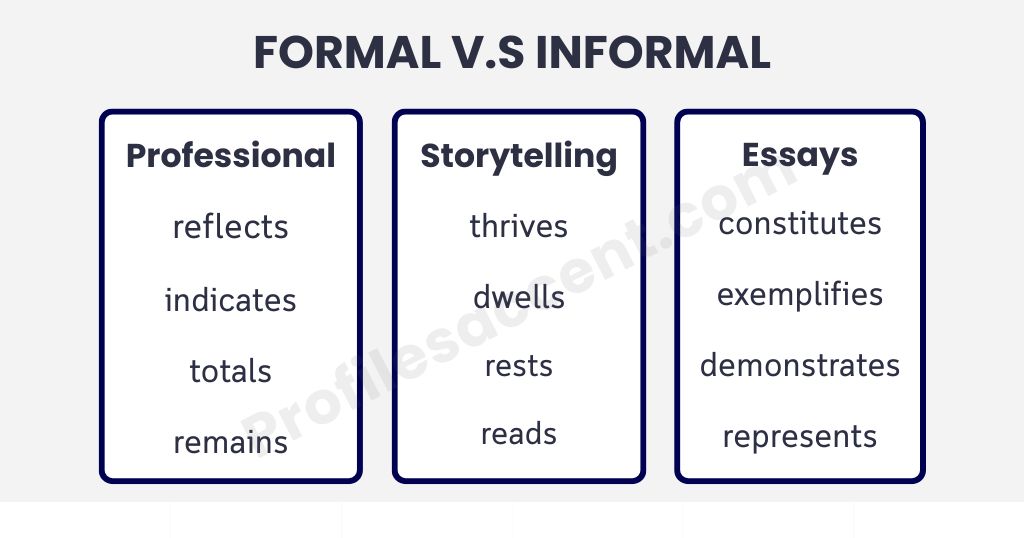
For essays and academic writing: constitutes, exemplifies, demonstrates, represents, embodies, indicates. These words carry argumentative weight and signal that you’re making a deliberate claim.
For professional emails: reflects, indicates, totals, costs, remains, positions. These are precise without being stiff. They communicate clearly in business contexts.
For storytelling and creative work: thrives, dwells, rests, reads, prevails, mirrors. These add color and texture. They help the reader feel the scene, not just understand it.
Words to avoid in formal contexts: seems, feels, stays. These suggest uncertainty or casualness. In an essay or professional report, they undercut your authority.
Mistakes Writers Make When Replacing “Is”
Using “exists” when existence isn’t the point. “The opportunity exists” works. But “The problem exists” sounds odd when “The problem persists” or “The problem remains” is what you mean. “Exists” is for presence. “Persists” is for something stubbornly ongoing.
Swapping “is” for “represents” in every sentence. This creates a new repetition problem. Vary your choices.
Using vivid words in the wrong register. “The quarterly figures embody our strategy” sounds theatrical in a spreadsheet summary. Save embodies for when the connection is genuinely meaningful.
Forgetting to restructure the whole sentence. “The result is illustrative of poor planning” replaced as “The result is representative of poor planning” is still a weak sentence. The better fix: “The result illustrates poor planning.” Convert the noun phrase to an active verb and you’re done.
Treating “seems” and “appears” as identical. They’re close but not the same. Seems leans on personal impression. Appears sounds more observational and slightly more formal. “He seems tired” is your gut feeling. “He appears tired” is what you’d note in a report.
Other Words for “Is” You Should Know (And How They Differ)
- Becomes implies change or transformation, not a current state. Don’t swap it for “is” unless something is actually shifting.
- Equals works for mathematical or direct equivalence. It doesn’t carry the same weight in qualitative statements.
- Proves suggests testing or confirmation. Use it when the state has been verified, not just observed.
- Tends to is a softer alternative when you want to describe a pattern rather than a fixed state.
- Functions as is useful when something is playing a role that isn’t its primary identity. “The kitchen functions as a workspace” tells you more than “The kitchen is a workspace.”
Picking the Right Word to Replace “Is”
Here’s the simplest decision framework:
- Is something simply present or ongoing? Use exists, persists, remains.
- Are you defining what something is or means? Use constitutes, represents, signifies.
- Are you describing how something appears or feels? Use seems, appears, reads, proves.
- Are you writing formally? Lean toward demonstrates, embodies, constitutes.
- Is the sentence in casual or creative writing? Consider feels, sits, thrives.
- Can you remove “is” without replacing it at all? Do that first.
The word “is” isn’t the villain. Overusing it is. Give your sentences a sharper verb, and they’ll do more work with less effort.
Discover More Articles:

I’m Rowan, a language addict who loves exploring how words work in everyday communication. I’ve spent years studying English vocabulary and helping others express themselves more clearly. My goal is simple: make learning new words easy and practical. I focus on real-life examples that show when and how to use different terms. Through clear explanations and honest guidance, I help readers choose the right words for any situation with confidence.