There’s a moment every writer knows. You’re mid-sentence, making a solid point, and then you reach for “but.” Again. It shows up in your paragraph three times. Maybe four. The word itself isn’t wrong. It’s just doing too much heavy lifting.
But here’s the part that rarely gets discussed: “but” doesn’t just contrast two ideas. It quietly cancels the first one. When you write “Your plan is creative, but it won’t work,” the reader forgets the compliment almost instantly. The “but” erases it. That’s a lot of power for a three-letter word.
Knowing when to replace it, and what to replace it with, changes how your writing lands.
What “But” Is Really Doing in Your Sentence
At its core, “but” signals a turn. It tells the reader: what I just said is about to get complicated. It works as a contrast word, an exception marker, and sometimes even as a word meaning “only” (as in: “She was but a child”).
The emotional weight it carries is mild resistance. Not hostility. Not shock. Just a quiet push in a new direction. That tone matters when you’re choosing a replacement.
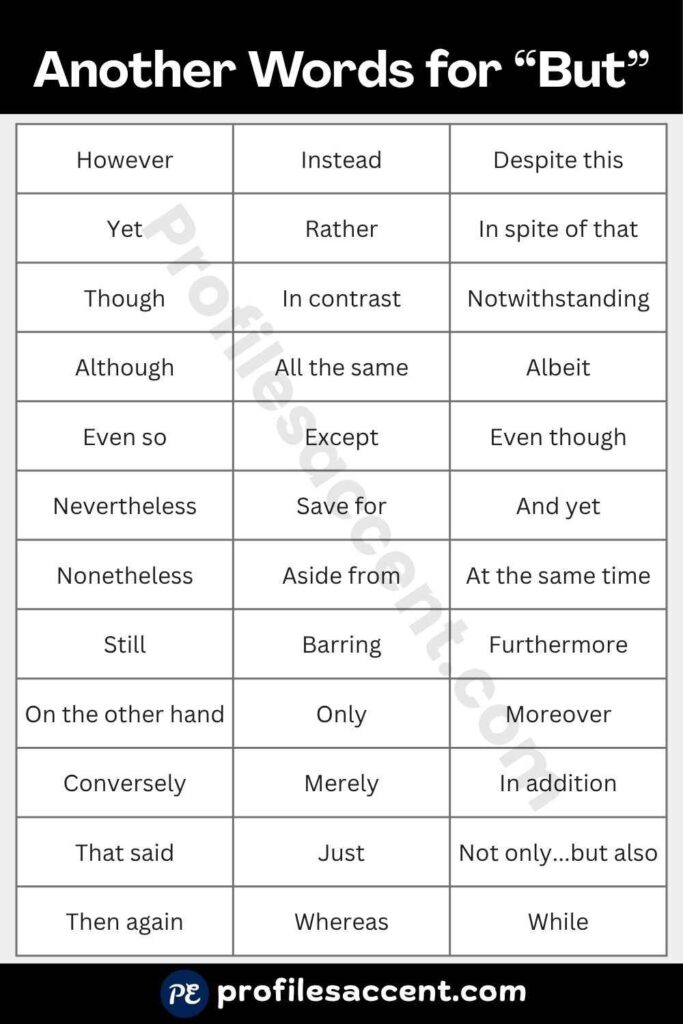
Another Word for But: 40+ Synonyms at a Glance
| Word / Phrase | Tone | Best Used When | Example |
| However | Neutral/Formal | Introducing a formal contrast | The report was thorough. However, key data was missing. |
| Yet | Neutral | Short, punchy contrast | She studied hard, yet the results surprised her. |
| Though | Casual | Softening a contradiction | It’s a long drive. Worth it, though. |
| Although | Semi-formal | Starting a contrasting clause | Although it rained, the event went well. |
| Even so | Casual/Warm | Acknowledging both sides equally | He was nervous. Even so, he gave a great speech. |
| Nevertheless | Formal | Academic or professional writing | The budget was tight; nevertheless, the team delivered. |
| Nonetheless | Formal | Same role as nevertheless | Errors existed; nonetheless, the core idea was sound. |
| Still | Neutral | When something remains true despite contrast | The price is high. Still, the quality justifies it. |
| On the other hand | Neutral | Comparing two valid sides | Option A is fast. On the other hand, Option B is cheaper. |
| Conversely | Analytical | Direct logical opposites | Sales rose in Q1. Conversely, Q2 saw a dip. |
| That said | Casual/Balanced | Acknowledging and then pivoting | Great effort from the team. That said, we missed the target. |
| Then again | Conversational | Second-guessing or reconsidering | It sounds risky. Then again, the reward is significant. |
| While | Neutral | Holding two truths at once | While the design looks good, the function needs work. |
| Whereas | Formal/Analytical | Showing direct contrast between two things | Cats are independent, whereas dogs tend to seek attention. |
| Instead | Redirecting | Replacing one idea with another | Don’t rush. Instead, take a careful approach. |
| Rather | Soft redirect | Correcting or replacing gently | She didn’t quit. Rather, she changed direction. |
| In contrast | Formal | Academic comparisons | Urban areas saw growth. In contrast, rural towns declined. |
| All the same | Casual | Keeping a relaxed, balanced tone | It wasn’t perfect. All the same, I enjoyed it. |
| Except | Exclusion | Leaving out one element | Everyone agreed, except the manager. |
| Save for | Literary/Formal | Elegant exclusion | The room was quiet, save for a ticking clock. |
| Aside from | Neutral | Excluding something while moving forward | Aside from one error, the work was clean. |
| Barring | Formal | Conditional exceptions | Barring any delays, we should arrive on time. |
| Only | Limitation | Adding a gentle restriction | She agreed, only asking for more time. |
| Merely | Soft | Downplaying scale or degree | He didn’t fail. He merely stumbled. |
| Just | Casual | Light contrast or small exception | It’s not bad. Just a bit long. |
| Despite this | Formal | Acknowledging but overriding | The risks were clear. Despite this, they moved forward. |
| In spite of that | Formal | Same as despite this | In spite of that, the outcome was positive. |
| Notwithstanding | Very Formal | Legal or academic contexts | Notwithstanding the delays, the project succeeded. |
| Albeit | Formal/Literary | Mild concession within a sentence | It was a success, albeit a slow one. |
| Even though | Emphatic | Strong contrast between facts | Even though she was tired, she stayed until the end. |
| And yet | Literary/Emotional | Surprising contrast with emotional pull | The plan seemed foolproof. And yet, it failed. |
| At the same time | Balanced | Two things true simultaneously | The work was difficult. At the same time, it was rewarding. |
| Furthermore | Additive | Adding, not contrasting (positive pivot) | The results were good. Furthermore, the feedback was strong. |
| Moreover | Additive/Formal | Strengthening a point with more evidence | The product works. Moreover, it’s affordable. |
| In addition | Neutral/Additive | Positive build-up without contradiction | She leads the team. In addition, she mentors new staff. |
| Not only…but also | Emphatic | Doubling a positive or strong point | Not only did he finish early, but he also exceeded the goal. |
| On the contrary | Strong | Flat-out disagreeing with the previous point | This wasn’t a setback. On the contrary, it was a turning point. |
| By contrast | Analytical | Side-by-side comparison in formal writing | Summers here are humid. By contrast, winters are mild. |
| That being said | Conversational | Balanced pivot in informal or spoken tone | Good meeting, everyone. That being said, we need a clearer plan. |
| Mind you | British/Casual | A light, friendly pushback | It’s a nice place. Mind you, the parking is terrible. |
| Having said that | Neutral/Spoken | Polite contrast in dialogue or presentations | The data supports the idea. Having said that, risks remain. |
The Hidden Problem With But (And the Fix Most Writers Miss)
This is the part most synonym lists skip entirely.
When you say “Your idea is interesting, but I disagree,” the listener mentally deletes “your idea is interesting.” The “but” acts like an undo button. The contrast swallows the compliment.
If you want to keep both ideas alive, swap “but” for “and” or “while.”
Compare these two:
- “Your proposal is solid, but the timeline is unrealistic.”
- “Your proposal is solid, and the timeline needs adjustment.”
The second version keeps the praise standing. The first quietly buries it. This is a shift worth practicing, especially in professional emails, feedback, or any writing where relationships matter.
Synonyms for “But” Grouped by What You Actually Need
When you want a clean contrast:
- However, yet, still, whereas, conversely, on the other hand
When you need formal or academic contrast:
- Nevertheless, nonetheless, notwithstanding, albeit, in contrast, by contrast
When you’re writing casually:
- Though, even so, then again, that said, all the same, mind you
When you’re excluding something:
- Except, save for, aside from, barring, other than
When “but” feels too negative (positive alternatives):
- Furthermore, moreover, in addition, not only…but also, at the same time
When you want to redirect:
- Instead, rather, on the contrary
How Strong Is Your Contrast? A Tone Scale for “But” Synonyms
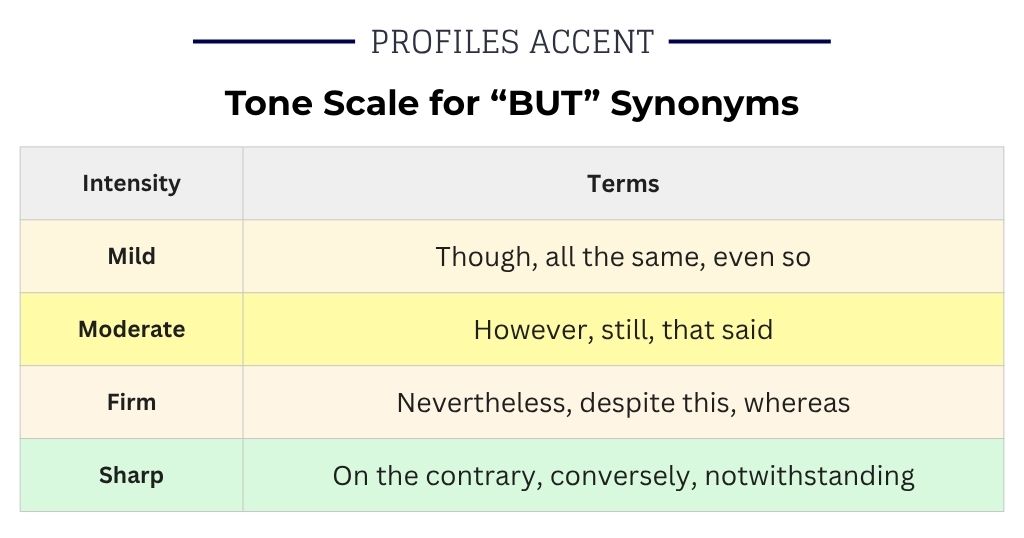
Different replacements carry different weight. Here’s a rough scale from softest to sharpest:
- Mild: Though, all the same, even so
- Moderate: However, still, that said
- Firm: Nevertheless, despite this, whereas
- Sharp: On the contrary, conversely, notwithstanding
If you’re writing a professional email and want to push back without sounding aggressive, stay in the “mild to moderate” range. If you’re writing an analytical essay and need clear opposition, move toward “firm.”
Same Sentence, Four Ways: Seeing “But” Synonyms in Action
Here are four versions of the same sentence, each targeting a different context.
Original: “The presentation was good, but the ending was weak.”
- Formal: The presentation was strong overall; however, the closing section lacked impact.
- Casual: Solid presentation. The ending could use some work, though.
- Academic: While the presentation demonstrated clear research, the concluding section failed to reinforce the central argument.
- Creative: The presentation held the room right until the final slide, which landed with a quiet thud instead of a close.
Each version shifts how the criticism feels. The formal version sounds measured. The academic one sounds precise. The creative one makes the problem memorable.
Another Word for But in an Essay or IELTS Writing
In academic writing, “but” on its own sounds too simple. Examiners look for variety and precision.
Good choices for essays: However (most versatile), Nevertheless, Nonetheless, Although, Whereas, Despite this, Conversely
What to avoid: Starting formal paragraphs with “but” directly (though it’s acceptable in creative writing and modern journalism).
One common error: writing “although…but” in the same sentence. These two cancel each other out grammatically. Use one or the other, not both.
Also avoid “despite of.” The correct phrase is simply “despite” or “in spite of.”
Mistakes People Make When Swapping Out “But”
1. Treating all synonyms as drop-in replacements
“However” needs a semicolon or a new sentence. You can’t just swap it for “but” with a comma. Writing “It was cold, however we stayed” is a punctuation error. It should be “It was cold; however, we stayed.”
2. Using “nevertheless” in casual conversation
It sounds stiff in a text message or social post. Stick to “though,” “even so,” or “still” for informal tones.
3. Reaching for “on the contrary” too often
This phrase signals a full disagreement. If you’re just adding nuance, not fully disagreeing, it’s too strong.
4. “But also” without the “not only”
The phrase “not only…but also” requires parallel structure. Both sides need to match in form.
Words Close to “But” That Writers Often Mix Up
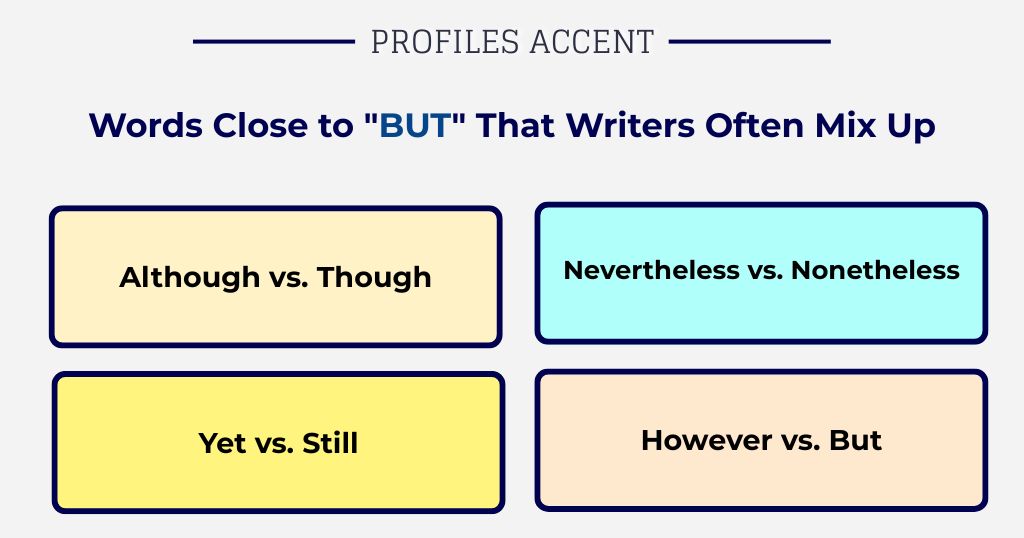
Although vs. Though: “Although” usually starts a clause. “Though” can appear at the end of a sentence casually. “It worked, though” sounds natural. “It worked, although” does not.
Nevertheless vs. Nonetheless: Nearly interchangeable. “Nevertheless” feels slightly more formal and older in tone. Either works in academic writing.
Yet vs. Still: “Yet” often signals surprise. “Still” signals continuation despite something. “He hasn’t eaten yet” means it hasn’t happened. “He still hasn’t eaten” adds a layer of concern or impatience.
However vs. But: Both contrast. “But” joins clauses directly. “However” bridges sentences. Mix them up in structure and you’ll create punctuation errors.
The Right Synonym for “But” Starts With One Question
The word you pick after deciding to replace “but” should depend on one thing first:
- What role is “but” playing in that sentence?
- Is it contrasting, excluding, or limiting?
Once you know the role, match it to the tone your writing needs. Formal writing earns “however” and “nevertheless.” Casual writing breathes better with “though” or “even so.” Positive pivots land better with “and,” “moreover,” or “not only…but also.”
“But” will always have its place. The skill is knowing when something else fits better.
Discover More Articles:

I’m Rowan, a language addict who loves exploring how words work in everyday communication. I’ve spent years studying English vocabulary and helping others express themselves more clearly. My goal is simple: make learning new words easy and practical. I focus on real-life examples that show when and how to use different terms. Through clear explanations and honest guidance, I help readers choose the right words for any situation with confidence.