Here is a situation many writers know well. You finish a paragraph, read it back, and see the word “critique” sitting there three times in five lines. You need a replacement. But you open a thesaurus and get “censure” or “pan” words that completely change what you were trying to say.
That is the real problem. Finding another word for critique is not just about avoiding repetition. It is about keeping your meaning intact while changing the word on the page. The wrong synonym can make a balanced review sound like an attack, or make a formal essay sound like a blog comment.
This guide helps you find the right word, not just any word.
What “Critique” Actually Means
A critique is a careful, thoughtful look at something. It weighs both what works and what does not. The key word is balanced. A critique is not automatically negative. It is not praise either. It sits in the middle, looking closely.
That emotional neutrality is what makes it tricky to replace. Many synonyms drift toward one side or the other.
45+ Synonyms for Critique: Quick Table
| Word | Tone | Best Used When | Quick Example |
| Analysis | Neutral, formal | Breaking something into parts | “A close analysis of the poem revealed…” |
| Evaluation | Neutral | Measuring quality or performance | “The panel’s evaluation was thorough.” |
| Assessment | Neutral to professional | Judging value or progress | “His self-assessment showed real growth.” |
| Review | Neutral, flexible | Books, films, work drafts | “She wrote a review of the new novel.” |
| Appraisal | Formal, measured | Professional or property contexts | “The appraisal covered every weakness.” |
| Commentary | Warm, reflective | Explaining or reacting to something | “Her commentary on the draft was helpful.” |
| Examination | Neutral, thorough | Academic or medical contexts | “A careful examination of the argument.” |
| Feedback | Warm, personal | One-on-one writing or work review | “Can you give me feedback on this?” |
| Judgment | Slightly weighty | Final decisions or verdicts | “His judgment of the work surprised her.” |
| Scrutiny | Serious, intense | When something is looked at very closely | “The plan faced heavy scrutiny.” |
| Dissection | Clinical, precise | When analyzing deeply and systematically | “A full dissection of the storyline.” |
| Inspection | Neutral | Checking quality or accuracy | “A brief inspection found three errors.” |
| Annotation | Academic | Adding notes to a text | “Her annotations improved the manuscript.” |
| Inquiry | Open, exploratory | Investigating ideas or systems | “A critical inquiry into media bias.” |
| Interpretation | Thoughtful | Making sense of meaning or intent | “His interpretation of the text was fresh.” |
| Study | Academic, serious | Deep focused research or reflection | “A study of the film’s structural choices.” |
| Observation | Light, informal | Noticing something in writing or work | “A sharp observation about the pacing.” |
| Notation | Minimal, technical | Short written notes on a piece | “Quick notations in the margin helped.” |
| Reflection | Personal, introspective | Self-directed review or looking back | “Her reflection on the draft was honest.” |
| Response | Reactive, personal | Reacting to another person’s work | “A critical response to the short story.” |
| Treatise | Very formal | Long, structured written analysis | “He published a treatise on modern art.” |
| Discourse | Academic, broad | Extended intellectual discussion | “A sustained discourse on poetic form.” |
| Remark | Light, casual | Brief spoken or written observations | “A few sharp remarks on the structure.” |
| Take | Informal | Personal opinion on something | “What’s your take on the final chapter?” |
| Write-up | Informal | Short written summary or review | “She sent over a quick write-up.” |
| Overview | Light, summary-level | A broad look without deep detail | “An overview of the project’s weaknesses.” |
| Rundown | Casual | Informal list of issues or points | “Give me a quick rundown of your notes.” |
| Censure | Negative, formal | Official or moral disapproval | “The committee issued a formal censure.” |
| Condemnation | Strong, negative | Firm rejection or strong disapproval | “His condemnation of the policy was clear.” |
| Objection | Direct, negative | Pointing out a specific problem | “She raised an objection to the ending.” |
| Commendation | Positive | Approving and praising something | “The review was a full commendation.” |
| Endorsement | Positive, supportive | Official or public approval | “A quiet endorsement of the approach” |
| Validation | Positive, affirming | Confirming something is correct or good | “She needed validation, not criticism.” |
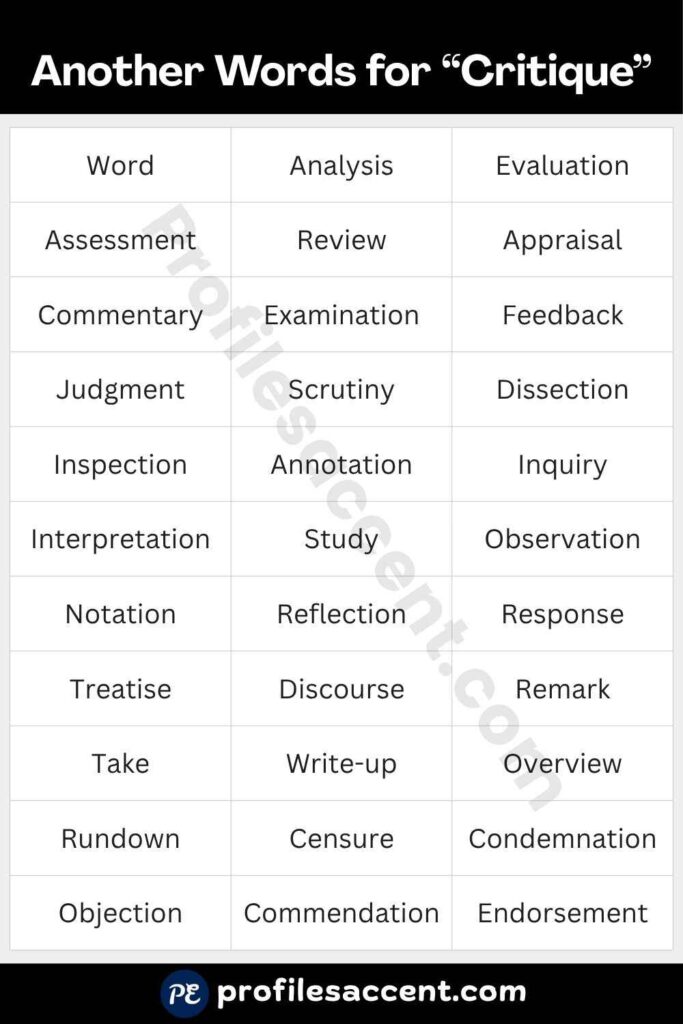
From Gentle to Forceful: A Tone Scale for Critique Synonyms
This is what most synonym lists skip entirely. The word you choose does not just swap out “critique.” It shifts the feeling of your sentence.
Neutral territory: Analysis, evaluation, assessment, examination. These words carry no emotional charge. They are clean. Use them in academic writing, business reports, or anywhere you want to sound objective.
Warm and personal: Feedback, reflection, commentary, response. These feel more human. They suggest a conversation, not a verdict. If you are reviewing a friend’s draft or giving developmental notes, these fit naturally.
Heavy and official: Scrutiny, appraisal, judgment, inquiry. These carry weight. They imply seriousness. Use them when the stakes feel real or formal.
Negative lean: Censure, condemnation, objection, disapproval. These are not critiques anymore. They are judgments with a negative conclusion already built in. Only use them when the negative angle is exactly what you mean.
Positive lean: Commendation, endorsement, validation, appreciation. The opposite direction. These work when you want to describe praise presented in a thoughtful structure.
Intensity Scale: Lightest to Strongest

Sometimes you need to match the weight of your word to the weight of your situation. Here is how several synonyms line up from mildest to most forceful:
Remark → Observation → Feedback → Review → Assessment → Evaluation → Scrutiny → Judgment → Censure → Condemnation
A “remark” barely touches the surface. A “condemnation” leaves no room for discussion. Most writing lives somewhere in the middle. Picking the right intensity is just as important as picking the right meaning.
Sentence Rewrites: Seeing the Difference in Action
Original: “The professor gave a harsh critique of her essay.”
- Formal: “The professor offered a rigorous evaluation of her submitted work.”
- Casual: “The professor tore apart her essay during review.”
- Academic: “The professor conducted a formal assessment of her argument structure.”
- Creative: “Her essay came back bleeding with the professor’s observations.”
Each version tells the same story but lands differently. The formal version respects the setting. The casual version feels real. The academic version is clean and precise. The creative version has texture.
Original: “He critiqued my writing style.”
- Professional: “He assessed my writing approach and offered structured feedback.”
- Casual: “He gave me his take on how I write.”
- Academic: “He provided a critical analysis of my stylistic choices.”
Notice how “take” feels like coffee-shop conversation, while “critical analysis” belongs in a seminar room. Same event, completely different register.
Another Word for Critique in an Essay

If you are writing a school or university paper, word choice matters for how serious your writing sounds. Some synonyms work well in essays. Others will pull the tone down.
Good fits for essays: critical analysis, textual examination, scholarly appraisal, systematic evaluation, interpretive study, literary assessment.
Words to avoid in formal essays: write-up, take, rundown, remark, crit. These are too informal and can weaken an otherwise strong argument.
If you are looking for another word for critique in an essay, “critical analysis” is usually the safest and most widely accepted replacement. It is formal, precise, and recognized across most academic subjects.
Another Word for Critiquing Someone
This is a gap most synonym guides ignore. Reviewing a person’s work or performance needs different language than reviewing a book or a film.
- Good options here: performance review, peer assessment, formative feedback, professional evaluation, developmental appraisal.
Avoid: judgment, condemnation, scrutiny, censure. These words feel punishing when directed at a person rather than a piece of work. Even if the feedback is accurate, those words create defensiveness before the person even reads the content.
Self Critique Synonym: Looking Inward Has Its Own Language
Self-critique is its own category. It involves looking inward, which is more personal and often more uncomfortable than reviewing someone else’s work.
- Strong alternatives: self-assessment, self-examination, personal reflection, introspective review, internal appraisal.
These feel appropriate in journals, personal statements, therapy discussions, or professional development plans. They carry honesty without sounding harsh toward yourself.
Social Critique Synonym: When the Subject Is Society Itself
When critique refers to examining society, culture, or institutions, the vocabulary shifts again.
- Good options: social commentary, cultural analysis, ideological examination, systemic inquiry, institutional critique, societal observation.
These are used in essays about media, politics, history, or art. They are more abstract than personal feedback and more sweeping than a single work review.
Synonyms That Look Right But Are Not Interchangeable
Treating “critique” and “criticism” as identical. They are close but not the same. Criticism often implies a negative focus, especially in everyday speech. Critique suggests balance. Swapping them carelessly can shift your meaning without you realizing it.
Using negative synonyms when you mean something balanced. If you write “his condemnation of the draft,” readers expect something harsh. If you meant a thoughtful mixed review, that word misleads.
Picking formal synonyms in casual settings. Writing “I’d like to offer a disquisition on your blog post” to a friend sounds odd. Match the register to the relationship.
Using “review” when you mean something deeper. A review can be brief and surface-level. If you are doing a deep, structured analysis, “evaluation” or “critical analysis” carries more weight.
Words That Live Near Critique Without Meaning the Same Thing

- Criticism sits closest to critique but leans more negative in modern everyday use. Great for pointing out flaws, but use carefully when you want balance.
- Appraisal often appears in professional or financial contexts. It implies a formal measurement of worth.
- Exegesis is a specialist term used mainly in theology or literary studies. It means a very close reading of a specific text.
- Annotation refers to written notes added to a document, usually brief and marginal, not a full evaluation.
- Dissection suggests taking something apart piece by piece. It is clinical in tone and works well for detailed structural analysis.
Picking the Right Word with Confidence
When you need to replace “critique,” the fastest rule is this: match tone to context, not just meaning. Ask yourself whether you want neutral, warm, heavy, negative, or positive. Then pick from that emotional zone.
- If you are in academic writing, reach for evaluation, assessment, or critical analysis.
- If you are giving someone personal feedback, feedback or commentary will serve you better.
- If you are describing a negative outcome, censure or condemnation are accurate, but only use them when the negativity is real and intentional.
The right word does not just fill a space. It tells the reader exactly how to feel before they finish the sentence.
Discover More Articles:

I’m Rowan, a language addict who loves exploring how words work in everyday communication. I’ve spent years studying English vocabulary and helping others express themselves more clearly. My goal is simple: make learning new words easy and practical. I focus on real-life examples that show when and how to use different terms. Through clear explanations and honest guidance, I help readers choose the right words for any situation with confidence.