You wrote “deeper” three times in one paragraph. It happens. Not because you lack vocabulary, but because “deeper” is one of those words that feels like it fits everywhere. Deeper meaning. Deeper connection. Deeper voice. Deeper analysis.
But here’s the problem: the same word doing four different jobs starts to feel lazy, even when the ideas behind it are rich. Readers notice. Editors definitely notice.
The good news? Once you understand why you’re using “deeper,” picking a better word becomes surprisingly easy.
What Deeper Really Means Before You Replace It
“Deeper” is the comparative form of “deep.” It signals that something goes further than the surface, whether physically, emotionally, or intellectually. It carries quiet weight. It suggests there’s more beneath what’s visible.
But that flexibility is also what makes it tricky to replace. A synonym that works for physical depth will completely fall apart when applied to emotional sincerity. So context is everything here.
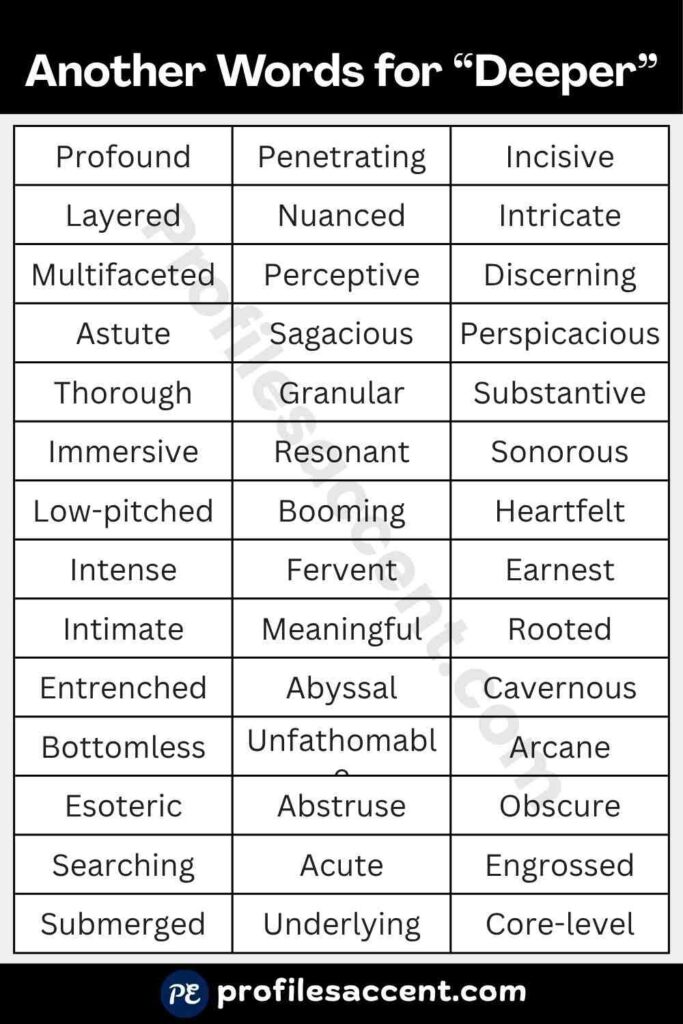
40+ Synonyms for Deeper: Sorted by Context
| Word | Context | Example |
| Profound | Emotional / Intellectual | A profound sense of loss |
| Penetrating | Analytical / Academic | A penetrating critique |
| Incisive | Academic / Professional | An incisive argument |
| Layered | Complexity / Narrative | A layered story |
| Nuanced | Abstract / Tonal | A nuanced response |
| Intricate | Ideas / Systems | An intricate theory |
| Multifaceted | Concepts / Characters | A multifaceted issue |
| Perceptive | Intellectual / Personal | A perceptive observation |
| Discerning | Judgment / Awareness | A discerning eye |
| Astute | People / Analysis | An astute reader |
| Sagacious | Formal / Wisdom | A sagacious mentor |
| Perspicacious | Formal / Academic | A perspicacious scholar |
| Thorough | Research / Writing | A thorough examination |
| Granular | Research / Detail | A granular breakdown |
| Substantive | Essays / Reports | A substantive discussion |
| Immersive | Experience / Learning | An immersive study |
| Resonant | Sound / Emotional Impact | A resonant tone |
| Sonorous | Sound / Voice | A sonorous voice |
| Low-pitched | Sound / Audio | A low-pitched hum |
| Booming | Sound / Volume | A booming echo |
| Heartfelt | Emotion / Sincerity | A heartfelt apology |
| Intense | Emotion / Feeling | An intense bond |
| Fervent | Emotion / Belief | Fervent devotion |
| Earnest | Emotion / Tone | An earnest effort |
| Intimate | Relationships | An intimate connection |
| Meaningful | Relationships / Context | A meaningful conversation |
| Rooted | Beliefs / Values | A deeply rooted habit |
| Entrenched | Systems / Behavior | An entrenched pattern |
| Abyssal | Physical / Scientific | The abyssal trench |
| Cavernous | Physical / Space | A cavernous void |
| Bottomless | Physical / Figurative | A bottomless pit |
| Unfathomable | Mystery / Scale | Unfathomable depth |
| Arcane | Hidden / Specialized | Arcane knowledge |
| Esoteric | Specialized / Abstract | An esoteric concept |
| Abstruse | Complex / Academic | Abstruse reasoning |
| Obscure | Hidden / Unknown | An obscure reference |
| Searching | Questions / Inquiry | A searching question |
| Acute | Awareness / Senses | Acute perception |
| Engrossed | Attention / Focus | Engrossed in thought |
| Submerged | Physical / Emotional | Submerged in grief |
| Underlying | Root Cause / Meaning | The underlying issue |
| Core-level | Structure / Analysis | A core-level shift |
Why the Same Synonym for Deeper Won’t Work Everywhere
This is where most synonym lists fail you. They give you a word without telling you when it breaks down.
Physical depth
Physical depth calls for spatial words. “Abyssal,” “cavernous,” and “bottomless” feel right when describing oceans, caves, or literal holes. Using “profound” here works sometimes, but “profound trench” already leans abstract. “Profound hole” sounds almost poetic when you want plain clarity.
Intellectual depth
Intellectual depth is where “deeper” gets replaced most often in academic and professional writing. Words like “incisive,” “penetrating,” and “granular” signal that you’ve gone beyond surface-level thinking. “A more granular analysis” tells a reader you examined specifics. “A more incisive argument” says your logic cuts through noise.
Emotional depth
Emotional depth needs warmth. “Intense” works, but it can also describe anxiety or conflict. For positive emotional weight, “heartfelt,” “earnest,” and “intimate” carry sincerity without sounding stiff. “A heartfelt apology” lands differently than “a profound apology,” even though both imply sincerity.
Sound depth
Sound depth is its own world. “Resonant,” “sonorous,” and “low-pitched” belong to music, voice, and acoustics. They should never wander into emotional or analytical sentences. A “resonant argument” borrows from sound vocabulary to mean emotionally impactful, which can work creatively, but only intentionally.
Hidden or abstract depth
Hidden or abstract depth uses words like “arcane,” “esoteric,” or “underlying.” These suggest something is beneath the surface of knowledge, not just beneath the surface in space. They work for philosophy, research, and topics with hidden complexity.
From Gentle to Striking: A Tone Scale for Deeper Synonyms
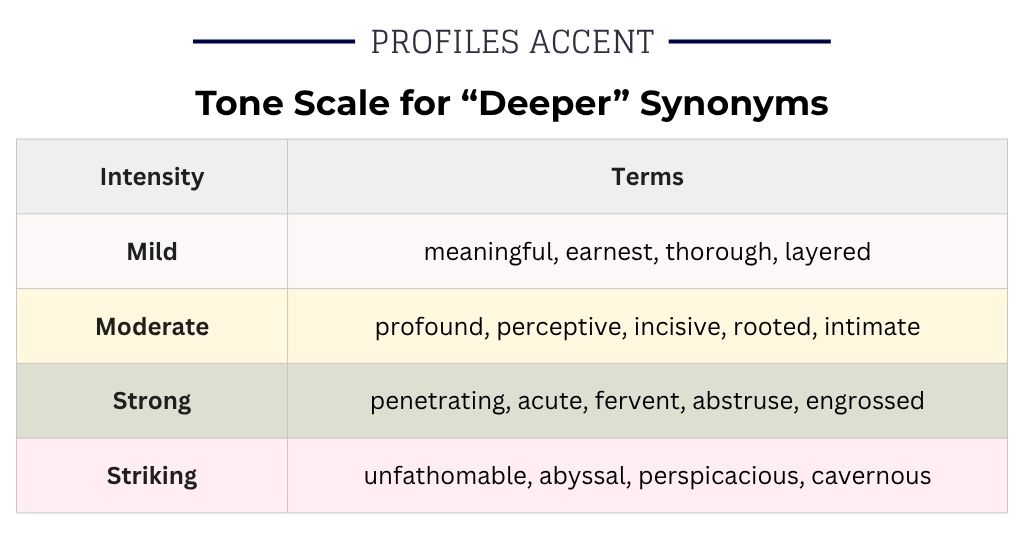
Not every synonym carries the same weight. Sometimes you need something soft. Sometimes you need something that hits.
- Mild: meaningful, earnest, thorough, layered
- Moderate: profound, perceptive, incisive, rooted, intimate
- Strong: penetrating, acute, fervent, abstruse, engrossed
- Striking: unfathomable, abyssal, perspicacious, cavernous, submerged
This scale matters most in creative and academic writing. If you’re describing a quiet moment of self-reflection, “submerged in thought” might overpower the tone. “Absorbed in thought” keeps it calm. Save the stronger words for moments that earn them.
Deeper in a Sentence: Four Rewrites, Four Different Feels
Here’s where theory becomes practical. Let’s take real sentences and rewrite them for different tones.
Original: She wanted a deeper understanding of the topic.
- Formal: She sought a more thorough comprehension of the subject.
- Academic: Her aim was to develop a more penetrating insight into the field.
- Creative: She wanted to reach something beneath the surface of what she already knew.
- Casual: She wanted to really get into it, not just skim the top.
Original: They formed a deeper connection over time.
- Formal: They developed a more meaningful rapport as time passed.
- Academic: A more intimate and substantive bond emerged between them.
- Creative: Something rooted itself between them quietly, over years.
- Casual: They just got closer. Genuinely closer.
Original: His voice had a deeper quality.
- Formal: His voice carried a distinctly resonant quality.
- Creative: There was something low and full in his voice, like it came from somewhere settled.
- Casual: His voice was richer, lower, the kind that fills a room.
Each rewrite removes “deeper” without losing its meaning. And each version serves a different reader in a different setting.
Formal Synonyms for Deeper vs. Everyday Alternatives
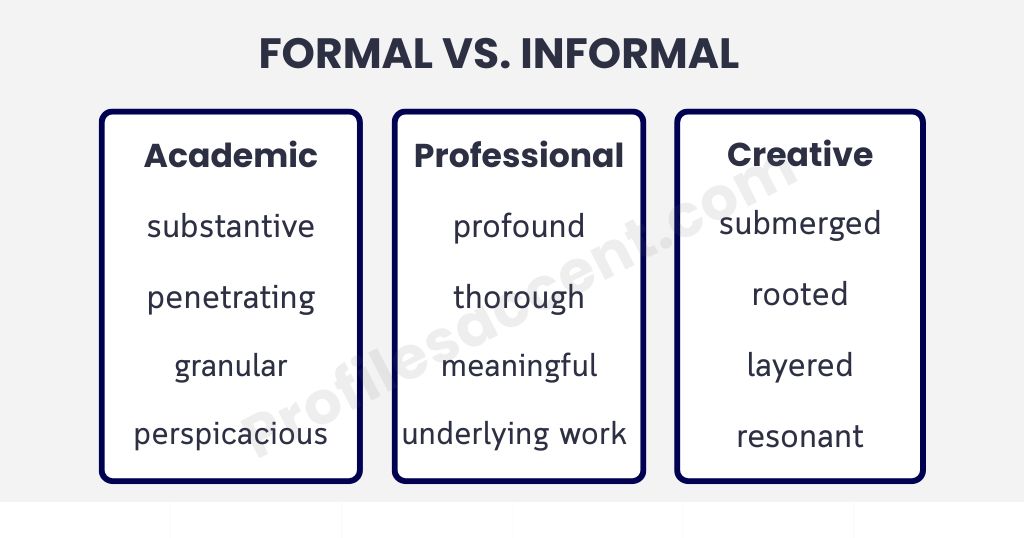
For essays and academic writing: reach for incisive, substantive, penetrating, granular, perspicacious. These signal rigor. Avoid “heavy” or “next-level,” which belong to informal speech.
For professional emails and reports: profound, thorough, meaningful, and underlying work cleanly. They’re clear without being stiff or overly literary.
For creative writing: submerged, rooted, layered, resonant, and cavernous give you imagery. They let the reader feel the depth rather than just understand it.
For casual writing or conversation: absorbed, intense, heartfelt, and real all work naturally. Nobody speaks in “perspicacious” at the dinner table.
One word to use carefully: “penetrating.” In analytical writing, it signals sharp thinking. In emotional contexts, it can feel cold or even aggressive. Always check how it lands in the sentence before keeping it.
Mistakes People Make When Swapping Out Deeper
Replacing “deeper” with “more deeper.” This is a grammar error. “Deeper” is already comparative. If you want emphasis, write “significantly deeper” or “considerably more profound.” Never stack two comparatives.
Using “profound” for everything. It’s the most popular replacement, and it shows. “Profound” suits abstract, serious, or emotional weight. It does not suit physical space, sound, or casual tone. Overusing it makes writing feel performative.
Choosing a word that doesn’t collocate. Some words simply don’t pair naturally with certain nouns. “Bottomless insight” doesn’t work. “Esoteric connection” sounds cold. Always test the full phrase, not just the synonym alone.
Ignoring register. Dropping “sagacious” into a casual blog post, or writing “getting heavy into it” in a research paper, both break trust with the reader. The synonym has to match the space you’re writing in.
Words That Live Near Deeper But Mean Something Different
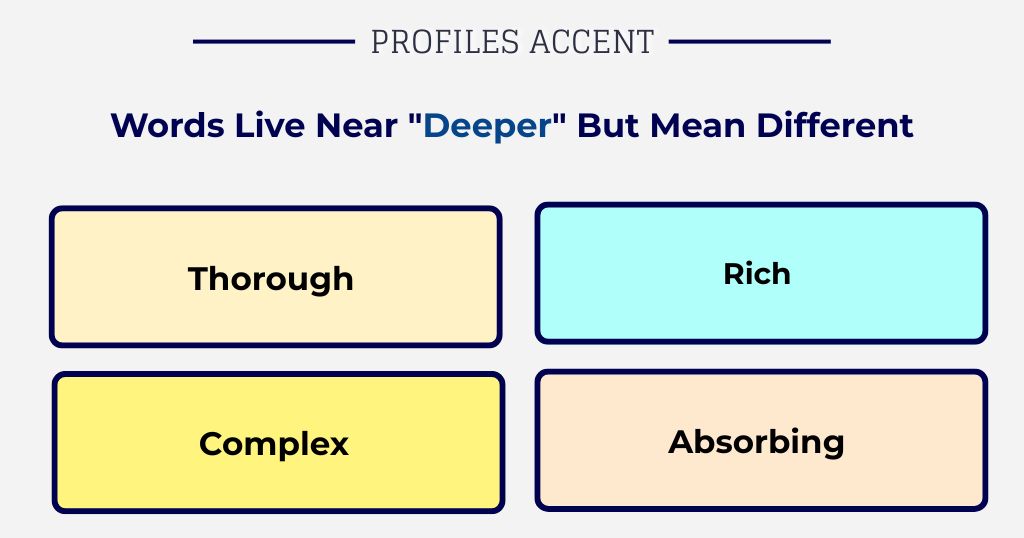
These aren’t synonyms for “deeper,” but they often appear in the same conversations and are worth keeping in mind.
- Thorough focuses on completeness, not necessarily depth. A thorough search covers everything. A deep search goes further down one path.
- Rich often refers to complexity in detail, especially in texture, color, or content. “Rich analysis” means full of substance, not necessarily layered in the same way “deep analysis” implies.
- Complex describes how many parts something has. Something can be complex without being deep. Deep suggests layers; complex suggests components.
- Absorbing describes the effect depth has on attention. If something is absorbing, it pulls you in. That’s what depth does to a reader or learner.
- Underlying points specifically to what sits beneath the surface of a situation. It’s useful when you want to signal that the real issue or meaning hasn’t been named yet.
The Fastest Way to Pick the Right Synonym for Deeper
Before you replace “deeper,” answer one quick question: Am I describing something physical, intellectual, or emotional?
- Physical? Try cavernous, abyssal, unfathomable.
- Intellectual? Try incisive, granular, penetrating, layered.
- Emotional? Try heartfelt, rooted, intimate, earnest.
- Sound? Try resonant, sonorous, full-bodied.
That single question cuts out 80% of the guesswork. The right word isn’t the most impressive one. It’s the one that makes the reader feel exactly what you meant, without them stopping to notice the word at all.
Discover More Articles:

I’m Rowan, a language addict who loves exploring how words work in everyday communication. I’ve spent years studying English vocabulary and helping others express themselves more clearly. My goal is simple: make learning new words easy and practical. I focus on real-life examples that show when and how to use different terms. Through clear explanations and honest guidance, I help readers choose the right words for any situation with confidence.