You just typed “information” for the fourth time in three paragraphs. It feels clunky. You know there’s a better word, but every synonym you try either sounds too stiff or too casual for what you’re writing.
That’s not a vocabulary problem. That’s a context problem.
Information is a neutral, all-purpose word. It works everywhere, which is exactly why it starts to feel hollow when overused. The right replacement depends on what kind of information you mean, who you’re writing for, and what tone you want to carry.
This guide helps you make that choice precisely.
What Information Actually Means (and Why It’s Tricky to Replace)
At its core, information is facts or knowledge passed from one person or source to another. It sits in the middle of a natural ladder: raw data gets shaped into information, and information gets processed into knowledge. That middle position is what makes replacing it so tricky. A word like “data” pulls it downward toward numbers and raw input. A word like “wisdom” pushes it upward into deep understanding.
Most synonym lists ignore this. They treat all three as equals. They’re not.
Synonyms for Information: 45+ Quick Table
| Word | Tone | Best Used When |
| Data | Neutral/Technical | Referring to numbers, stats, or raw input |
| Details | Casual/Neutral | Sharing specific facts or particulars |
| Facts | Direct/Neutral | Emphasizing truth and accuracy |
| Knowledge | Formal/Deep | Describing learned or applied understanding |
| Findings | Formal/Academic | Presenting research or study results |
| Evidence | Formal/Strong | Supporting a claim or argument |
| Intelligence | Formal/Strategic | Military, business, or sensitive contexts |
| Briefing | Professional | Delivering a short summary to someone |
| Disclosure | Formal/Legal | Revealing sensitive or protected content |
| Documentation | Formal/Official | Written records or official material |
| Insight | Thoughtful | Sharing deeper understanding or perspective |
| Guidance | Helpful | Offering direction or advice-based content |
| Notice | Neutral/Official | Informing someone of something formally |
| Update | Casual/Professional | Sharing recent changes or developments |
| Report | Formal | Organized presentation of gathered facts |
| News | Casual | Recent or current developments |
| Input | Collaborative | Contributions or ideas shared by others |
| Scoop | Informal/Journalistic | Exclusive or inside story |
| Lowdown | Casual | Full explanation or inside story |
| Background | Neutral | Context or history behind something |
| Overview | Neutral/Professional | High-level summary of a topic |
| Content | Digital/Neutral | Material shared in written or media form |
| Material | Academic/Neutral | Subject matter or reference resources |
| Figures | Technical | Statistics or numerical information |
| Statistics | Technical/Formal | Measured numerical facts |
| Metrics | Technical/Professional | Quantifiable performance measurements |
| Advice | Helpful | Direction given to assist decision-making |
| Counsel | Formal/Professional | Expert or legal guidance |
| Heads-up | Informal | Quick advance warning or alert |
| Announcement | Public/Formal | Officially shared news or decisions |
| Notification | Formal/Digital | Alert or formal message |
| Message | Casual/Neutral | Communication sent to someone |
| Particulars | Formal | Specific individual facts or details |
| Record | Formal/Official | Documented account of facts |
| Observations | Academic | Noted findings from watching or studying |
| Testimony | Legal/Formal | Spoken or written statement of facts |
| Brief | Professional | Short summary or outline |
| Rundown | Casual | Quick summary of key points |
| Account | Neutral/Narrative | Description of events or facts |
| Profile | Professional/Descriptive | Collected details about a subject or person |
| Summary | Neutral | Condensed version of larger content |
| Deets | Slang | Informal abbreviation of “details” |
| Gen | British Slang | Informal British term for information |
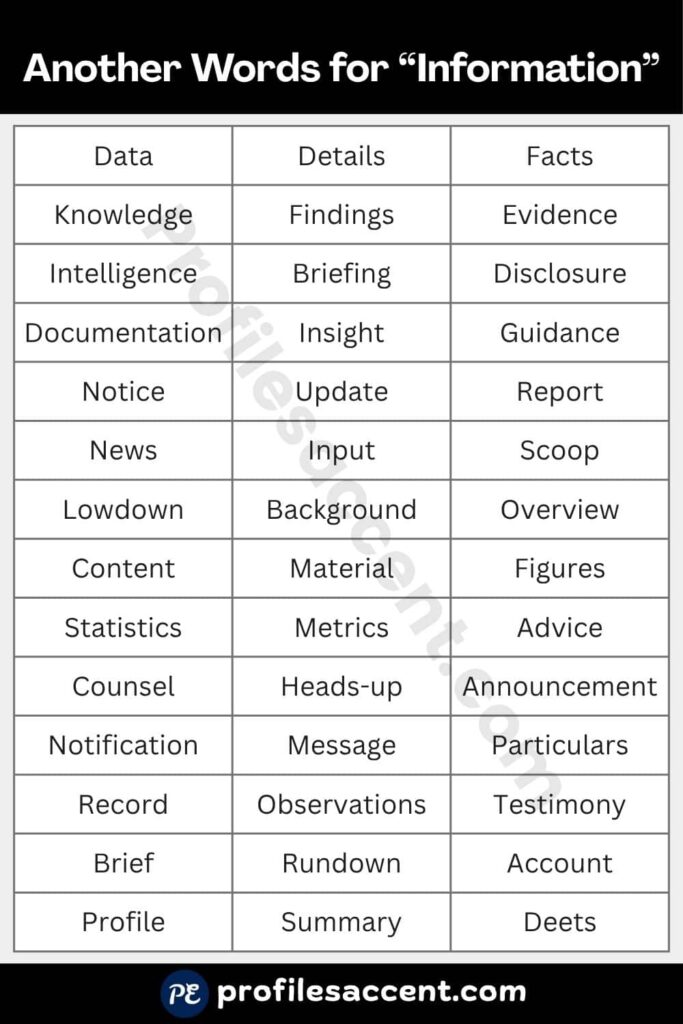
Other Words for Information, Grouped by What You’re Describing
Synonyms aren’t one-size-fits-all. The best word depends on the nature of what you’re describing.
When the information is raw or unprocessed
Use data, figures, statistics, or metrics. These words signal that the information hasn’t been interpreted yet. “The data shows three patterns” sounds precise. “The information shows three patterns” sounds vague.
When the information has been analyzed
Use findings, evidence, observations, or insight. These words carry weight. They imply someone looked carefully and drew conclusions. They work well in reports, research summaries, and professional writing.
When information is being delivered to someone
Use briefing, notification, update, announcement, or message. These words focus on the act of sharing rather than the content itself. They fit communications, emails, and media writing.
When information is informal or conversational
Use lowdown, scoop, heads-up, rundown, or deets. These are natural in everyday speech, casual blogs, and informal storytelling. They would sound strange in a formal report.
How Heavy Is Your Word? A Tone Scale for Information Synonyms
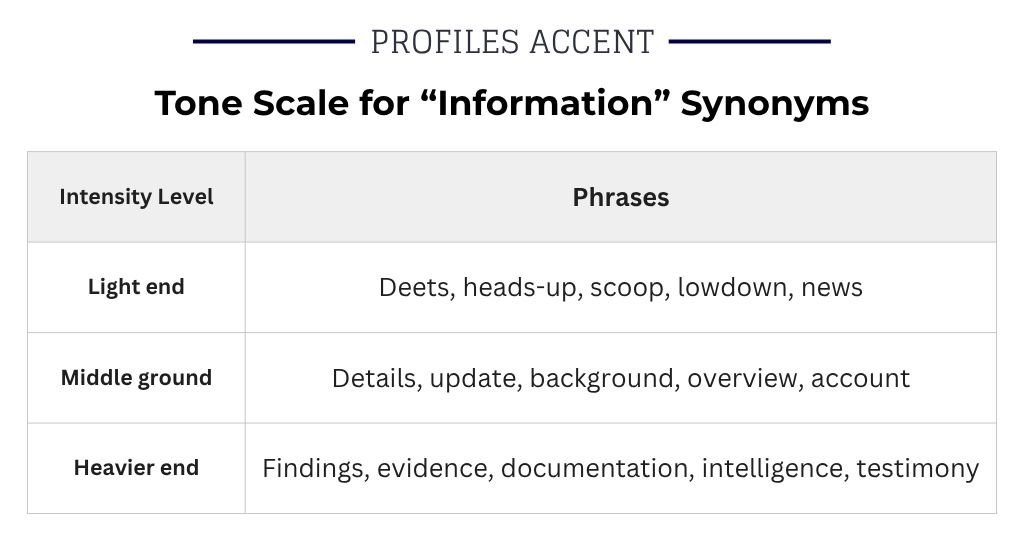
Not all synonyms carry the same weight. Here’s how some key words rank in terms of seriousness and authority:
- Light end: deets, heads-up, scoop, lowdown, news
- Middle ground: details, update, background, overview, account
- Heavier end: findings, evidence, documentation, intelligence, testimony
If you’re writing a performance review and you use the word “scoop,” that’s a tone mismatch. If you use “findings,” you sound deliberate and credible. The word you pick signals how seriously you’re treating the subject.
Same Sentence, Better Word: Rewrites Using Information Synonyms
Here’s where word choice makes a visible difference.
Original sentence: “Please share the information about the project.”
- Formal: “Please provide the full documentation regarding the project.”
- Casual: “Can you give me the rundown on the project?”
- Academic: “Kindly submit your findings related to the project scope.”
- Creative: “Walk me through everything you know about this project.”
Original sentence: “We collected information from the survey.”
- Formal: “We gathered substantial evidence through the survey process.”
- Casual: “We got all the details from the survey.”
- Academic: “The survey yielded meaningful data across all response categories.”
- Professional: “Survey metrics were collected and compiled for review.”
Each rewrite changes what the reader feels. The academic version sounds rigorous. The casual version feels approachable. Neither is wrong; they’re just calibrated differently.
Another Word for Information in an Essay, Email, or Story
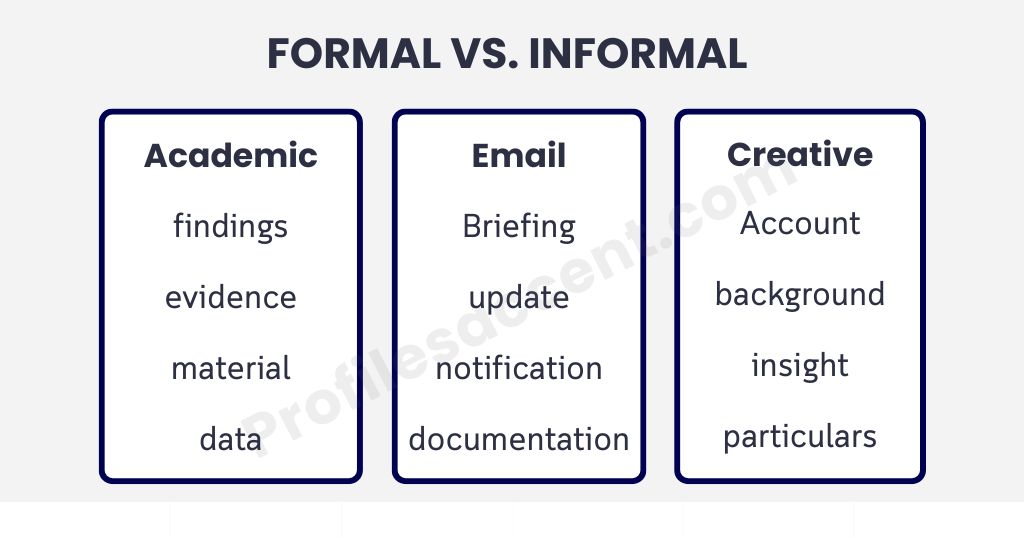
For essays and academic writing:
- Lean on “findings,” “evidence,” “material,” “data,” and “observations.” These signal that you’re dealing with verified, sourced content, not casual knowledge.
For professional emails:
- “Briefing,” “update,” “notification,” and “documentation” all work well. They keep the tone clean and purposeful without feeling distant.
For storytelling and creative writing:
- “Account,” “background,” “insight,” and “particulars” add texture. They let you describe information as part of a narrative, not just a list.
Words to avoid in formal writing:
- “Scoop,” “deets,” “lowdown,” “gen,” and “heads-up” all belong in informal spaces. They can work brilliantly in journalism or casual content, but they’ll undermine your credibility in academic or legal writing.
The Actionability Gap: A Smarter Way to Replace “Information”
Here’s something most synonym guides skip entirely. Before replacing “information,” ask yourself one question: does this need to drive action?
If yes, the better words are guidance, directive, instruction, or counsel. These imply that the reader needs to do something with what they receive.
If no, and you’re simply adding context, use background, overview, details, or particulars. These are context-setters, not action-drivers.
Using “guidance” when you mean “context” creates confusion. Using “background” when you actually want someone to act on something undersells the urgency. This distinction is invisible in most synonym lists but matters a lot in workplace writing.
Information Synonyms That Look the Same But Aren’t
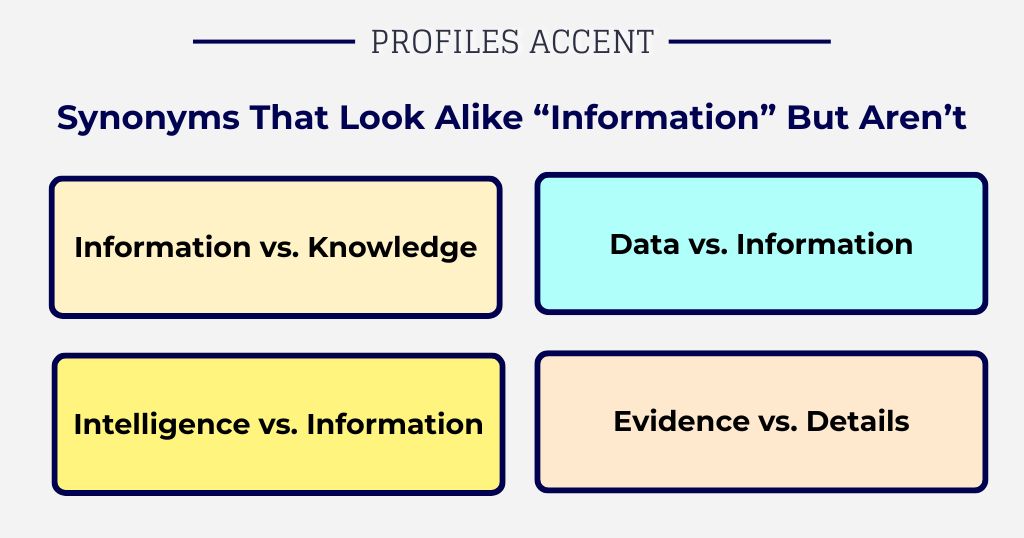
Information vs. Knowledge: Information is received. Knowledge is understood and retained. If someone tells you a country’s GDP, that’s information. If you can explain what it means and why it shifts, that’s knowledge. Using “knowledge” when you mean “information” quietly overstates what you’re claiming.
Data vs. Information: Data is raw. Information is data that has been organized or given context. Writing “the data confirms our approach” in a business report can sound imprecise if what you actually mean is the findings or interpreted results.
Intelligence vs. Information: Intelligence carries an edge. It suggests the content is strategic, gathered purposefully, or sensitive. “We received intelligence about the competitor’s launch” sounds very different from “we received information.” Use intelligence carefully and deliberately.
Evidence vs. Details: Evidence implies support for a specific claim. Details are simply specifics. They’re not the same level of claim. Evidence proves. Details describe.
When Certain Synonyms for Information Can Backfire
A few words on this list need careful handling.
- “Intelligence” has a completely different meaning when referring to cognitive ability. Always check that your context makes the intended meaning obvious.
- “Disclosure” implies something sensitive or previously hidden was revealed. Don’t use it casually when you simply mean “we shared the schedule.” It sets a different tone than you may intend.
- “Testimony” belongs in legal and formal settings. Using it loosely in casual writing makes the writing feel stiff and awkward.
Words Related to “Information” Worth Adding to Your Vocabulary
- Communicate (verb): The action of sharing information. Useful when describing the process, not the content.
- Transparency (noun): The quality of sharing information openly. Often used in organizational or trust-building contexts.
- Enlightenment (noun): A deeper, transformative form of understanding gained from information. More philosophical in weight.
- Awareness (noun): General understanding without deep detail. You’re informed, but not necessarily fully versed.
- Clarification (noun): A specific type of information shared to remove confusion. More precise than “information” in many situations.
The Right Synonym for Information Comes Down to Three Questions
If you’re stuck, here’s the shortcut:
Ask three things:
- Who is the audience?
- What is the purpose?
- Is this meant to inform, persuade, update, or guide?
Once you know those three things, the right synonym becomes obvious. A research paper needs “findings.” A team email needs an “update.” A conversation with a friend needs the “lowdown.” A legal document needs “documentation” or “testimony.”
The word “information” isn’t weak. But it’s a placeholder until you find the word that actually fits your moment. Now you have more than forty options to pick from, each with a reason behind it.
Discover More Articles:

I’m Rowan, a language addict who loves exploring how words work in everyday communication. I’ve spent years studying English vocabulary and helping others express themselves more clearly. My goal is simple: make learning new words easy and practical. I focus on real-life examples that show when and how to use different terms. Through clear explanations and honest guidance, I help readers choose the right words for any situation with confidence.