You’ve just finished writing a paragraph. You read it back. The word “overall” appears three times. It sounds repetitive, a little flat, and you know a better word exists somewhere. You just can’t think of it right now.
That’s exactly what this guide fixes.
“Overall” is a useful word, but it gets overworked fast. The bigger problem? Not all its replacements mean the same thing. Swapping the wrong one into your sentence can shift your tone, confuse your reader, or even lower your score in academic writing.
This guide gives you the right word for the right moment.
What “Overall” Actually Does in a Sentence
Overall pulls two jobs. Sometimes it works as an adverb, wrapping up a thought or giving a broad impression. Other times it works as an adjective, sitting in front of a noun to describe something that covers everything.
- “The overall result was positive.” (adjective)
- “Overall, the trip went well.” (adverb)
That difference matters a lot when choosing a replacement.
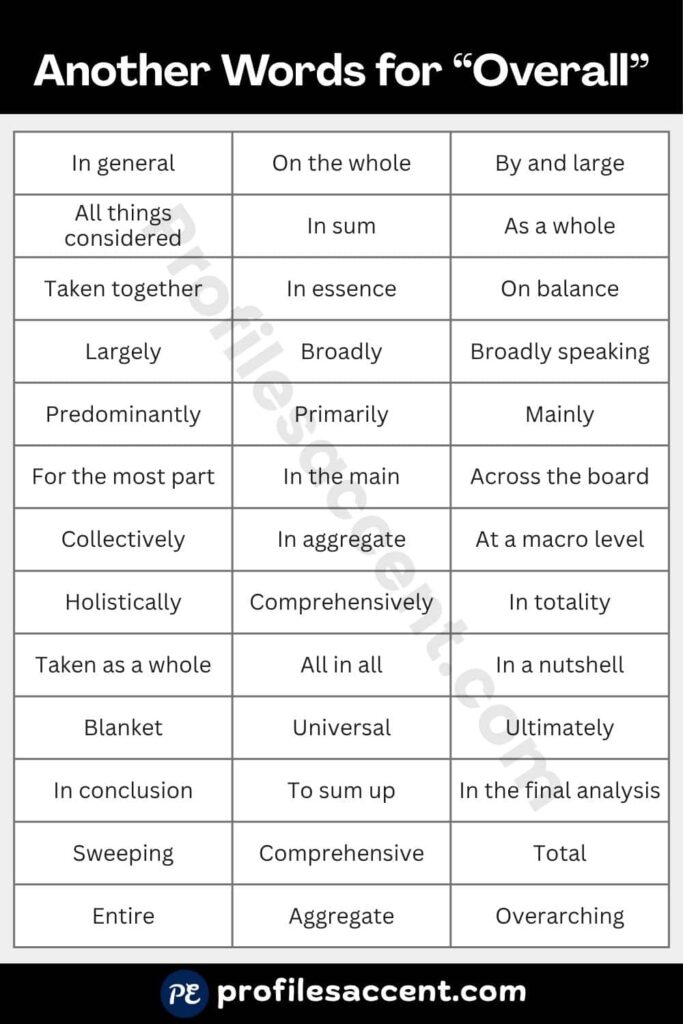
40+ Quick Synonym Table of Overall at a Glance
| Word/Phrase | Tone | Use It When | Example |
| In general | Neutral | Giving a broad view | In general, the plan worked. |
| On the whole | Slightly formal | Weighing everything together | On the whole, results improved. |
| By and large | Conversational | Casual summary | By and large, people agreed. |
| All things considered | Balanced | After listing pros and cons | All things considered, it was fair. |
| In sum | Formal | Academic conclusion | In sum, the evidence is strong. |
| As a whole | Neutral | Describing a group or system | The team, as a whole, performed well. |
| Taken together | Formal | Combining multiple findings | Taken together, the data shows growth. |
| In essence | Formal | Capturing the core point | In essence, the idea is simple. |
| On balance | Professional | After weighing two sides | On balance, benefits outweigh risks. |
| Largely | Neutral | Mostly true, with some exceptions | Largely, the system works. |
| Broadly | Neutral | Wide but not absolute | Broadly, this approach succeeds. |
| Broadly speaking | Neutral | Introducing a generalization | Broadly speaking, costs rose. |
| Predominantly | Formal | Mostly, with clear emphasis | Predominantly positive feedback. |
| Primarily | Formal/Professional | Main focus | Primarily driven by demand. |
| Mainly | Neutral | Most cases | Mainly used for summaries. |
| For the most part | Conversational | With few exceptions | For the most part, it went smoothly. |
| In the main | Slightly formal | British English tone | In the main, students responded well. |
| Across the board | Professional | Consistent in all areas | Results improved across the board. |
| Collectively | Formal | Group action or outcome | Collectively, the studies confirm this. |
| In aggregate | Technical | Data and statistics | In aggregate, sales rose 12%. |
| At a macro level | Academic/Research | Big-picture view | At a macro level, the pattern is clear. |
| Holistically | Academic | Looking at the full system | Viewed holistically, the model works. |
| Comprehensively | Formal | Thorough and complete scope | Comprehensively reviewed and approved. |
| In totality | Formal | Full extent of something | Consider the evidence in totality. |
| Taken as a whole | Formal | Synthesizing all parts | Taken as a whole, the research is solid. |
| All in all | Informal | Casual wrap-up | All in all, a good experience. |
| In a nutshell | Casual | Quick informal summary | In a nutshell, it worked. |
| When all is said and done | Informal | After everything is done | When all is said and done, it matters. |
| At the end of the day | Informal | Conversational conclusion | At the end of the day, effort counts. |
| Ultimately | Neutral to formal | Final point after a process | Ultimately, the choice is yours. |
| In conclusion | Formal | Closing an essay or report | In conclusion, three themes emerge. |
| To sum up | Neutral | Wrapping up any writing | To sum up, the results were mixed. |
| In the final analysis | Formal | Thoughtful final judgment | In the final analysis, trust matters. |
| Sweeping | Descriptive | Wide range of effect | Sweeping changes were introduced. |
| Comprehensive | Adjective, formal | Covering everything | A comprehensive review was done. |
| Total | Adjective, neutral | Complete quantity | The total impact was significant. |
| Entire | Adjective, neutral | All parts included | The entire process was reviewed. |
| Aggregate | Adjective, technical | Combined total | The aggregate cost exceeded estimates. |
| Overarching | Adjective, formal | Main theme or goal | The overarching strategy was clear. |
| Blanket | Adjective, professional | Applies to all cases | A blanket policy was introduced. |
| Universal | Adjective, strong | True in every case | Universal access was the goal. |
The Part Most Writers Miss When Replacing Overall
Here’s something no synonym list will tell you clearly. You cannot swap adverb replacements into adjective positions and vice versa.
- Consider this sentence: “The overall budget exceeded projections.”
You cannot replace “overall” with “in general” here. “In general budget” makes no sense. You need an adjective replacement like “total,” “aggregate,” or “comprehensive.”
But in this sentence: “Overall, the project succeeded,” you need an adverb phrase. “In general,” “on the whole,” or “by and large” all work here.
Always check what job overall is doing before you replace it.
Meaning Clusters: Not All Overall Synonyms Work the Same Way
Words That Summarize
These close an argument or wrap up a thought. They tell your reader: we’ve covered everything, here’s my conclusion.
“In sum” is tight and academic. “All things considered” implies you’ve weighed two sides. “On balance” leans toward professional writing and suggests a judgment call was made.
Words That Describe Scope
These describe how wide something is, not how it ends.
- “Comprehensive” says nothing was left out.
- “Overarching” points to a theme that covers everything underneath it.
- “Blanket” means the same rule applies to all cases, no exceptions.
Words That Show a Trend
“Largely,” “predominantly,” and “broadly” all suggest something is mostly true. They leave room for exceptions. “Universally” does not leave room. Use it only when something truly applies to everyone, everywhere.
How Strong Is Your Word? A Tone Scale for Overall Synonyms
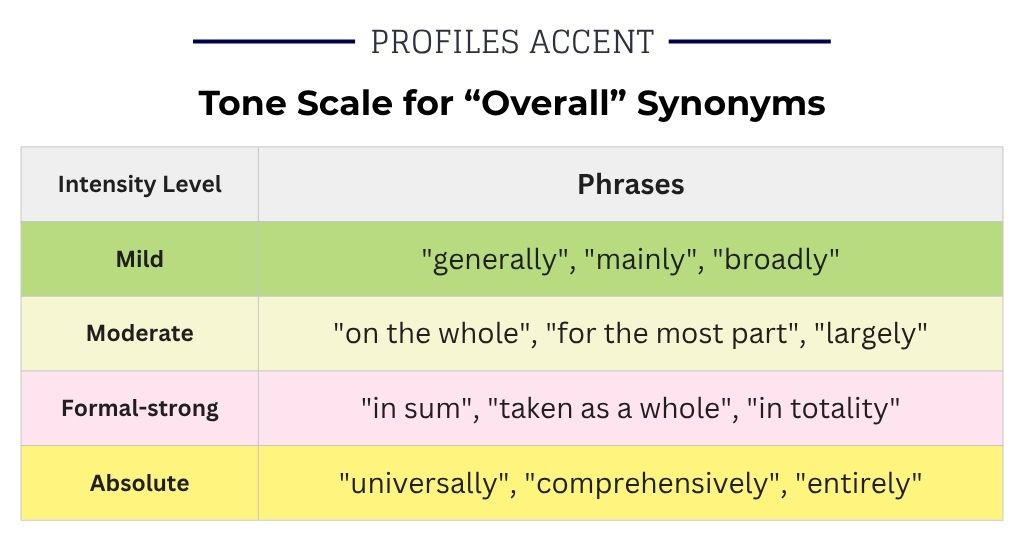
Not every synonym carries the same weight. Here’s how they line up from lightest to strongest:
- Mild: “generally” / “mainly” / “broadly”
- Moderate: “on the whole” / “for the most part” / “largely”
- Formal-strong: “in sum” / “taken as a whole” / “in totality”
- Absolute: “universally” / “comprehensively” / “entirely”
Using a strong word like “universally” when you mean “mostly” is a common mistake. It makes your writing look overstated.
Seeing the Difference: Overall Synonym Rewrites in Real Sentences
Original: “Overall, the feedback was good.”
- Formal: “On balance, the feedback reflected positively on the program.”
- Academic: “Taken as a whole, participant responses indicated a favorable outcome.”
- Casual: “All in all, people liked it.”
- Professional email: “By and large, the response has been encouraging.”
Original: “The overall cost was high.”
- Formal: “The aggregate cost surpassed initial projections.”
- Neutral: “The total expenditure was higher than expected.”
- Academic: “The comprehensive financial assessment revealed significant overspending.”
Original: “Overall, students performed well.”
- Research tone: “Collectively, student performance data showed improvement.”
- IELTS essay: “In general, students demonstrated a strong grasp of core concepts.”
Notice how each replacement shifts not just the word but the entire feeling of the sentence.
Which Overall Synonym Fits Where: Context-by-Context Breakdown
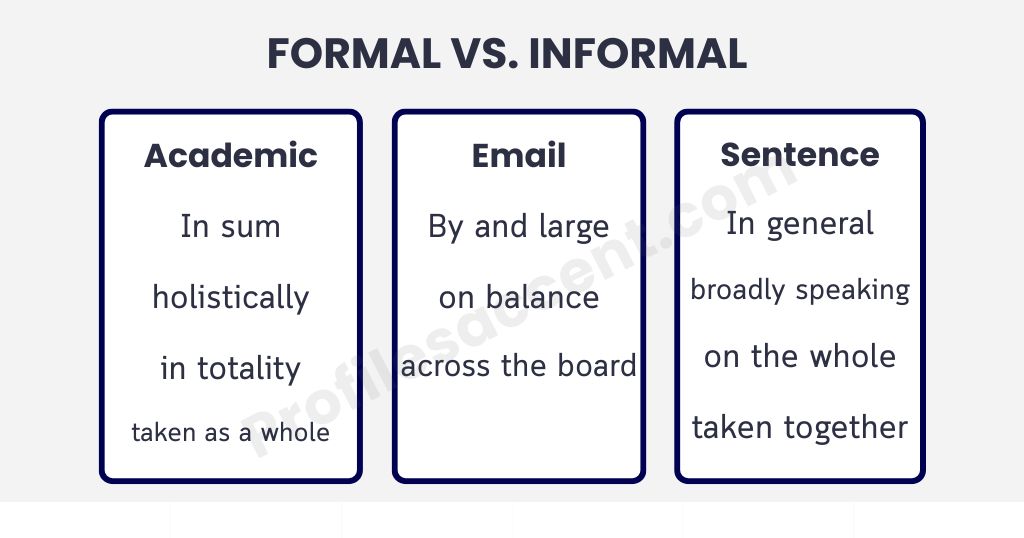
For essays and academic writing: “In sum,” “taken as a whole,” “holistically,” “in totality.” Avoid “all in all” in formal essays. It reads as idiomatic and can lower your score.
For IELTS Writing Task 1: “Overall” is actually expected in the overview paragraph. In Task 2, swap it for “in general,” “on the whole,” or “all things considered” to show vocabulary range.
For research papers and theses: “Collectively,” “in aggregate,” “at a macro level,” “taken together.” These signal data-handling precision.
For emails and professional writing: “By and large,” “on balance,” “across the board.” These feel natural without sounding stiff.
For starting a sentence: “In general,” “broadly speaking,” “on the whole,” “taken together” all work cleanly at the start. “In a nutshell” and “at the end of the day” work in conversation but not in formal writing.
Sometimes the Best Overall Synonym Is No Word at All
This is the tip most writers never hear. Sometimes “overall” adds nothing. It just fills space.
- Weak: “Overall, the project was a success.”
- Stronger: “The project delivered on every key target and finished under budget.”
Before reaching for a synonym, ask yourself: does this word add meaning, or is it a verbal habit? If the sentence works without it, cut it.
This makes writing tighter and more confident.
Mistakes People Make When Choosing Another Word for Overall
- Mixing informal phrases into formal writing. “At the end of the day” belongs in conversation, not in research papers.
- Using “universally” when you mean “mostly.” These are not the same. “Universally” leaves zero exceptions.
- Treating “in conclusion” and “in summary” as identical. “In conclusion” closes an argument. “In summary” just recaps what was said. The difference matters in essays.
- Replacing an adjective “overall” with an adverb phrase. “In general cost” is not English. Check the grammar before swapping.
- Overusing “holistically” in casual writing. It’s an academic term. In everyday writing, it sounds forced.
Related Words That Work Alongside Overall Synonyms
Cumulative: Builds over time. “The cumulative effect of small changes is significant.” Not a direct synonym but useful when outcomes build gradually.
Widespread: Covers a large area or many people. Not the same as “overall” but useful when describing reach.
Sweeping: Great in creative or political writing. “Sweeping reforms were introduced.” Implies scale and impact.
Sequential: Not a synonym, but often confused when someone means things happened across a timeline rather than all at once.
Picking the Right Synonym for Overall, Every Single Time
Here’s the short version of everything above.
- If you’re closing an academic argument, use “in sum,” “taken as a whole,” or “on balance.”
- If you’re describing something that covers everything, use “comprehensive,” “total,” or “aggregate.”
- If you’re writing casually, “all in all” or “by and large” will feel natural.
- If you’re writing for IELTS, vary between “in general,” “on the whole,” and “all things considered,” and keep the informal phrases out of Task 2.
When in doubt, check what “overall” is doing in the sentence first. That single step will point you to the right replacement faster than any list.
Discover More Articles:

I’m Rowan, a language addict who loves exploring how words work in everyday communication. I’ve spent years studying English vocabulary and helping others express themselves more clearly. My goal is simple: make learning new words easy and practical. I focus on real-life examples that show when and how to use different terms. Through clear explanations and honest guidance, I help readers choose the right words for any situation with confidence.