There’s a moment every writer knows. You’ve typed the word hope three times in two paragraphs, and it’s starting to feel thin. Hollow, even. Not because hope is a weak idea, but because the same word used repeatedly loses its weight. It stops landing.
The bigger problem? “Hope” covers a wide emotional range. The quiet hope of a child waiting for snow. The desperate hope of someone in a hospital waiting room. The professional hope in a business proposal. These are not the same feeling, and they shouldn’t share the same word.
This guide helps you find the exact word you actually mean, not just a swap that sounds similar.
What the Word Hope Is Really Carrying
At its core, hope is the belief that something good is possible, even when it isn’t certain. It sits between doubt and confidence. It leans forward. Emotionally, it carries warmth, longing, and a kind of quiet courage. The tone can be soft or urgent, personal or collective, spiritual or practical.
That range is exactly why finding the right synonym matters.
Another Word for Hope: 45+ Synonyms at a Glance
| Word | Tone | Best For | Quick Example |
| Wish | Gentle, personal | Casual writing, creative | “Her only wish was to go home.” |
| Aspiration | Formal, ambitious | Essays, goals | “His aspiration kept him going.” |
| Desire | Emotional, strong | Storytelling, character voice | “A quiet desire burned inside her.” |
| Longing | Aching, bittersweet | Poetry, emotional writing | “He felt a deep longing for peace.” |
| Expectation | Neutral, forward-looking | Professional, formal | “The team had high expectations.” |
| Anticipation | Excited, positive | Upbeat writing, events | “Anticipation filled the room.” |
| Faith | Spiritual, deep | Religious, personal essays | “She held onto her faith.” |
| Trust | Calm, relational | Interpersonal writing | “There was trust in her voice.” |
| Yearning | Intense, emotional | Literary, creative fiction | “A deep yearning pulled at him.” |
| Confidence | Strong, assured | Professional, academic | “The team moved forward with confidence.” |
| Optimism | Bright, forward | Motivational, general writing | “Optimism carried them through winter.” |
| Belief | Firm, quiet | Academic, personal | “Her belief in change never wavered.” |
| Vision | Bold, purposeful | Leadership, essays | “The founder had a clear vision.” |
| Prayer | Spiritual, vulnerable | Religious contexts | “Her prayer was simple and honest.” |
| Craving | Urgent, deep | Fiction, strong emotion | “He had a craving for a fresh start.” |
| Prospect | Neutral, practical | Business, planning | “The prospect of growth excited them.” |
| Ambition | Driven, intense | Career writing, essays | “Ambition pushed her past the setback.” |
| Promise | Warm, forward | General, storytelling | “There was promise in the new year.” |
| Dream | Soft to bold | Creative, personal narratives | “She never let go of that dream.” |
| Assurance | Calm, confident | Formal letters, professional | “They offered assurance of support.” |
| Enthusiasm | Energetic, outward | Casual, upbeat writing | “Enthusiasm lit up the whole group.” |
| Inclination | Mild, thoughtful | Academic, careful tone | “He had an inclination it would work.” |
| Conviction | Strong, certain | Speeches, essays | “She spoke with deep conviction.” |
| Reliance | Trust-based | Interpersonal, professional | “His reliance on the plan was steady.” |
| Possibility | Open, neutral | General, creative | “The possibility kept her moving.” |
| Potential | Neutral, growth-focused | Coaching, academic | “The potential here is undeniable.” |
| Fortitude | Strong, moral | Literary, formal | “Fortitude replaced fear over time.” |
| Resilience | Emotional strength | Inspirational, personal | “Resilience carried her through it.” |
| Zeal | Fired up, passionate | Motivational, speeches | “Zeal replaced doubt in his chest.” |
| Gleam | Poetic, faint | Creative writing | “A gleam of something better remained.” |
| Outlook | Neutral, forward | Professional, general | “A positive outlook shaped the work.” |
| Assent | Agreeable, neutral | Formal, light | “He gave assent to the possibility.” |
| Hunger | Urgent, raw | Fiction, emotional | “A hunger for justice drove her.” |
| Idealism | High-minded | Essays, political writing | “Youthful idealism never fully died.” |
| Buoyancy | Light, uplifting | Upbeat storytelling | “A sense of buoyancy lifted the group.” |
| Tenacity | Firm, determined | Inspirational, professional | “Tenacity replaced the despair slowly.” |
| Warmth | Soft, relational | Personal essays, letters | “She offered warmth in her words.” |
| Serenity | Calm, spiritual | Meditation, personal writing | “Serenity settled in where fear had been.” |
| Anticipation | Eager, positive | Events, transitions | “She woke with anticipation each morning.” |
| Charity | Generous, spiritual | Religious, formal | “He extended charity in his thinking.” |
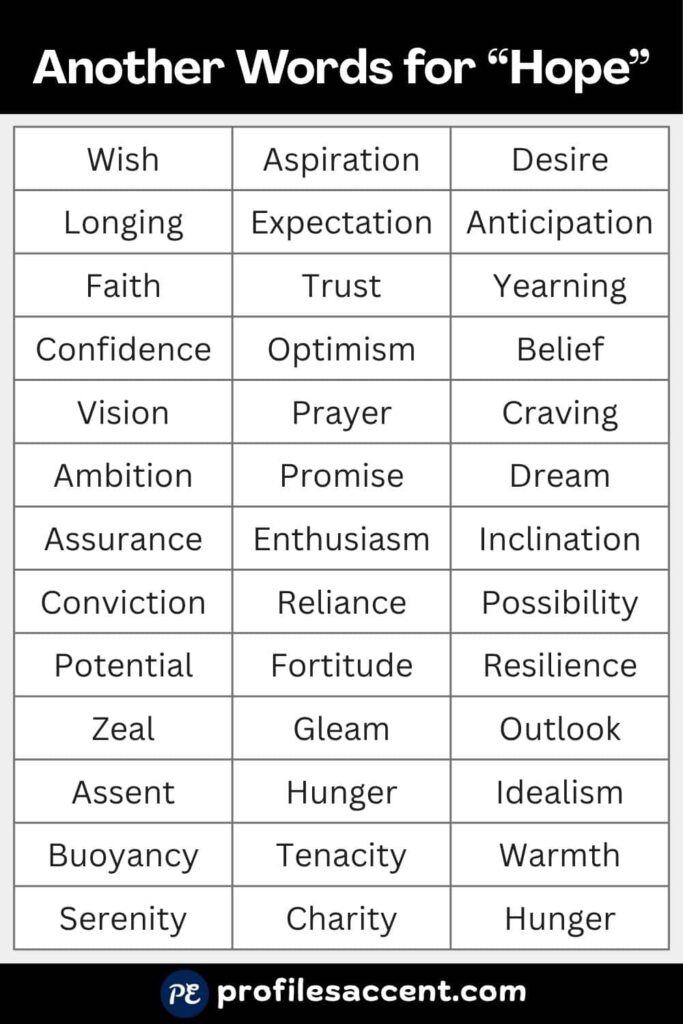
Hope Synonyms Grouped by What They Actually Mean
Not all of these words are interchangeable. Grouping them helps you see the real differences.
Soft and Personal Hope Synonyms
Wish, dream, longing, warmth. These words carry a quiet emotional weight. They’re inward. A character using these words feels vulnerable, not loud. Perfect for personal essays or fiction where the narrator is soft-spoken.
Strong and Action-Driven Words for Hope
Ambition, conviction, zeal, tenacity, hunger. These are active. They imply movement, not just feeling. Use them when your subject is pushing toward something, not just wishing for it.
Formal Synonyms for Hope
Expectation, prospect, assurance, outlook, confidence. Strip away the emotion. These are clean, forward-looking words that work in business writing, academic essays, or professional emails without sounding sentimental.
Spiritual and Devotional Words for Hope
Faith, prayer, charity, serenity, belief. These words carry a religious or philosophical layer. Be intentional with them. Using “prayer” in a secular piece can shift the tone in a way you didn’t plan.
Poetic Alternatives to Hope
Yearning, gleam, buoyancy, longing, idealism. These belong in creative writing where feeling is the whole point. They carry atmosphere. They stretch meaning past the literal.
How Intense Is Your Hope? A Scale of Synonyms
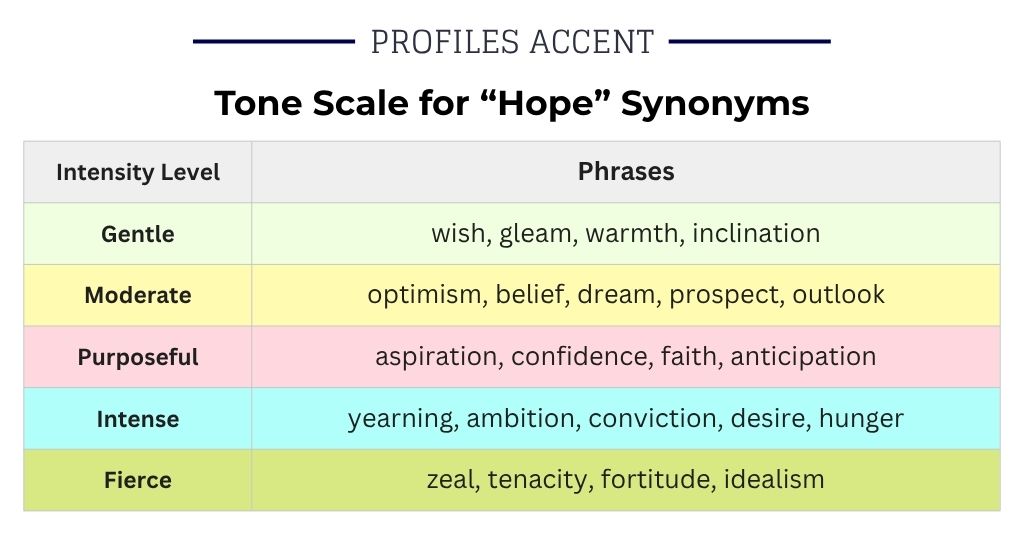
If you picture hope on a sliding scale from soft to fierce, the word you pick places your writing somewhere on that spectrum. Here’s a rough guide:
- Gentle: wish, gleam, warmth, inclination
- Moderate: optimism, belief, dream, prospect, outlook
- Purposeful: aspiration, confidence, faith, anticipation
- Intense: yearning, ambition, conviction, desire, hunger
- Fierce: zeal, tenacity, fortitude, idealism
A sentence built around “gleam” and a sentence built around “zeal” are emotionally miles apart, even if both trace back to the idea of hope. That gap is exactly what synonym choices control.
Replacing “Hope” in Real Sentences: Before and After
Here are four original sentences rewritten across different tones. No rewrite is better by default. Each serves a different context.
Original: “She hoped things would get better.”
- Formal essay: “She held firm in her expectation that conditions would improve.”
- Casual storytelling: “Something inside her still believed it could turn around.”
- Academic: “Her sustained optimism contributed to her persistence through difficulty.”
- Literary: “A quiet yearning kept her from giving up, even when logic suggested otherwise.”
Each version changes how the reader feels about the character. The literary version makes her complex. The academic version makes her a subject. The casual version makes her relatable.
Original: “I hope you’re doing well.”
- Professional email: “I trust this message finds you in good health.”
- Warmer professional: “I’m confident you’re doing well and look forward to connecting.”
- Casual text: “Hope things are going good on your end.”
The phrase “I hope you’re doing well” has become almost invisible in emails. Swapping it signals that you actually thought about the opening line.
Where Each Hope Synonym Belongs: Formal vs. Informal
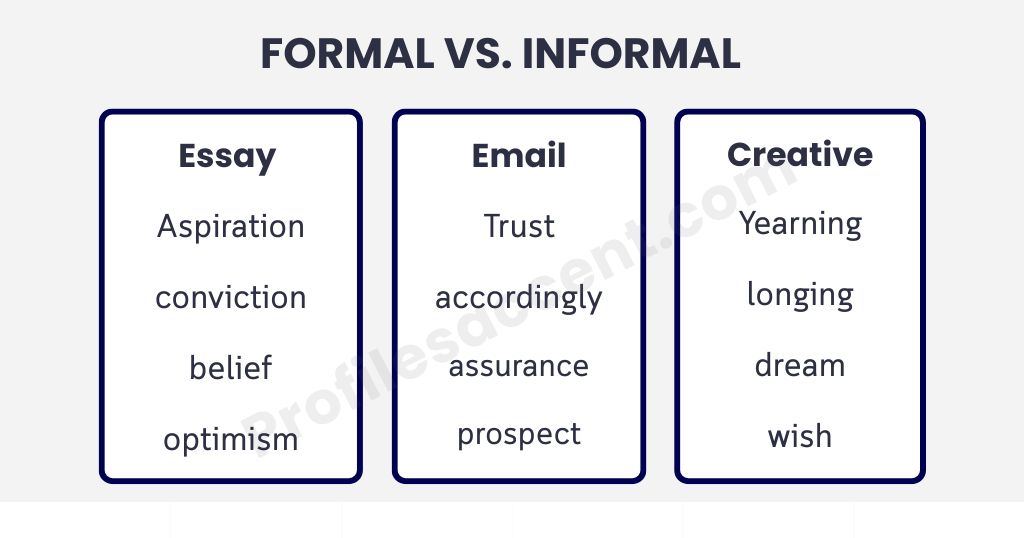
Use in essays and academic writing:
- Aspiration, conviction, belief, optimism, expectation, idealism, confidence
Use in professional emails:
- Trust, assurance, prospect, outlook, confidence, expectation
Use in creative and personal writing:
- Yearning, longing, dream, wish, gleam, desire, warmth, faith
Use in spiritual or devotional writing:
- Faith, prayer, serenity, charity, belief
Words to avoid in formal writing:
- Craving, hunger, zeal (too raw), gleam (too vague), warmth (too soft for most professional contexts)
Hope Synonyms That Writers Confuse Most
Swapping “hope” with “expect” carelessly. These feel similar, but expectation implies more certainty. Saying “I expect it will rain” sounds like a prediction. “I hope it won’t” sounds like a wish. They’re not the same emotionally.
Using “wish” in professional writing. Wishing sounds passive. In a formal context, it reads as weak. “We wish you success” in a business proposal feels like a greeting card, not a strategy.
Treating “faith” as universally spiritual. In some contexts, faith is simply about trust. But many readers will read a spiritual layer into it automatically. Know your audience before using it.
Overusing “optimism.” It’s a great word, but it can sound performed, especially in personal writing. Real optimism in prose shows through action and tone, not just by naming it.
Confusing “yearning” with “longing.” They’re close but not identical. Yearning often implies a stronger physical pull. Longing tends to feel more reflective, more distant. The difference is subtle but real in literary writing.
Words That Live Close to Hope but Mean Something Different
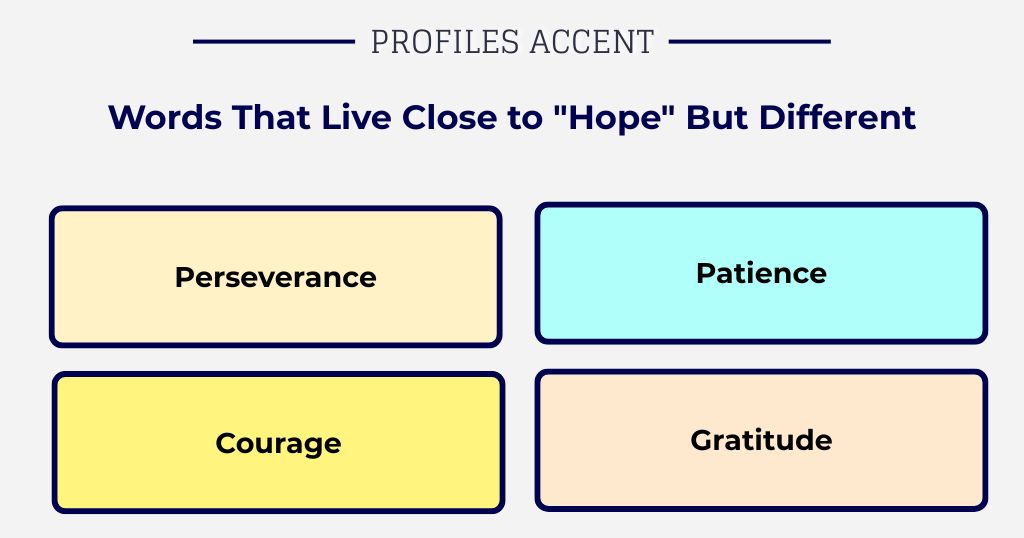
These aren’t direct synonyms, but they live near hope and often pair with it.
- Perseverance: Continuing despite difficulty. Hope fuels it, but perseverance is the action.
- Courage: Often what hope requires. You can feel hopeful and still need courage to act on it.
- Patience: Hope that waits without demanding. Passive in form, but quietly strong.
- Gratitude: Sometimes the result of fulfilled hope. Worth using when looking backward.
- Possibility: The condition that makes hope logical. Hope needs possibility to exist.
When Choosing a Hope Synonym Requires Extra Care
In mental health writing, be careful with words that minimize or inflate the concept.
- “Wish” can feel dismissive when used to describe someone’s deep need for recovery.
- “Faith” can feel exclusionary in secular or multicultural contexts if misread.
- “Optimism” in a clinical context risks making struggle sound like a personal failure of attitude.
Write with care when hope touches grief, loss, illness, or trauma. The word you pick either holds the reader or distances them.
The Right Synonym for Hope Changes Everything
The best synonym for hope is the one that carries exactly as much weight as your sentence needs. Soft situations call for soft words. Driven characters need driven language. Professional contexts need words that move forward without sentiment.
If your writing feels flat, the word isn’t the problem. The mismatch between your word and your meaning is. Use this guide to close that gap.
Discover More Articles:

I’m Rowan, a language addict who loves exploring how words work in everyday communication. I’ve spent years studying English vocabulary and helping others express themselves more clearly. My goal is simple: make learning new words easy and practical. I focus on real-life examples that show when and how to use different terms. Through clear explanations and honest guidance, I help readers choose the right words for any situation with confidence.