You’ve typed the word “building” three times in two paragraphs. It’s starting to feel flat. Maybe you’re writing an essay, a business report, or a creative piece, and suddenly that one word is everywhere, pulling energy out of your writing without you even noticing.
The fix isn’t just swapping in a random synonym. The wrong replacement can make a sentence sound stiff, wrong, or even unintentionally funny. Imagine writing “the army secured the domicile” when you meant a military base. That’s a tone disaster.
This guide cuts through the noise. You’ll find 35+ strong alternatives, understand which ones fit where, and walk away knowing exactly how to use them.
What Does “Building” Really Mean Across Different Uses
At its core, a building is a physical structure with walls and a roof, made for people to use. But the word does more than one job. It can be a noun (the structure itself), a verb (the act of constructing), or part of a phrase like “building trust” or “building a team.” Each job needs different words. That’s the real challenge.
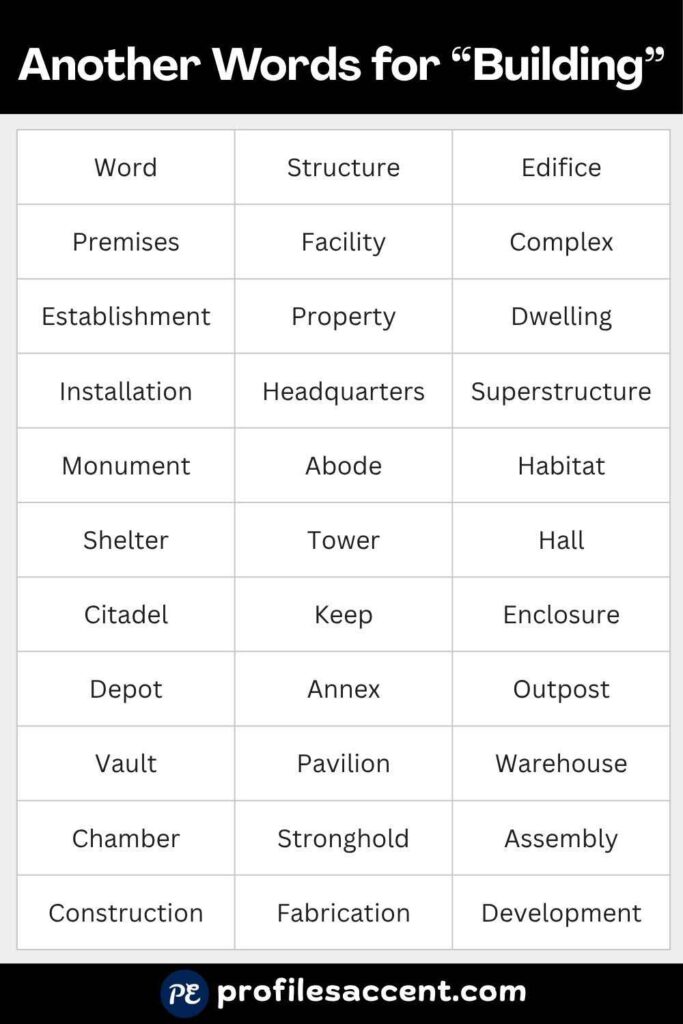
Quick Another Word for Building: 35+ Synonyms at a Glance
| Word | Tone | Best Used When | Quick Example |
| Structure | Neutral | Describing form or engineering | The old structure needs repair. |
| Edifice | Formal/Grand | Large, impressive buildings | The stone edifice drew crowds. |
| Premises | Legal/Official | Business or legal contexts | Staff must badge into the premises. |
| Facility | Functional | Buildings with specific uses | The training facility opens Monday. |
| Complex | Technical | Group of connected buildings | The hospital complex spans two blocks. |
| Establishment | Formal | Businesses or institutions | A well-known dining establishment. |
| Property | Ownership context | Real estate, law, finance | The property sold above asking price. |
| Dwelling | Residential | Homes and living spaces | A modest dwelling near the river. |
| Installation | Military/Industrial | Functional or defense sites | A coastal radar installation. |
| Headquarters | Organizational | Main office of a company | Their headquarters moved to Austin. |
| Superstructure | Academic/Technical | Built above a foundation | The superstructure showed stress cracks. |
| Monument | Historical | Buildings with lasting significance | A monument to civic pride. |
| Abode | Literary/Poetic | Creative or storytelling writing | She returned to her quiet abode. |
| Habitat | Environmental | Where people or animals live | A natural habitat, now urbanized. |
| Shelter | Basic/Survival | Simple protective structure | They built a shelter from branches. |
| Tower | Specific form | Tall vertical structures | The glass tower reflected the sky. |
| Hall | Communal use | Public or gathering spaces | The town hall was packed. |
| Citadel | Historical/Dramatic | Fortified or imposing structures | The citadel stood for five centuries. |
| Keep | Archaic/Historical | Old defensive structures | Knights defended the castle keep. |
| Enclosure | Practical | Fenced or walled-off areas | The livestock enclosure was expanded. |
| Depot | Industrial/Transport | Storage or distribution hubs | Goods arrived at the city depot. |
| Annex | Structural add-on | Extension of a main building | The annex houses overflow offices. |
| Outpost | Remote/Military | Structures far from the center | A research outpost near the poles. |
| Vault | Secure/Underground | Reinforced or underground rooms | The records are stored in the vault. |
| Pavilion | Outdoor/Elegant | Open or park structures | A wedding pavilion by the lake. |
| Warehouse | Storage/Industrial | Large storage buildings | The warehouse holds excess inventory. |
| Chamber | Interior/Formal | A specific room or enclosed space | The council met in the upper chamber. |
| Stronghold | Military/Dramatic | Secure or defensive positions | The valley stronghold fell at dawn. |
| Assembly | Process context | Act of putting together | The assembly of parts took three days. |
| Construction | Process context | The act of building | Construction started in spring. |
| Fabrication | Technical process | Building from components | Steel fabrication runs on a tight schedule. |
| Development | Growth/Planning | New buildings or areas | A residential development near the school. |
One Word, Three Different Jobs
This is what most synonym lists miss. “Building” shifts meaning based on how it’s used. A physical structure and the act of constructing something need entirely different replacements.
As a physical object: Go with structure, edifice, premises, or facility. These all describe something that already exists and can be seen.
As an ongoing action: Words like construction, erection, fabrication, or assembly describe a process still happening. “The construction is 60% complete” works perfectly. “The edifice is 60% complete” sounds off.
As a metaphor or growth phrase: This is where most writers struggle. When you write “building a team” or “building confidence,” you need a different vocabulary altogether.
For “building relationships,” stronger choices include: fostering connections, cementing partnerships, nurturing rapport, or deepening ties. Each carries a slightly different feel. “Fostering” suggests care and patience. “Cementing” suggests permanence and effort. Pick based on what you actually mean.
For “building a team,” consider: assembling a unit, mobilizing talent, shaping a workforce, or consolidating a group. “Assembling” is quick and action-focused. “Shaping” suggests a longer, more thoughtful process.
For building up (growth or accumulation), try: escalating, expanding, compounding, amplifying, or reinforcing. These work well in both business writing and academic essays.
A Tone Scale for Building Synonyms
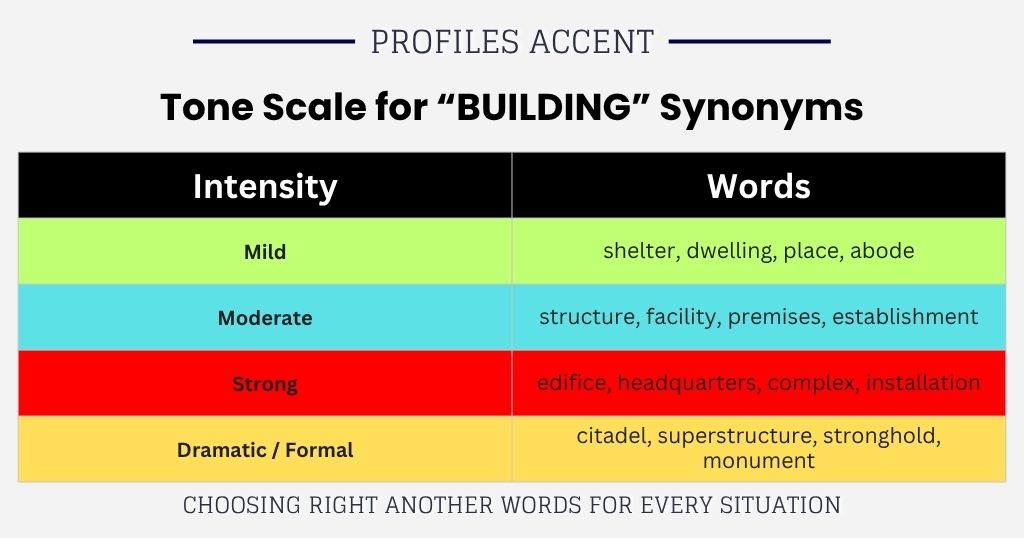
Not all synonyms carry equal weight. Here’s how some of these words rank from low-key to high-impact:
- Mild: shelter, dwelling, place, abode
- Moderate: structure, facility, premises, establishment
- Strong: edifice, headquarters, complex, installation
- Dramatic/Formal: citadel, superstructure, stronghold, monument
If you’re writing a casual email, “place” or “facility” is perfectly fine. If you’re writing about a cathedral, a courthouse, or a parliament building, “edifice” or “monument” will carry the weight the subject deserves.
Sentence Rewrites: See the Difference
Weak: “The building was damaged in the storm.”
- Formal: “The structure sustained significant damage during the storm system.”
- Academic: “The architectural installation suffered considerable deterioration as a result of the meteorological event.”
- Creative: “Wind tore through the old premises like it had a grudge.”
- Casual: “The place got hit pretty bad in the storm.”
Each version says the same thing. But they feel completely different. The creative version uses “premises” in an unexpected way, giving it personality. The formal version uses “structure” to stay neutral and professional.
Weak: “We need to focus on building trust with clients.”
- Business writing: “We need to prioritize cementing client confidence through consistent delivery.”
- Casual: “Let’s work on connecting better with the people we serve.”
- Academic: “Establishing relational credibility with stakeholders remains a central organizational priority.”
Notice how “cementing” in the business version implies it’s a deliberate, lasting effort. That’s a stronger signal than “building.”
Synonyms for Building in Formal vs. Everyday Writing
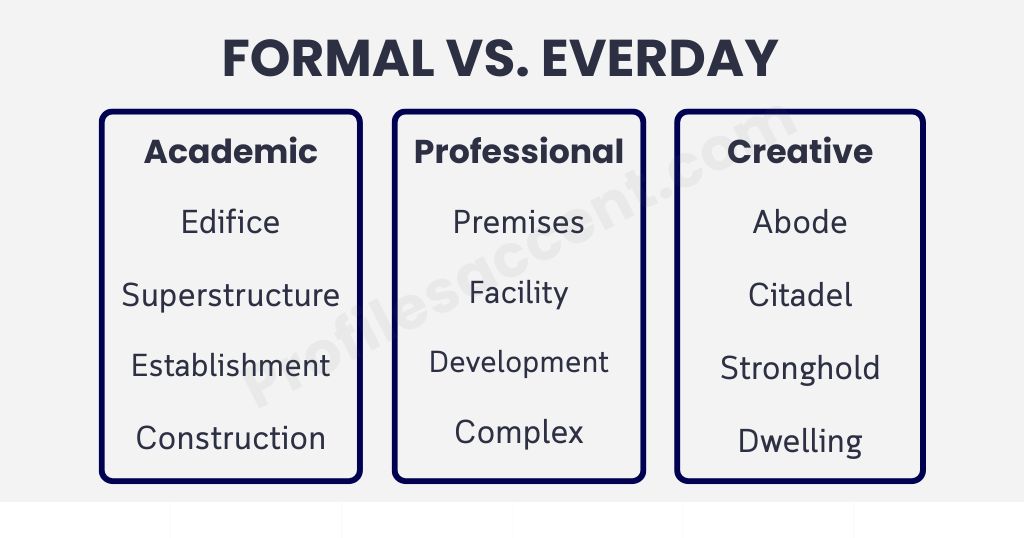
- Best for essays and academic writing: edifice, superstructure, establishment, construction, fabrication. These carry intellectual weight and sound considered.
- Best for business emails and reports: premises, facility, headquarters, development, complex. These are clean and functional without sounding stiff.
- Best for storytelling and creative writing: abode, citadel, stronghold, dwelling, tower, haven. These carry atmosphere and visual weight.
- Avoid in formal writing: spot, place, joint, setup. These belong in casual speech, not reports or essays.
Synonym Swaps That Silently Backfire
Domicile is not a general synonym. It’s a legal residential term. You would not call a sports stadium or a factory a domicile. Writers who pick it from a thesaurus without context often create sentences that read as unintentionally comic.
Edifice implies grandeur. Don’t use it for a small garden shed or a roadside convenience store. Reserve it for buildings that genuinely impress by size, history, or design.
Construction can mean the product or the process. “The construction was beautiful” (the result) and “construction is underway” (the process) are both valid, but they describe different things. Be clear which meaning you intend.
Premises is almost always plural. Saying “a premises” is grammatically awkward in most styles. Use it in a plural context or restructure the sentence.
Facility works better when there’s a specific function involved. A vague building with no clear purpose is better called a structure. A building for training, treating patients, or manufacturing is a facility.
Words That Live in the Same Neighborhood
Blueprint: Not the building itself, but the plan behind it. Useful in metaphorical writing when describing strategies or frameworks.
Footprint: Refers to the ground area a building covers. Helpful in architectural or environmental discussions.
Facade: The outer face of a building. Also used figuratively for appearances that hide what’s underneath.
Framework: The underlying support system. Works both literally and metaphorically, especially when writing about organizations or ideas.
Infrastructure: The broader system buildings exist within, roads, utilities, systems. Used in planning, policy, and civic writing.
So Which Synonym for Building Should You Actually Use?
The word you choose signals how seriously you take your writing. “Structure” is safe and neutral. “Edifice” announces importance. “Premises” signals formality. “Abode” tells a story.
Before swapping in any synonym, ask three quick questions:
- Is this a physical object or an action?
- What tone does the context require?
- Does this word fit the size and purpose of what I’m describing?
Answer those honestly, and you’ll pick the right word every time.
Discover More Articles:

I’m Rowan, a language addict who loves exploring how words work in everyday communication. I’ve spent years studying English vocabulary and helping others express themselves more clearly. My goal is simple: make learning new words easy and practical. I focus on real-life examples that show when and how to use different terms. Through clear explanations and honest guidance, I help readers choose the right words for any situation with confidence.