You sent the email. You had the meeting. You pitched the idea. And now you’re sitting there typing: “I just wanted to follow up…”
Stop right there.
Why “Follow Up” Stops Working After a While
That phrase has become so overused that most people skim past it before finishing the sentence. It signals hesitation. It sounds like you’re apologizing for reaching out. And honestly, it wastes the most important part of your message: the first line.
The good news is that “follow up” has many sharper, more precise replacements. The better news is that choosing the right one can shift how your entire message lands.
What “Follow Up” Actually Means
At its core, following up means continuing a conversation or action that already started. It implies there was a first step, and now you’re building on it.
The phrase carries a neutral tone by default. But context loads it with meaning. In sales, it can feel pushy. In healthcare, it sounds clinical. In a team setting, it might just mean checking in. That gap between intention and perception is exactly why word choice matters here.
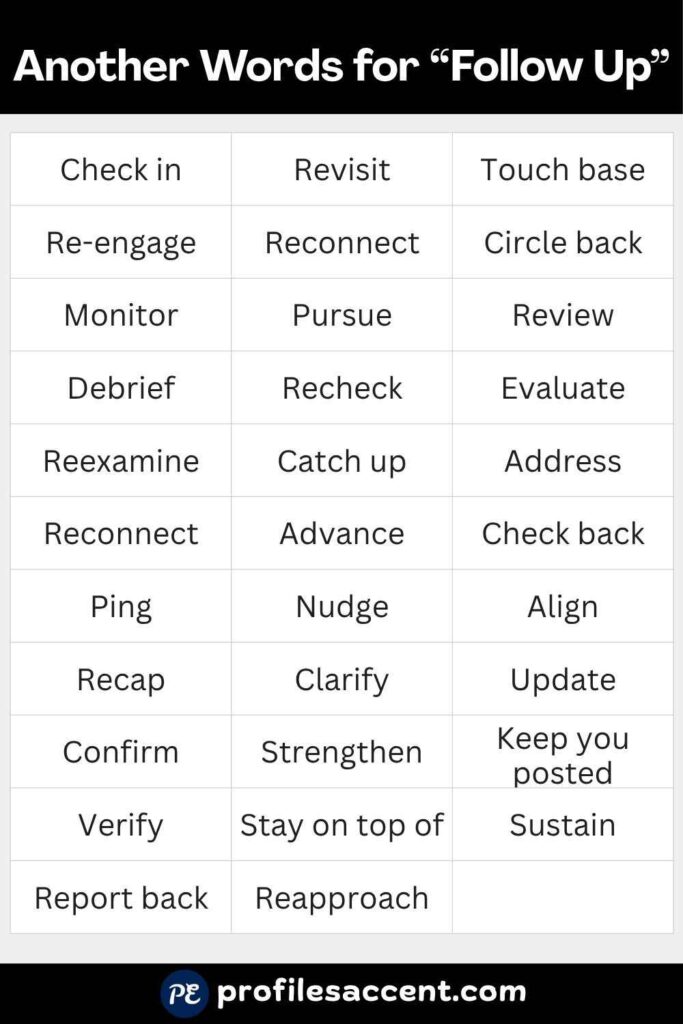
40+ Follow Up Synonyms at a Glance: Quick Reference Table
| Word or Phrase | Tone | Best Used When |
| Check in | Friendly | Quick team updates |
| Revisit | Thoughtful | Returning to a paused topic |
| Touch base | Casual | Internal, low-stakes messages |
| Re-engage | Professional | Restarting a cold conversation |
| Reconnect | Warm | Networking or relationship building |
| Circle back | Informal | Returning after a delay |
| Monitor | Neutral | Tracking ongoing progress |
| Pursue | Confident | Moving an action forward |
| Review | Formal | Assessing completed work |
| Debrief | Structured | Post-event or post-project meetings |
| Recheck | Clinical | Medical or quality-check context |
| Evaluate | Analytical | Measuring outcomes |
| Reexamine | Careful | Looking again with fresh eyes |
| Catch up | Relaxed | Reconnecting after time apart |
| Address | Direct | Handling something specific |
| Reconnect | Relational | Client or peer outreach |
| Advance | Action-driven | Executive or leadership context |
| Check back | Simple | Low-formality reminders |
| Ping | Very casual | Slack or internal chat |
| Nudge | Gentle | Soft reminder without pressure |
| Align | Collaborative | Syncing on shared goals |
| Recap | Summary-focused | After a meeting or call |
| Clarify | Precise | When something needs clearing up |
| Update | Neutral | Progress reports |
| Confirm | Decisive | Locking in a decision or date |
| Strengthen | Positive | Building on previous success |
| Keep you posted | Informal promise | Ongoing communication |
| Verify | Formal | Fact-checking or accuracy |
| Stay on top of | Continuous | Project management |
| Sustain | Long-term | Ongoing client relationships |
| Report back | Accountable | Team task completion |
| Reapproach | Fresh angle | Re-entering a stalled conversation |
The Grammar Nobody Talks About: Follow Up vs. Follow-Up
Here is something most synonym articles skip entirely. “Follow up” changes form depending on how you use it, and that changes which synonym fits.
As a verb (the action): no hyphen.
“I will follow up with her before Thursday.”
Good swaps here: pursue, check in, reconnect, revisit.
As a noun (the thing itself): hyphenated.
“Can we schedule a follow-up next week?”
Good swaps here: debrief, review session, recheck, alignment meeting.
As an adjective (describing something): also hyphenated.
“She sent a follow-up email.”
Good swaps here: subsequent, secondary, continuation.
Using the wrong form is a small mistake that quietly affects your credibility as a writer. Most people never notice the rule until someone points it out.
Follow Up Synonym Groups by What You Actually Mean
Let’s break this down by what you’re actually trying to say.
When you want to check on progress:
“Update,” “monitor,” and “check back” all work here. But “monitor” implies you’re watching something over time, while “check back” is a one-time action. Choose based on whether the situation is ongoing or singular.
When you want to continue a conversation:
“Revisit” and “re-engage” feel different. Revisiting something means giving it fresh thought. Re-engaging means restarting a connection, especially one that went quiet. Subtle difference, but it matters.
When you want to confirm or finalize:
Skip “follow up” entirely and use “confirm” or “verify.” These signal decisiveness rather than vagueness. They tell the reader you need something specific, not just a general response.
When you are rebuilding a relationship:
“Reconnect” or “catch up” carry warmth that “follow up” does not. If you’re reaching out to a former client or an old colleague, those words soften the message and make it feel personal rather than transactional.
From Soft to Sharp: A Tone Scale for Follow Up Alternatives
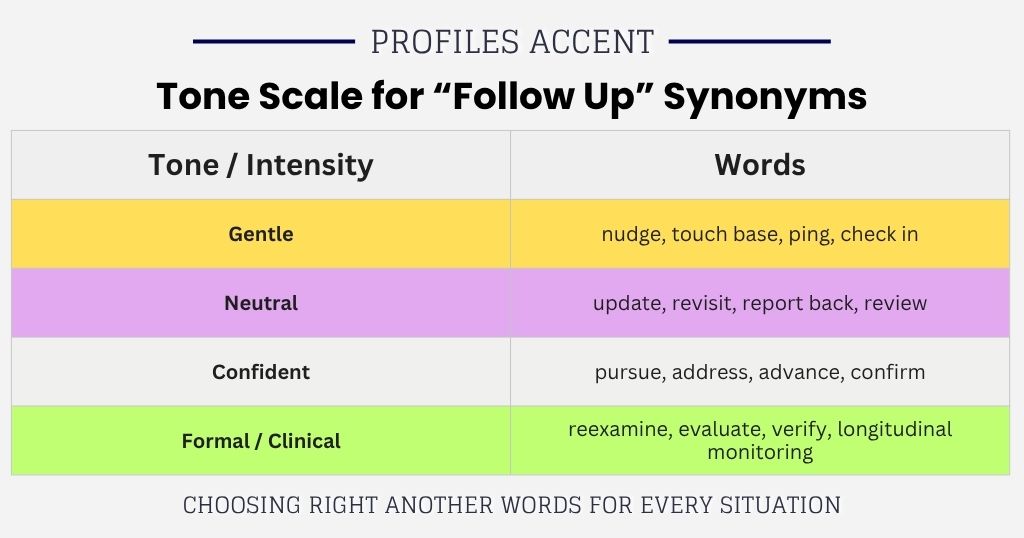
Some situations need a soft touch. Others need clarity and confidence. Here is how some synonyms sit on that spectrum:
- Gentle: nudge, touch base, ping, check in
- Neutral: update, revisit, report back, review
- Confident: pursue, address, advance, confirm
- Formal/Clinical: reexamine, evaluate, verify, longitudinal monitoring
If you’re writing to a CEO about a delayed decision, “nudge” would feel wrong. If you’re chatting with a teammate on Slack, “reexamine” would feel stiff. Match your word to your audience and the weight of the situation.
Same Sentence, Better Words: Follow Up Rewrites in Action
Here are five common “follow up” sentences rewritten to sound sharper and more purposeful.
Original: “I just wanted to follow up on my last email.”
- Formal: “Regarding my previous message, could you share your thoughts on the proposal?”
- Casual: “Hey, did you get a chance to look at what I sent?”
- Confident: “Can you confirm whether the proposal works for your team?”
Notice how “I just wanted to” disappears in every version. That phrase quietly shrinks your authority.
Original: “I’m following up on our meeting.”
- Formal: “I’m writing to continue our discussion from Tuesday’s session.”
- Casual: “Circling back on what we talked about earlier.”
- Creative: “Our conversation got me thinking, and I wanted to pick that thread back up.”
Original: “She followed up with the doctor.”
- Clinical: “She completed her post-treatment evaluation.”
- Simple: “She returned for her scheduled recheck.”
Original: “We need to follow up on the project status.”
- Project-focused: “Let’s do a quick status review before the end of the week.”
- Direct: “Can you report back on where the project stands?”
Original: “I’ll follow up next week.”
- Casual: “I’ll check back with you on Monday.”
- Confident: “Expect to hear from me by Tuesday with next steps.”
Another Word for Follow Up Email, Meeting, and More
For a follow-up email:
Instead of opening with “I just wanted to follow up,” try starting directly with what you need.
- “Can you let me know where things stand with the contract?”
- “I’d love your feedback on what I sent over.”
- “Has anything shifted on your end since we last spoke?”
These feel like real messages from a real person, not a template.
For a follow-up meeting:
- “Debrief” works when you’re reviewing something completed.
- “Alignment check” works when two teams need to sync.
- “Recap session” works when the goal is to make sure everyone is on the same page.
Each one tells the attendee what to expect before they even walk in.
For continuous follow-up in a project:
Phrases like “sustained monitoring” or “iterative review” work better in formal project documentation. For everyday use, “staying on top of” or “tracking progress” keep things clear without sounding corporate.
In medical contexts:
Healthcare professionals use “post-treatment evaluation,” “subsequent examination,” or “monitoring” rather than “follow-up” in clinical notes. “Aftercare” also appears in patient-facing materials. These terms feel more precise and intentional in a medical setting.
The Opposite of Follow Up: Antonyms Worth Knowing
Understanding the opposite of a word sharpens how you use it.
The true opposite of following up is abandoning the effort. Words like “drop,” “neglect,” “disregard,” and “leave unfinished” capture that sense. If you followed up on something, you continued it. If you did the opposite, you let it go.
On the timeline side, words like “initiate,” “launch,” or “open” represent what happens before follow-up. Every follow-up assumes something came first.
Follow Up Synonyms That Look Similar But Mean Different Things
“Circle back” vs. “revisit”: Circle back implies you are returning after being pulled away. Revisit means looking at something again with intention, often to reconsider it.
“Check in” vs. “update”: Checking in is about connection. Asking for an update is about information. Use “check in” with people you have a relationship with. Use “update” when you specifically need progress details.
“Debrief” vs. “recap”: A debrief is usually more structured, often used after a significant event. A recap is lighter and can happen anytime. Don’t schedule a “debrief” for a five-minute conversation.
“Monitor” vs. “evaluate”: Monitoring is ongoing and passive. Evaluating is active and leads to judgment or decision-making. A project gets monitored over time; a project gets evaluated at a milestone.
Words That Work Alongside Follow Up Alternatives
- Reiterate – When you are restating something already said to make sure it landed.
- Respond – Simpler than “follow up” when you are actually replying to something.
- Proceed – Useful when you are moving forward on something already discussed.
- Coordinate – When the follow-up involves two or more people working together.
- Facilitate – When your role is to help something move forward, not do it yourself.
Mistakes People Make When Swapping Follow Up Synonyms
Using “circle back” in formal written communication. It works in speech and casual messages, but in a formal proposal or report, it sounds out of place.
Treating “reexamine” and “review” as identical. Reviewing is routine. Reexamining suggests something went wrong or needs a second, more careful look.
Overusing “touch base.” It is fine once in a while, but if every other message from you says “just touching base,” it starts to feel meaningless.
Adding “just” before any synonym. “I just wanted to check in” has the same problem as the original. The word “just” softens your message too much and makes you sound unsure.
Picking the Right Follow Up Synonym Without Overthinking It
Before you pick a synonym, ask two things.
First, what exactly am I trying to do? Are you checking status? Rebuilding a relationship? Moving a decision forward? The clearer your goal, the easier the right word becomes.
Second, who is reading this? Your word choice should reflect your relationship with that person. A senior executive gets “advance” or “confirm.” A close colleague gets “check in” or “ping.”
When in doubt, be direct. Skip the filler opener and start with your actual question. That alone will make your message more effective than any synonym swap.
Discover More Articles:

I’m Rowan, a language addict who loves exploring how words work in everyday communication. I’ve spent years studying English vocabulary and helping others express themselves more clearly. My goal is simple: make learning new words easy and practical. I focus on real-life examples that show when and how to use different terms. Through clear explanations and honest guidance, I help readers choose the right words for any situation with confidence.