You drafted a strong sentence. Then you noticed you used “advocating” three times in two paragraphs. You swap in “supporting” and suddenly the whole tone shifts. That one word change made the sentence feel weaker, less committed.
This happens more than writers admit. “Advocating” carries a specific weight. Not every synonym holds the same force. Knowing the difference is what separates forgettable writing from writing that actually lands.
What “Advocating” Really Means
At its core, advocating means actively pushing for something you believe in. It is not passive agreement. It is not quiet approval. It involves visible, often repeated effort to move people or systems toward a specific position, person, or idea.
The emotional baseline is commitment. The tone is forward-moving. The person advocating has skin in the game.
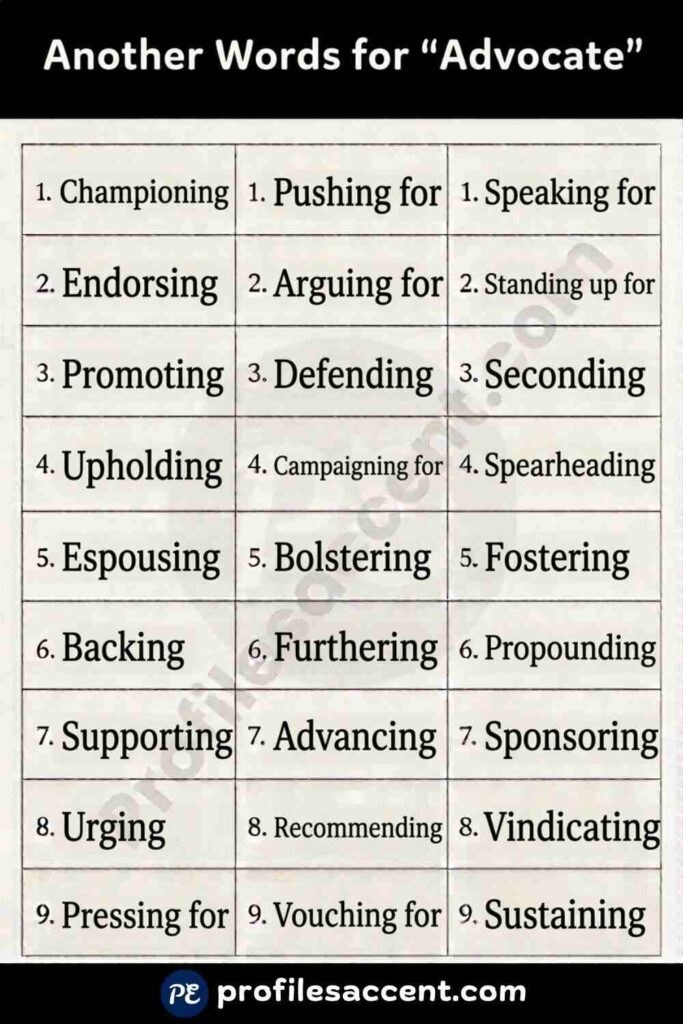
Another Word for Advocating: 30+ Synonyms at a Glance
| Word | Tone | Best Used When | Example |
| Championing | Strong, passionate | Fighting publicly for a cause | She is championing better school lunches. |
| Endorsing | Formal, official | Giving public or professional approval | The board is endorsing the new plan. |
| Promoting | Action-driven | Actively spreading an idea or initiative | He is promoting mental health awareness. |
| Upholding | Moral, principled | Defending something already established | They are upholding patient rights. |
| Espousing | Intellectual, personal | Adopting beliefs or philosophies | She began espousing plant-based living. |
| Backing | Neutral, supportive | General support, formal or casual | The union is backing the workers. |
| Supporting | Mild, general | Broad, everyday usage | He is supporting the local shelter. |
| Urging | Pressing, urgent | Calling strongly for action | The doctor is urging better guidelines. |
| Pressing for | Determined, direct | Pushing persistently toward a goal | They are pressing for cleaner water. |
| Pushing for | Informal, driven | Everyday persuasion or workplace requests | She is pushing for flexible hours. |
| Arguing for | Logical, evidence-based | Academic or debate settings | The paper is arguing for reform. |
| Defending | Protective, firm | Standing up for a person or idea | He is defending the accused’s rights. |
| Campaigning for | Public, grassroots | Social causes and elections | They are campaigning for equal pay. |
| Bolstering | Strengthening, firm | Adding weight to a cause or position | The data is bolstering their case. |
| Furthering | Progressive, strategic | Moving a goal or agenda forward | She is furthering disability access. |
| Advancing | Formal, forward-moving | Institutional or policy contexts | The NGO is advancing child welfare. |
| Recommending | Calm, advisory | Suggesting with authority but no pressure | She is recommending a new approach. |
| Vouching for | Personal, loyal | Defending a specific person’s character | He vouched for her professionalism. |
| Speaking for | Representative | Acting as someone’s voice | She is speaking for the community. |
| Standing up for | Emotional, protective | Defending against unfair treatment | He is standing up for his teammate. |
| Seconding | Agreeable, formal | Supporting a motion or someone’s idea | She is seconding the proposal. |
| Spearheading | Leading, aggressive | Taking charge of a new initiative | He is spearheading the safety review. |
| Fostering | Nurturing, gentle | Growing conditions for something to thrive | The program is fostering civic voices. |
| Propounding | Academic, considered | Presenting a theory or structured idea | She is propounding an alternative model. |
| Sponsoring | Formal, financial | Institutional backing with commitment | The firm is sponsoring the bill. |
| Vindicating | Defensive, justice-driven | Proving something right after doubt | She is vindicating her earlier stance. |
| Sustaining | Steady, ongoing | Keeping something alive and supported | The group is sustaining the cause. |
| Rooting for | Casual, warm | Informal emotional support | Everyone is rooting for the team. |
| Going to bat for | Informal, loyal | Standing up for someone personally | He went to bat for his colleague. |
| Crusading for | Intense, long-term | Moral or social justice movements | She has been crusading for housing reform for years. |
| Pleading for | Emotional, urgent | Appeals driven by empathy or desperation | The family is pleading for justice. |
The Mistake Writers Make With Advocating Synonyms
People often treat “advocating” as a synonym for “supporting.” Technically, they overlap. But the feel is very different.
Saying someone is supporting a cause feels passive. It could mean they liked a social media post. Saying someone is advocating for that same cause means they are actively, visibly working toward it. One word, completely different picture.
Similarly, “promoting” leans toward marketing and visibility. “Defending” leans toward protection against attack. “Championing” signals emotional intensity and personal investment. These are not interchangeable, even when they technically mean “advocating.”
Pick based on what is actually happening, not just what sounds similar.
How Strong Is Your Word? The Intensity Scale for Advocating Synonyms
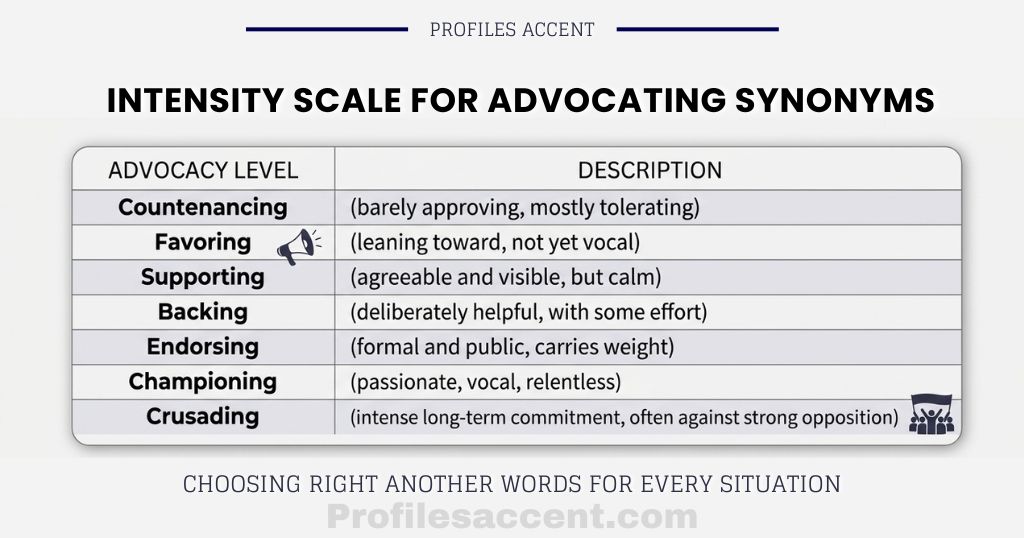
Not every act of advocacy is equal. Here is how the energy shifts as the commitment grows:
- Countenancing (barely approving, mostly tolerating)
- Favoring (leaning toward, not yet vocal)
- Supporting (agreeable and visible, but calm)
- Backing (deliberately helpful, with some effort)
- Endorsing (formal and public, carries weight)
- Championing (passionate, vocal, relentless)
- Crusading (intense long-term commitment, often against strong opposition)
If you are writing about a local council member at a public meeting, “endorsing” fits. If you are writing about a parent fighting a broken education system for five years, “crusading” is the word.
The right intensity tells the reader how much the person actually cares.
Flat Sentences, Stronger Rewrites
Original: “She was advocating for change in the company.”
- Formal: “She was pressing for systematic reform within the organization.”
- Casual: “She was pushing hard for things to change.”
- Academic: “She was propounding a restructured model for internal operations.”
- Creative: “She had become the company’s most inconvenient conscience, championing change at every turn.”
Original: “He kept advocating for the new policy.”
- Formal: “He continued urging adoption of the revised policy framework.”
- Casual: “He would not stop pushing for that new rule.”
- Academic: “He persistently argued for implementation of the proposed measures.”
Each rewrite shifts not just the word, but the reader’s image of the person. The subject goes from vague to specific, from flat to three-dimensional.
Another Word for Advocating in an Essay
When writing a formal essay or thesis, “advocating” can feel too conversational or political. These alternatives work better in that context:
- Propounding works when you are introducing a new theory or framework your paper is built around.
- Arguing for signals rational, evidence-based support. It is clean and direct. Most academic readers respond well to it.
- Advancing is ideal when discussing what a researcher, policy, or institution is doing over time. It carries forward movement without emotional heat.
- Espousing works when describing someone who has adopted a philosophy or value system, especially across time.
Avoid “crusading” or “pleading for“ in academic writing unless you are deliberately signaling emotional bias in your subject.
Advocating for Yourself Synonym: Words That Sound Confident
Searching for “advocating for yourself” in a professional setting? This is where word choice matters most. Some words sound desperate. Others sound powerful.
Avoid: “pleading for recognition” or “begging for a raise.” These destroy the image you are trying to build.
Use instead:
- Asserting your value – Direct, confident, no apology needed.
- Negotiating your terms – Professional, strategic, positions you as an equal.
- Claiming your seat – Strong, figurative, communicates earned presence.
- Making your case – Logical, measured, works in almost any workplace context.
The language you use to describe self-advocacy changes how others see you in the room.
When Certain Synonyms Quietly Backfire
A few of these words carry strong implications. Misuse creates friction.
Crusading can sound extreme. If the cause is a minor workplace request, this word makes the writer seem dramatic.
Vindicating implies someone was doubted or accused first. Do not use it unless that context exists.
Countenancing technically means tolerating or allowing, not actively supporting. Many writers misread it as a synonym for endorsing. It is not.
Pleading for is emotionally loaded. It suggests vulnerability or desperation. In professional writing, it can undermine the authority of the person being described.
Always ask: does this word describe the level of effort and emotional state accurately?
Advocating Antonym: The Other Side of the Word
Understanding what advocacy is not sharpens your choices.
Opposing is the clearest opposite. The person is actively working against something.
Dissuading means trying to talk someone out of a course of action.
Denouncing goes further. It is public rejection, often with moral judgment attached.
Stifling describes someone actively blocking an idea from gaining ground.
These matter because sometimes you need the contrast. Writing “while some were championing the bill, others were quietly stifling it” gives the reader the full picture.
Words Close to Advocating That Writers Mix Up
- Proponent (noun) – The person who advocates. Not an action word.
- Advocacy (noun) – The practice or movement, not the act itself in a sentence.
- Activist – More specifically tied to social or political change. Not every advocate is an activist.
- Lobbyist – Advocates within political or legislative systems, often professionally and with financial interests.
- Spokesperson – Speaks on behalf of a group, but may not personally believe the cause.
These distinctions matter. Calling someone a lobbyist when you mean advocate changes the entire perception of their motivation.
The Right Advocating Synonym Is Closer Than You Think
The right synonym for “advocating” is the one that matches the actual intensity, setting, and relationship involved. Championing is not the same as supporting. Pleading is not the same as pressing. Spearheading is not the same as endorsing.
Go back to your sentence. Ask: how hard is this person actually working? How emotional is this? How formal is the setting? The answers will tell you exactly which word belongs there.
Discover More Articles:

I’m Rowan, a language addict who loves exploring how words work in everyday communication. I’ve spent years studying English vocabulary and helping others express themselves more clearly. My goal is simple: make learning new words easy and practical. I focus on real-life examples that show when and how to use different terms. Through clear explanations and honest guidance, I help readers choose the right words for any situation with confidence.