You are halfway through writing something important. An email. An essay. A story. And then you type it again: situation. It sits there, dull and shapeless, doing almost nothing for your sentence.
The word is not wrong. It just does not carry weight. It tells the reader what exists but not how serious it is, how urgent it feels, or how much it matters. That gap between “something is happening” and “here is exactly what is happening” is where word choice becomes your most powerful tool.
This guide helps you close that gap.
What “Situation” Actually Means
At its core, situation describes the combination of things happening around a person or place at a specific moment. It is neutral by nature. It carries no emotion, no severity, no judgment. That is both its strength and its weakness. When you need precision, it fails you.
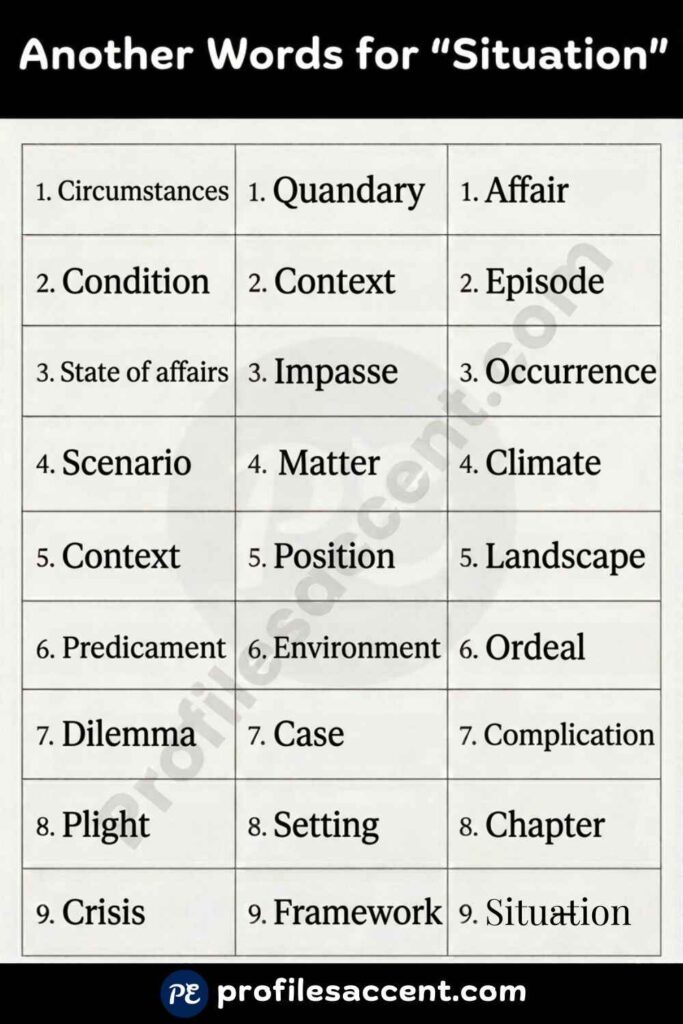
Quick 25+ Synonyms for Situation by Tone and Context
| Word | Tone | Best Used When | Short Example |
| Circumstances | Neutral/Formal | External factors affect someone | “Given the circumstances, we waited.” |
| Condition | Neutral | Describing a state of being | “The condition of the market is unstable.” |
| State of affairs | Neutral/Formal | Summarizing how things stand | “The current state of affairs is concerning.” |
| Scenario | Neutral/Planning | Imagining possible outcomes | “In this scenario, costs rise sharply.” |
| Context | Formal/Academic | Background behind an event | “The historical context changes everything.” |
| Predicament | Mildly negative | Person is in mild trouble | “He talked his way out of the predicament.” |
| Dilemma | Mildly negative | A choice between two hard options | “She faced a real dilemma at work.” |
| Plight | Serious/Sympathetic | Subject is suffering, needs help | “The plight of the refugees moved millions.” |
| Crisis | Urgent/Severe | Things are breaking down fast | “The city responded to the water crisis.” |
| Quandary | Confused/Uncertain | Unsure what to do next | “I am in a quandary about which offer to take.” |
| Juncture | Formal/Critical | A key turning point in time | “At this juncture, every decision matters.” |
| Impasse | Negative/Stuck | Two sides cannot agree | “Talks reached an impasse by Tuesday.” |
| Matter | Casual/Professional | Referring to the issue at hand | “Let us focus on the matter before us.” |
| Position | Neutral/Professional | Someone’s standing or role | “She is in a strong position to negotiate.” |
| Environment | Neutral | The surrounding conditions | “The work environment needs improvement.” |
| Case | Formal/Investigative | A specific real-life example | “In this case, the evidence was clear.” |
| Setting | Narrative/Creative | Time and place in a story | “The setting created a tense atmosphere.” |
| Framework | Academic | The structure shaping an event | “The legal framework limits our options.” |
| Affair | Formal/Broad | A general matter or event | “The whole affair was poorly managed.” |
| Episode | Narrative/Sequence | One event in a series | “That episode changed how we handled things.” |
| Occurrence | Factual/Neutral | Something that happened | “The occurrence was documented carefully.” |
| Climate | Figurative | General mood or trend | “The political climate shifted after the vote.” |
| Landscape | Figurative | Broader view of a topic | “The competitive landscape is shifting fast.” |
| Ordeal | Negative/Emotional | A deeply difficult experience | “Surviving the ordeal took months.” |
| Complication | Technical/Negative | A problem that grows within a plan | “A complication delayed the surgery.” |
| Chapter | Creative/Personal | A phase in someone’s life | “That chapter of her life taught her a lot.” |
The Emotional Weight Behind Each Synonym for Situation
Here is something standard thesauruses do not tell you. The word you choose signals to your reader exactly how worried they should feel. This is called emotional weight, and it matters more than most writers realize.
Think of it as a scale. On one end: calm, factual words like condition and circumstances. Move along the scale and you reach predicament, which hints at mild trouble the person probably caused themselves. Further along, plight signals real suffering with causes beyond the person’s control. At the far end, quagmire tells the reader someone is stuck and sinking, with no easy way out.
Choosing the wrong point on this scale confuses your reader. Writing “the company faces a predicament” when the company is actually collapsing undercuts the urgency. Writing “the team finds itself in a quagmire” over a small scheduling conflict is dramatic and loses trust.
Match your word to the actual weight of what you are describing.
When Your “Situation” Becomes a Problem
Not every synonym works the same way when the situation turns negative. The key question is: does the person have the power to fix it, or are they stuck?
- If the subject has power, reach for words like hurdle, complication, or obstacle. These carry the unspoken message that with enough effort, a way forward exists.
- If the subject is trapped or suffering, words like plight, ordeal, or bind carry more honesty. They signal that outside help or a structural change may be needed, not just personal effort.
The phrase “situation or problem“ is extremely common in search because writers sense this distinction but do not always have the right words. Now you do.
How Intense Is Your Word? A Tone Scale for Situation Synonyms
Here is how several words sit across an emotional scale, from the least alarming to the most urgent.
- Calm end: Circumstance, Condition, State of affairs
- Mild concern: Predicament, Dilemma, Quandary
- Serious: Plight, Crisis, Ordeal
- No-way-out: Impasse, Quagmire, Deadlock
Moving from circumstance to quagmire is not just about vocabulary. It shifts the entire emotional expectation of your sentence. Readers feel the difference even when they do not consciously notice it.
See the Difference: Sentence Rewrites Using Other Words for Situation
Original (weak): “The situation at work has become very difficult.”
- Formal: “The professional conditions at the firm have deteriorated significantly.”
- Casual: “Things at work have gotten really messy lately.”
- Academic: “The organizational climate has undergone a marked decline in cohesion.”
- Creative: “The office had become a tightrope that nobody remembered signing up to walk.”
Original (weak): “She was in a bad situation in life.”
- Formal: “Her personal circumstances left little room for advancement.”
- Casual: “She was going through a rough patch.”
- Empathetic: “The hand she had been dealt was genuinely unfair.”
- Literary: “Her lot in life had asked too much of her too soon.”
Original (weak): “We need to address the situation at hand.”
- Professional: “We must respond to the matter before us without delay.”
- Urgent: “The exigency of this moment demands immediate action.”
- Conversational: “Let us deal with what is right in front of us right now.”
Each rewrite does more than change a word. It repositions the entire tone of the sentence.
Another Word for “Situation” in an Essay
Academic writing suffers most from overused “situation.” It signals vague thinking. When you use it in an essay, you are often telling the reader there is something to analyze without actually analyzing it.
Replace it based on what the situation is actually doing in your argument:
- Describing historical background? Use milieu or climate.
- Analyzing relationships between groups? Use dynamic.
- Setting up your argument’s boundaries? Use framework or parameters.
- Referring to a specific studied case? Use instance or case study.
The shift from “The situation in post-war Europe was complicated” to “The political dynamic of post-war Europe created a fragile and shifting balance of power” is the difference between vague and precise.
Formal vs. Informal: Picking the Right “Situation” Synonym for Your Context
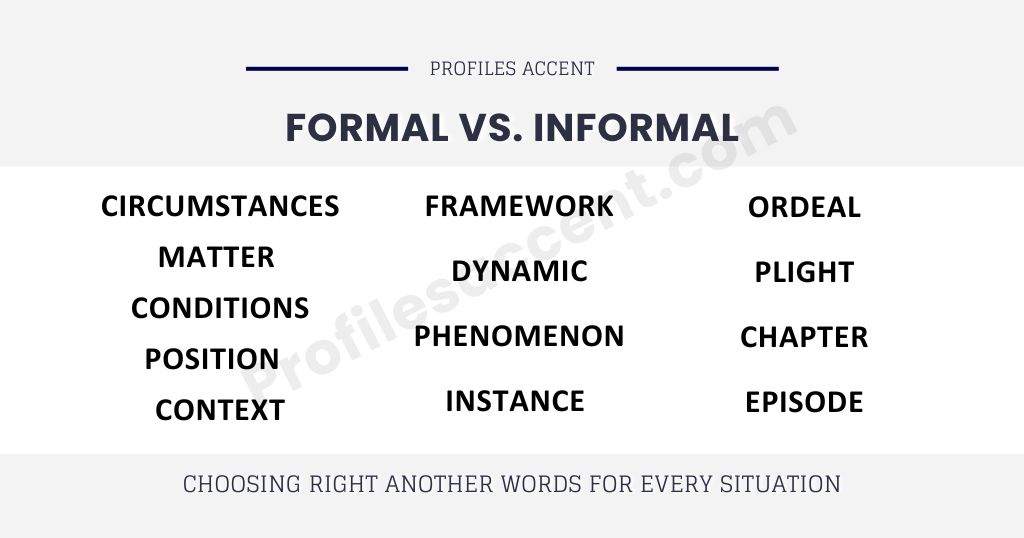
In professional emails or reports:
- Strong choices: circumstances, matter, conditions, position
- Avoid: pickle, jam, fix, spot (too casual, undercuts authority)
In academic essays:
- Strong choices: context, framework, dynamic, phenomenon, instance
- Avoid: predicament, ordeal, plight (these carry emotional weight that does not suit analytical tone)
In storytelling or creative writing:
- Strong choices: ordeal, plight, chapter, episode, setting, climate
- Avoid: framework, parameters (too structural, kills the narrative energy)
Mistakes Writers Make When Replacing “Situation”
Mixing severity levels. Using crisis for a minor inconvenience or circumstance for a true emergency both lose credibility. Match the weight.
Treating “circumstances” and “situation” as identical. They are close but not the same. Circumstances almost always points to external factors pressing on a person from outside. Situation can be internal or immediate. “Given the circumstances” acknowledges outside pressure. “Given the situation” just acknowledges that something is happening.
Using “dilemma” for any hard moment. A dilemma is specifically a choice between two difficult options. If only one path exists, it is not a dilemma. It is a predicament, a bind, or an ordeal.
Overusing “scenario.” This word works well for hypothetical planning. It sounds odd when used for things that are already happening. “The current scenario is troubling” should just be “the current situation is troubling” or, better, “the current conditions are troubling.”
Related Words Worth Knowing
Conjuncture: The coming together of several circumstances at once. Useful when multiple forces collide at a single point in time.
Exigency: The urgent demands of a critical moment. Stronger than “situation at hand.” Rarely used but highly effective in formal writing.
Milieu: The social, cultural, or environmental setting shaping events. Elegant and precise in essays.
Stalemate: Specifically a situation where two sides are equal and neither can win. Carries a sense of frustrated standstill.
Disposition: How things are arranged or ordered at a given time. Less common but useful in legal, military, or strategic writing.
The Smarter Way to Choose a “Situation” Synonym
The goal is not to avoid “situation” completely. The goal is to stop reaching for it automatically. Before you type it, pause for one second and ask: is this neutral, negative, urgent, or structural? That single question will point you toward a better word almost every time.
Precision in word choice is not about sounding impressive. It is about making sure your reader feels exactly what you mean.
Discover More Articles:

I’m Rowan, a language addict who loves exploring how words work in everyday communication. I’ve spent years studying English vocabulary and helping others express themselves more clearly. My goal is simple: make learning new words easy and practical. I focus on real-life examples that show when and how to use different terms. Through clear explanations and honest guidance, I help readers choose the right words for any situation with confidence.