You typed “impact.” Then you stopped. Something felt off. The word sits on the page doing almost nothing, carrying a meaning so broad it barely means anything at all. Every press release uses it. Every report leans on it. After a while, readers skip right over it.
That’s not a vocabulary problem. That’s a precision problem. And the fix is simpler than you think.
What “Impact” Really Means (And Why It Matters)
At its core, “impact” describes what happens when one thing changes another. It can be physical, emotional, social, or financial. The word works in almost every sentence, which is exactly why it weakens almost every sentence. It covers too much ground to point anywhere specific.
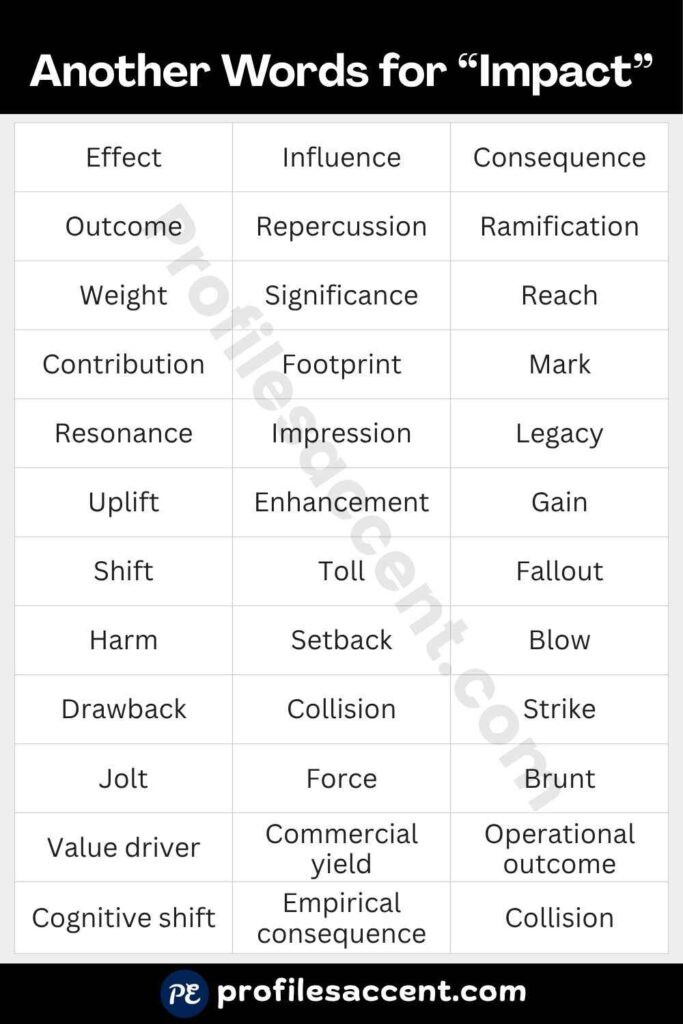
Quick 40+ Synonyms for Impact, Organized the Way Writers Actually Think
| Word | Tone | Use It When | Quick Example |
| Effect | Neutral | Showing direct cause and result | The change had a clear effect. |
| Influence | Gradual | Something shaped over time | Her teaching influenced thousands. |
| Consequence | Serious | Results of a decision | Face the consequences of that choice. |
| Outcome | Neutral | Final result of a process | The outcome was better than expected. |
| Repercussion | Cautionary | Indirect or delayed result | The policy had lasting repercussions. |
| Ramification | Formal | Complex ripple effects | Consider the ramifications first. |
| Weight | Subtle | Importance or pressure | His words carried real weight. |
| Significance | Formal | Meaningful relevance | The report holds great significance. |
| Reach | Scope-based | How far something spreads | The campaign’s reach surprised everyone. |
| Contribution | Positive | Something added of value | Her contribution shaped the project. |
| Footprint | Scale-based | Size of presence or damage | The company reduced its carbon footprint. |
| Mark | Lasting | A permanent trace left behind | He left his mark on the field. |
| Resonance | Emotional | Deep connection with an audience | The speech had real resonance. |
| Impression | Personal | Effect on someone’s mind | The film left a strong impression. |
| Legacy | Long-term | What something leaves behind | Her legacy continues to inspire. |
| Uplift | Positive | A boost in performance or morale | The program gave students a real uplift. |
| Enhancement | Positive | Improvement in quality | The update was a clear enhancement. |
| Gain | Positive | Net positive result | The gains outweighed the risks. |
| Shift | Neutral/big | A change in direction or thinking | The data caused a major shift in strategy. |
| Toll | Negative | Gradual damage over time | Overwork takes a serious toll. |
| Fallout | Negative | Unwanted results after an event | The financial fallout was severe. |
| Harm | Negative | Direct damage or hurt | The policy caused measurable harm. |
| Setback | Negative | A step backward | The delay was a significant setback. |
| Blow | Negative | A sudden damaging hit | The news was a blow to morale. |
| Drawback | Negative | A clear downside | The main drawback was the cost. |
| Collision | Physical | Objects or forces meeting | The collision damaged both vehicles. |
| Strike | Physical | A direct hit | The lightning strike was unexpected. |
| Jolt | Physical/emotional | A sudden shock | The announcement gave everyone a jolt. |
| Force | Physical | Power behind something | The force of the wave was immense. |
| Brunt | Physical | Main part of a hit or burden | She bore the brunt of the criticism. |
| Value driver | Business | What moves financial results | Customer trust is our core value driver. |
| Commercial yield | Business | Financial return | The campaign produced strong commercial yield. |
| Operational outcome | Business | Process-level result | Track operational outcomes monthly. |
| Cognitive shift | Academic | A change in how people think | The study produced a measurable cognitive shift. |
| Empirical consequence | Academic | Research-proven result | Document the empirical consequences clearly. |
Positive, Negative, Physical, Emotional: Impact Synonyms by Meaning
Not all synonyms for “impact” mean the same thing. Grouping them by meaning helps you pick the right one faster.
When the change is gradual: Use influence, shape, or shift. These suggest something building slowly, not hitting all at once.
When the result is sudden: Use blow, jolt, strike, or repercussion. The suddenness is part of the meaning.
When you want to sound professional but specific: Use outcome, contribution, significance, or commercial yield. These land cleanly in reports, emails, and proposals.
When the feeling matters more than the fact: Use resonance, impression, mark, or legacy. These carry emotional weight without sounding dramatic.
When something went wrong: Use fallout, toll, setback, or harm. Each one points in a slightly different direction, so choose based on what actually happened.
How Strong Is Your Word? A Scale from Ripple to Rupture

One thing most synonym lists miss is that “impact” has a strength level. A small change and a catastrophic one both get called “impact.” That’s lazy writing. Here’s how to grade your word choice by how powerful the effect actually was:
- Mild: ripple, shift, nudge, trace.
- Moderate: influence, effect, outcome, mark.
- Strong: consequence, repercussion, toll, resonance.
- Extreme: devastation, seismic shift, upheaval, collapse.
If your writing says something “had a significant impact,” you have room to do much better. Was it a ripple? A rupture? The right word carries the story forward on its own.
See the Difference: Weak Sentences Rewritten with Better Synonyms for Impact
Here’s where the rubber meets the road. Same idea, better word, different power.
Original: The new program had a big impact on students.
- Formal: The program produced measurable gains in student performance.
- Casual: Students actually felt the difference this time.
- Academic: The intervention yielded significant cognitive and behavioral outcomes.
- Creative: Something shifted in those classrooms, quietly but completely.
Original: Social media is impacting mental health.
- Formal: Social media use correlates with declining mental health outcomes.
- Casual: Too much scrolling is taking a real toll on how people feel.
- Academic: Excessive platform engagement has documented psychological repercussions.
- Creative: The feed never stops, and neither does the damage.
Original: The budget cuts impacted our research.
- Formal: Budget reductions directly impaired our research capacity.
- Casual: We lost months of work because of those cuts.
- Academic: Funding constraints produced measurable consequences for research output.
- Creative: Every cut left a gap where an idea used to be.
Notice how each rewrite forces you to commit to a direction. That commitment is what makes writing trustworthy.
Formal or Casual? Picking the Right Impact Synonym for Your Context

If you’re writing an essay or academic paper, reach for consequence, ramification, empirical outcome, or scholarly influence. These signal care and precision.
For professional emails and business reports, result, contribution, value, or operational outcome feel clean and direct.
For storytelling or personal writing, mark, ripple, resonance, and legacy breathe life into the sentence. They let the reader feel something rather than just understand something.
Words to keep out of formal writing: blow, jolt, wallop, ripple. These work in casual or creative contexts but look out of place in a research paper or business proposal.
Affect, Effect, and Impact: The Mix-Up That Keeps Costing Writers
This one causes real errors.
Affect is a verb. It describes the action of influencing something. “Noise affects concentration.” You do the affecting.
Effect is a noun. It describes the result. “Noise has a negative effect on concentration.” The effect is the thing that exists.
Most synonym lists throw both words into the same column as if they work the same way. They don’t. Mixing them up in a professional or academic context reads as careless, even when the rest of the writing is solid.
Why “Impactful” Is the Synonym for Impact You Should Stop Using
Skip it. Seriously.
“Impactful” sounds like a word built in a committee room. It means something like “having impact,” which is almost completely empty. Writers use it when they want something to sound important without saying exactly what was important about it.
If something impressed you, say it was impressive. If it moved people, say it was moving or stirring. If it changed thinking, call it eye-opening or transformative. Any of these does the job that “impactful” pretends to do.
Mistakes Writers Make When Replacing the Word Impact
Mixing noun and verb forms is the most frequent error. You can say “the collision had an effect” but not “the collision effected traffic” (unless you mean caused it in a very formal sense). When in doubt, use affect as your verb and effect as your noun.
Using a synonym that sounds similar but points differently is another trap. “Repercussion” implies something indirect and often delayed. “Consequence” is more direct. Writers sometimes swap them and change the meaning without realizing it.
Over-replacing is also a problem. If you drop “impact” and now every sentence uses “consequence,” you’ve just traded one overused word for another. Rotate. Use the scale. Match the word to the actual strength of what happened.
Words That Live Near Impact but Mean Something Different
- Efficacy – measures how well something works, not just whether it changed things. Common in health and policy writing.
- Leverage – suggests using something strategically to multiply results. More active than “impact.”
- Causality – points to the direct link between a cause and its result. Useful in research contexts when you need to be precise about what caused what.
- Footprint – covers the spread or size of an effect, especially environmental or digital presence.
- Momentum – describes an effect that builds on itself over time, rather than landing once and stopping.
Stop Guessing, Start Choosing the Right Word for Impact
Every time you reach for “impact,” pause for three seconds.
Ask what actually happened.
- Did something increase? Say so.
- Did trust erode slowly? Call it a toll.
- Did a speech change how a room full of people thought? That’s a shift, or resonance, or a mark that stayed long after the lights went down.
The best word is never the broadest one. It’s the one that could only fit that exact sentence.
Discover More Articles:

I’m Rowan, a language addict who loves exploring how words work in everyday communication. I’ve spent years studying English vocabulary and helping others express themselves more clearly. My goal is simple: make learning new words easy and practical. I focus on real-life examples that show when and how to use different terms. Through clear explanations and honest guidance, I help readers choose the right words for any situation with confidence.