There’s a moment every writer knows. You’ve typed the word “confront” three times in two paragraphs, and something feels off. Not wrong exactly, just flat. Repeated. Like the word is doing too much heavy lifting while the sentence beneath it stays weak.
The real problem isn’t repetition. It’s that “confront” carries a lot of weight, and most of the time, only a fraction of that weight is what you actually need.
Choosing the right replacement changes how the reader feels about the situation, the person, and the tone of your writing entirely.
So What Does “Confront” Really Mean?
“Confront” means to face something or someone directly, usually when doing so feels difficult or uncomfortable. It can describe a conversation, a crisis, a personal fear, or a standoff between two people.
The emotional weight behind it leans slightly tense. It suggests resistance, courage, or pressure, depending on the situation. That’s why swapping it carelessly can shift the entire mood of a sentence.
35+ Synonyms for Confront: Quick-Reference Table
| Word | Tone | Works Best When | Example |
| Address | Neutral, formal | Raising an issue professionally | She addressed the concern directly. |
| Challenge | Direct, assertive | Questioning someone’s decision | He challenged the final ruling. |
| Face | Calm, resolute | Dealing with a hard reality | You have to face this eventually. |
| Tackle | Active, positive | Solving a problem with effort | They tackled the issue as a team. |
| Oppose | Firm, resistant | Disagreeing with an action | She openly opposed the new policy. |
| Stand up to | Brave, personal | Resisting pressure or a bully | He finally stood up to his critic. |
| Engage with | Measured, thoughtful | Professional or academic settings | We need to engage with this data. |
| Meet head-on | Bold, decisive | Taking charge of a hard situation | She met the crisis head-on. |
| Square off | Tense, competitive | Two sides preparing to clash | Both teams squared off before negotiations. |
| Call out | Informal, pointed | Naming a behavior publicly | She called him out in front of everyone. |
| Intercept | Sudden, direct | Catching someone before they leave | He intercepted her on the way out. |
| Brave | Courageous, emotional | Facing fear or danger | They braved the difficult conversation. |
| Dispute | Intellectual, firm | Disagreeing with facts or claims | He disputed every point in the report. |
| Approach | Soft, neutral | Starting a delicate conversation | She approached him about the mistake. |
| Weather | Patient, enduring | Surviving a long difficult stretch | They weathered the tension together. |
| Grapple with | Deep, internal | Struggling with a complex idea | He grappled with the moral weight of it. |
| Press | Persistent, firm | Demanding answers or action | The reporter pressed him for details. |
| Lock horns | Casual, clashing | Two people disagreeing strongly | They locked horns over the budget. |
| Have it out | Raw, informal | Clearing tension through argument | They finally had it out after months. |
| Reckon with | Reflective, serious | Accepting a truth you’ve avoided | She had to reckon with her past choices. |
| Rebuke | Sharp, formal | Expressing strong disapproval | The manager rebuked the behavior firmly. |
| Counter | Strategic, calm | Responding to an argument | She countered his point with evidence. |
| Resist | Defensive, strong | Refusing to yield to pressure | He resisted every attempt to change him. |
| Defy | Bold, rebellious | Refusing to comply with authority | She defied expectations completely. |
| Take on | Confident, brave | Willingly facing a hard challenge | He took on the toughest assignment. |
| Reproach | Gentle, emotional | Expressing disappointment to someone | She quietly reproached his carelessness. |
| Pin down | Tactical, direct | Forcing someone to be specific | The editor pinned him down on the facts. |
| Expose | Revealing, bold | Bringing hidden truths to light | The article exposed the real problem. |
| Assert oneself | Empowered, clear | Setting a boundary firmly | She asserted herself in the meeting. |
| Come to terms with | Accepting, internal | Making peace with something hard | He came to terms with what had happened. |

Same Word, Three Very Different Situations
“Confront” doesn’t behave the same way in every sentence. There are actually three different situations where writers reach for it, and each one needs a different kind of replacement.
When it’s about a person: You’re describing a direct interaction, often charged with tension. Words like challenge, press, square off, or stand up to fit here. They carry interpersonal energy.
When it’s about a problem or reality: This is less about people and more about courage or action. Tackle, face, grapple with, reckon with, and weather all work well. They suggest effort without aggression.
When it’s about power: This is where most synonym lists fall short. Who holds the power matters. Confronting a superior feels different from confronting a peer or a subordinate. Defy works when challenging authority. Reproach or rebuke work when you’re in a position of authority. Oppose sits somewhere in the middle. Same feeling, very different power dynamics.
How Hard Should the Word Hit? A Tone Scale for Confront Synonyms
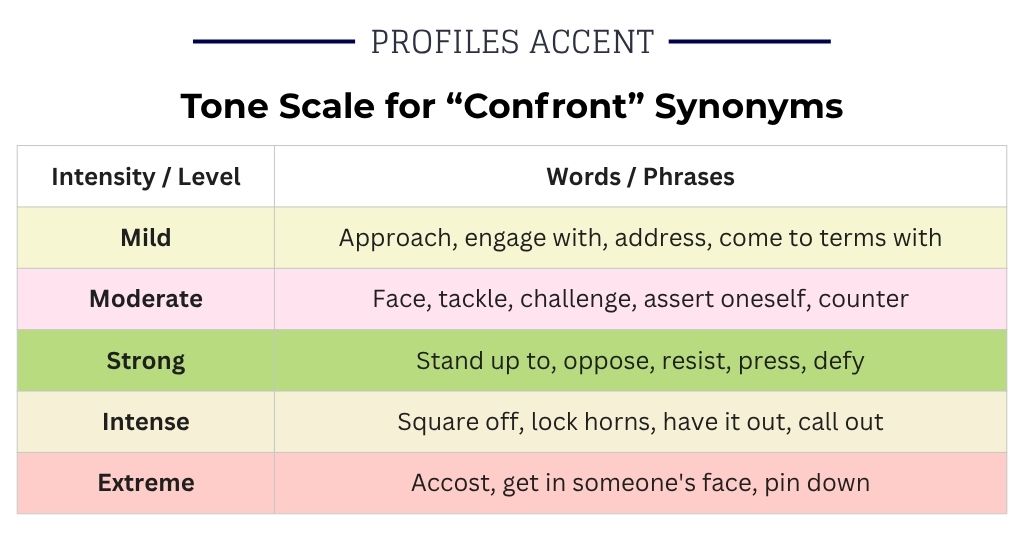
Not every “confront” situation calls for the same level of force. Here’s how common replacements sit on a scale from soft to sharp:
- Mild: Approach, engage with, address, come to terms with
- Moderate: Face, tackle, challenge, assert oneself, counter
- Strong: Stand up to, oppose, resist, press, defy
- Intense: Square off, lock horns, have it out, call out
- Extreme: Accost, get in someone’s face, pin down
When you’re revising, ask yourself: how much tension does this moment actually need? Using “squared off” in a quiet workplace email sends the wrong signal. Using “address” in a scene where two rivals finally clash feels toothless.
Watch What Happens When You Swap the Word
Original: He confronted his manager about the missing report.
- Formal: He raised the matter with his manager directly.
- Casual: He called his manager out about the missing report.
- Academic: He challenged his manager’s account of the missing document.
- Creative: He walked into his manager’s office and pressed for answers.
Each version shifts the reader’s feeling. The formal version sounds professional and measured. The casual one adds friction. The academic one feels intellectual. The creative one builds tension. Same event, completely different atmosphere.
Original: She had to confront the truth about her decision.
- Formal: She was compelled to reckon with the consequences of her choice.
- Casual: She finally had to face what she’d done.
- Academic: She was forced to grapple with the ethical weight of her decision.
- Creative: The truth sat waiting, and she couldn’t avoid it any longer.
Notice that when the object is a feeling or reality rather than a person, the language softens naturally. “Grapple with” and “reckon with” do work that “confront” can’t do on its own.
A Nicer Word for Confront (Without Losing the Point)
Some situations call for confronting something without the word sounding aggressive. Performance reviews, feedback conversations, family discussions. You need honesty without hostility.
These alternatives carry the same directness but without the combative undertone:
- Address works in almost every professional setting.
- Raise is even softer (“I wanted to raise something with you”).
- Discuss removes pressure while keeping openness.
- Bring up sounds casual and low-stakes.
- Revisit works when the topic is sensitive and needs careful handling.
None of these are weak choices. They’re strategic. When the goal is a productive conversation rather than a showdown, the word you choose signals your intent before you’ve even made your point.
Another Word for Confront in an Essay or Academic Writing
Students often search for “another word for confront in an essay” and land on lists that include words like “accost” or “face off.” These are informal or literary terms. They don’t belong in academic writing.
For essays, use:
- Challenge when analyzing opposition or resistance in historical, political, or literary contexts
- Grapple with when discussing a character or figure wrestling with a moral question
- Oppose when describing ideological or political conflict
- Reckon with when writing about legacy, consequence, or accountability
- Counter when presenting a rebuttal or academic dispute
Avoid: “call out,” “have it out,” “get in someone’s face,” or any phrase with a conversational pulse. These drop the register of your essay noticeably.
Confront Synonym Mistakes That Quietly Hurt Your Writing
Using “accost” as a gentler substitute. It’s actually more aggressive than “confront.” It implies someone was approached in a startling or threatening way. Don’t use it to soften a scene.
Using “challenge” when you mean “question.” Challenging someone implies a power dispute. Questioning can be genuinely curious. They are not interchangeable.
Using “oppose” for personal disagreements. Oppose carries a formal, almost institutional tone. Saying you “opposed your roommate” sounds oddly stiff. “Pushed back” or “disagreed with” works better in informal contexts.
Treating “face” and “confront” as always identical. You can face a sunrise. You can face your fears gently. “Face” is quieter and more neutral. “Confront” implies resistance. The difference matters in fiction, especially.
Picking intensity randomly. If someone “squared off” against a coworker over a minor scheduling issue, the word choice creates unintended drama. Match the intensity of the word to the intensity of the moment.
Confront Antonyms: The Language of Stepping Back
When you need the opposite of confronting, the language of avoidance opens up:
- Avoid, evade, sidestep, dodge, ignore, retreat from, shy away from, gloss over, turn a blind eye to.
These aren’t always negative. A character who sidesteps a painful truth might be protecting themselves. Choosing “sidestep” instead of “avoid” adds texture without judgment.
Words Related to Confront (But Not Quite the Same)
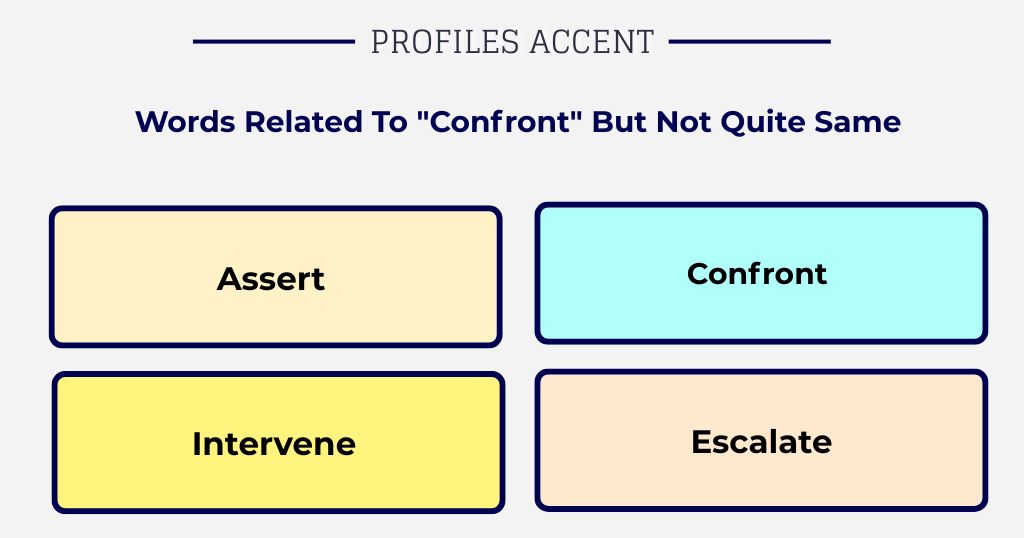
These words orbit “confront” but mean something slightly different:
- Assert focuses on declaring your position, not necessarily facing someone else.
- Intervene involves stepping into a situation from the outside rather than facing something head-on.
- Confront and confess are sometimes confused in emotional contexts. One is outward-facing; the other is inward.
- Escalate happens after a confrontation, not during one. Writers sometimes reach for “confront” when they mean the situation worsened.
- Accountability is the result of healthy confrontation, not a synonym for it. Worth noting when writing about personal growth or social justice topics.
Picking the Right Synonym for Confront, Every Time
Before you pick a replacement for “confront,” ask three things:
- Is the target a person or a situation? That alone narrows your options significantly.
- How much tension belongs in this moment? Match the emotional weight of the word to the scene.
- What register are you writing in? A sharply casual word drops the formality of an essay. A stiff formal word kills the energy of a dialogue scene.
Get those three right, and the synonym almost picks itself.
Discover More Articles:

I’m Rowan, a language addict who loves exploring how words work in everyday communication. I’ve spent years studying English vocabulary and helping others express themselves more clearly. My goal is simple: make learning new words easy and practical. I focus on real-life examples that show when and how to use different terms. Through clear explanations and honest guidance, I help readers choose the right words for any situation with confidence.