There is a quiet difference between saying “I respect your choice” and “I honor your choice.” Same idea. Completely different weight.
Most writers pick the familiar word and move on. But word choice shapes how people feel when they read. The right synonym does more than swap one word for another. It adjusts tone, signals relationship, and controls emotional depth in ways the base word simply cannot.
This article helps you choose precisely.
What “Respect” Actually Carries
At its core, respect means recognizing the worth of someone or something and letting that recognition shape your behavior. It lives somewhere between admiration and obedience, between feeling and action. That is exactly why it is so hard to replace with just one word. It stretches across emotional, social, and behavioral territory at the same time.
Quick 45+ Synonym Table: Another Word for Respect
| Word | Tone | Best Used When | Quick Example |
| Esteem | Warm, formal | Admiring someone’s character | “She is held in high esteem.” |
| Regard | Neutral, polished | Professional or relational contexts | “I have great regard for his work.” |
| Reverence | Deep, sacred | Something almost untouchable | “He spoke with reverence.” |
| Veneration | Elevated, formal | Historical or deeply admired figures | “The elder was treated with veneration.” |
| Admiration | Warm, positive | Appreciating talent or effort | “My admiration for her grew daily.” |
| Deference | Submissive, polite | Yielding to someone’s authority | “He spoke with deference to the judge.” |
| Appreciation | Grateful, sincere | Valuing a contribution or quality | “Her appreciation for the craft showed.” |
| Courtesy | Social, surface-level | Polite behavior in daily interaction | “Basic courtesy goes a long way.” |
| Civility | Restrained, formal | Maintaining peace despite differences | “They disagreed with civility.” |
| Honor | Strong, dignified | Recognizing someone’s integrity | “It is an honor to stand beside you.” |
| Homage | Public, formal | Acknowledging greatness or legacy | “They paid homage to the founder.” |
| Awe | Wonder-based | Mixed respect and astonishment | “She looked at the surgeon with awe.” |
| Consideration | Thoughtful | Thinking of others before acting | “He showed real consideration for her time.” |
| Recognition | Acknowledgment-based | Validating someone’s effort | “She earned recognition for her patience.” |
| Thoughtfulness | Gentle, interpersonal | Relationships and everyday care | “His thoughtfulness made her feel seen.” |
| Compliance | Action-based | Following rules or decisions | “Compliance with the policy is expected.” |
| Heed | Quiet, attentive | Paying careful attention to something | “He heeded her warnings.” |
| Observance | Formal, rule-based | Honoring traditions or agreements | “Observance of the rule was required.” |
| Adherence | Steady, procedural | Following guidelines or commitments | “Her adherence to the agreement impressed them.” |
| Acknowledgment | Neutral, validating | Recognizing someone’s presence or effort | “A simple acknowledgment changed her mood.” |
| Props | Casual, urban | Informal credit or recognition | “Give him props for that.” |
| Dap | Slang, physical | A gesture of mutual respect | “They gave each other dap.” |
| Giving flowers | Modern slang | Publicly praising someone’s work | “We should give her flowers for that idea.” |
| Solicitude | Formal, caring | Showing genuine concern for someone | “His solicitude toward the patient was clear.” |
| Attentiveness | Relational, quiet | Being present and aware | “Attentiveness is one form of deep respect.” |
| Approbation | Very formal | Official or literary approval | “The committee expressed its approbation.” |
| Obeisance | Old-fashioned, formal | Deep submission or ceremonial respect | “They bowed in obeisance.” |
| Cherish | Warm, emotional | Holding something precious | “He cherished her trust.” |
| Value | Practical | Recognizing worth in something | “She truly values his opinion.” |
| Prize | Personal, emphatic | Holding something in the highest regard | “He prized honesty above all.” |
| Sincerity | Character-based | Authentically honoring someone | “Her sincerity in the relationship was visible.” |
| Salutation | Greeting-based | Formal acknowledgment in written form | “The letter opened with a respectful salutation.” |
| Affection | Warm, personal | Blended respect and fondness | “His affection for his mentor never faded.” |
| Autonomy-validation | Modern, relational | Honoring someone’s right to decide | “She practiced autonomy-validation without hesitation.” |
| Credit | Professional, casual | Acknowledging someone’s contribution | “Give credit where it belongs.” |
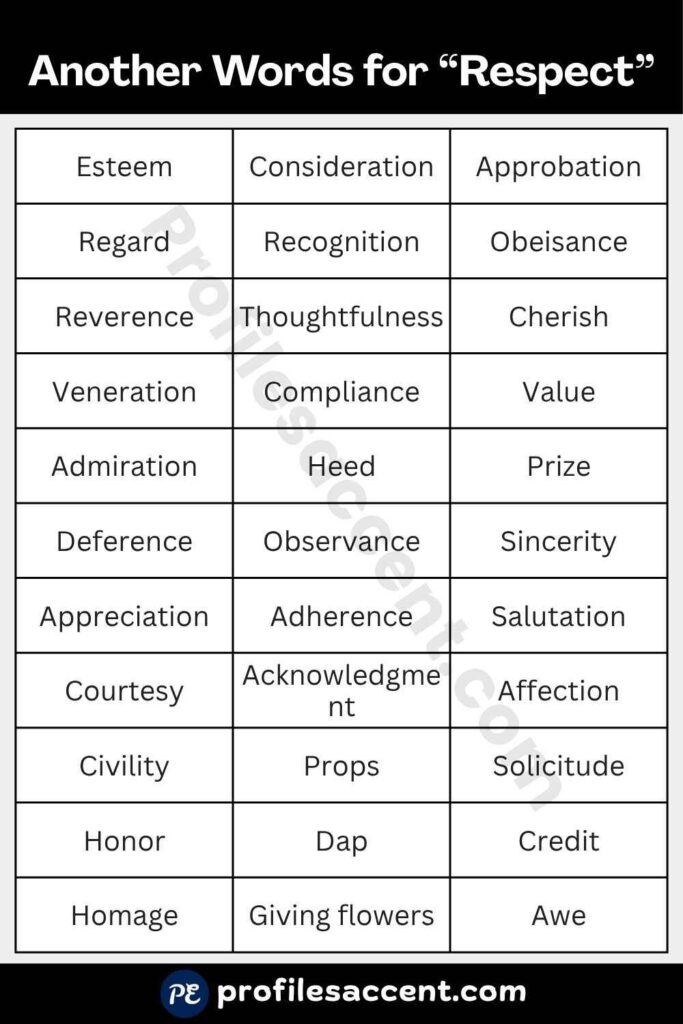
Four Ways Respect Changes Meaning
Respect does not mean one thing. It stretches across four zones, and the synonym you pick depends on which zone you are working in.
Zone 1: Emotional Admiration
This is respect you feel inside. You look at someone’s character, their choices, or their strength and something rises in you. Words like esteem, reverence, admiration, and awe live here. They describe an internal state, not an action.
Zone 2: Behavioral Compliance
This is respect you show through actions. Following rules. Honoring decisions. Deferring to authority. You may not personally agree, but your behavior reflects recognition of something larger. Compliance, adherence, observance, and deference belong here.
Zone 3: Interpersonal Consideration
This is the quiet, daily form of respect. It is how you treat people in conversation, in relationships, in shared spaces. Thoughtfulness, attentiveness, courtesy, and civility are its closest expressions. This zone is the most underrepresented in standard synonym lists.
Zone 4: Aspect or Particular
Often overlooked entirely. When someone says “in that respect,” they are not talking about admiration at all. They mean “in that detail” or “in that specific way.” Here, the right synonyms are aspect, particular, point, feature, and detail. Mixing these up with Zone 1 is a surprisingly common mistake.
How Strong Is Your Respect? A Tone Scale for Synonyms
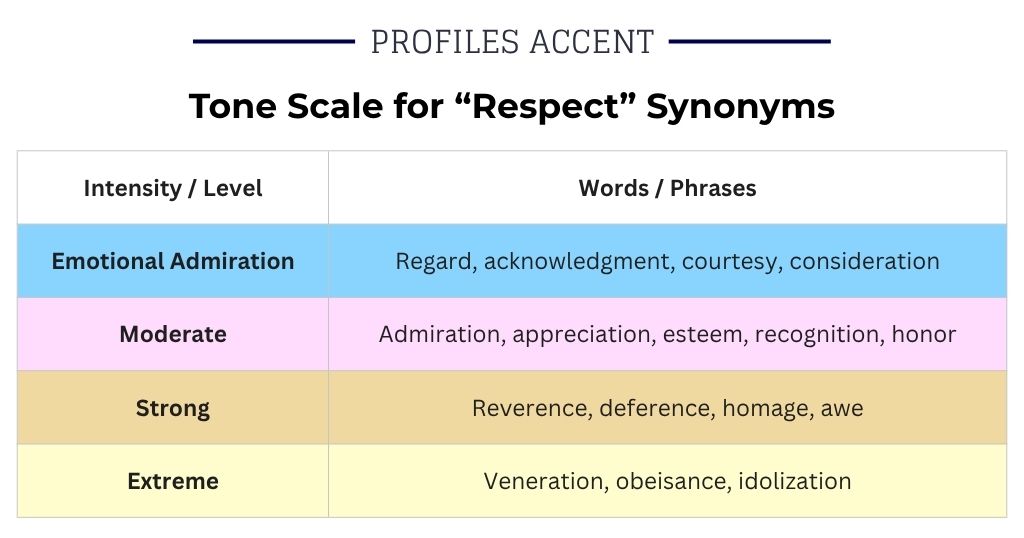
Not all respect is equal in emotional weight. Here is how common synonyms sit on the scale, from gentle to intense:
Emotional Admiration
- Regard, acknowledgment, courtesy, consideration
Moderate
- Admiration, appreciation, esteem, recognition, honor
Strong
- Reverence, deference, homage, awe
Extreme
- Veneration, obeisance, idolization
Understanding this scale helps writers avoid mismatch. Using veneration for a casual professional relationship sounds theatrical. Using courtesy when describing a spiritual or sacred connection feels flat.
Same Sentence, Different Word: See the Shift
Original: “I respect your decision.”
- Formal: “I defer to your judgment entirely.”
- Casual: “I get it. I’m not going to push back on that.”
- Academic: “I recognize the autonomy embedded in that choice.”
- Emotional: “Your call matters to me, and I’ll honor it.”
Original: “He showed respect to his teacher.”
- Formal: “He conducted himself with deference toward his instructor.”
- Casual: “He gave his teacher her props.”
- Narrative: “Something in the way he listened showed more than politeness. It was genuine esteem.”
Original: “We need to respect the rules.”
- Professional: “Adherence to these guidelines remains non-negotiable.”
- Conversational: “These rules are there for a reason. Let’s follow them.”
- Academic: “Compliance with established protocols ensures collective fairness.”
Each version lands differently. None is wrong. All depend on the context, the audience, and the relationship between the speaker and subject.
Formal and Informal Synonyms for Respect, Sorted by Setting
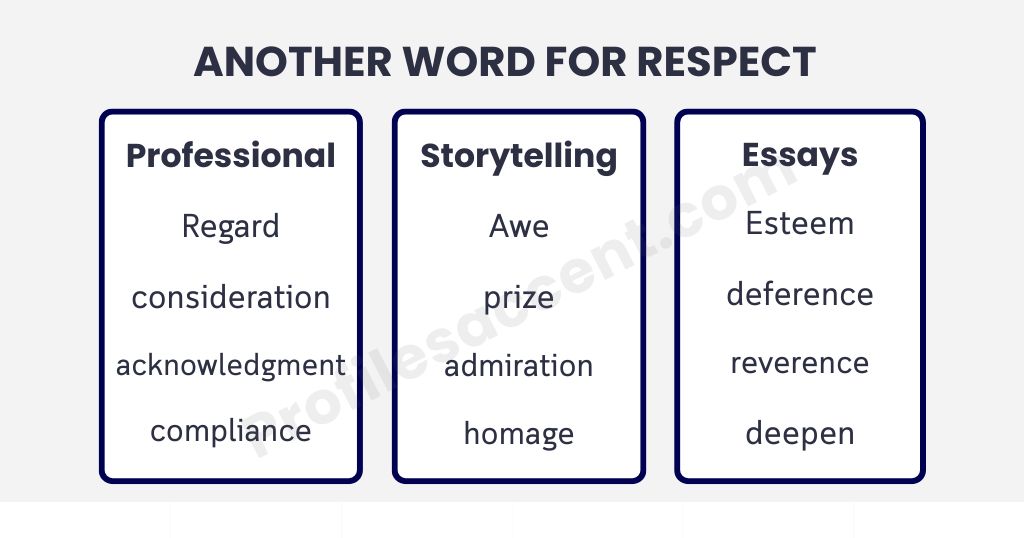
For essays and academic writing:
- Esteem, deference, reverence, approbation, veneration, solicitude
These carry scholarly weight. They signal awareness of nuance and precision.
For professional emails:
- Regard, consideration, acknowledgment, compliance, recognition
Warm but efficient. They respect the reader’s time while maintaining professionalism.
For storytelling and creative writing:
- Awe, cherish, prize, admiration, homage, affection, attentiveness
These breathe life. They create texture and emotional resonance.
Words to avoid in formal contexts:
- Props, dap, mad love, giving flowers
These belong in informal or creative writing only. Placing them in a cover letter or academic paper undermines the writer’s credibility instantly.
Common Mistakes When Using Respect Synonyms
Mixing deference and admiration.
Deference means yielding. Admiration means looking up to someone with positive feeling. A junior employee may defer to a manager they do not admire. A fan admires an artist without ever deferring to them. These are not the same.
Using reverence too casually.
Reverence carries near-sacred weight. Saying “I have reverence for good coffee” is technically possible but tonally strange. Save it for things that genuinely carry cultural, spiritual, or deeply personal meaning.
Forgetting the plural form.
“Please give my respects to your family” is not an expression of admiration. It is a polite greeting. The right synonyms there are regards, compliments, or best wishes, not esteem or reverence.
Treating compliance as warm respect.
“I complied with his request” is not the same as “I honored his request.” Compliance is neutral at best. Honor adds genuine regard. Context decides which one you need.
Vertical vs. Horizontal Respect: A Distinction Most Lists Miss
This distinction rarely appears in standard thesauruses, but it matters a lot in interpersonal writing.
Vertical respect flows upward. It involves hierarchy, authority, age, or power. Words like deference, obeisance, and submission describe it. This type is often rule-based or socially conditioned.
Horizontal respect flows between equals. It is based on mutual recognition, shared dignity, and the acknowledgment of each other’s autonomy. Words like consideration, attentiveness, recognition, and equity describe it better.
A healthier relationship relies on horizontal respect. An institutional setting often runs on vertical respect. Knowing which one you are writing about shapes which synonym fits.
Words Close to Respect (But Not Quite the Same)
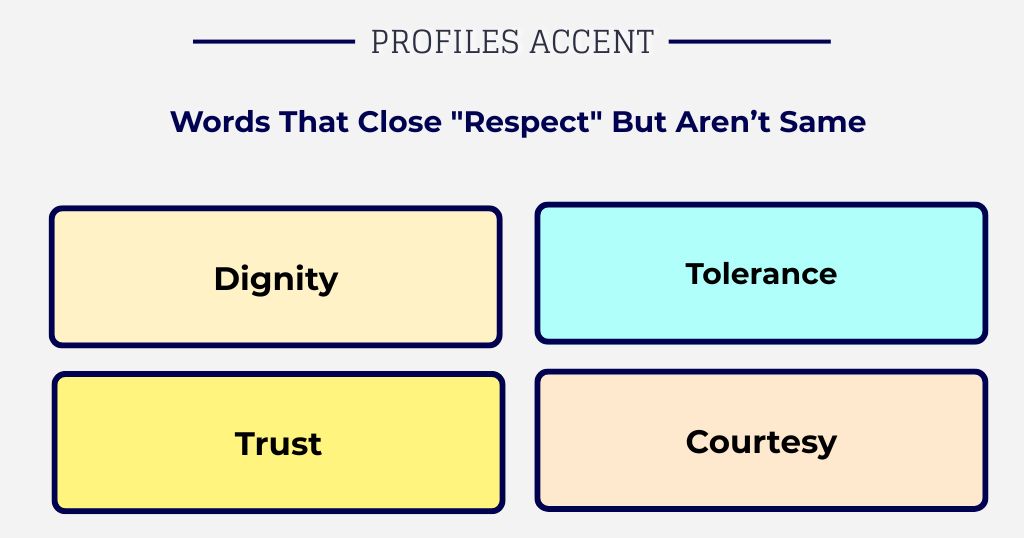
- Dignity: The inherent worth a person carries. You can respect someone without affirming their dignity. But affirming dignity is a deeper, more unconditional act.
- Tolerance: Often confused with respect. Tolerating something means accepting it exists without interference. Respecting it means recognizing its value. Not the same thing.
- Trust: Builds alongside respect but is earned through reliability, not just regard. You can respect someone you do not fully trust yet.
- Courtesy: The behavioral surface of respect. It is form without necessarily containing feeling. Respect can exist without courtesy, and courtesy can exist without genuine respect.
- Recognition: Narrower than respect. It acknowledges presence or contribution but does not necessarily involve esteem or emotional weight.
How to Pick the Right Synonym for Respect Every Time
Before you reach for a synonym, ask yourself three questions.
First, is this respect something felt or something done? If it is an internal state, pick emotional words like esteem or reverence. If it is a behavior or action, lean toward deference, compliance, or observance.
Second, how intense is the feeling? A polite professional nod calls for regard or acknowledgment. Something deep and long-held calls for veneration or homage.
Third, who is the audience? Slang lands with peers. Formal alternatives earn credibility in professional or academic settings. Creative writing rewards precision and unexpected word choices that feel fresh rather than routine.
The right synonym does not just fill a blank. It shapes how your sentence sounds, how your character feels, and how your reader receives the moment you are describing.
Discover More Articles:

I’m Rowan, a language addict who loves exploring how words work in everyday communication. I’ve spent years studying English vocabulary and helping others express themselves more clearly. My goal is simple: make learning new words easy and practical. I focus on real-life examples that show when and how to use different terms. Through clear explanations and honest guidance, I help readers choose the right words for any situation with confidence.