You just finished a project. Your manager says, “I have some feedback for you.” Your stomach tightens a little. Is it good? Is it critical? You genuinely cannot tell.
That single word carries so much weight, yet it tells you almost nothing. The problem is not just vagueness. It is that “feedback” has become a catch-all word used in so many situations that it often loses its power. Writers, professionals, and students default to it out of habit, when a more precise word would do the job far better.
Choosing the right alternative is not about sounding smarter. It is about being clearer, setting the right tone, and respecting your reader.
What Makes “Feedback” Such a Loaded Word
At its core, feedback is a response that helps someone understand how they are doing. It can be a single comment or a full written report. It carries an evaluative weight that a word like “reply” does not.
What makes it tricky is that feedback flows in different directions. A manager gives feedback downward to a team member. A customer gives it upward to a company. A peer gives it sideways to a colleague. Each direction calls for a slightly different word.
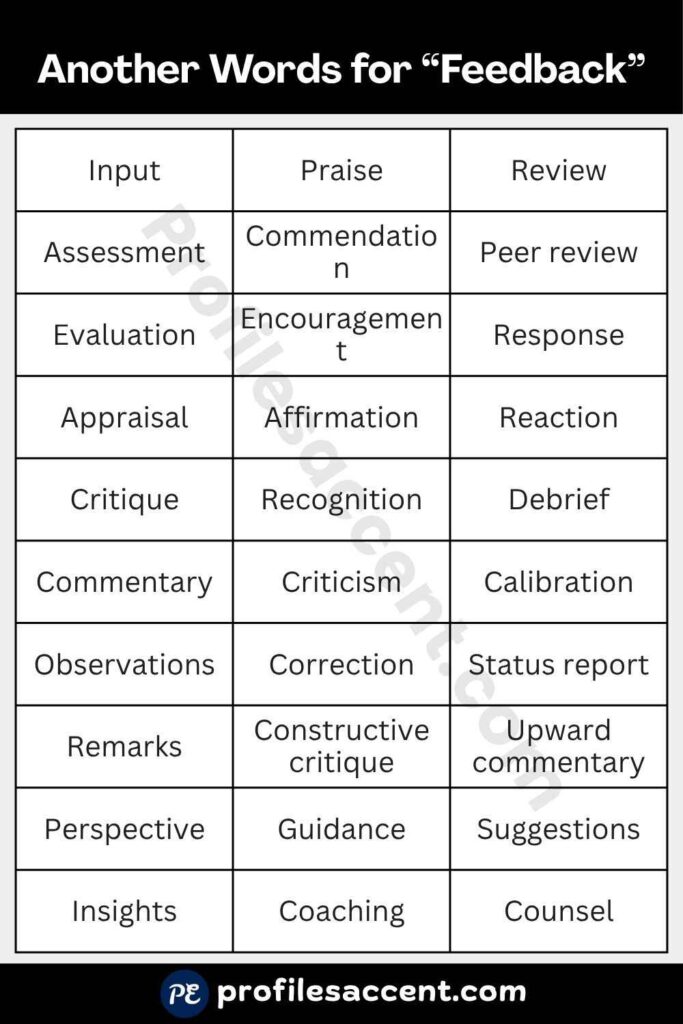
Quick 40+ Synonyms for Feedback Sorted by Real-World Context
| Word | Tone | Best Used When |
| Input | Neutral, collaborative | Asking a team for ideas before a decision |
| Assessment | Formal | Documenting performance or quality |
| Evaluation | Formal | Structured review of a project or person |
| Appraisal | Formal, hierarchical | Manager reviewing an employee’s work |
| Critique | Analytical | Reviewing creative or academic work |
| Commentary | Thoughtful | Providing extended written observations |
| Observations | Neutral | Noting what you noticed without judgment |
| Remarks | Slightly formal | Brief written or spoken comments |
| Perspective | Open, respectful | Sharing a viewpoint in a conversation |
| Insights | Warm, professional | Sharing what you learned from experience |
| Suggestions | Helpful | Recommending small improvements |
| Recommendations | Authoritative | Advising a clear course of action |
| Guidance | Supportive | Helping someone navigate a challenge |
| Coaching | Developmental | Building someone’s skills over time |
| Counsel | Wise, professional | Advising with experience behind the words |
| Praise | Positive | Recognizing good work openly |
| Commendation | Formal, positive | Official recognition of achievement |
| Encouragement | Warm | Boosting confidence after effort |
| Affirmation | Personal | Confirming someone’s value or direction |
| Recognition | Public or professional | Acknowledging a person’s contribution |
| Criticism | Direct, sharp | Pointing out what went wrong clearly |
| Correction | Neutral | Fixing a specific error without judgment |
| Constructive critique | Balanced | Criticism focused on improvement |
| Review | Standard | Examining work before finalizing it |
| Peer review | Academic, collaborative | Colleagues evaluating each other’s work |
| Response | Conversational | Reacting to something said or shared |
| Reaction | Immediate, emotional | How someone felt about something |
| Debrief | Post-event | Reviewing what happened after a meeting or project |
| Calibration | Technical, process-based | Aligning expectations across a team |
| Status report | Process-driven | Updating stakeholders on progress |
| Upward commentary | Corporate | Employees sharing views with leadership |
Synonyms That Look Alike But Work Very Differently
Many people think these words mean the same thing. They do not.
Appraisal only flows one way. A manager appraises an employee. You would not say, “I have an appraisal for my director.” That sounds off, even though it technically involves evaluation. Power direction matters here.
Critique is not automatically negative. In creative fields, a critique is a structured, thoughtful look at a piece of work. It can be mostly positive. Writers often avoid this word fearing it sounds harsh, but in an artistic or academic setting, it is actually the most respectful choice.
Response and reaction are easily confused. A response implies thought. A reaction is immediate and often emotional. If a client carefully reviewed your proposal and wrote back with notes, that is a response. If they gasped when they saw the price, that is a reaction.
Guidance versus criticism is another common mix-up. Guidance focuses on the path forward. Criticism focuses on what went wrong. Both can be useful, but they land very differently on the person receiving them.
The One Thing Most Feedback Synonym Lists Miss
Here is something most synonym guides skip entirely. Not all feedback words carry the same expectation of action.
Some words are purely observational. “Opinion” and “reaction” sit at this end. They describe what someone thought or felt, but they do not push for change.
Other words are inherently action-oriented. “Recommendations,” “guidance,” and “coaching” all imply that something will happen next. When you use these words, you signal that the conversation is not just about sharing views but about moving forward.
This matters when writing professionally. If you ask someone for their “opinion,” they may give you a casual thought. If you ask for their “recommendations,” you are inviting structured, actionable input. Same intent, but the word shapes the quality of what you receive.
How Hard Does Your Word Hit? A Tone Scale for Feedback Synonyms

Knowing how strong a word feels helps you avoid sending the wrong signal. Here is a rough scale from lightest to most direct:
- Gentle end: Thoughts, input, perspective, suggestions, encouragement
- Middle ground: Observations, commentary, insights, review, assessment
- More formal: Evaluation, appraisal, guidance, recommendations, debrief
- Sharpest: Criticism, critique, correction, objection, adverse commentary
A word like “thoughts” feels like an open invitation. “Evaluation” carries weight. “Criticism” signals that something was wrong. When you want to be direct without being harsh, “observations” or “assessment” usually hit the right balance.
Feedback in a Sentence, Rewritten Four Ways
Seeing substitutions in action is more useful than a list alone.
Original: “Can I give you some feedback on your report?”
- Formal: “I have a few assessment notes on the report I would like to share.”
- Casual: “I had some thoughts on the report, do you have a minute?”
- Encouraging: “I wanted to share some observations that could make this even stronger.”
The formal version sets a structured tone. The casual version lowers the stakes. The encouraging version signals that the conversation is meant to help, not critique.
Original: “We appreciate your feedback.”
- Professional email: “Thank you for taking the time to share your insights.”
- Warm and personal: “Your thoughts genuinely helped us see things differently.”
- Impact-focused: “Your input is directly shaping how we improve.”
Notice how “your input is directly shaping how we improve” feels more meaningful than a generic thank-you. It shows the person their contribution actually mattered.
Original: “The teacher gave feedback on my essay.”
- Academic: “The professor provided a written critique of the essay’s structure and argument.”
- Neutral: “The teacher shared her observations and noted areas for revision.”
- Developmental: “The coaching I received helped me rethink my thesis entirely.”
Better Words for Positive Feedback (That Actually Feel Like More Than a Pat on the Back)
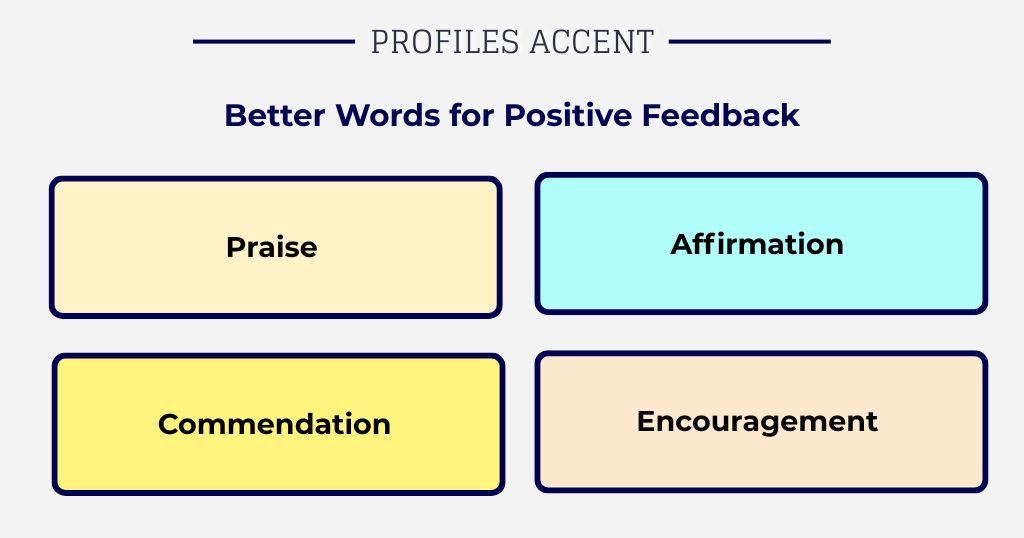
When you want to recognize someone’s work, generic words like “good feedback” fall flat. These carry more weight:
- Praise works in public settings. “She received praise from the entire board” carries a sense of visible recognition.
- Affirmation works in personal or mentoring conversations. It says: I see you, and I believe in your direction.
- Commendation suits formal situations. Think annual reports, award ceremonies, official letters.
- Encouragement is different from praise. Praise is about what someone did. Encouragement is about who they can become. Use it when someone needs confidence, not just a compliment.
Constructive Feedback Synonyms That Do Not Sound Like Corporate Softening
“Constructive feedback” is a phrase people use to soften bad news. These alternatives carry the same intent but feel fresher:
- Developmental input
- Improvement-focused observations
- Growth-oriented guidance
- Calibration notes (useful in team settings)
- Coaching points
The key difference between these and plain criticism is that they orient toward a goal. They say: here is where we want to go, and here is what stands in the way.
Words That Seem Like Good Substitutes But Really Are Not
Some substitutions sound smart but create problems in context.
Do not use “scrutiny” when you mean feedback. Scrutiny implies suspicion. It is what investigations face, not employees.
Avoid “verdict” in collaborative settings. It sounds like a judgment has already been made. That shuts down dialogue.
“Retort” is for arguments. It carries a combative edge that rarely belongs in professional or educational settings.
In sensitive situations, such as mental health discussions, academic probation, or performance improvement plans, overly clinical words like “audit findings” or “deficiency report” can feel dehumanizing. In those cases, “guidance,” “support notes,” or “developmental conversation” are far more appropriate.
Words That Live in the Same Neighborhood as Feedback
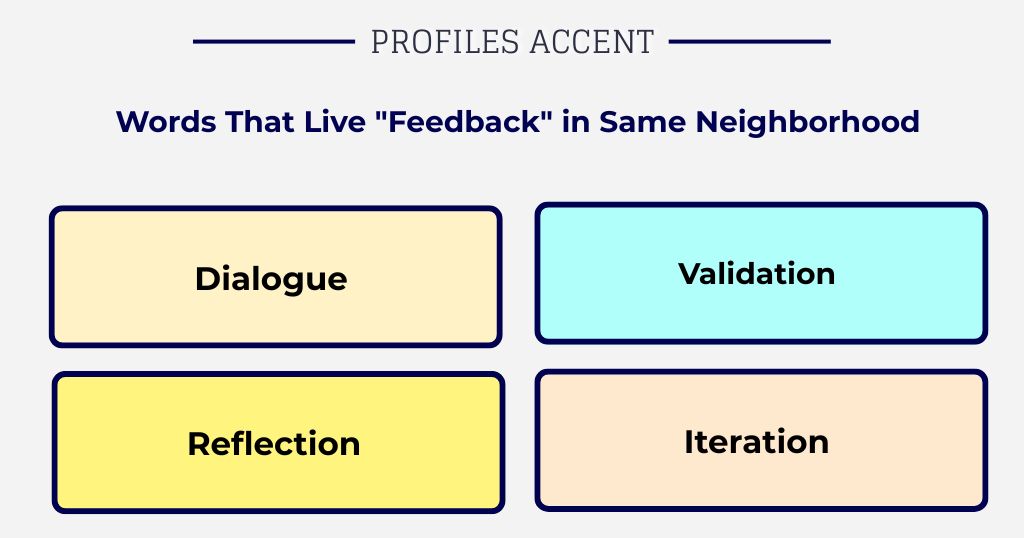
- Dialogue includes feedback but adds back-and-forth exchange. Use it when two people are contributing equally.
- Reflection is what someone does with feedback after receiving it. It is internal, not external.
- Validation is a type of positive feedback focused on confirming someone’s feelings or decisions are sound.
- Iteration often follows feedback in creative or technical work. It is the action loop that feedback triggers.
Mentorship is a relationship built on ongoing, structured feedback over time.
Pick Your Word With Confidence
Here is the simplest way to decide. Ask yourself three things before you write:
- Who is receiving this? A peer, a manager, a student, or a customer all need different tones.
- What direction does it flow? Downward evaluation, upward commentary, or lateral exchange each call for different words.
- Is it meant to inform or to push for change? Passive words like “reaction” inform. Active words like “recommendations” push for change.
Get those three things right and the synonym will almost choose itself.
Discover More Articles:

I’m Rowan, a language addict who loves exploring how words work in everyday communication. I’ve spent years studying English vocabulary and helping others express themselves more clearly. My goal is simple: make learning new words easy and practical. I focus on real-life examples that show when and how to use different terms. Through clear explanations and honest guidance, I help readers choose the right words for any situation with confidence.