Most writers reach for disparities and never look back. It does the job. But when you use the same word three times in an essay, a report, or a policy brief, the writing starts to feel flat. Worse, it can signal to a reader that you haven’t thought deeply about which kind of difference you’re describing.
That’s the real issue here. Disparities isn’t just a synonym for “difference.” It carries weight. Swapping it out isn’t just about variety. It’s about precision.
What Does Disparities Really Mean?
At its core, a disparity is a noticeable gap between two things, usually one that feels unfair or unbalanced. It goes beyond plain difference. When you say two cities have a disparity in hospital access, you’re not just stating a fact. You’re implying that the gap matters, that something is off, and often that someone is getting a worse deal.
The word leans toward injustice, even when no one says so directly.
40+ Synonyms for Disparities: Quick Table
| Word | Tone | Best For | Quick Example |
| Inequality | Neutral to serious | Social or economic writing | Income inequality across regions |
| Inequity | Strong, moral | Policy, health, justice topics | Inequity in vaccine distribution |
| Imbalance | Moderate | Systems, markets, nature | An imbalance in resource allocation |
| Gap | Simple, direct | Any context, especially data | The gap in test scores widened |
| Discrepancy | Factual, precise | Reports, audits, data errors | A discrepancy in the census figures |
| Differential | Technical | Wages, health, statistics | Wage differential by sector |
| Divide | Vivid, social | Opinion, journalism, essays | The digital divide in rural areas |
| Asymmetry | Formal, structural | Research, policy analysis | Power asymmetry in negotiations |
| Divergence | Trend-based | When two things are drifting apart | Growing divergence in outcomes |
| Variance | Statistical | Data science, research | Variance in mortality rates |
| Unevenness | Descriptive | Casual writing, storytelling | Unevenness in opportunity |
| Disproportion | Structural | Size or share comparisons | A disproportion in funding levels |
| Contrast | Broad | Comparisons of any kind | A stark contrast in living standards |
| Chasm | Intense, dramatic | Strong impact writing | A chasm between rich and poor |
| Gulf | Vivid, figurative | Journalism, persuasive writing | A growing gulf in educational access |
| Inconsistency | Contradictory | When facts don’t match | Inconsistency in enforcement |
| Dissimilarity | Formal | Academic or literary writing | Clear dissimilarity in outcomes |
| Skew | Data-driven | Statistics, analysis | A skew toward wealthier districts |
| Stratification | Systemic | Class, race, social structure | Economic stratification by zip code |
| Polarization | Extreme split | Political or social writing | Growing polarization in wealth |
| Mismatch | Practical | Skills, expectations, data | A mismatch between supply and demand |
| Lopsidedness | Informal | Casual essays, opinion pieces | The lopsidedness of the funding model |
| Otherness | Philosophical | Cultural or identity discussions | A sense of otherness in representation |
| Fragmentation | Social | Community, society, systems | Fragmentation in access to services |
| Separation | General | Distance between groups | Separation in academic performance |
| Rupture | Dramatic | Sudden or severe breaks | A rupture in social equity |
| Drift | Subtle, gradual | Slow-changing differences | A quiet drift in outcomes over time |
| Distance | Spatial or abstract | Measuring gaps metaphorically | The distance between policy and reality |
| Disequilibrium | Technical | Economics, science, systems | Disequilibrium in supply chains |
| Incongruity | Literary, ironic | When two things clash oddly | The incongruity of wealth beside poverty |

How the Right Word Changes Everything by Context
Not all synonyms work everywhere. Here’s where the real writing skill lives.
Health Writing
When writing about health topics, disparities is common, but inequities is often sharper. Inequity suggests the gap wasn’t accidental. It points to systems, history, or policy.
If you’re writing about mental health disparities, consider using mental health inequities when you want to highlight systemic causes, or gaps in mental health access when the focus is practical and service-based.
Economic Writing
For economic disparity, income inequality and wealth gap are widely understood and widely searched. Stratification works well in academic papers when describing rigid social layers. Polarization fits better when the divide is intensifying or political.
Educational Writing
Achievement gap has become almost its own term in education policy. For formal essays, educational inequity signals awareness of root causes. Learning divide works in more accessible, general-audience writing.
Racial and Regional Writing
Racial disparities can be replaced with racial inequities in policy writing, or demographic divides when the focus is geographic or population-based. Regional disparities often pair well with geographic imbalance or place-based inequality.
From Mild to Severe: A Tone Scale for Disparity Synonyms
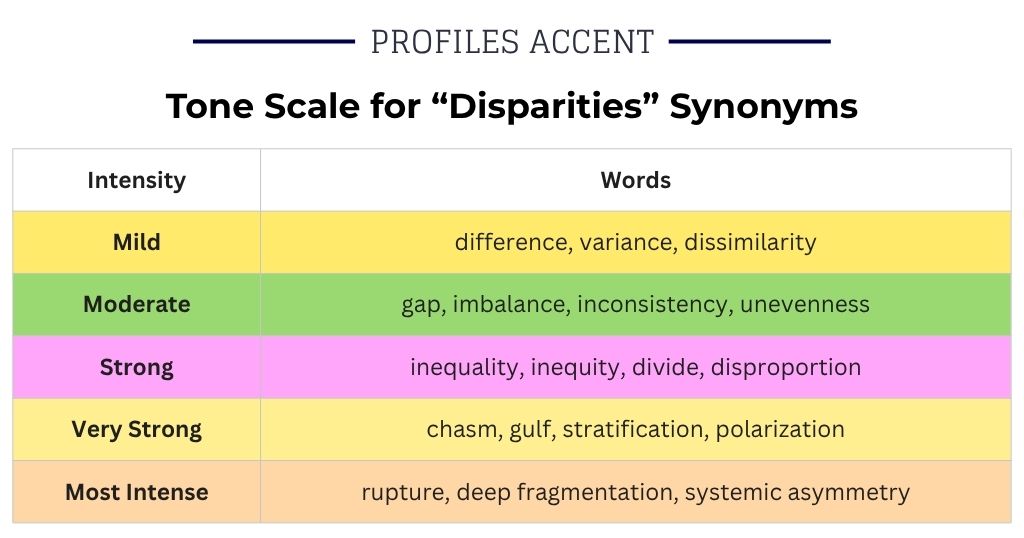
The word you choose sends a signal about how serious you think the problem is. Here’s a rough scale:
- Mild: difference, variance, dissimilarity
- Moderate: gap, imbalance, inconsistency, unevenness
- Strong: inequality, inequity, divide, disproportion
- Very Strong: chasm, gulf, stratification, polarization
- Most Intense: rupture, deep fragmentation, systemic asymmetry
If you’re writing a casual blog post, gap or difference keeps things light. If you’re drafting a policy brief or a social justice report, inequity or stratification signals that you understand the depth of the problem.
Same Sentence, Different Word: Watch the Meaning Shift
Here’s how swapping one word can shift the entire feel of a sentence.
Original: There are major disparities in how students access technology.
- Formal: Significant inequities persist in student access to digital resources across income levels.
- Casual: Not every student has the same shot at getting online for homework.
- Academic: Data reveals a structural asymmetry in technology access among K-12 populations.
- Journalistic: The digital divide is leaving low-income students behind before class even starts.
Each version says something slightly different. The casual one focuses on fairness. The academic one focuses on structure. The journalistic one adds urgency. Pick the version that matches what you actually want to say.
Original: We need to address health disparities in rural areas.
- Policy: Closing health inequities in underserved rural communities requires targeted federal investment.
- Accessible: People in rural areas often get worse healthcare, and that needs to change.
- Research: Rural-urban health differentials point to gaps in both access and outcome metrics.
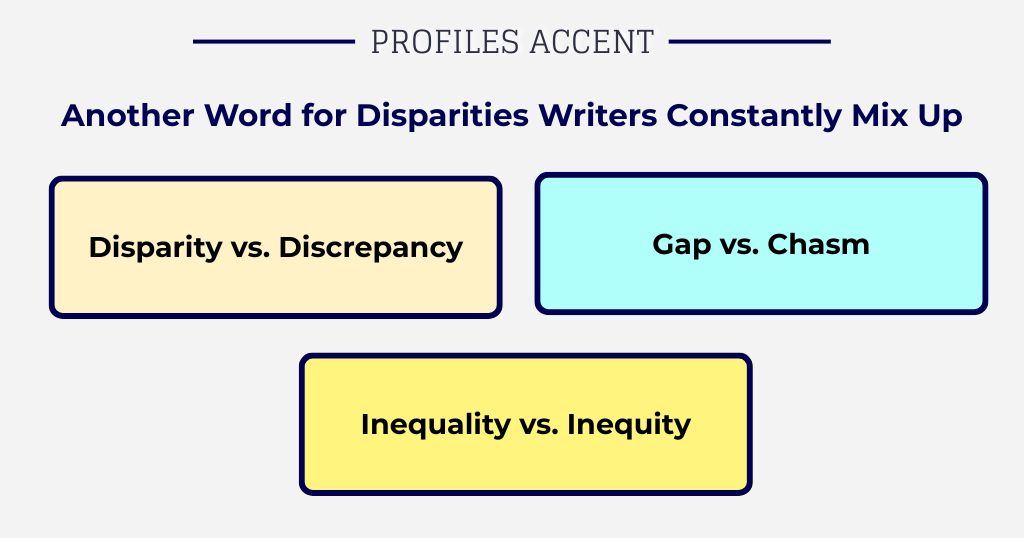
Another Word for Disparities That Writers Constantly Mix Up
This is where most writers trip up.
Disparity vs. Discrepancy
A discrepancy is usually a factual error or mismatch. Two numbers that don’t add up. A testimony that contradicts the evidence. A disparity is deeper. It’s a structural, ongoing gap, often between groups of people. One is a mistake to be corrected. The other is a condition to be addressed.
Inequality vs. Inequity
Inequality is the measurement. Inequity is the judgment. Saying two people have unequal salaries describes a fact. Saying their pay reflects an inequity means the difference is unjust. Both words oppose disparity, but for different reasons. Parity resolves inequality. Equity challenges inequity.
Gap vs. Chasm
Both describe distance, but a gap can potentially be closed. A chasm feels permanent, vast, and dramatic. Use chasm carefully. It’s strong. Use it too often and it loses its punch.
When Word Choice Becomes a Sensitivity Issue
When writing about racial disparities, mental health disparities, or gender-based disparities, word choice carries real stakes. Some readers will read inequality as neutral and detached. Others will see inequity as politically loaded. Know your audience.
In academic and health writing, both disparities and inequities are standard and respected terms. In general journalism, gap or divide often communicates the same idea without triggering defensiveness.
Avoid using difference alone when you mean a disparity with real consequences. Calling a 20-year gap in life expectancy between neighborhoods a “difference” undersells what’s happening. Word choice shapes whether readers feel the weight of the issue or skim past it.
The Verb Problem Nobody Talks About
There is no verb form of disparity. None. Writers sometimes write things like “the outcomes disparated” or try to use disparate as a verb. That’s incorrect. Disparate is an adjective meaning essentially different in kind, and it isn’t even closely related to disparity in usage.
When you need to express the action of creating or widening a disparity, use verbs like:
- widen, deepen, grow (to describe a worsening gap)
- stratify, skew, fragment (to describe structural forces creating gaps)
- diverge, separate (when two groups or trends move apart)
This small fix alone will make your writing cleaner and more credible.
Words That Live in the Same Neighborhood as Disparities
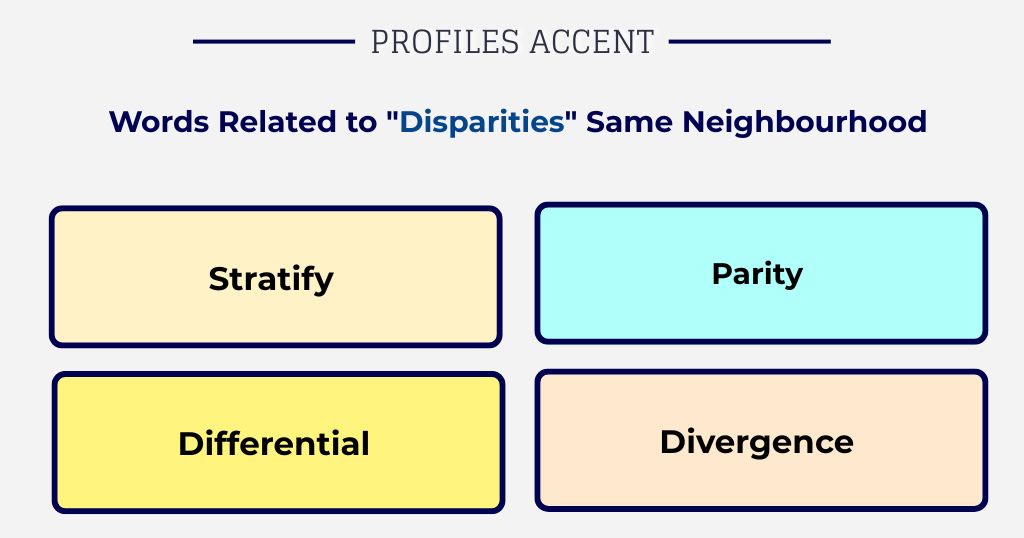
- Stratify (verb): To divide something into layers or levels, often by class, income, or status. Useful when describing how systems create gaps over time.
- Parity (noun): The direct opposite of disparity. Equal standing or comparable conditions. Common in pay discussions and sports.
- Differential (noun/adjective): A measured gap, often numerical. Feels precise and research-oriented.
- Divergence (noun): The act of moving apart. Fits well when describing trends that were once similar but are growing apart.
- Asymmetry (noun): An uneven distribution of power, resources, or outcomes. More structural in tone than gap.
So Which Synonym for Disparities Should You Actually Pick?
When you need another word for disparities, don’t just grab the first synonym you find.
Ask what you’re really describing.
- Is it a data mismatch? Use discrepancy.
- Is it an ongoing social gap? Use inequality or inequity.
- Is it a sharp, dramatic divide? Use gulf or chasm.
- Is it structural and systemic? Use asymmetry or stratification.
The right synonym doesn’t just replace a word. It tells your reader exactly how serious the gap is, where it lives, and whether someone should be alarmed.
Discover More Articles:

I’m Rowan, a language addict who loves exploring how words work in everyday communication. I’ve spent years studying English vocabulary and helping others express themselves more clearly. My goal is simple: make learning new words easy and practical. I focus on real-life examples that show when and how to use different terms. Through clear explanations and honest guidance, I help readers choose the right words for any situation with confidence.