You pick up a résumé. The candidate wrote: “Cultivated strong team relationships.” Fine. But now imagine reading: “Built lasting trust across departments, turning new hires into confident contributors.” Suddenly the person feels real.
That is the power hiding inside word choice. “Cultivate” is a solid word, but it is also a comfortable one. Writers reach for it on autopilot. The result? Sentences that pass by without landing anywhere.
This guide will not just hand you a list. It will show you which word fits where, why some synonyms carry risk, and how a single swap can shift your whole tone.
What “Cultivate” Really Carries
At its core, cultivate means to grow something through steady, deliberate care. It started in farming. Over time it stretched into personal growth, relationships, and skill-building.
The emotional weight is patient effort. Not a quick action. Not an accident. Something tended over time. That is the tone baseline you carry into any synonym you choose.
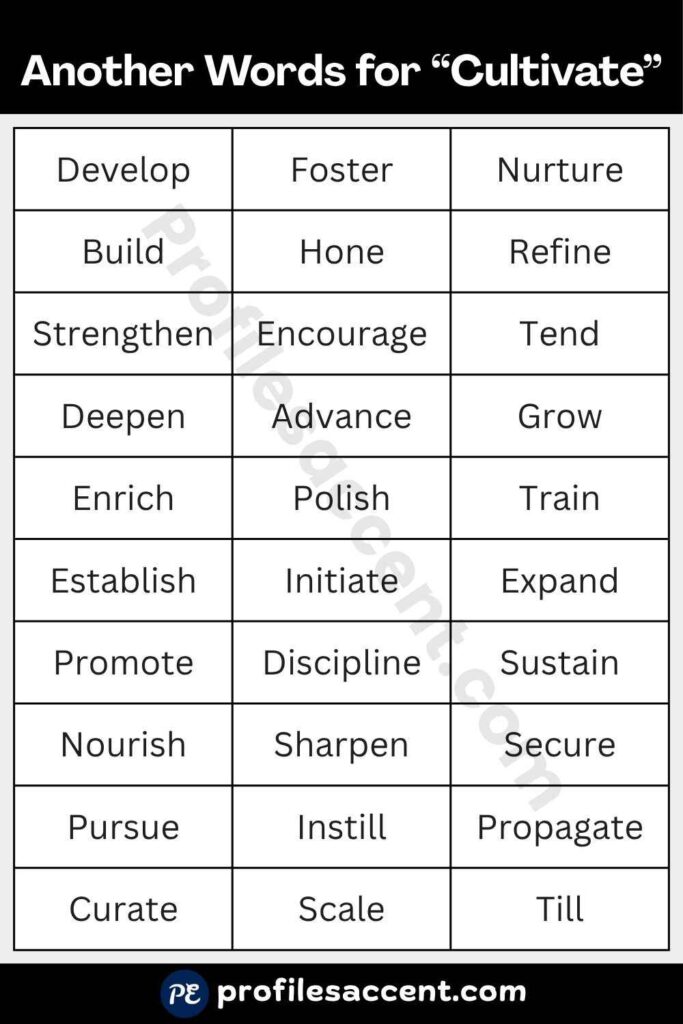
Quick 45+ Synonyms for Cultivate at a Glance
| Word | Tone | Best Used When | Example |
| Develop | Neutral, action | Skills, habits, programs | Developed a training plan for new staff |
| Foster | Warm, supportive | Relationships, culture, growth | Fostered a culture of open feedback |
| Nurture | Gentle, caring | People, ideas, talent | Nurtured a young writer’s confidence |
| Build | Direct, practical | Résumé, networking, habits | Built strong client partnerships |
| Hone | Precise, focused | A specific skill | Honed her analytical thinking over years |
| Refine | Polished, elevated | Style, process, persona | Refined his communication approach |
| Strengthen | Growth-focused | Bonds, systems, skills | Strengthened team cohesion |
| Encourage | Light, supportive | Habits, creativity, others | Encouraged a daily reflection practice |
| Tend | Soft, ongoing | Gardens, relationships | Tended the friendship through hard seasons |
| Deepen | Intimate, relational | Friendships, understanding | Deepened her understanding of the subject |
| Advance | Forward-focused | Career, goals, knowledge | Advanced his expertise in data analysis |
| Grow | Simple, universal | Audience, mindset, business | Grew a loyal online following |
| Enrich | Meaningful, layered | Mind, culture, experience | Enriched the team with diverse perspectives |
| Polish | Detail-oriented | Presentations, skills, image | Polished her public speaking style |
| Train | Structured, repetitive | Athletes, habits, staff | Trained his focus through daily practice |
| Establish | Formal, foundational | Connections, norms, routines | Established a productive morning routine |
| Initiate | Proactive, first-step | New relationships, programs | Initiated a peer mentorship structure |
| Expand | Scaling tone | Networks, skills, reach | Expanded her professional network |
| Promote | Facilitative | Culture, growth, awareness | Promoted a healthy work environment |
| Discipline | Rigorous, self-directed | Habits, mindset, practice | Disciplined himself to write daily |
| Sustain | Long-term focus | Relationships, efforts, growth | Sustained momentum through a tough quarter |
| Nourish | Deeply caring | Mind, relationships, creativity | Nourished her creative curiosity |
| Sharpen | Quick, crisp | Focus, instincts, skills | Sharpened his instincts through experience |
| Secure | Strategic, formal | Deals, alliances, trust | Secured key partnerships with investors |
| Pursue | Intentional | Interests, connections, goals | Pursued a deeper interest in philosophy |
| Instill | Values-driven | Habits, beliefs, culture | Instilled a growth mindset in her team |
| Propagate | Technical, spread-focused | Ideas, plants, content | Propagated new farming techniques |
| Curate | Modern, selective | Online presence, content | Curated an aesthetic that felt authentic |
| Scale | Digital, growth tone | Audience, business, skills | Scaled his brand from 0 to 50k followers |
| Till | Agricultural only | Farmland, soil | Tilled the dry soil before the rains came |
How the Meaning of Cultivate Shifts by Context
The word you need depends not just on what you mean, but on what you are talking about.
When it is about a person or relationship, “nurture” and “foster” carry emotional warmth. They suggest patience and care. “Court” however leans strategic. You use it when someone is deliberately trying to win favor. It is not dishonest, but it is intentional in a calculating way.
When it is about a skill, “hone” and “sharpen” imply you already have something and are making it better. “Develop” suggests you are building it fresh. Small difference. Big impact on how experienced you sound.
When it is about a habit, “instill” works beautifully. It suggests the habit goes deep, almost into the bones. “Encourage” is lighter, more external. One implies transformation. The other implies nudging.
In education writing, “enrich” and “deepen” are strong choices. They respect the complexity of learning without sounding clinical. “Train” works for practical skills but can sound mechanical in an essay about intellectual growth.
In agriculture, only certain words belong. Till, tend, work, grow, propagate. These are the real field words. Do not carry them into a personal development sentence. “She tilled her leadership skills” lands awkwardly.
From Gentle to Intense: A Tone Scale for Cultivate Synonyms
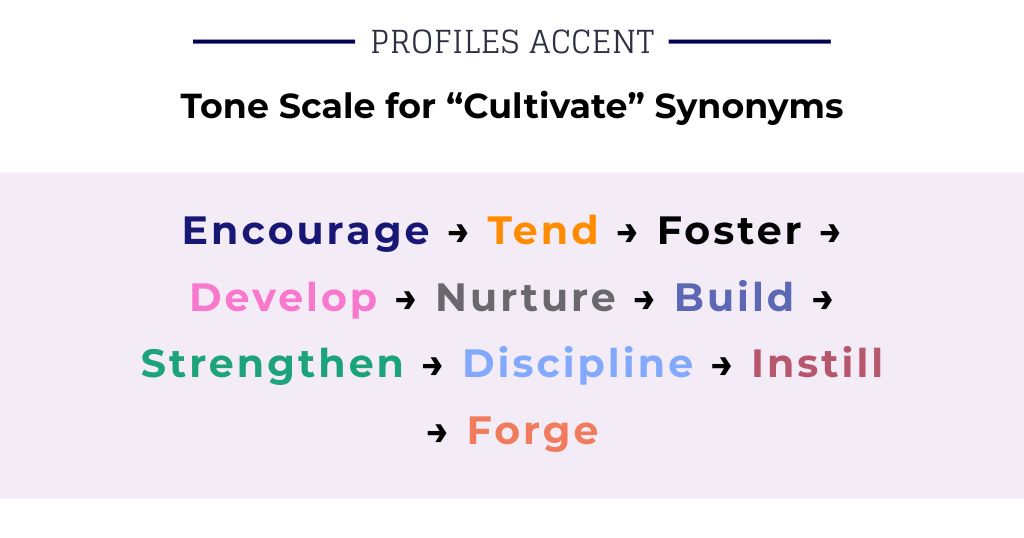
Different synonyms carry different emotional weight. Here is how they line up from lightest to most intense:
Encourage → Tend → Foster → Develop → Nurture → Build → Strengthen → Discipline → Instill → Forge
- “Encourage” barely pushes.
- “Tend” suggests light, ongoing care.
- “Foster” implies active support.
- “Develop” feels goal-oriented.
- “Nurture” adds real warmth.
- “Build” is grounded and practical.
- “Strengthen” shows visible effort.
- “Discipline” signals serious commitment.
- “Instill” goes deeper, into values and identity.
- “Forge” is the strongest.
It suggests something was shaped through real pressure and struggle.
When you write a résumé, middle-range words like “developed,” “built,” and “strengthened” hit the right note. They sound neither passive nor dramatic. In personal essays or fiction, the deeper end of the scale creates emotional resonance.
Same Sentence, Different Word: Rewrites That Prove the Point
Original: She cultivated a good habit of reading.
- Formal: She established a consistent reading practice over several months.
- Casual: She got into the habit of reading every night before bed.
- Academic: She internalized reading as a disciplined intellectual pursuit.
- Creative: She nourished a hunger for books until they became her daily bread.
Each version says roughly the same thing. But they feel completely different. The creative version adds texture. The academic one signals rigor. Pick based on who is reading and what you want them to feel.
Original: He cultivated the relationship with his mentor.
- Formal: He strengthened his professional relationship with his mentor over two years.
- Casual: He kept in close touch with his mentor and made the most of every conversation.
- Academic: He fostered a sustained mentoring relationship that shaped his research trajectory.
- Creative: He tended that mentorship the way you tend a slow fire, carefully, patiently, never letting it go cold.
Notice how “tended” in the creative version brings back the agricultural root of the word, but in a poetic, human way. That is the kind of layering good writers use.
Another Word for Cultivate on a Resume vs. in an Essay
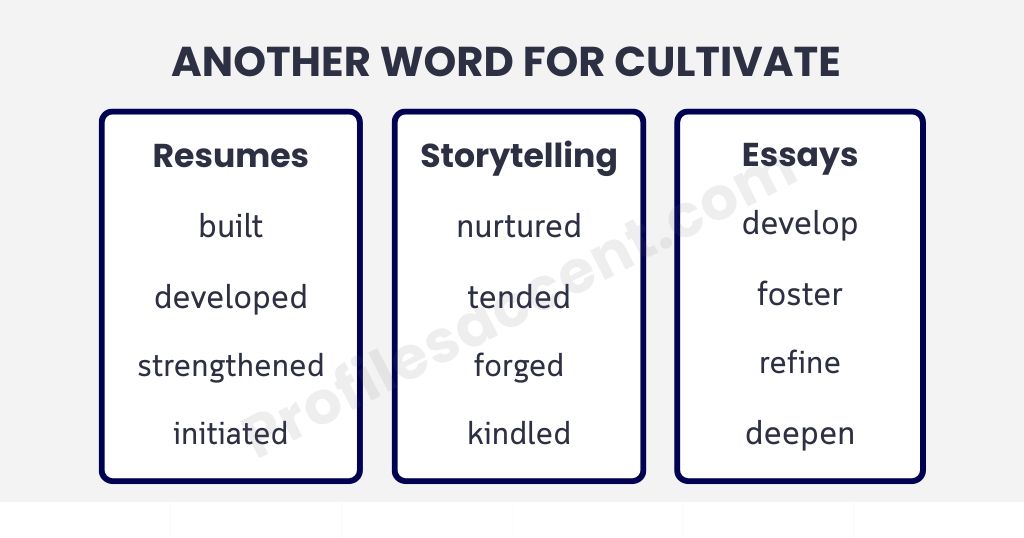
Best for academic essays: develop, foster, refine, deepen, enrich, advance
These do not draw attention to themselves. They support the argument without sounding performative.
Best for résumés: built, developed, strengthened, initiated, established, expanded, fosteredPair each with a number or result whenever possible. “Fostered” sounds stronger when followed by “resulting in a 35% improvement in team retention.”
Best for storytelling or creative writing: nurtured, tended, forged, kindled, nourished
These carry emotional texture. They slow the reader down in the best way.
Words to avoid in formal contexts: cozy up to, butter up, suck up to, get in with
These are conversational and lean negative. They suggest manipulation rather than genuine effort. Save them for fiction characters you do not want the reader to trust.
Cultivate Synonyms in Slang and Digital Language
Most dictionaries miss this entirely. In modern content creation, “cultivate” has practical equivalents that live in digital language.
Creators do not say they are “cultivating an audience.” They say they are growing a community, building a following, curating an aesthetic, or scaling their presence. These are not lesser words. They are the natural language of the space.
If you are writing about someone’s online persona, “curate” is the most precise modern option. It implies selection, taste, and intentional design. “Grow” handles numbers and reach. “Build” handles structure and community.
This context matters especially if you write content about social media, personal branding, or digital careers.
Where Writers Go Wrong with Cultivate Synonyms
Using “foster” and “nurture” interchangeably. They are close, but “foster” often implies an enabling environment. “Nurture” is more personal and direct. You foster a culture. You nurture a person.
Putting agricultural synonyms in growth contexts. “She tilled her patience every morning” is a grammatical oddity. Till, sow, and harvest belong to soil. Keep them there unless you are writing intentional metaphor.
Treating “court” as always negative. Courting someone’s attention or business can be strategic without being dishonest. Context controls tone. In a political thriller, “court” implies cunning. In a business profile, it implies smart relationship management.
Stacking synonyms on a résumé. Using “developed,” “fostered,” “built,” and “cultivated” all in the same document makes the writing feel padded. Pick one or two that fit best, then vary your active verbs elsewhere.
Words Related to Cultivate Worth Keeping Nearby
- Germinate sits close to the agricultural meaning but also works metaphorically when an idea is just beginning to take shape. Earlier than “develop.” More tentative.
- Kindle works for enthusiasm, interest, or passion specifically. You kindle curiosity. You do not kindle a skill.
- Engender is formal and works well in academic writing when describing how conditions create outcomes. “The policy engendered trust.”
- Catalyze suggests a spark that speeds up change. Useful when the action was a turning point, not a slow burn.
- Mentor is sometimes the better choice when “cultivate someone” refers to guiding another person’s growth. It is concrete, understood, and carries professional weight.
Choosing the Right Synonym for Cultivate
The right synonym for “cultivate” is the one that fits the object, the audience, and the emotional register of what you are writing.
Ask three quick questions before swapping the word:
- What am I growing? A skill, a person, a habit, a field?
- Who is reading this? A hiring manager, a professor, a friend?
- How much emotional weight do I want this sentence to carry?
The answers will narrow your choices fast. A résumé answer and a novel answer will almost never be the same word. And that is exactly how it should be.
Discover More Articles:

I’m Rowan, a language addict who loves exploring how words work in everyday communication. I’ve spent years studying English vocabulary and helping others express themselves more clearly. My goal is simple: make learning new words easy and practical. I focus on real-life examples that show when and how to use different terms. Through clear explanations and honest guidance, I help readers choose the right words for any situation with confidence.