There’s a moment in writing when the word “reality” starts to feel worn out. You’ve used it twice in one paragraph. You look at it again. It feels flat. You know what you mean, but the word isn’t carrying the weight anymore.
That’s not a small problem. Word choice shapes how readers feel about your message. “The reality of the situation” reads very differently from “the hard truth of the situation” or “what we’re actually dealing with here.” Same idea. Completely different punch.
This guide is for writers, students, and anyone who wants to say what they mean more precisely.
What “Reality” Actually Means
At its core, reality is everything that exists outside your imagination. It’s the world as it is, not as you wish it were. But the word carries emotional weight too. When someone says “face reality,” they usually mean something uncomfortable is being avoided. The word isn’t neutral. It often signals disappointment, urgency, or grounding.
That emotional layer matters when choosing a synonym.
45+ Quick Synonym Table for Reality
| Word | Tone | Best Used When | Quick Example |
| Actuality | Neutral/Formal | Correcting a misconception | “In actuality, costs rose.” |
| Truth | Direct | Stating facts plainly | “Face the truth.” |
| Fact | Concrete | Citing specific evidence | “The facts speak clearly.” |
| Existence | Philosophical | Discussing what is real | “The existence of the problem…” |
| Substance | Literary | Showing something has real weight | “Her words had substance.” |
| Authenticity | Positive | Describing what is genuine | “She valued authenticity.” |
| Tangibility | Sensory | Showing something can be felt or proved | “The tangibility of loss.” |
| Verity | Formal/Literary | Essays, older prose | “A verity of modern life.” |
| Materiality | Academic | Legal or philosophical writing | “Questions of materiality…” |
| Hard facts | Informal | Arguing with evidence | “Look at the hard facts.” |
| Bottom line | Conversational | Cutting to what matters | “The bottom line is this.” |
| True state | Neutral | Describing a situation honestly | “The true state of things.” |
| Lived experience | Modern | Personal or social writing | “Her lived experience differed.” |
| Groundedness | Reflective | Emotional or psychological writing | “He lacked groundedness.” |
| Brass tacks | Slang | Casual, blunt conversation | “Let’s get to brass tacks.” |
| What is | Minimalist | Spare, powerful writing | “Accept what is.” |
| The real world | Everyday | Contrasting theory with practice | “In the real world, it fails.” |
| Cold light of day | Idiomatic | Harsh realization | “In the cold light of day…” |
| Concreteness | Academic | Essays, research | “The concreteness of evidence.” |
| Objectivity | Professional | Reports, journalism | “We need objectivity here.” |
| State of affairs | Formal | Describing a situation | “The current state of affairs…” |
| Realism | Neutral | Art, attitude, philosophy | “She approached it with realism.” |
| Naked truth | Emotional | Confrontational or raw writing | “The naked truth finally emerged.” |
| Prevailing condition | Technical | Reports, policy writing | “The prevailing condition…” |
| The real deal | Slang | Confirming something is genuine | “She’s the real deal.” |
| Living truth | Poetic | Creative or emotional prose | “It became a living truth.” |
| Solid ground | Figurative | Stability, confidence | “Back on solid ground.” |
| The here and now | Present-focused | Mindfulness, motivation | “Stay in the here and now.” |
| Waking world | Poetic | Dreams vs. real life contrast | “Back to the waking world.” |
| Empirical ground | Academic | Science, philosophy writing | “On empirical ground…” |
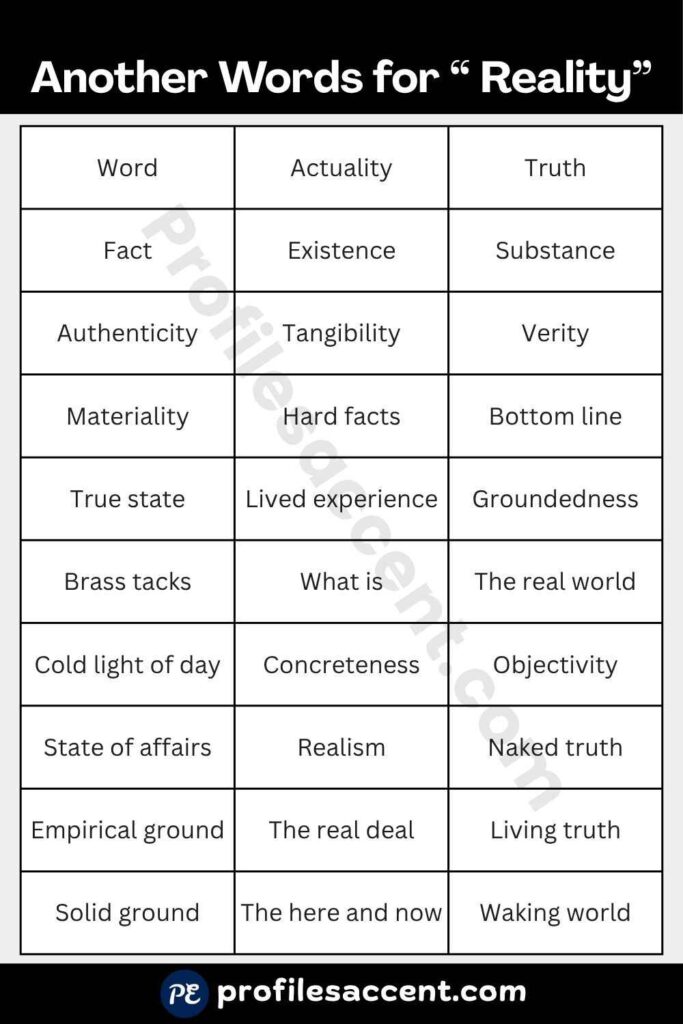
Reality Isn’t One Thing: How Context Splits the Meaning
“Reality” shifts meaning depending on context. So do its synonyms. Here’s how to read those shifts.
When reality means “what exists physically”
- Use: substance, materiality, tangibility, corporeality
These words emphasize that something can be touched, measured, or verified. Good for science writing, legal arguments, or grounded essays.
When reality means “a painful truth”
- Use: cold light of day, naked truth, hard facts, brass tacks
These carry emotional sting. They signal discomfort. Use them when the point is to wake someone up or cut through denial.
When reality means “how things actually are” (vs. what someone imagined)
- Use: actuality, true state, state of affairs, what is
These are corrective. They work when you’re pushing back on a false belief or wrong assumption without being harsh about it.
When reality means “genuine, not fake”
- Use: authenticity, realness, the real deal
These are about identity and integrity, not just existence. A person can have authenticity. A plan can have realness. Use these in personal essays, interviews, or character writing.
When reality means “life as most people live it”
- Use: the real world, lived experience, the here and now, everyday existence
These are softer. They center the human experience rather than abstract fact.
How Strong Is Your Word? A Tone Scale for Reality Synonyms

Some synonyms whisper. Others hit hard. Here’s a rough scale from gentle to sharp:
- Mild: Existence, state of affairs, the here and now
- Moderate: Actuality, truth, realism, groundedness
- Direct: Hard facts, naked truth, true state, bottom line
- Blunt/Raw: Brass tacks, cold light of day, get real, what is
The intensity you choose should match how seriously you want your reader to sit with the information. A mental health article calls for “lived experience.” A legal brief calls for “materiality.” A motivational speech might call for “the bottom line.”
Same Sentence, Smarter Words: Rewrites Using Synonyms for Reality
Here’s where word choice actually becomes visible.
Original sentence: “We have to accept the reality of the situation.”
- Formal: “We must acknowledge the true state of affairs and act accordingly.”
- Casual: “Let’s be honest about where things actually stand.”
- Academic: “Confronting the empirical ground of this circumstance is essential.”
- Creative: “The waking world was asking something of us, and we could no longer look away.”
Each version carries a different relationship with the reader. The formal one creates distance. The casual one invites the reader in. The creative one pulls them emotionally. Same idea, four different doors.
Original: “Reality can be harsh.”
- Formal: “The prevailing condition of life often resists what we hope for.”
- Slang: “The real world doesn’t care about your plans.”
- Poetic: “What is true rarely softens itself for comfort.”
- Blunt: “Hard facts don’t bend.”
The Slang Side: Informal and Idiomatic Alternatives Nobody Lists
Most thesaurus-style pages ignore this completely. But slang is how most people actually talk about reality.
“Keep it real” means stay honest, stay true to yourself, don’t pretend. It’s not about literal facts. It’s about character.
“Get real” is a command. It means stop pretending, stop being naive, face what’s in front of you. You wouldn’t use “get actual” or “get factual.” The slang only works as slang.
“For real?” confirms surprise. It asks if something actually happened. No synonym replaces it in that tone.
“That’s the real deal” confirms authenticity, not just existence. A product can be the real deal. A person can be the real deal. It means no imitation, no substitute.
These aren’t interchangeable with formal synonyms. Use them in dialogue, captions, personal essays, or any writing that’s meant to feel like a real person talking.
Where “Reality” Comes From (And Why It Still Shapes the Synonyms We Use)
This matters for essay writers especially. The English word “reality” comes from the Latin res, meaning “thing” or “matter.” So “real” originally meant “relating to the thing itself.” Reality, then, is the state of being concerned with what the thing actually is.
In Greek, aletheia is often translated as truth or reality, but it literally means “unconcealed.” What is real is what is not hidden. That’s a powerful image for writers. Something isn’t just real because it exists. It’s real because it can’t be covered up forever.
The Greek word physis refers to the natural unfolding of things, nature as it actually grows and moves. It’s closer to “the way things naturally are” than to “objective fact.”
These roots explain why “reality” feels heavier than “fact.” Fact is a single point. Reality is the whole landscape.
Synonyms That Look Right But Aren’t: Common Mistakes to Avoid
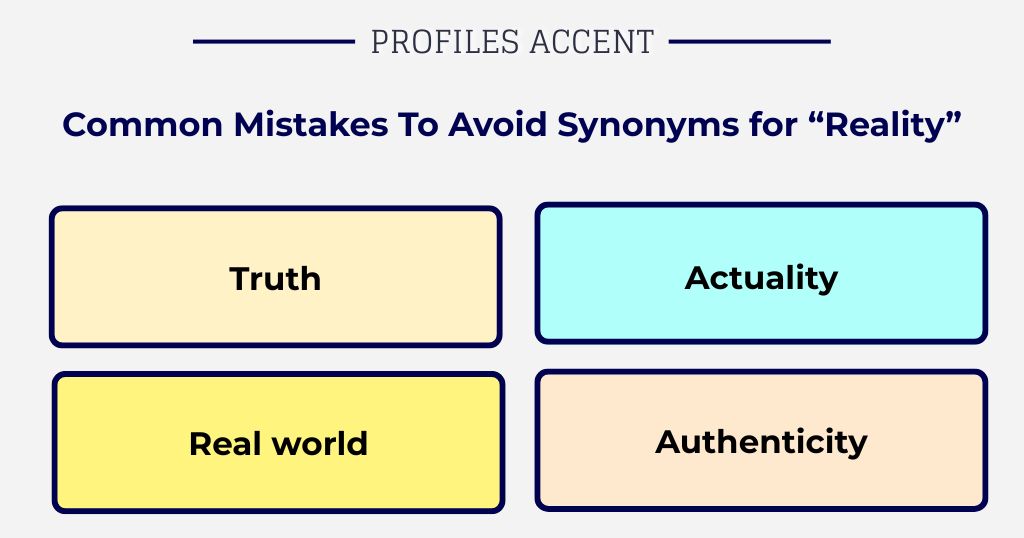
Swapping “reality” with “truth” carelessly. Truth is usually about a specific claim. Reality is bigger. “The truth of the situation” implies one correct answer. “The reality of the situation” implies a whole set of conditions, many of which may be uncomfortable.
Using “actuality” as a filler. “In actuality” works when you’re correcting something. Using it just to vary your writing sounds stiff and unnatural.
Overusing “real world” in academic writing. It’s conversational. In an essay or report, “prevailing conditions” or “empirical circumstance” fits better.
Mistaking “authenticity” for “reality.” They overlap but aren’t twins. Reality is about existence. Authenticity is about being genuine. A fake diamond exists in reality. It just lacks authenticity.
Forcing poetic synonyms into practical writing. “The waking world” is beautiful in a short story. In a business email, it’s just odd.
Words That Live Near Reality Without Meaning the Same Thing
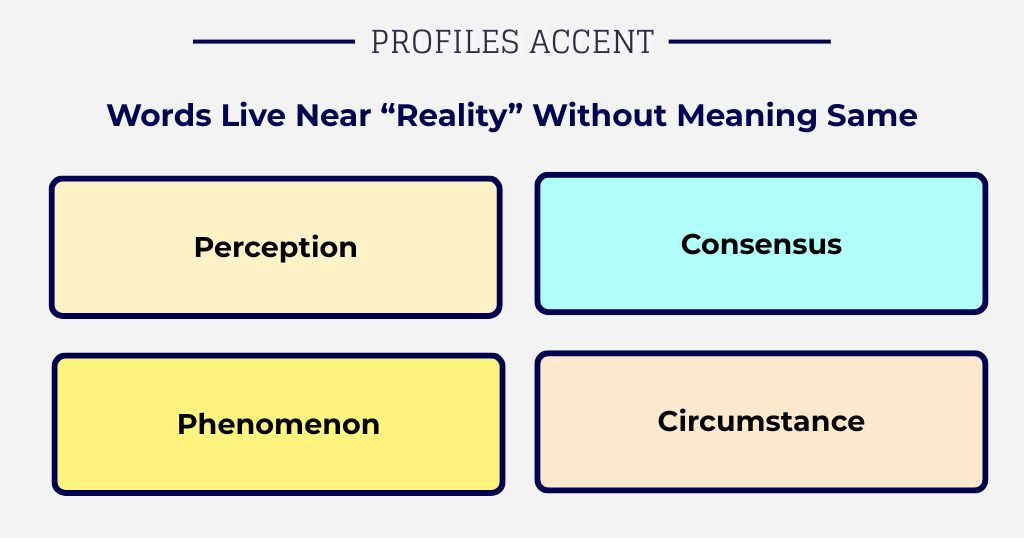
- Perception – Reality filtered through a person’s senses and beliefs. What’s real to one person may not match what’s real to another. Related to reality but not the same as it.
- Consensus – When a group agrees on what is real. Used in social and political writing. “The consensus reality” means what most people accept as true.
- Phenomenon – A real, observable event or fact. More specific than reality. Scientists use it to describe what can be seen, measured, or detected.
- Circumstance – The conditions around a situation. When you say “given the circumstances,” you’re describing what reality looks like in a specific moment.
- Condition – The current state of something. More clinical. Good for reports and assessments.
So Which Word Should You Actually Use?
Here’s the honest shortcut: ask yourself what you want the reader to feel, not just what you want them to know.
- If you want clarity, use actuality or truth.
- If you want weight, use hard facts or naked truth.
- If you want warmth, use lived experience or the real world.
- If you want literary depth, use substance or the waking world.
- If you want bluntness, use brass tacks or bottom line.
The best synonym isn’t always the most impressive one. It’s the one that makes your reader stop and think, “yes, exactly that.”
Discover More Articles:

I’m Rowan, a language addict who loves exploring how words work in everyday communication. I’ve spent years studying English vocabulary and helping others express themselves more clearly. My goal is simple: make learning new words easy and practical. I focus on real-life examples that show when and how to use different terms. Through clear explanations and honest guidance, I help readers choose the right words for any situation with confidence.