There’s a moment every writer faces. You’ve used “fairness” three times in two paragraphs, and now it sits on the page looking tired. Or worse, you chose a synonym that felt right but landed wrong. “Justice” when you meant warmth. “Equality” when you meant balance. “Impartiality” in a text to a friend.
Word choice is quiet but powerful. The right synonym does more than replace a word. It shifts how people feel about your message before they even finish reading the sentence.
This guide helps you pick the right word, every single time.
What Fairness Actually Means at Its Core
At its core, fairness means treating people in a way that feels right and balanced, without playing favorites. It holds both a moral weight and an emotional one. When someone calls a decision “fair,” they’re saying it passed a test, not just a rulebook. That emotional layer is what makes replacing this word tricky.
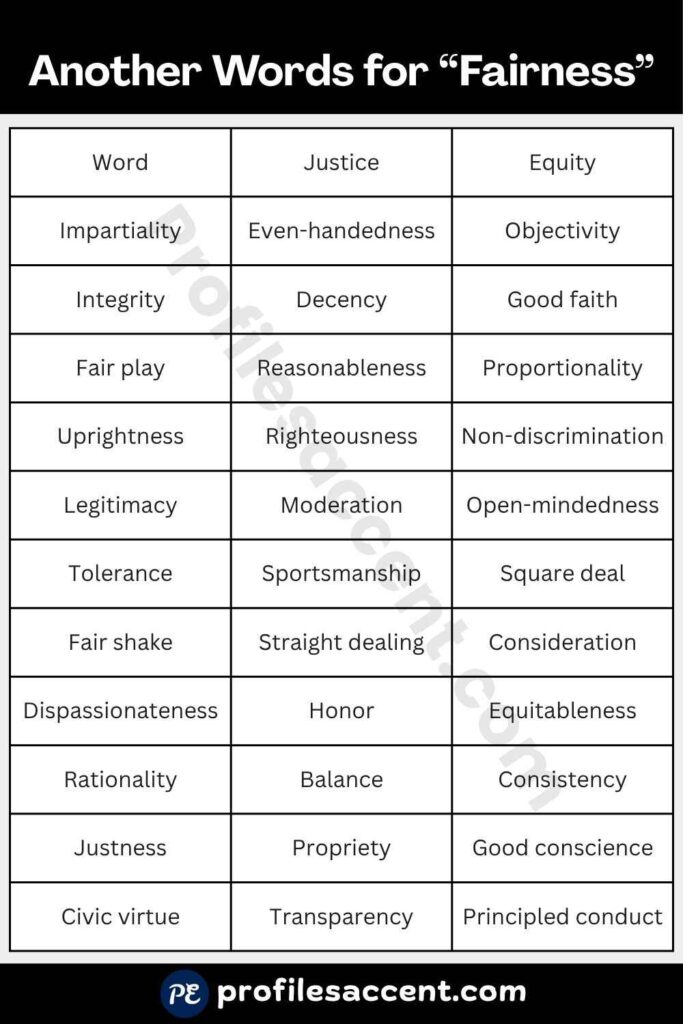
Quick 35+ Synonyms for Fairness at a Glance
| Word | Tone | Best Used When | Quick Example |
| Justice | Formal, serious | Writing about rights or systems | “Justice was served in the courtroom.” |
| Equity | Academic, structural | Discussing unequal starting points | “Equity matters more than sameness here.” |
| Impartiality | Neutral, professional | Describing a judge or mediator | “The panel acted with full impartiality.” |
| Even-handedness | Balanced, calm | Managing group decisions | “Her even-handedness earned everyone’s trust.” |
| Objectivity | Analytical | Academic or journalistic writing | “Objectivity guided the committee’s choice.” |
| Integrity | Moral, character-based | Describing a person’s values | “He led the team with quiet integrity.” |
| Decency | Warm, human | Everyday or emotional writing | “Basic decency goes a long way.” |
| Good faith | Trustworthy | Contracts, agreements, relationships | “Both sides acted in good faith.” |
| Fair play | Informal, friendly | Sports, games, school contexts | “The coach emphasized fair play above all.” |
| Reasonableness | Practical | Legal or civil writing | “The decision showed clear reasonableness.” |
| Proportionality | Precise | Law, punishment, policy writing | “The sentence lacked proportionality.” |
| Uprightness | Moral, old-fashioned | Literature or formal essays | “Her uprightness was beyond question.” |
| Righteousness | Emotional, strong | Moral or spiritual contexts | “He spoke with genuine righteousness.” |
| Non-discrimination | Formal, policy | HR, law, civil rights writing | “The policy ensures non-discrimination.” |
| Legitimacy | Authoritative | Government, leadership, decisions | “Voters questioned the decision’s legitimacy.” |
| Moderation | Gentle, careful | Conflict resolution, tone control | “Moderation kept the debate civil.” |
| Open-mindedness | Warm, reflective | Education, personal growth writing | “Open-mindedness makes better leaders.” |
| Tolerance | Inclusive | Social or cultural contexts | “Tolerance is not the same as agreement.” |
| Sportsmanship | Spirited, positive | Competitive settings | “Losing with sportsmanship takes real strength.” |
| Square deal | Casual, American | Informal writing or dialogue | “He just wanted a square deal.” |
| Fair shake | Slang, conversational | Everyday speech or fiction writing | “Give everyone a fair shake.” |
| Straight dealing | Direct, honest | Business or interpersonal writing | “Straight dealing built the partnership.” |
| Consideration | Thoughtful | Interpersonal, empathetic writing | “She showed real consideration for others.” |
| Dispassionateness | Cool, detached | Legal, journalistic, analytical | “The report was praised for its dispassionateness.” |
| Honor | Strong, moral | Literature, formal essays, speeches | “He defended the decision on grounds of honor.” |
| Equitableness | Formal, precise | Academic or policy documents | “The equitableness of the tax plan was debated.” |
| Rationality | Logical | Philosophy, debate, argument | “Rationality shaped the verdict.” |
| Balance | Neutral, visual | Everyday, editorial, conversational | “The judge maintained balance throughout.” |
| Consistency | Reliable | Workplace, education, policy | “Consistency is what makes rules feel fair.” |
| Justness | Formal | Philosophical or legal essays | “The justness of the ruling was admired.” |
| Propriety | Formal, polished | Etiquette, formal speech | “He acted with propriety at every stage.” |
| Good conscience | Personal, reflective | Narrative or emotional writing | “She could leave with a good conscience.” |
| Civic virtue | Public, idealistic | Political or social commentary | “Civic virtue requires more than voting.” |
| Transparency | Open, trustworthy | Business, governance, journalism | “Transparency builds trust faster than rules.” |
| Principled conduct | Formal, behavioral | Organizational writing | “The firm is known for principled conduct.” |
Not All Fairness Synonyms Mean the Same Thing
Not all synonyms mean the same thing, even when they look close. Here’s where most writers slip up.
When the System Itself Is the Issue
Words like equity, proportionality, and legitimacy speak to structure. They’re not about one person’s behavior. They’re about whether a rule, system, or outcome was designed fairly. Use these when the issue is bigger than a single choice.
When It Is About Who Someone Is
Integrity, uprightness, honor, and principled conduct describe who someone is, not just what they did. These feel weightier. They carry a moral history. Using “integrity” in place of “fairness” says the person is consistently that way, not just fair in one moment.
When the Writing Needs to Feel Human
Decency, consideration, open-mindedness, and good faith live in a softer emotional space. They feel less like courtroom words and more like kitchen-table ones. If your writing needs to feel caring and close, reach for these.
When the Moment Calls for Something Lighter
Fair shake, square deal, fair play, and sportsmanship carry energy. They feel alive. They work in fiction dialogue, blog posts, or informal essays where formal language would feel stiff.
How Strong Is Your Word? A Tone Scale for Fairness Synonyms

Some synonyms whisper. Others hit hard. Here’s how they line up, moving from lightest to most charged.
- Mild: Consideration, Moderation, Tolerance
These suggest fairness without pushing. They’re soft, almost cautious.
- Moderate: Balance, Good faith, Decency, Open-mindedness
These are the everyday workhorses. Warm and credible without being heavy.
- Firm: Impartiality, Objectivity, Even-handedness, Consistency
These mean business. They signal that bias was deliberately set aside.
- Strong: Justice, Equity, Integrity, Legitimacy
These carry authority. Use them when stakes are high or when the topic involves rights, power, or systems.
- Most Charged: Righteousness, Uprightness, Civic virtue
These are moral declarations. They signal deep belief. Overuse them and they start to sound preachy. Use them once, at the right moment, and they land.
Same Sentence, Four Different Words for Fairness
Here are four original sentences transformed across different writing tones.
Original: “We believe in fairness for all students.”
- Formal: “The institution upholds equity in every aspect of student assessment.”
- Casual: “Every student gets a fair shake here, full stop.”
- Academic: “Impartiality governs the evaluation process at every instructional level.”
- Creative: “Every desk in this room holds the same right to be heard.”
Notice how “creative” avoids the synonym entirely, but captures fairness through imagery. That’s advanced writing.
Original: “The manager treated everyone with fairness.”
- Formal: “The manager demonstrated consistent impartiality in all personnel decisions.”
- Casual: “She gave everyone a square deal, no exceptions.”
- Academic: “Her conduct reflected principled objectivity across team interactions.”
- Narrative: “She never had favorites. Not once.”
Original: “Fairness is important in any relationship.”
- Formal: “Equitableness forms the foundation of any sustainable interpersonal relationship.”
- Casual: “Good faith is what keeps relationships from falling apart.”
- Academic: “Relational integrity depends on consistent and transparent conduct between parties.”
- Emotional: “Decency is what makes people feel safe enough to stay.”
Where Each Synonym for Fairness Actually Belongs
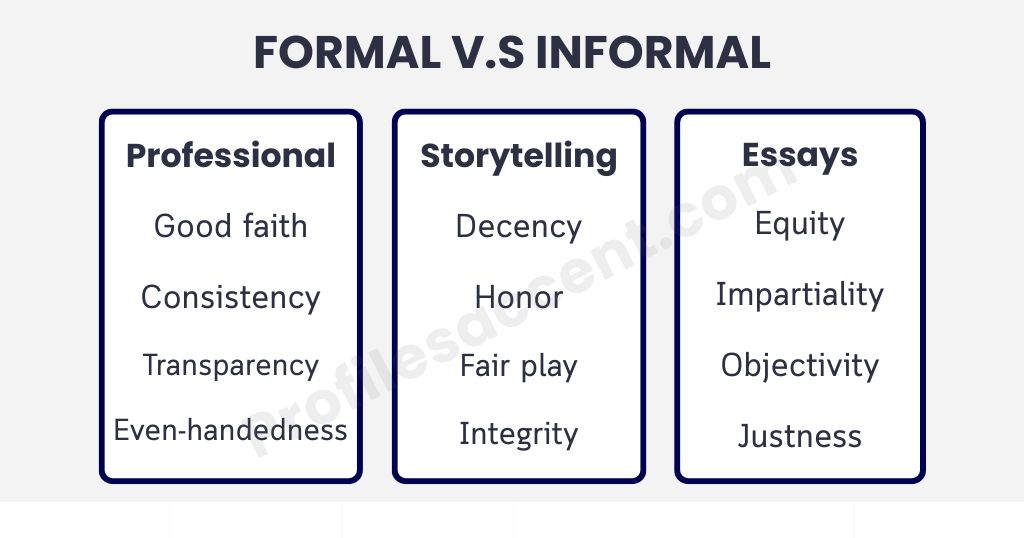
Best for essays and academic writing:
- Equity, Impartiality, Objectivity, Justness, Dispassionateness
These carry analytical weight. They signal precision. Readers in academic settings expect this register.
Best for professional emails and workplace writing:
- Good faith, Consistency, Transparency, Even-handedness
These are trustworthy without being stiff. They signal reliability to colleagues and clients.
Best for storytelling and narrative writing:
- Decency, Honor, Fair play, Good conscience, Integrity
Characters feel real when their fairness has texture. “He had integrity” tells more than “he was fair.”
Words to avoid in formal writing:
- Fair shake, Square deal, Straight shooting
These are conversational idioms. In a report or essay, they break the register and undermine credibility.
A Few Words of Caution Around Fairness and Its Synonyms
The word “fairness” shows up in conversations about race, gender, disability, income, and access. Some synonyms carry more political or social weight than others.
- Equity has become a loaded term in some policy debates. In certain contexts, it signals a progressive framing. In others, it’s purely structural. Know your audience before defaulting to it.
- Non-discrimination belongs in legal and policy writing. In casual conversation, it can feel clinical or cold.
- Righteousness often implies a moral position from above. It can come across as self-congratulatory if not placed carefully.
When writing about social systems, be specific about what kind of fairness you mean. Process fairness (how decisions are made) is different from outcome fairness (what results from those decisions). Many arguments that appear to be about “fairness” are actually disagreements between these two types.
Mistakes Writers Make When Replacing the Word Fairness
Treating “equality” and “equity” as the same word
They are not. Equality means everyone gets the same thing. Equity means everyone gets what they actually need. In education or policy writing, using the wrong one completely changes your argument.
Using “justice” when you mean “kindness”
Justice is about what’s deserved. Kindness is about what’s given freely. If a teacher gives a struggling student extra time, that’s equity and decency, not justice in the legal sense.
Overusing “impartiality” in personal writing
Impartiality works when describing systems or roles. But saying you were “impartial” about a personal decision can feel cold. “Objective” or “balanced” often reads better in emotional contexts.
Leaning on “integrity” too loosely
Integrity describes a consistent pattern, not a single moment. If someone did one decent thing, calling it integrity inflates the word. Save it for character descriptions that span time.
Words Close to Fairness but Not Quite the Same
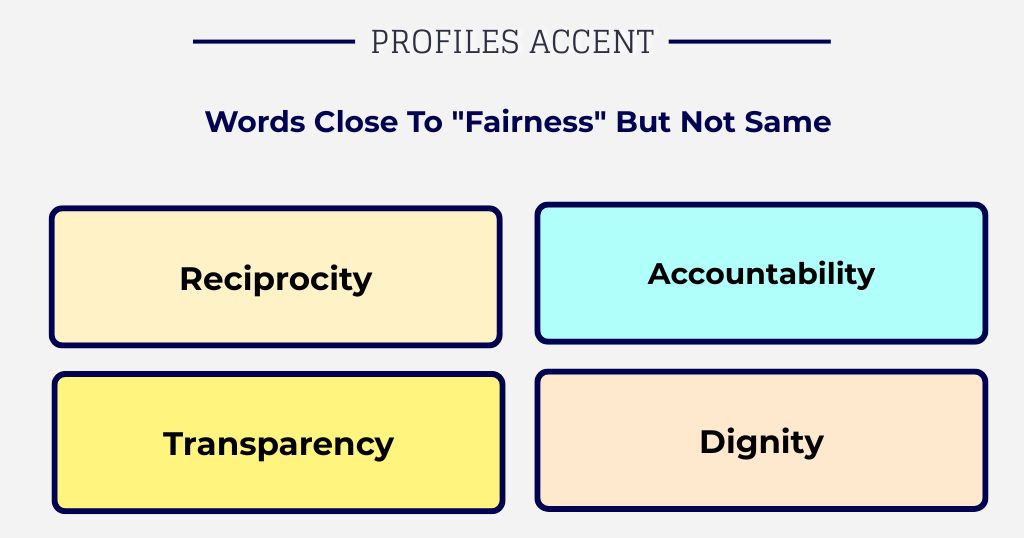
- Reciprocity: Fairness that goes both ways. It assumes mutual obligation. Useful in relationship and business writing.
- Accountability: What happens when fairness breaks down and someone must answer for it. Often paired with justice but not identical.
- Transparency: Fairness made visible. A process can be fair but if people can’t see how it works, trust erodes. Transparency is what makes fairness believable.
- Dignity: The floor below fairness. Even when outcomes aren’t equal, treating people with dignity is the baseline. This word goes deeper than fairness in emotional writing.
So Which Synonym for Fairness Should You Actually Use?
- If you’re writing about a system or policy, reach for equity, proportionality, or legitimacy.
- If you’re writing about a person’s character, try integrity, decency, or honor.
- If you need warmth, use good faith, consideration, or fair play.
- If the tone is academic or legal, impartiality, objectivity, and justness carry the most precision.
And if your sentence still feels flat after swapping the word, the problem might not be the synonym. It might be the sentence. Sometimes the fix is cutting it entirely and showing the fairness through action instead.
That’s the deeper craft move, and no thesaurus teaches it.
Discover More Articles:

I’m Rowan, a language addict who loves exploring how words work in everyday communication. I’ve spent years studying English vocabulary and helping others express themselves more clearly. My goal is simple: make learning new words easy and practical. I focus on real-life examples that show when and how to use different terms. Through clear explanations and honest guidance, I help readers choose the right words for any situation with confidence.