You’ve typed the word “beneficial” three times in one paragraph. It starts to feel repetitive. So you reach for a synonym, but then you freeze. Is “advantageous” too stiff? Does “helpful” sound too casual? Does “wholesome” even fit here?
This is a real writing problem. The word “beneficial” carries a specific weight, and swapping it carelessly can change the entire tone of your sentence. This guide helps you pick the right replacement, every single time, whether you’re writing an essay, a work email, or a health blog.
So What Does “Beneficial” Really Mean?
At its core, “beneficial” means something produces a good result or positive effect, usually in a lasting or meaningful way. It sits in the middle of the formality scale. Not too stiff, not too casual. It works across health, education, business, and social topics, which is exactly why writers overuse it.
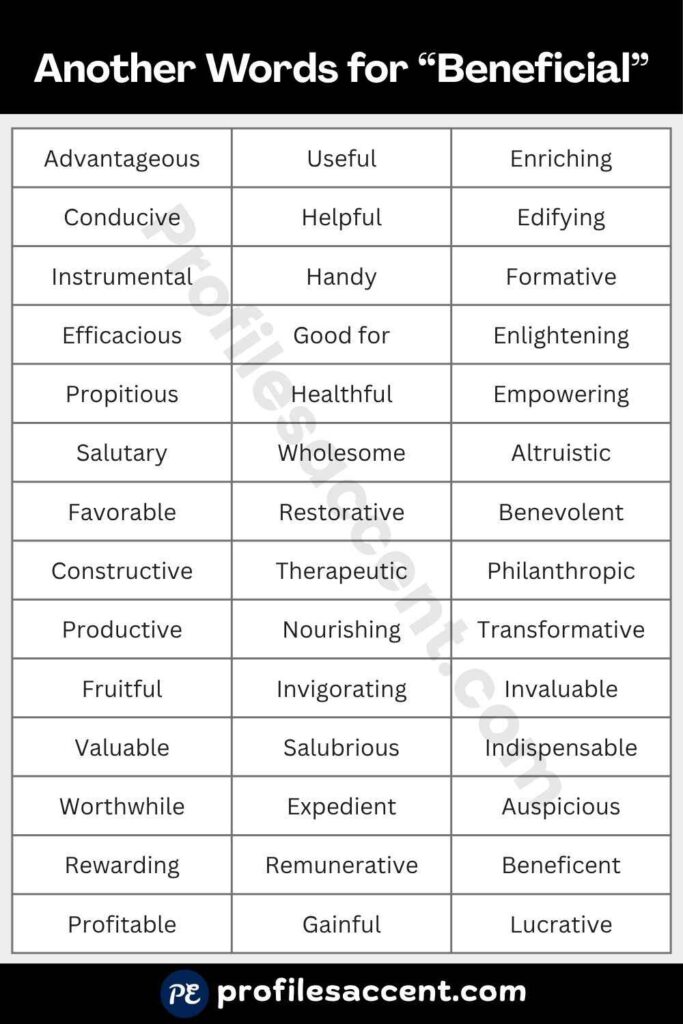
Another Word for Beneficial: Quick-Reference Table (40+ Synonyms)
| Word | Tone | Best Used When | Quick Example |
| Advantageous | Formal | Comparing strategies or options | “The deal was advantageous for both sides.” |
| Conducive | Formal | Describing an environment that supports a goal | “Good lighting is conducive to focus.” |
| Instrumental | Formal | One thing played a key role in a result | “Her feedback was instrumental in our success.” |
| Efficacious | Academic | Proving that something works as intended | “The treatment proved efficacious in trials.” |
| Propitious | Academic | Timing or conditions that favor success | “It was a propitious moment to launch.” |
| Salutary | Academic | Hard lessons that bring long-term improvement | “The setback had a salutary effect on the team.” |
| Favorable | Semi-formal | Circumstances or outcomes that support progress | “The weather conditions were favorable.” |
| Constructive | Semi-formal | Feedback, discussions, or meetings | “The review session was constructive.” |
| Productive | Semi-formal | Outcomes that generate real results | “We had a productive afternoon.” |
| Fruitful | Semi-formal | Efforts that yield solid results | “Our research proved fruitful.” |
| Valuable | Semi-formal | Things that add clear worth | “That experience was valuable to my growth.” |
| Worthwhile | Semi-formal | Effort that pays off | “The extra practice was worthwhile.” |
| Rewarding | Semi-formal | Personal satisfaction tied to outcome | “Teaching can be deeply rewarding.” |
| Profitable | Business | Financial gain from an activity | “The campaign was highly profitable.” |
| Lucrative | Business | Strong financial return | “It opened lucrative opportunities.” |
| Gainful | Business | Employment or reward-generating activity | “She found gainful work after the course.” |
| Remunerative | Formal/Business | Well-compensated roles or contracts | “The contract was remunerative.” |
| Expedient | Business/Political | Practical and quick, though not always ideal | “Passing the bill quickly was expedient.” |
| Useful | Casual | Practical, everyday situations | “That tip was really useful.” |
| Helpful | Casual | Making something easier | “Her advice was so helpful.” |
| Handy | Casual | Convenient in a simple way | “This tool comes in handy often.” |
| Good for | Casual | Everyday recommendation | “Sleep is good for your mood.” |
| Healthful | Health | Directly promotes physical health | “Healthful eating builds strong habits.” |
| Wholesome | Health/Lifestyle | Pure, clean benefit for body or mind | “She chose a wholesome daily routine.” |
| Restorative | Health | Helps recover strength or wellbeing | “Rest has a restorative effect.” |
| Therapeutic | Health | Supports healing or mental relief | “The walk felt therapeutic.” |
| Nourishing | Health/Food | Provides nutrients and strength | “A nourishing meal after a long day.” |
| Invigorating | Health | Creates energy and vitality | “The morning air was invigorating.” |
| Salubrious | Health (literary) | Health-giving environments or climates | “The salubrious coastal air suited him.” |
| Enriching | Personal growth | Improves quality or depth of experience | “Travel can be deeply enriching.” |
| Edifying | Personal growth | Teaches something morally or intellectually | “The lecture was edifying for students.” |
| Formative | Personal growth | Has lasting influence on character | “Those years were formative for her.” |
| Enlightening | Personal growth | Expands understanding or awareness | “The conversation was enlightening.” |
| Empowering | Social/Motivational | Builds confidence or agency | “The training was empowering.” |
| Altruistic | Describing a person | Selflessly acts for others’ good | “Her altruistic nature inspired the team.” |
| Benevolent | Describing a person | Kind-hearted, generous intent | “A benevolent employer helps staff grow.” |
| Philanthropic | Describing a person | Gives resources for broader social good | “The philanthropic donor funded the clinic.” |
| Transformative | High impact | Completely changes something for the better | “The program had a transformative impact.” |
| Invaluable | High impact | So useful it’s hard to measure | “His mentorship was invaluable.” |
| Indispensable | High impact | Cannot succeed without it | “She became indispensable to the project.” |
| Auspicious | Literary | Signals a promising start or timing | “An auspicious beginning to the year.” |
| Beneficent | Rare/Literary | Producing or doing good actively | “A beneficent policy for rural schools.” |
Why Synonyms for “Beneficial” Don’t All Mean the Same Thing
Not all these words are interchangeable. Here’s where writers often go wrong.
When the benefit is strategic: Use advantageous, expedient, or instrumental. These words suggest someone planned well or gained an edge. They belong in business writing, policy discussions, or academic arguments.
When the benefit relates to health: Wholesome, healthful, restorative, and therapeutic each have their own lane. “Wholesome” suggests purity and simplicity. “Therapeutic” often carries emotional healing. “Restorative” means recovery. Don’t mix them up.
When the benefit is financial: Stick to profitable, lucrative, or gainful. Using “wholesome” in a finance article sounds odd. Using “lucrative” in a health article sounds cold.
When describing impact on a person: “Beneficial” can sound clinical when applied to a human being. Saying “She is beneficial to the team” sounds robotic. Instead, try “She is an asset to the team” or “Her contributions have been invaluable.”
From Mild to Powerful: The Synonym Intensity Scale for Beneficial
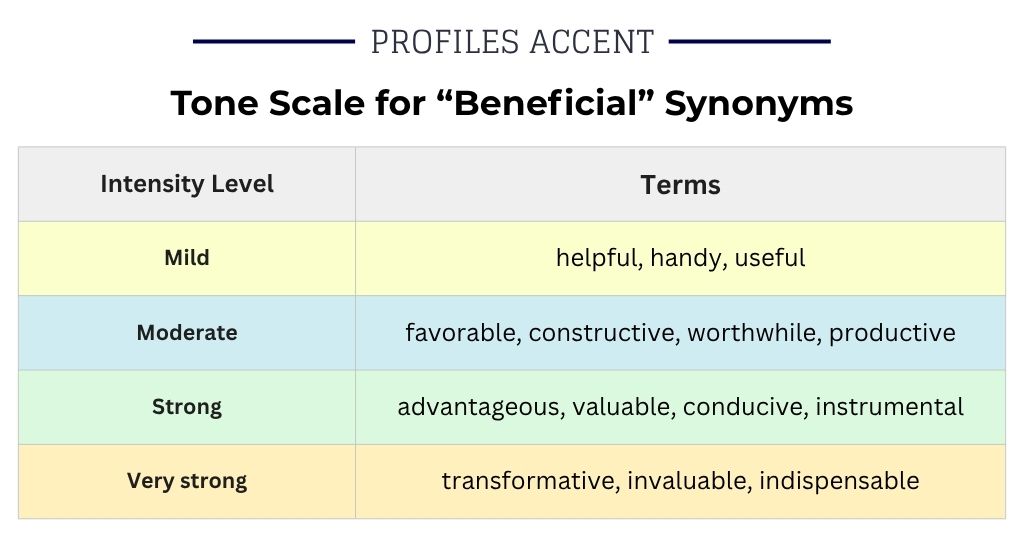
Some moments need a soft word. Others need force. Here’s how these synonyms line up from lightest to strongest:
- Mild: helpful, handy, useful
- Moderate: favorable, constructive, worthwhile, productive
- Strong: advantageous, valuable, conducive, instrumental
- Very strong: transformative, invaluable, indispensable
Use mild words in casual conversation. Move up the scale for essays, business proposals, or high-stakes writing.
Watch the Difference: Rewriting Sentences with Beneficial Synonyms
Here’s where the real learning happens. Same idea, different words, completely different feel.
Original: “Exercise is beneficial for your mental health.”
- Formal essay: “Regular physical activity is instrumental in maintaining psychological wellbeing.”
- Health blog: “Moving your body daily does wonders for your mood and mind.”
- Academic paper: “Consistent aerobic exercise has proven efficacious in reducing anxiety symptoms.”
- Casual talk: “Working out really helps your headspace.”
Original: “The new policy was beneficial to small businesses.”
- Business tone: “The revised regulation proved advantageous for small-scale operators.”
- News tone: “Small business owners welcomed the policy as a favorable development.”
- Advocacy tone: “This measure is transformative for entrepreneurs who’ve long been overlooked.”
Notice how each rewrite does more than swap a word. It shifts the entire perspective of the sentence.
Formal or Casual? Matching the Right Beneficial Synonym to Your Context
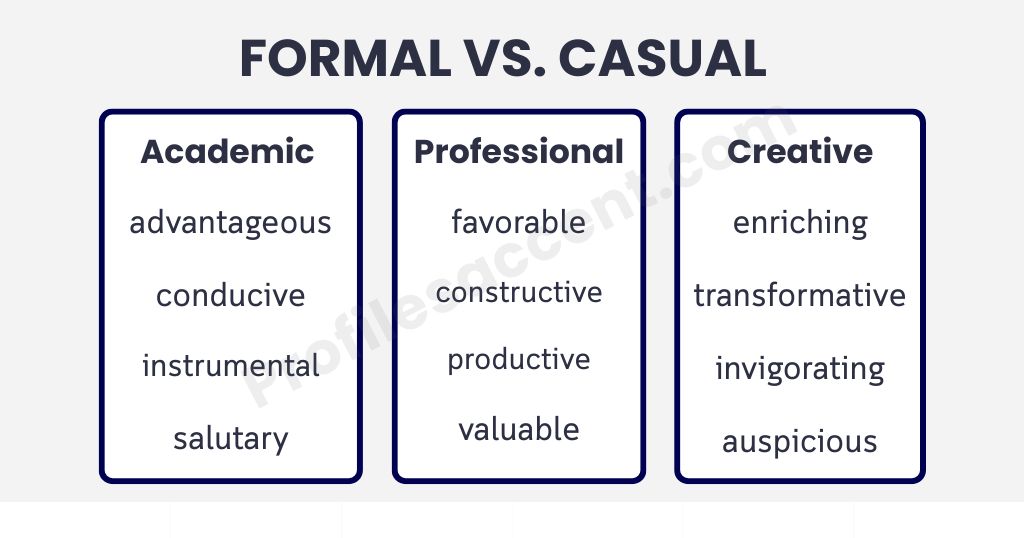
- Best for academic essays or IELTS writing: advantageous, conducive, instrumental, salutary, efficacious, propitious
- Best for professional emails or reports: favorable, constructive, productive, valuable, profitable
- Best for storytelling or creative writing: enriching, transformative, invigorating, auspicious, enlightening
Words to avoid in formal writing: handy, good for, nice to have. These are perfectly fine in conversation but too loose for academic or corporate contexts.
Mistakes Writers Make When Replacing “Beneficial”
Mistake 1: Treating all synonyms as equal substitutes.
“Salutary” and “wholesome” are not the same. “Salutary” often implies a hard lesson that led to growth. “Wholesome” implies purity. Mixing them up creates tonal confusion.
Mistake 2: Using financial words in emotional contexts.
Writing “volunteering was lucrative for her spirit” is awkward. “Lucrative” belongs with money, not personal fulfillment. Use “rewarding” or “enriching” instead.
Mistake 3: Applying human-growth words to objects.
Saying a machine is “edifying” sounds odd. Save “edifying,” “enlightening,” and “formative” for experiences and people.
Mistake 4: Overusing “advantageous.”
It’s a strong word, but when every sentence uses it, it loses power. Rotate with “favorable,” “constructive,” or “fruitful” to keep writing fresh.
Mistake 5: Confusing “beneficial to” vs. “beneficial for.”
Both are grammatically correct. “Beneficial to the community” sounds slightly more formal. “Beneficial for your health” feels more natural in everyday writing. In academic work, either is fine. Let the surrounding tone guide you.
When You Need Another Word for a Beneficial Person
This gap rarely gets addressed. When a person helps others meaningfully, “beneficial” sounds cold and clinical.
Better options depending on context:
- An asset focuses on their value to a group or project.
- Altruistic describes someone whose nature is selflessly helpful.
- Beneficent applies to someone who actively produces good for others, often through actions or policies.
- Philanthropic is reserved for people who donate time, money, or resources for social causes.
Choose based on what kind of goodness you’re describing.
Words That Live in the Same Neighborhood as “Beneficial”
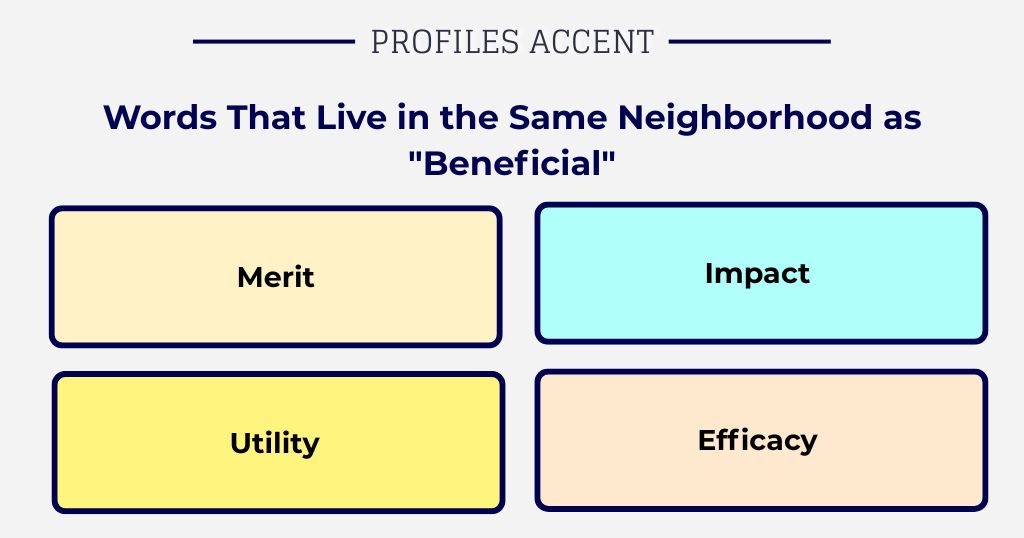
These aren’t direct synonyms but often appear in the same context:
- Utility (noun): the practical usefulness of something. Useful when writing about tools or systems.
- Merit (noun): the quality of being good or worthy. Often appears in academic or evaluative writing.
- Impact (noun): the strong effect something has. Pairs well with “positive” when “beneficial” feels flat.
- Efficacy (noun): the power to produce a desired effect. Strong in medical and scientific writing.
- Advantage (noun): a condition that puts one in a favorable position. The noun form of “advantageous.”
Opposite of Beneficial: Antonyms Worth Knowing
Quick reference for antonyms, because knowing the opposite sharpens your understanding of the word itself.
- Harmful: causes direct damage
- Detrimental: chips away at health, progress, or success over time
- Counterproductive: an action meant to help that actually makes things worse
- Deleterious: slow, serious, long-term destruction
- Adverse: conditions or effects that work against the desired outcome
- Inimical: naturally hostile or opposed to growth
These aren’t interchangeable either. A “counterproductive” policy is different from a “harmful” one. One backfires. The other actively damages.
Still Unsure? Here’s How to Choose the Right Synonym for Beneficial Fast
Still not sure which word fits? Run through this mental checklist:
- Is the context health-related? Go with wholesome, healthful, or therapeutic.
- Is it about money or business? Reach for profitable, lucrative, or favorable.
- Is it for a formal essay or exam? Use advantageous, conducive, or instrumental.
- Is it high-impact and lasting? Try transformative, invaluable, or indispensable.
- Is it casual and conversational? Keep it simple: helpful, useful, or good for.
The right word doesn’t just replace “beneficial.” It makes the sentence more precise, more powerful, and more fitting for the reader you’re writing for. That’s the whole point.
Discover More Articles:

I’m Rowan, a language addict who loves exploring how words work in everyday communication. I’ve spent years studying English vocabulary and helping others express themselves more clearly. My goal is simple: make learning new words easy and practical. I focus on real-life examples that show when and how to use different terms. Through clear explanations and honest guidance, I help readers choose the right words for any situation with confidence.