Picture this. You’re writing a story. Your character walks into an abandoned hospital at midnight. You type: “It was scary.”
And something feels flat. Wrong. Like putting ketchup on a fine steak.
“Scary” works in conversation. But in writing, it often drains the very energy you’re trying to create. The good news? English gives you dozens of better options. Each one carries a slightly different emotional charge. Once you understand those differences, your word choices stop being guesses and start being decisions.
What “Scary” Is Really Trying to Say
At its core, “scary” means something that causes fear or anxiety. Simple enough. But here’s what most people miss: fear comes in different flavors. There’s the slow creep of unease. The sudden jolt of shock. The heavy dread that sits in your chest. “Scary” covers all of it in a vague way. A good synonym targets the exact type of fear you mean.
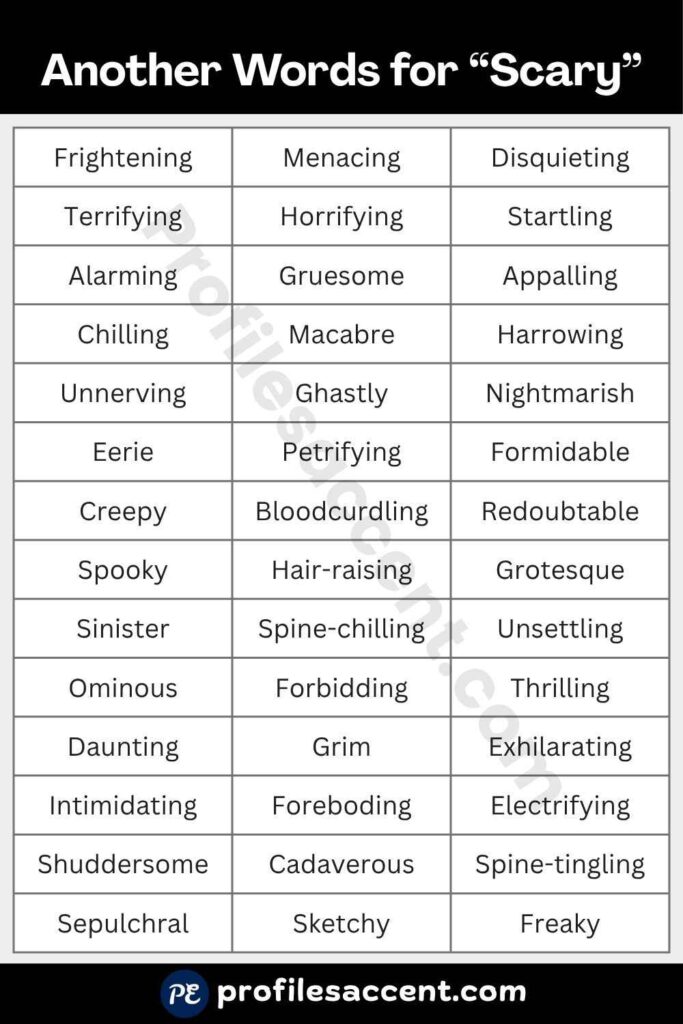
40+ Synonyms for Scary: Quick Table
| Word | Tone | Best For | Example |
| Frightening | Neutral/Formal | Most contexts | A frightening report on road safety |
| Terrifying | Strong | Intense situations | A terrifying storm hit the coast |
| Alarming | Formal | Danger or urgency | Alarming crime statistics |
| Chilling | Creative | Suspense, dark stories | A chilling tale of betrayal |
| Unnerving | Subtle | Loss of calm | His silence was deeply unnerving |
| Eerie | Atmospheric | Strange places, quiet dread | The forest had an eerie stillness |
| Creepy | Informal | Discomfort, unease | That smile felt really creepy |
| Spooky | Casual/Light | Halloween, ghosts | The old attic was spooky |
| Sinister | Literary | Hidden evil, dark intent | A sinister grin crossed his face |
| Ominous | Formal | Warning signs, bad feeling | Ominous clouds gathered overhead |
| Daunting | Formal | Challenges, scale | Starting over felt daunting |
| Intimidating | Person-focused | People, authority | The coach had an intimidating style |
| Menacing | Person/scene | Active threat | A menacing figure stepped forward |
| Horrifying | Strong | Shocking events | A horrifying accident on the highway |
| Gruesome | Visual | Gore, death | A gruesome discovery in the cellar |
| Macabre | Literary | Death, dark themes | The painting had a macabre beauty |
| Ghastly | Strong | Shock, disgust | A ghastly wound on his arm |
| Petrifying | Extreme | Absolute terror | The drop was absolutely petrifying |
| Bloodcurdling | Extreme | Screams, horror | A bloodcurdling scream echoed outside |
| Hair-raising | Vivid | Adventures, close calls | A hair-raising chase through the city |
| Spine-chilling | Creative | Horror, suspense | A spine-chilling twist at the end |
| Forbidding | Visual/Formal | Places, faces | A forbidding iron gate blocked the path |
| Grim | Neutral | Serious, dark situations | The doctor gave a grim assessment |
| Foreboding | Atmospheric | Dread before events | She had a foreboding sense all morning |
| Disquieting | Formal/Literary | Mental unease | A disquieting silence filled the room |
| Startling | Sudden | Surprises, shock | A startling noise woke everyone |
| Appalling | Moral fear | Shocking wrongness | The conditions were appalling |
| Harrowing | Emotional | Painful, traumatic | A harrowing account of survival |
| Nightmarish | Vivid | Bad situations, chaos | A nightmarish commute through floods |
| Formidable | Respectful fear | Opponents, challenges | A formidable rival in the finals |
| Redoubtable | Very Formal | Respected opponents | A redoubtable legal team |
| Grotesque | Visual | Twisted appearance | A grotesque creature in the shadows |
| Unsettling | Subtle | Quiet, building dread | Something unsettling about his tone |
| Thrilling | Positive fear | Fun scares, excitement | A thrilling dive off the cliffs |
| Exhilarating | Positive fear | Rush, energy | The race was absolutely exhilarating |
| Electrifying | Positive energy | High-stakes excitement | An electrifying final match |
| Spine-tingling | Positive/Neutral | Awe, beauty, suspense | A spine-tingling performance |
| Freaky | Slang | Casual, strange | That dream was seriously freaky |
| Sketchy | Slang | Unsafe, untrustworthy | That street looked pretty sketchy |
| Sepulchral | Literary | Tomb-like, hollow | A sepulchral quiet hung in the hall |
| Cadaverous | Visual/Literary | Deathly appearance | His cadaverous face alarmed visitors |
| Shuddersome | Creative/Rare | Physical revulsion | A shuddersome encounter in the dark |
The Real Differences Between Words for Scary
Not all these words mean the same thing. Here’s where writers get it wrong. They grab a synonym from a list without checking what kind of fear it actually names.
The quiet, creeping type: Words like eerie, unsettling, ominous, and disquieting describe fear that sneaks up on you. Nothing has gone wrong yet. But something feels off. These work best in suspense, slow-burn stories, or when describing a strange atmosphere.
The sudden shock type: Startling, alarming, hair-raising. These describe fear that hits fast. A loud bang. A near miss. An unexpected piece of news.
The deeply disturbing type: Horrifying, harrowing, appalling. These carry moral weight. It’s not just fear; it’s the feeling that something terribly wrong has happened. Use these for real-world tragedy, crime, or ethical violations.
The visual type: Gruesome, ghastly, grotesque, cadaverous. These are about what you see. They describe appearance, not just mood. A crime scene. A wound. A disturbing face.
The respectful type: Daunting, formidable, intimidating. Here, the fear comes from being outmatched, not from danger. You’re not running away. You’re standing in front of something impressively powerful.
When Scary Feels Good: Another Word for Scary in an Exciting Way
Here’s something most synonym lists completely skip.
Sometimes fear is the whole point. Roller coasters. Horror films. Bungee jumping. In these moments, “scary” flips from negative to exciting. The words you need here are completely different.
- Thrilling suggests a burst of sharp, excited feeling.
- Exhilarating means you come out the other side feeling energized and alive.
- Electrifying works for group experiences with high stakes and shared energy.
- Spine-tingling fits that moment when goosebumps rise, not from terror but from awe.
If someone says “skydiving sounds scary,” they might mean it’s exciting and they want to try it. Calling it exhilarating captures that intention perfectly.
How Strong Is the Fear? Scary Synonyms Ranked by Intensity
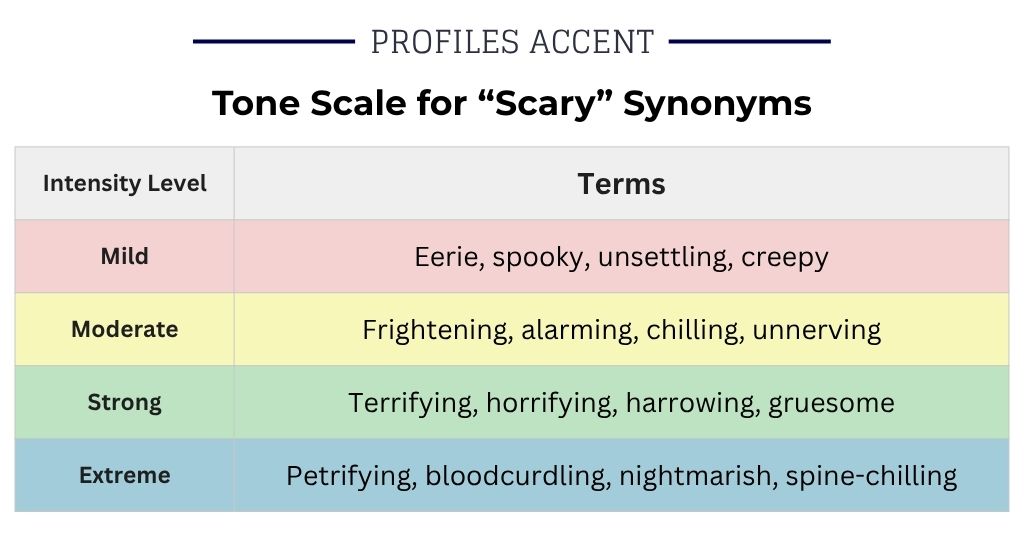
Fear runs on a spectrum. Choosing the wrong intensity level is one of the most common writing mistakes.
- Mild: Eerie, spooky, unsettling, creepy
These create atmosphere. They suggest something is slightly wrong without turning it into a crisis.
- Moderate: Frightening, alarming, chilling, unnerving
These are solid, reliable choices. Strong enough to take seriously, controlled enough not to overwhelm.
- Strong: Terrifying, horrifying, harrowing, gruesome
These demand attention. Save them for moments that earn the intensity.
- Extreme: Petrifying, bloodcurdling, nightmarish, spine-chilling
Use sparingly. If everything is bloodcurdling, nothing is. These words lose power when overused.
Weak Sentences, Stronger Rewrites
Here’s where the real difference shows up. Same basic idea. Completely different effect.
Original: “The basement was scary.”
- Formal: “The basement had a deeply foreboding quality, as if something long buried still waited there.”
- Casual: “Walking into that basement felt creepy in a way I couldn’t explain.”
- Creative: “The basement exhaled a cold, sepulchral silence that pressed against her chest.”
Original: “He was a scary person.”
- Professional: “His imposing presence made even senior staff uncomfortable.”
- Story: “There was something menacing in the way he stood very still and watched.”
Original: “The news was scary.”
- Formal report: “The findings were deeply alarming and prompted immediate review.”
- Casual: “Honestly? That story was pretty harrowing to read.”
Notice what shifts. It’s not just vocabulary. The right word controls the emotional temperature of the whole sentence.
Another Word for Scary Person, Place, or Event
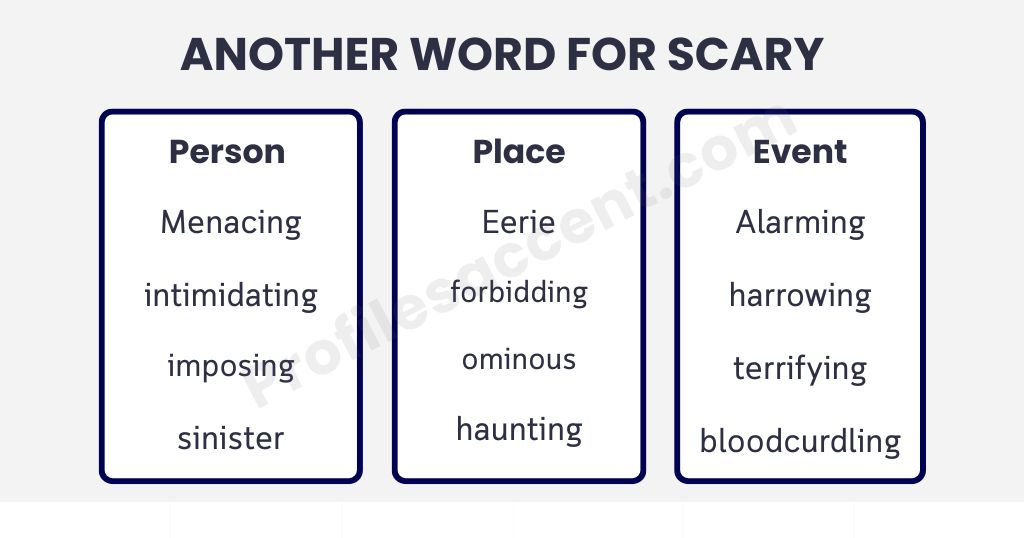
Writers often grab the first synonym they find without asking: scary in what way, exactly?
- For a scary person: Menacing, intimidating, imposing, sinister. These describe behavior, posture, intent.
- For a scary place: Eerie, forbidding, ominous, haunting. These describe atmosphere and setting.
- For a scary event: Alarming, harrowing, terrifying, bloodcurdling. These describe impact and experience.
Getting this match right is what separates precise writing from vague writing.
Scary Synonyms That Start With S, O, and A
Sometimes you need alliteration. Or a specific sound. Here are options organized by first letter:
Starting with S: Sinister, spine-chilling, startling, shuddersome, sepulchral, spooky, startling
Starting with O: Ominous, otherworldly, off-putting, overwhelming, oppressive
Starting with A: Alarming, appalling, awful, awe-inspiring (positive fear), anxiety-inducing
Mistakes People Make When Swapping Out “Scary”
Mixing intensity levels carelessly. Calling a mildly awkward situation petrifying kills the word’s power for when you actually need it.
Using “creepy” in formal writing. It works in stories and casual posts. It doesn’t belong in professional reports or academic essays.
Confusing “daunting” with “terrifying.” Daunting means the task feels overwhelmingly hard. Terrifying means you feel actual fear. Starting a new job can be daunting. Hearing footsteps in an empty house is terrifying.
Overusing “chilling.” It’s a great word. But once it appears four times in a single article, it loses all temperature.
Treating “ominous” and “sinister” as identical. Ominous signals something bad is coming. Sinister suggests active, deliberate evil is already present.
The Opposite of Scary: When You Need to Go the Other Way
Sometimes you need contrast. Words that push back against fear:
- Reassuring restores confidence.
- Comforting offers warmth.
- Soothing quiets anxiety.
- Calming reduces panic.
- Heartening gives hope when things looked dark.
These antonyms are useful in contrast writing, character arcs, and emotional storytelling where tension needs a release.
Five Related Words That Go Deeper Than Scary
- Foreboding: A feeling that something bad is going to happen, even if nothing has yet. It’s more personal and internal than “ominous.”
- Dread: Heavier than fear. It sits, it waits. Dread doesn’t startle; it accumulates.
- Trepidation: Nervous anticipation. Less than terror, more than mild worry. Useful for formal writing.
- Macabre: Fear mixed with dark, often artistic appreciation of death. More specific than “scary.”
- Harrowing: Deeply emotionally painful fear. Often tied to real trauma or survival stories.
The Right Scary Synonym, Every Time
Here’s a quick mental filter before you pick:
- Ask yourself what type of fear you mean. Is it slow-building or sudden? Is it visual or emotional? Is it meant to thrill or disturb?
- Ask about intensity. Would you call a spider in the bathroom spine-chilling? Probably not. Save your strongest words for your strongest moments.
- Ask about register. Are you writing a story, a professional report, a social media caption? Your audience changes the right word entirely.
The goal isn’t to sound impressive. It’s to be accurate. The right word doesn’t just describe fear. It makes the reader feel the specific kind of fear you meant all along.
Discover More Articles:

I’m Rowan, a language addict who loves exploring how words work in everyday communication. I’ve spent years studying English vocabulary and helping others express themselves more clearly. My goal is simple: make learning new words easy and practical. I focus on real-life examples that show when and how to use different terms. Through clear explanations and honest guidance, I help readers choose the right words for any situation with confidence.