You finish writing a sentence. It says something “resonated.” And then you read it back and think… that feels flat. Overused. Like everyone else’s writing.
The word “resonate” is doing a lot of heavy lifting these days. Speeches, brand campaigns, book reviews, personal essays. It shows up everywhere, which means it’s starting to lose its punch.
The real problem is not just overuse. It’s that writers often use “resonate” when they actually mean something more specific. Something sadder, or warmer, or more intellectual. And that gap in precision costs you the emotional weight you were going for.
This guide helps you find the exact word you need, depending on what kind of connection you are describing.
What the Word “Resonate” Is Really Saying
At its core, “resonate” means two things. Physically, it refers to a sound that vibrates and fills a space. Emotionally, it means something deeply connected with a person’s feelings, beliefs, or experiences.
When you say “that book resonated with me,” you mean it did not just entertain you. It touched something true inside you. That is the emotional weight the word carries. And that is exactly why its synonym matters so much.
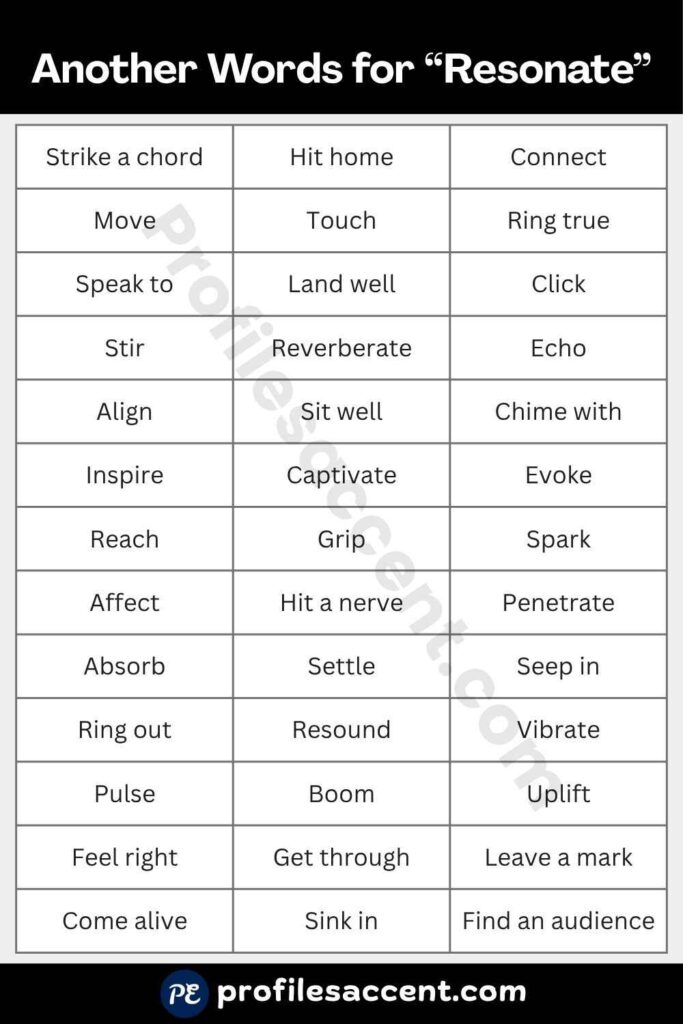
30+ Synonyms for Resonate: Quick-Access Table
| Word | Tone | Best Used When | Example |
| Strike a chord | Emotional | A story or speech hits deep feelings | “Her words struck a chord with the crowd.” |
| Hit home | Honest, raw | A truth lands with real personal weight | “That scene really hit home.” |
| Connect | Warm, simple | Something aligns with personal experience | “This message connects with readers.” |
| Move | Emotional, literary | Something stirs genuine feeling | “The film moved everyone in the room.” |
| Touch | Gentle, personal | A quiet emotional impact | “His story touched people deeply.” |
| Ring true | Credible | Something feels believable or authentic | “Her apology rang true.” |
| Speak to | Direct, personal | Something addresses a shared experience | “This poem speaks to every parent.” |
| Land well | Professional | An idea is received positively | “The pitch landed well with investors.” |
| Click | Casual, modern | Something feels instantly right | “The concept just clicked.” |
| Stir | Evocative | Something awakens feeling gently | “The music stirred old memories.” |
| Reverberate | Dramatic, deep | Impact that spreads and lasts | “The news reverberated through the city.” |
| Echo | Literary | Something reflects a feeling or thought | “His words echoed long after the talk.” |
| Align | Professional | Agreement or logical match | “This strategy aligns with our values.” |
| Sit well | Conversational | Something feels acceptable or right | “That explanation sat well with everyone.” |
| Chime with | Formal, British | Harmony with an existing belief | “His ideas chimed with ours perfectly.” |
| Inspire | Uplifting | Something motivates or energizes | “Her courage inspired thousands.” |
| Captivate | Engaging | Something grips attention fully | “The story captivated readers from page one.” |
| Evoke | Artistic | Something brings a memory or feeling to mind | “The painting evoked a sense of loss.” |
| Reach | Human, direct | A message successfully finds its audience | “This campaign truly reached people.” |
| Grip | Intense | Something holds attention with power | “The documentary gripped every viewer.” |
| Spark | Creative | Triggers a reaction or idea | “The talk sparked something in her.” |
| Affect | Academic, neutral | A general emotional or mental influence | “The story deeply affected him.” |
| Hit a nerve | Sensitive | Exposes something uncomfortable or raw | “The article hit a nerve online.” |
| Penetrate | Strong, intense | Getting past emotional or mental walls | “Her speech penetrated even the skeptics.” |
| Absorb | Quiet, deep | Something is taken in fully | “He absorbed every word she said.” |
| Settle | Calm, reflective | An idea slowly feels right after thinking | “Her advice slowly settled with me.” |
| Seep in | Gradual | Impact that grows quietly over time | “The grief seeped in over weeks.” |
| Ring out | Acoustic, dramatic | A sound or message is heard clearly and strongly | “Her voice rang out across the hall.” |
| Resound | Sound, powerful | A space is filled with a deep sound | “Applause resounded through the theater.” |
| Vibrate | Physical, acoustic | Literal sound movement | “The bass vibrated through the floor.” |
| Pulse | Rhythm, physical | A steady, rhythmic movement or sound | “Music pulsed through the speakers.” |
| Boom | Loud, physical | A deep, powerful sound fills a space | “Thunder boomed across the valley.” |
| Uplift | Positive, spiritual | Something raises mood or spirit | “Her story uplifted the whole room.” |
| Feel right | Informal | Something intuitively seems correct | “The choice just felt right.” |
| Get through | Direct | A message successfully reaches someone emotionally | “His words finally got through to her.” |
| Leave a mark | Lasting | Something makes a permanent impression | “That novel left a mark on me.” |
| Come alive | Creative, vivid | Something becomes meaningful and real | “The story came alive in his hands.” |
| Sink in | Gradual | Understanding or feeling arrives slowly | “The reality took days to sink in.” |
| Find an audience | Broad, analytical | A message successfully reaches many people | “The campaign finally found its audience.” |
Not All Resonate Synonyms Mean the Same Thing
Here is something most synonym lists miss. “Resonate” does not always mean the same thing in every sentence. The replacement word must match not just the emotion, but the direction of impact.
When something connects emotionally (“the film resonated with me”), you want words like move, touch, stir, or strike a chord. These all show emotional response but differ in intensity.
Touch is gentle. Stir adds some movement to that feeling. Move goes further. Strike a chord suggests a specific emotional frequency was hit precisely.
When something makes logical sense (“the strategy resonated with the team”), you need a different set entirely: align, sit well, click, land well, or chime with. These are about agreement and clarity, not emotion.
When something creates a lasting physical impact (“the sound resonated through the hall”), the right words are reverberate, resound, boom, or ring out. These belong to a physical world. Using “strike a chord” here would confuse readers.
Matching the right synonym to the right type of connection matters more than finding the most impressive word.
How Strong Do You Want It? A Tone Scale for “Resonate” Alternatives
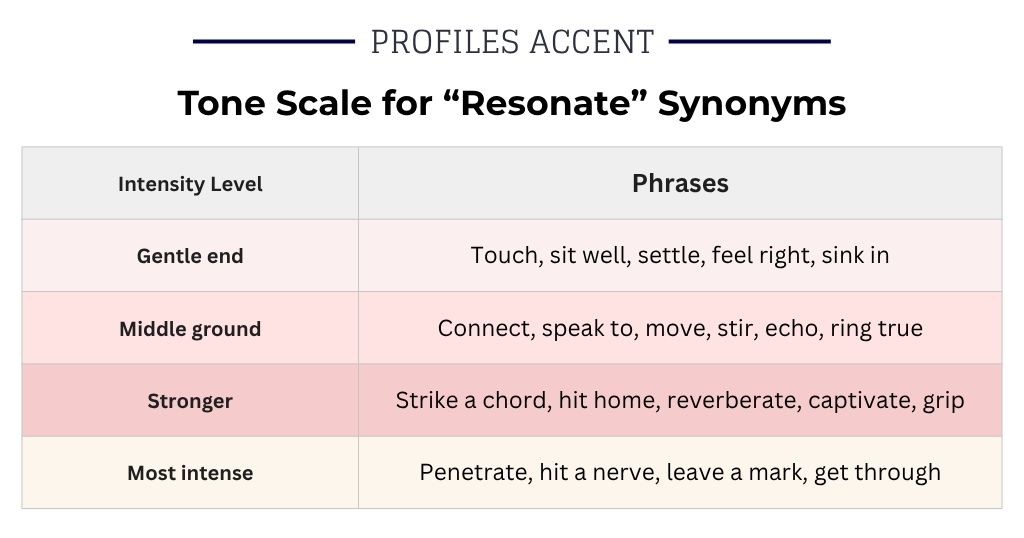
Not every moment calls for the same emotional weight. Here is how these synonyms shift across a scale from quiet to intense:
- Gentle end: touch, sit well, settle, feel right, sink in
These are soft. They suggest quiet, personal impact. Good for introspective writing, personal essays, or situations where the emotion is subtle.
- Middle ground: connect, speak to, move, stir, echo, ring true
These carry genuine emotional impact without being overwhelming. They work in most writing contexts, professional or personal.
- Stronger: strike a chord, hit home, reverberate, captivate, grip
These signal deeper impact. Something important happened. The reader feels it clearly.
- Most intense: penetrate, hit a nerve, leave a mark, get through
These are for moments that cut past defenses. Use them carefully. They signal real disruption, not just pleasant connection.
See the Difference: Rewriting Sentences with Better Words Than “Resonate”
Sometimes the best way to understand synonym choice is to see it in action.
Original: “The campaign resonated with young people.”
- Formal: “The campaign connected meaningfully with younger audiences.”
- Casual: “Young people really clicked with that campaign.”
- Creative: “Something in the campaign reached young people where they actually lived.”
- Academic: “The campaign demonstrated measurable emotional alignment with youth demographics.”
Original: “Her story resonated deeply.”
- Literary: “Her story seeped into the reader slowly, then stayed.”
- Conversational: “Her story just hit home.”
- Professional: “Her story landed with real impact across the audience.”
Original: “That speech resonated with everyone in the room.”
- Emotional: “That speech moved every single person in the room.”
- Powerful: “That speech struck a chord no one expected.”
- Simple: “Everyone in the room felt something during that speech.”
Notice how the alternative word changes what the reader pictures. “Clicked” feels modern and light. “Seeped in” feels slow and heavy. “Struck a chord” feels musical and precise. The meaning shifts with the word.
Which Synonym for Resonate Works in Which Setting?
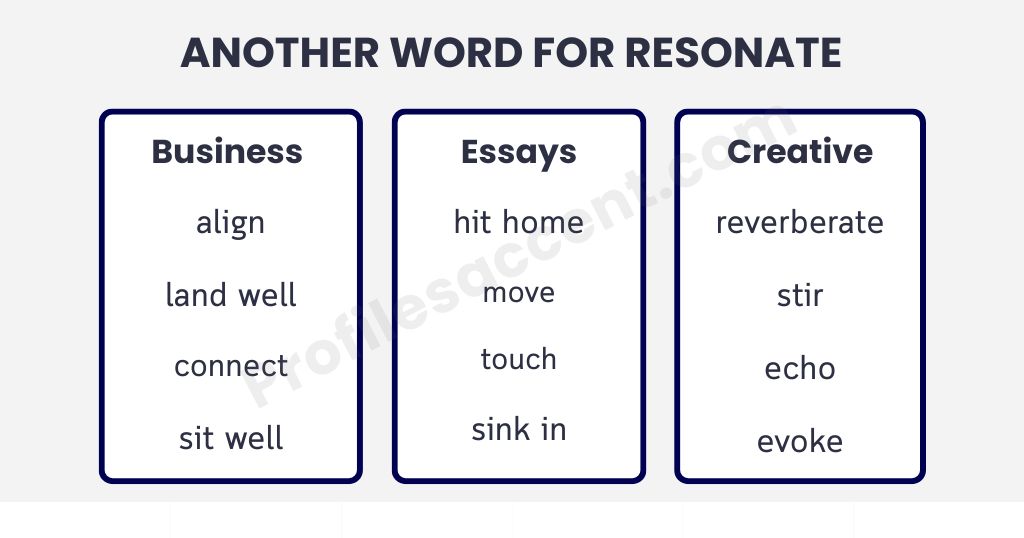
- In professional writing and business emails: Use align, land well, connect, or sit well. These feel clean and credible.
- In personal essays or memoirs: Use hit home, move, touch, or sink in. These honor emotional honesty.
- In academic writing: Use affect, engage, or align. Avoid anything that sounds too casual or poetic.
- In creative fiction or poetry: Use reverberate, stir, echo, evoke, or seep in. These give your language texture.
- In casual conversation or social media: Click, hit home, feel right, and get through all sound natural and easy.
Common Errors When Swapping Out “Resonate”
Using acoustic words for emotional moments. If someone’s speech moved you emotionally, saying it “vibrated with you” sounds strange. Vibrate and pulse belong to sound, not feeling.
Confusing “hit a nerve” with “strike a chord.” These feel similar but are opposites in tone. “Strike a chord” is warm and connective. “Hit a nerve” means something touched a wound or sensitive point. Using the wrong one changes your message completely.
Overusing “connect.” It is a fine word, but vague. When you write “this connects,” readers are left wondering: connects how? Emotionally? Logically? Spiritually? Be specific.
Treating “echo” and “reverberate” as identical. Echo suggests reflection, that something mirrors back. Reverberate suggests ongoing, spreading impact. A truth can echo. A disaster reverberates.
Words Closely Related to “Resonate” – And How They Differ
Evoke is close to “resonate” but more specific. It means to bring something to mind, usually a memory, image, or feeling. Something can evoke sadness without resonating with the reader personally.
Engage is about capturing attention. Something resonates after it engages you. The order matters.
Validate is a synonym for situations where resonance happens because something confirms what someone already believed or felt.
Linger describes the aftereffect of resonance, not the resonance itself. A story can resonate and then linger. Two separate moments.
Reflect works when one thing mirrors another idea or feeling, similar to echo but more visual and thoughtful in tone.
The Smarter Way to Replace “Resonate” in Your Writing
“Resonate” is not a bad word. It is just doing too much work when writers use it as a default. The moment you ask yourself how something resonates, the right synonym becomes obvious.
- Is it gentle or powerful?
- Physical or emotional?
- Intellectual or gut-level?
- Lasting or instant?
Answer that first. Then choose your word. That single choice will make your writing feel more deliberate, more alive, and far more specific than anything the word “resonate” alone could carry.
Discover More Articles:
| Another Word for While: 40+ Synonyms, Examples & When to Use Each |
| Another Word for Always: 35+ Synonyms by Tone, Context & Meaning |
| Another Word for Moreover: 40+ Synonyms, Tone Guide & Usage Tips |

I’m Rowan, a language addict who loves exploring how words work in everyday communication. I’ve spent years studying English vocabulary and helping others express themselves more clearly. My goal is simple: make learning new words easy and practical. I focus on real-life examples that show when and how to use different terms. Through clear explanations and honest guidance, I help readers choose the right words for any situation with confidence.