You just wrote “profound impact” for the third time in one essay. You know it sounds repetitive, but every replacement you try either feels too weak or too dramatic. That is a real problem, and it is more common than you think.
The word “profound” is genuinely useful. But writers often reach for it out of habit, not precision. And when precision is missing, the whole sentence loses its punch.
This guide is not just a word list. It will show you which synonym fits which situation, how tone shifts when you swap words, and where most writers go wrong.
So What Does “Profound” Really Mean?
At its core, “profound” means something that goes very deep, whether that is a thought, a feeling, a change, or a physical space. It suggests more than surface level. It carries weight.
The tone is serious. The emotional register is high. When you call something profound, you are telling the reader: this matters more than it looks.
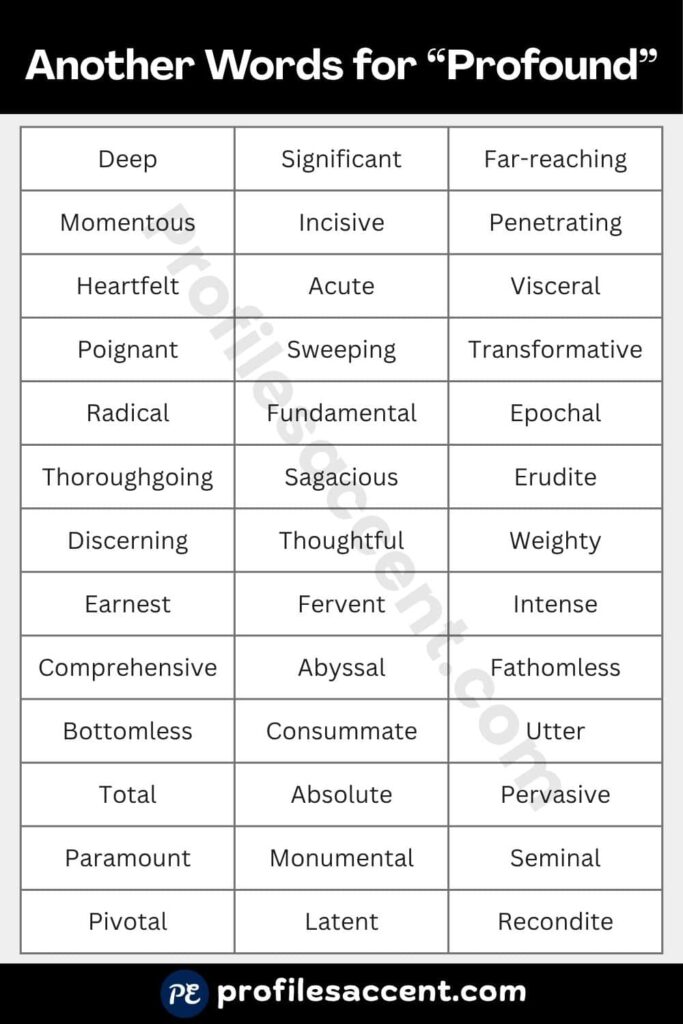
Another Word for Profound: 50+ Quick Synonym Table
| Word | Tone | Best Used When | Example |
| Deep | Neutral | Thoughts, emotions, water | A deep sense of loss |
| Significant | Formal | Impact, change, results | A significant shift in policy |
| Far-reaching | Professional | Consequences, effects | Far-reaching reforms |
| Momentous | Elevated | Events, decisions | A momentous occasion |
| Incisive | Academic | Analysis, critique | An incisive observation |
| Penetrating | Formal | Questions, insight | A penetrating look at the issue |
| Heartfelt | Warm | Apologies, gratitude | A heartfelt response |
| Acute | Precise | Pain, awareness, emotion | Acute awareness of danger |
| Visceral | Vivid | Raw emotion, reaction | A visceral response |
| Poignant | Emotional | Sadness, beauty, memory | A poignant farewell |
| Sweeping | Bold | Reform, change, narrative | Sweeping changes to the law |
| Transformative | Action-focused | Growth, experience | A transformative journey |
| Radical | Strong | Departure from normal | A radical shift in thinking |
| Fundamental | Core-level | Principle, problem, flaw | A fundamental misunderstanding |
| Epochal | Rare/strong | Historical shifts | An epochal moment in science |
| Thoroughgoing | Formal | Complete, detailed review | A thoroughgoing analysis |
| Sagacious | Academic | Wise person, wise choice | A sagacious advisor |
| Erudite | Scholarly | Knowledge, writing style | An erudite argument |
| Discerning | Precise | Judgment, taste | A discerning reader |
| Thoughtful | Gentle | Reflection, gesture | A thoughtful reply |
| Weighty | Informal-formal | Decisions, words | A weighty decision |
| Earnest | Sincere | Tone, intent | An earnest plea |
| Fervent | Passionate | Belief, desire | A fervent supporter |
| Intense | General | Emotion, focus | An intense feeling of regret |
| Comprehensive | Neutral | Coverage, understanding | A comprehensive view |
| Abyssal | Creative | Depth, darkness | Abyssal silence |
| Fathomless | Poetic | Mystery, depth | Fathomless grief |
| Bottomless | Vivid | Hunger, despair | A bottomless pit of doubt |
| Consummate | Formal | Skill, mastery | A consummate professional |
| Utter | Emphatic | Shock, silence, failure | Utter disbelief |
| Total | Simple | Completeness | Total silence fell over the room |
| Absolute | Definitive | Control, truth, quiet | Absolute stillness |
| Pervasive | Spreading | Influence, mood | A pervasive sense of unease |
| Paramount | Priority | Importance, concern | Of paramount importance |
| Monumental | Visual weight | Achievement, shift | A monumental discovery |
| Seminal | Intellectual | Work, idea, research | A seminal text in the field |
| Pivotal | Action-based | Moment, role, decision | A pivotal turning point |
| Latent | Hidden | Potential, meaning | A latent truth beneath the surface |
| Recondite | Rare | Obscure knowledge | A recondite area of philosophy |
| Staggering | Informal emphasis | Scale, number, effect | A staggering level of detail |
Not All Profound Synonyms Mean the Same Thing
“Profound” stretches across very different situations. That is what makes it tricky to replace. Before picking a synonym, identify which version of “profound” you actually mean.
When you mean deep thinking or wisdom:
Words like sagacious, incisive, and penetrating work better than a vague “profound.” They name the type of intelligence more clearly. “An incisive argument” tells the reader the thinking is sharp and cuts through noise. “A profound argument” is just… deep.
When you mean strong emotion:
Swap to visceral, heartfelt, or poignant depending on what kind of feeling you are describing. Grief can be poignant. A gut reaction can be visceral. “Profound sadness” becomes more powerful when you name the specific emotional texture.
When you mean large-scale change:
Use sweeping, transformative, radical, or epochal. These words carry movement and scale in a way that “profound” simply does not. A “profound change in leadership” sounds softer than “a sweeping change in leadership.” Choose based on how much force you want.
When you mean something hard to understand:
Try recondite, abstruse, or even fathomless. These words communicate difficulty without sounding vague.
How Strong Is Your Synonym? A Tone Scale for Profound
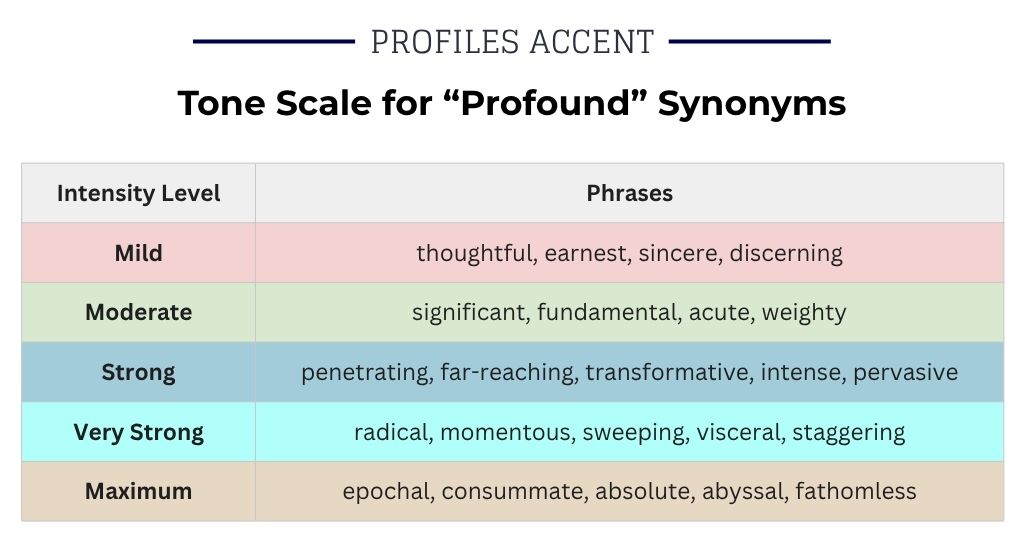
Not all synonyms carry equal weight. Some are mild. Some hit hard. Here is where common replacements fall on the scale:
- Mild: thoughtful, earnest, sincere, discerning
- Moderate: significant, fundamental, acute, weighty
- Strong: penetrating, far-reaching, transformative, intense, pervasive
- Very Strong: radical, momentous, sweeping, visceral, staggering
- Maximum: epochal, consummate, absolute, abyssal, fathomless
If your sentence needs a word that feels like an earthquake, reach for the higher end. If the moment is quieter and more internal, stay in the mild to moderate zone. Using “epochal” for a small personal realization is overkill. Using “thoughtful” for a civilization-changing event undersells it.
Swapping “Profound” in Real Sentences
Here is where word choice becomes real. Each original uses “profound.” The rewrites show how tone and perception shift.
Original: The book had a profound effect on her thinking.
- Formal: The book produced a transformative effect on her thinking.
- Casual: The book totally changed how she thought.
- Academic: The text exerted a seminal influence on her intellectual development.
- Creative: The book left a fathomless mark on everything she believed.
Original: He spoke with a profound sadness.
- Formal: He spoke with acute sadness.
- Casual: His voice carried something heavy, like he had been crying for days.
- Academic: His speech was marked by palpable grief.
- Creative: His words came out soaked in poignant sorrow.
Original: She had profound knowledge of the subject.
- Formal: She possessed comprehensive knowledge of the subject.
- Casual: She knew the subject inside and out.
- Academic: Her grasp of the material was erudite and precise.
- Creative: Her knowledge of it ran fathomless, drawn from years of quiet study.
Original: The discovery had a profound impact on science.
- Formal: The discovery had a far-reaching impact on science.
- Professional: The discovery created a pivotal shift in scientific understanding.
- Academic: The discovery proved seminal in reshaping scientific consensus.
- Strong: The discovery sent monumental ripples through the entire field.
Each rewrite does something specific. Notice how the casual versions drop the formal word entirely. That is often the right call.
Synonyms for Profound in Formal vs. Everyday Writing
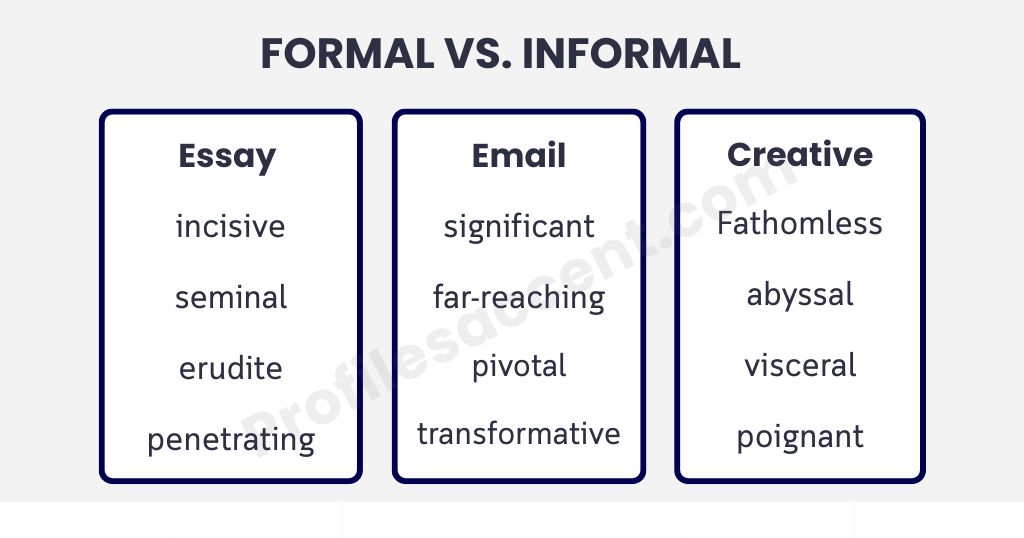
- For essays and academic writing:
Reach for incisive, seminal, erudite, penetrating, fundamental, or thoroughgoing. These carry academic weight without sounding overdone.
- For professional emails or business writing:
Use significant, far-reaching, pivotal, transformative, or comprehensive. Clean, direct, respected in any industry.
- For storytelling and creative writing:
Fathomless, abyssal, visceral, poignant, monumental, and pervasive give your prose texture and emotional color.
- Words to avoid in formal writing:
Do not use “staggering,” “total,” or “utter” in an academic paper. These belong to casual writing or emphasis-heavy journalism, not scholarly argument.
When Certain Words for Profound Can Backfire
A few replacement words carry risks if placed carelessly.
“Radical” used to mean “going to the root.” Today, in many conversations, it carries a political edge. If you are not discussing politics or ideology, consider sweeping or transformative instead to avoid unintended interpretation.
“Acute” is a medical term as well as an emotional one. If your sentence might be read in a health context, make sure “acute” reads as emotional intensity, not clinical severity. Clarify if needed.
“Fervent” works beautifully for belief, but it can sound slightly fanatical in certain contexts. Use it when passion is genuinely being described, not just mild enthusiasm.
“Erudite” and “sagacious” are formal and a bit rare. Using them in a casual article or a social media post will sound oddly stiff. Save them for essays or formal writing where elevated vocabulary fits.
Mistakes Writers Make When Replacing “Profound “
- Mistake 1: Using “deep” as a lazy replacement
“Deep” is sometimes the right word, but it is also vague. “A deep insight” is fine. “A deep experience” tells the reader almost nothing. Be more specific.
- Mistake 2: Mixing registers without realizing it
Dropping “sagacious” into a casual blog post or “staggering” into a formal thesis can jar the reader. Tone consistency matters.
- Mistake 3: Thinking all synonyms are interchangeable
“Profound impact” and “acute impact” are not the same. “Acute” means sharp and immediate. “Profound” means deep and lasting. Picking the wrong one changes the meaning of your sentence.
- Mistake 4: Overusing “transformative”
This word has become the new “profound” in business writing. It is now almost as overused. If everything is transformative, nothing is. Consider pivotal, paradigm-shifting, or fundamental as fresher options.
- Mistake 5: Using intensity words for small moments
Calling a minor realization “monumental” or “epochal” undercuts your credibility. Reserve your strongest words for genuinely big moments.
Words Close to Profound But Not Quite the Same
Abstruse: Similar to recondite, this word means something is hard to understand because of its complexity, not its depth. Use it for difficult theory or writing, not for emotions.
Palpable: You can almost touch it. This is excellent for describing emotions that fill a room, like a palpable tension or palpable grief.
Nuanced: Often misused, this means something has subtle and careful complexity. A nuanced view is not simply a “profound” one. It is one that holds multiple layers without collapsing them.
Seminal: Reserved for works, ideas, or moments that become foundations for everything that came after. Use sparingly.
Paradigmatic: Means it represents or even redefines a whole pattern or system. Very strong. Very specific. Good for academic contexts only.
Antonyms of Profound: Know the Other Side
The right antonym depends on what you mean by “profound.”
If you mean intellectual depth, the opposite is superficial, pedestrian, or simplistic.
If you mean emotional intensity, the opposite is detached, lukewarm, or indifferent.
If you mean sweeping change, the opposite is negligible, marginal, or inconsequential.
Using the right antonym also helps you understand which meaning of “profound” you are actually working with.
The Right Synonym for Profound Changes Everything
Stop treating “profound” as a compliment you give to serious things. Every time you write it, ask yourself: deep in what way? In thought? In feeling? In scale? In permanence?
Once you name the specific kind of depth, the right word appears. Not just a synonym, but the precise word that makes the reader feel exactly what you intend.
That is the difference between writing that sounds good and writing that lands.
Discover More Articles:

I’m Rowan, a language addict who loves exploring how words work in everyday communication. I’ve spent years studying English vocabulary and helping others express themselves more clearly. My goal is simple: make learning new words easy and practical. I focus on real-life examples that show when and how to use different terms. Through clear explanations and honest guidance, I help readers choose the right words for any situation with confidence.