You finish a sentence and stare at it. “This shows that…” Again. You used it three lines ago. The word feels thin now, like a rubber stamp someone pressed too many times. It stopped meaning anything.
But the problem is not just repetition. It is that “shows” is doing different jobs in different sentences, and each job needs a different word. Swapping it randomly leads to writing that sounds stiff, forced, or flat-out wrong.
This guide helps you pick the right word, not just a different one.
What “shows” actually does
At its core, “shows” means to make something visible, clear, or known. But that is a wide lane. It can mean proving a fact, revealing a feeling, guiding a person, explaining a concept, or putting something on display. The tone sitting underneath the word shifts depending on which of those meanings you need.
Neutral. Flexible. Extremely common. That is why writers reach for it so often, and why it eventually starts to feel overused.
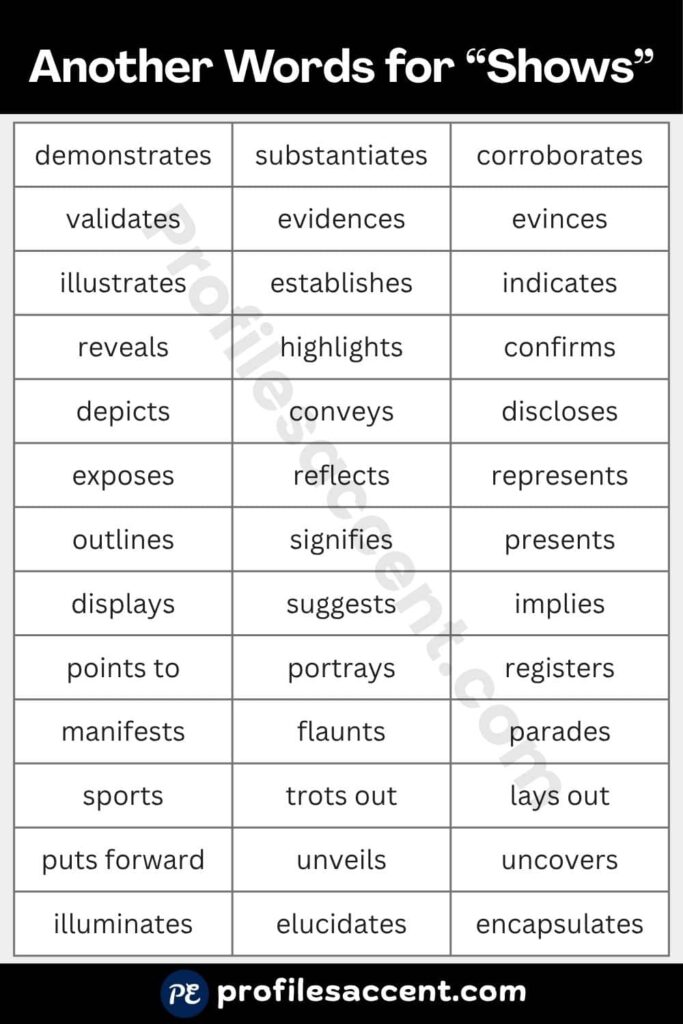
40+ Quick Shows Synonym Table
| Word | Tone | Best Used When |
| demonstrates | Academic | Connecting evidence to a clear conclusion |
| substantiates | Academic | Backing a claim with solid proof |
| corroborates | Academic | One source confirms what another found |
| validates | Academic | Confirming a theory or method is sound |
| evidences | Academic | Using data as direct proof |
| evinces | Academic | Formal, older scholarly writing |
| illustrates | Academic | Making an abstract idea clear via example |
| establishes | Academic | Setting a fact as a foundation |
| indicates | Formal | Pointing toward a conclusion without full proof |
| reveals | Formal | Uncovering something not immediately obvious |
| highlights | Formal | Drawing attention to a key detail or trend |
| confirms | Formal | Verifying something already suspected |
| depicts | Formal | Describing a scene, character, or visual |
| conveys | Formal | Communicating an idea through writing |
| discloses | Formal | Sharing something previously withheld |
| exposes | Formal | Bringing a hidden or negative truth into light |
| reflects | Formal | Showing how something mirrors a broader pattern |
| represents | Formal | Standing in for a larger idea |
| outlines | Formal | Presenting the structure of something |
| signifies | Formal | Carrying symbolic meaning |
| presents | Neutral | Introducing information straightforwardly |
| displays | Neutral | Making something visible or putting it on view |
| suggests | Neutral | Implying without stating outright |
| implies | Neutral | Hinting at meaning beneath the surface |
| points to | Neutral | Directing attention toward a finding |
| portrays | Neutral | Describing how something is represented |
| registers | Neutral | Noting that something is present |
| manifests | Neutral | Something becoming visible through its effects |
| flaunts | Casual | Showing off in a proud or bold way |
| parades | Casual | Displaying with noticeable pride |
| sports | Casual | Wearing something as a visible feature |
| trots out | Casual | Producing something again in a predictable way |
| lays out | Casual | Explaining information clearly |
| puts forward | Casual | Offering an idea for consideration |
| unveils | Creative | Revealing something new with occasion |
| uncovers | Creative | Bringing a hidden truth to light |
| illuminates | Creative | Making something obscure feel suddenly clear |
| elucidates | Creative | Explaining something complex simply |
| encapsulates | Creative | Capturing an essence briefly |
| lays bare | Creative | Stripping away pretense to reveal what is real |
| embodies | Creative | Representing an abstract idea physically |
Five Ways “Shows” Works (and Which Synonym Fits Each One)
“Shows” splits into five distinct jobs. Knowing which job your sentence needs is the real skill here.
Synonyms for Shows When You Are Proving Something
This is where most essay writers get stuck. If your sentence is connecting a piece of evidence to a conclusion, you need a word that carries logical weight.
- “Demonstrates” works here because it implies a clear, observable process.
- “Substantiates” goes further, suggesting the evidence is solid enough to stand up to challenge.
- “Corroborates” is the right pick when you are layering multiple sources together.
- “Validates” is slightly different. It works best when you are confirming that a method, approach, or theory holds up, not just that a single fact is true.
Another Word for Shows When You Are Revealing Something
“Reveals” suggests there was something concealed first. It carries a slightly dramatic undertone, as if pulling back a curtain. That works well in essays when you want to signal that a finding is surprising or significant.
“Exposes” carries negative weight. It implies the thing being revealed is problematic, unflattering, or wrong. Use it deliberately. If you write “the data exposes a flaw in the study,” you are making a judgment call, not just reporting a finding.
“Uncovers” sits between the two. It has energy and implies discovery, but without the harsh edge of “exposes.”
Shows Synonyms for Interpreting Data or Trends
If you cannot say something with certainty, the word you choose should reflect that. “Suggests” and “implies” are both honest hedges. They tell the reader: the evidence points this way, but the conclusion is not locked in.
“Indicates” is slightly stronger. It means the evidence is directional and meaningful, even if not definitive. In scientific and research writing, this is often the safest and most accurate choice.
“Points to” is a natural, less formal version of the same idea. It reads well in analytical writing without sounding forced.
Another Word for Shows in Creative and Literary Writing
This is where “depicts” and “portrays” belong. Neither of them means proof. They describe how something is represented. “The novel depicts rural poverty” is not saying the book proves poverty exists. It is saying the book shows it through scene and character.
“Encapsulates” is useful here too. It means the work captures the essence of something larger. “The painting encapsulates the anxiety of that era” says more than “the painting shows the anxiety of that era.”
Show Synonym for Making Things Easier to Understand
“Illustrates” is the bridge word. It sits between evidence and explanation. When you write “this illustrates the problem,” you are not claiming to prove anything, you are making a complex idea visible and accessible.
“Illuminates” does the same thing with more warmth. It suggests something murky has been made clear. “Elucidates” is the most formal of the three, appropriate in dense academic writing.
How Strong Is Your Synonym? A Tone Scale for “Shows”
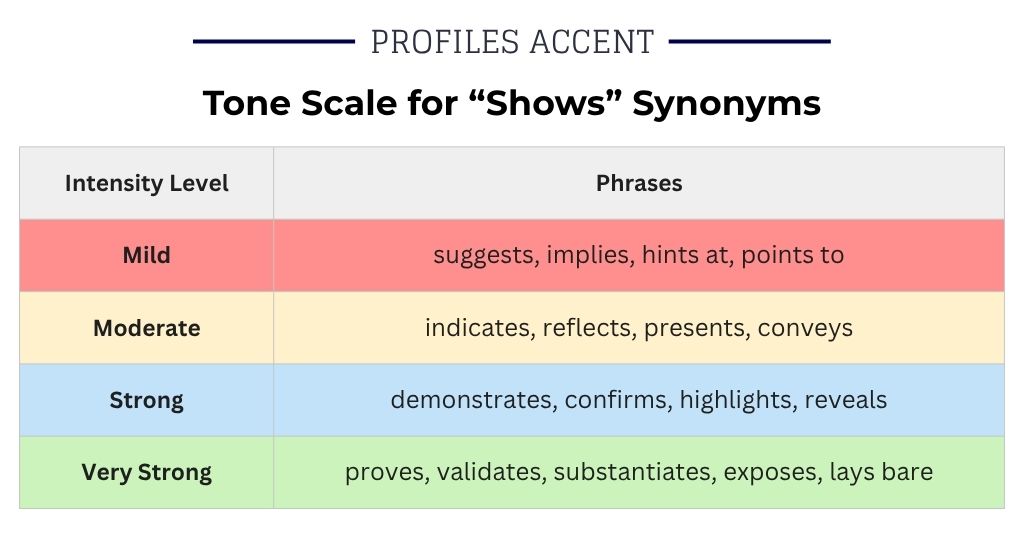
Not all synonyms carry equal force. Here is how they stack up from mild to strong.
- Mild: suggests, implies, hints at, points to
- Moderate: indicates, reflects, presents, conveys
- Strong: demonstrates, confirms, highlights, reveals
- Very Strong: proves, validates, substantiates, exposes, lays bare
The further right you go, the more confident the claim feels. Using a strong word when your evidence is thin makes the writing seem overblown. Using a mild word when your evidence is solid makes you sound unsure when you are not.
See the Difference: Sentence Rewrites Using Shows Synonyms
Original: “This shows that the policy failed.”
- Formal: “This confirms that the policy produced no measurable improvement.”
- Academic: “This substantiates the claim that the policy was ineffective.”
- Casual: “This lays out pretty clearly why the policy did not work.”
- Creative: “This lays bare the policy’s fundamental failure.”
Original: “The graph shows a sharp increase in 2022.”
- Formal: “The graph highlights a sharp increase in 2022.”
- Academic: “The graph illustrates a significant upward trend beginning in 2022.”
- Casual: “The graph puts the 2022 spike right in front of you.”
- Creative: “The graph reveals an unexpected surge in 2022.”
Original: “Her behavior shows that she is afraid.”
- Formal: “Her behavior suggests underlying fear.”
- Academic: “Her behavior indicates heightened anxiety.”
- Casual: “Her behavior gives away how scared she is.”
- Creative: “Her behavior lays bare a fear she cannot name.”
Notice how each word shifts the confidence level, the emotional tone, and the relationship between the writer and the reader.
Formal vs. Informal: Which Synonym for Shows Fits Where
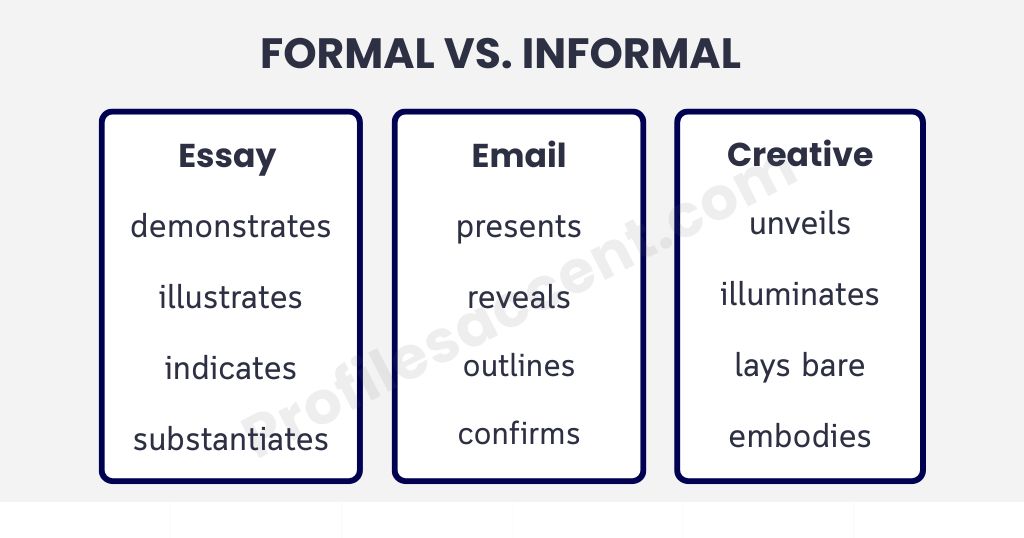
If you are writing an essay or research paper, reach for: demonstrates, illustrates, indicates, substantiates, validates, confirms, highlights, reflects, conveys.
If you are writing a business email or report: presents, reveals, outlines, confirms, highlights, points to.
If you are writing fiction or creative nonfiction: unveils, illuminates, lays bare, embodies, encapsulates, uncovers.
If you are writing dialogue or informal content: lays out, puts forward, flaunts, shows off, sports.
Words to avoid in formal writing: flaunts, parades, sports, trots out. These are not wrong words. They are wrong for the context.
Mistakes Writers Make When Replacing “Shows”
Using “demonstrates” for everything academic. It is the safe choice, so writers lean on it as a replacement for “shows” and then overuse it the same way. Watch for this.
Mistaking “depicts” for “proves.” “The chart depicts the rise in temperature” is fine. “The chart depicts that climate change is accelerating” is not. “Depicts” describes representation, not evidence.
Reaching for “manifests” when “appears” would do. “Manifests” is a real word with a clear meaning, but writers often use it to sound sophisticated when the sentence would be sharper without it.
Using “exposes” when you mean “reveals.” “Exposes” has judgment baked into it. If the thing being revealed is neutral or positive, “exposes” sounds hostile and out of place.
Treating “evinces” as interchangeable with “shows.” It is technically a synonym but it is so rare in modern writing that it pulls attention away from your argument and onto the word itself.
Related Words That Go Beyond a Simple Shows Synonym
Articulates – goes beyond showing; it means expressing something with precision and clarity. “The report articulates the risks clearly” is stronger than “the report shows the risks.”
Underscores – draws emphasis, usually to something the reader might otherwise overlook. “This underscores the importance of early intervention” signals that the point matters more than it might seem.
Captures – useful when describing how a piece of writing or art catches something true. “The photograph captures the exhaustion of the workers” has a quality that “shows” does not.
Traces – follows the development of something over time. “The study traces the decline in engagement across three years” is specific and active in a way “shows” is not.
When “Shows” Is Still the Right Word
Sometimes “shows” is genuinely the best word. It is clear, direct, and widely understood. If you are in doubt between “shows” and something fancier, ask yourself: does the fancier word make the sentence clearer, or just more decorated?
If the answer is “more decorated,” keep “shows.”
The goal of word choice is not to impress. It is to say exactly what you mean with exactly the right weight. Now you have the vocabulary to do that.
Discover More Articles:

I’m Rowan, a language addict who loves exploring how words work in everyday communication. I’ve spent years studying English vocabulary and helping others express themselves more clearly. My goal is simple: make learning new words easy and practical. I focus on real-life examples that show when and how to use different terms. Through clear explanations and honest guidance, I help readers choose the right words for any situation with confidence.