You’ve probably typed the word “new” three times in one paragraph and thought, something feels off here. You’re right. The word works fine, but it pulls no weight. It adds no color. It tells the reader almost nothing beyond the bare fact.
Here’s the thing: “new” is doing overtime in most writing. A new product, a new chapter, a new skill, a new beginning. Every one of those phrases could carry more meaning with a single word swap. Not a fancy word. Just the right word.
This guide helps you find it.
Why “New” Alone Isn’t Enough
At its core, “new” means something that didn’t exist before, or wasn’t known or used before. But that’s where things get interesting. “New” can describe a condition (unused), a timeline (recent), an experience (unfamiliar), or an idea (original). Each version needs its own vocabulary.
That’s why swapping in a random synonym often feels wrong. The word has to match the type of newness you’re describing.
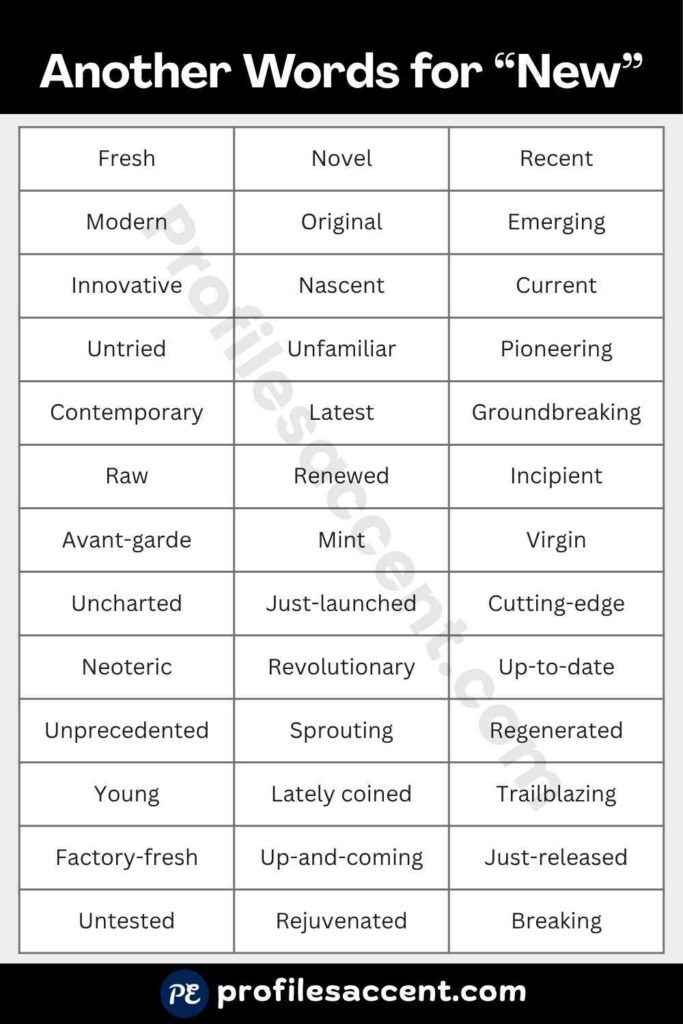
40+ Synonyms for New: Quick-Access Table
| Word | Tone | Best Used When | Example |
| Fresh | Positive | Things feel clean or energized | Fresh perspective on an old problem |
| Novel | Neutral | The idea is unusual or unique | A novel approach to team building |
| Recent | Neutral | Time-based, happened lately | Recent changes in the policy |
| Modern | Neutral | Related to current times | Modern design trends |
| Original | Positive | First of its kind | An original concept in storytelling |
| Emerging | Formal | Just starting to grow | Emerging markets in Southeast Asia |
| Innovative | Positive | Introduces new methods | An innovative teaching method |
| Nascent | Formal | Early-stage development | A nascent movement in climate tech |
| Current | Neutral | Happening right now | Current research on sleep disorders |
| Untried | Cautious | Not tested yet | An untried strategy for sales growth |
| Unfamiliar | Honest | New to someone personally | Navigating an unfamiliar system |
| Pioneering | Strong | First to do something bold | Pioneering work in gene therapy |
| Contemporary | Formal | Of the present era | Contemporary art installations |
| Latest | Casual | Most recent version or edition | The latest update fixed the bug |
| Groundbreaking | Strong | Shatters existing norms | Groundbreaking research in physics |
| Raw | Honest | Unrefined, just beginning | Raw talent waiting to be shaped |
| Renewed | Positive | Brought back with energy | A renewed interest in cooking |
| Incipient | Academic | At the very beginning | Incipient signs of economic recovery |
| Avant-garde | Creative | Ahead of mainstream thinking | An avant-garde approach to fashion |
| Mint | Casual/Slang | Perfect unused condition | Sold in mint condition |
| Virgin | Neutral | Never touched or used | Virgin territory for the brand |
| Uncharted | Bold | Unknown, unexplored | Uncharted waters for the industry |
| Just-launched | Informal | Newly released | A just-launched app for budgeting |
| Cutting-edge | Professional | Top of current innovation | Cutting-edge tools for data analysis |
| Neoteric | Rare/Academic | Modern, newly introduced | A neoteric framework for design |
| Revolutionary | Strong | Changes everything | A revolutionary shift in education |
| Up-to-date | Practical | Reflects latest information | An up-to-date reference guide |
| Unprecedented | Formal | Never happened before | Unprecedented growth in user numbers |
| Sprouting | Creative | Growing from nothing | Sprouting ideas across the team |
| Regenerated | Positive | Brought back to life | A regenerated neighborhood near downtown |
| Young | Soft | Early in life or growth | A young company with big ambitions |
| Lately coined | Academic | Recently created or named | A lately coined term in digital ethics |
| Trailblazing | Bold | Opens new paths | Trailblazing work in renewable energy |
| Factory-fresh | Casual | Brand new, straight from source | A factory-fresh laptop out of the box |
| Up-and-coming | Warm | Rising but not yet established | An up-and-coming designer in Milan |
| Just-released | Informal | Very recently made available | The just-released version runs faster |
| Untested | Cautious | Not proven yet | An untested theory about behavior |
| Rejuvenated | Warm | Renewed with new energy | A rejuvenated team after the retreat |
| Breaking | Urgent | Happening right now | Breaking developments in the case |
Not All “New” Means the Same Thing
This is where most synonym lists fail writers. They give you a pile of words with no map. Here’s the map.
When “new” means unused or untouched:
Words like mint, factory-fresh, pristine, virgin belong here. These are about physical condition. You’d use them for products, objects, or spaces that haven’t been touched. Saying a car is “mint” signals condition, not just age.
When “new” means recent in time:
Current, latest, up-to-date, contemporary, recent live in this group. These are time-stamped. Great for news articles, product updates, or professional writing that needs to signal relevance without drama.
When “new” means personally unfamiliar:
This is the “new to me” zone. Unfamiliar, unaccustomed, strange, unexplored are your tools. The thing itself might be old to the world, but it’s new to the person experiencing it. A word like novel can work here too, but unfamiliar feels more personal and honest.
When “new” means groundbreaking or never done before:
Pioneering, unprecedented, revolutionary, trailblazing carry serious weight. These aren’t casual words. Use them when something actually earns that level of description.
When “new” means the start of something:
Renewed, regenerated, rejuvenated, incipient work here. They carry a sense of motion and possibility. They’re especially useful when writing about personal change, a business pivot, or a cultural shift.
How Strong Is Your Word? A Tone Scale for Synonyms of New
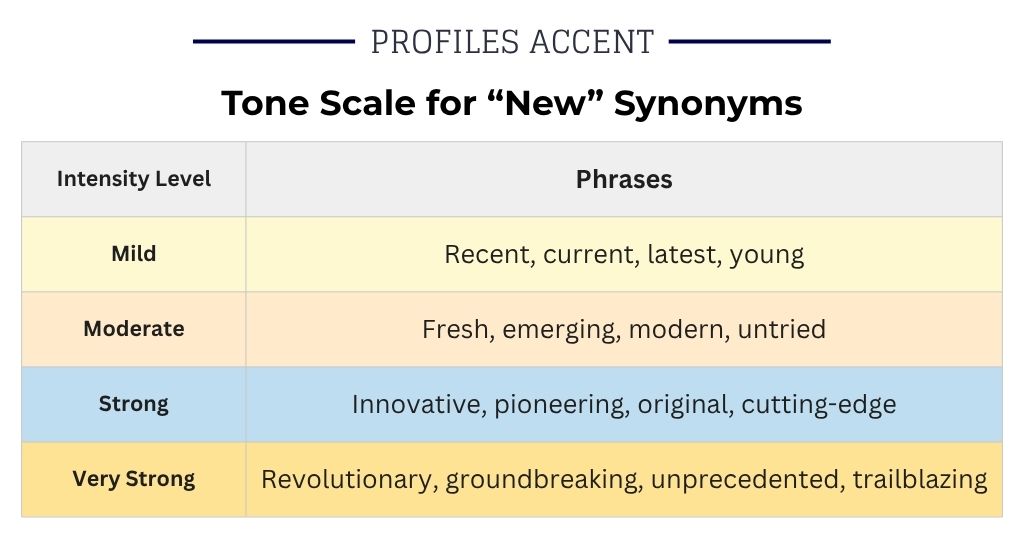
Not every “new” moment deserves the same energy. Here’s a rough scale:
- Mild: recent, current, latest, young
- Moderate: fresh, emerging, modern, untried
- Strong: innovative, pioneering, original, cutting-edge
- Very Strong: revolutionary, groundbreaking, unprecedented, trailblazing
If you’re writing a product description for a notebook, “latest” is enough. If you’re writing about a medical discovery that changes how we treat cancer, “unprecedented” earns its place. The mistake is using the strong words for ordinary things. It trains readers to stop believing you.
Watch the Difference: Rewrites Using Another Word for New
Original (weak): We launched a new program for students.
- Formal: We introduced an initiative designed specifically for students.
- Casual: We just rolled out a fresh program for students.
- Academic: An incipient educational program has been established for student development.
- Creative: A program unlike anything before it is now open for students.
Each version sends a different signal. The formal version implies planning and structure. The casual version feels energetic and friendly. The academic version suggests early-stage study. The creative version builds curiosity.
Original (weak): She learned a new skill.
- Professional: She developed an emerging competency in data analysis.
- Conversational: She picked up a skill she’d never tried before.
- Resume-ready: She acquired hands-on experience in project coordination.
- Storytelling: Something clicked. She was learning to code.
Another Word for New in an Essay vs. Everyday Writing
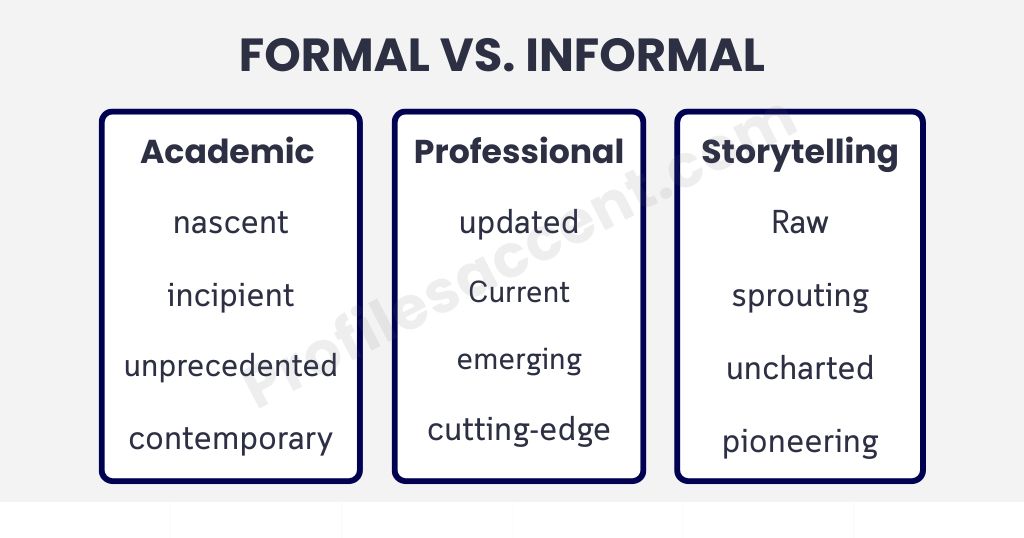
- For essays and academic writing:
Use nascent, incipient, unprecedented, contemporary, novel. These words carry weight without being dramatic. Avoid “brand new” or “mint” in formal writing. They’ll break the tone instantly.
- For professional emails:
Current, updated, emerging, cutting-edge, recently developed all land well. They’re direct, clear, and polished. Skip anything slang-adjacent.
- For storytelling and creative writing:
Raw, sprouting, uncharted, pioneering, rejuvenated give your prose texture. They feel alive on the page. You can even experiment with something like “just-born idea” if the voice supports it.
- Slang options for casual content:
Mint, fresh out the box, just dropped, red-hot. These belong in social media captions, casual blog posts, or youth-facing content. Outside those spaces, they’ll feel out of place.
A Few Synonyms for New That Deserve a Warning Label
A few synonyms carry extra baggage worth knowing about.
Virgin is widely used in neutral business contexts (“virgin territory”), but in some settings it can feel awkward depending on audience. Read the room.
Revolutionary gets overused in marketing until it means almost nothing. If your product is new but not category-defining, find a softer word. Calling an average update “revolutionary” reads as exaggeration, not enthusiasm.
Unprecedented showed up constantly during global crises and lost some of its punch. Use it when something truly has no comparison, not just when something surprised you.
Mistakes Writers Make When Replacing the Word New
- Using “novel” when you mean “recent”:
Novel doesn’t mean recent. It means unusually different or distinctive. A novel solution is one that nobody thought of before, not just one that arrived last week.
- Stacking intensity words:
“A groundbreaking, revolutionary, unprecedented approach” is too much. Pick one. Let it breathe.
- Using “modern” as a compliment:
Modern simply means of the current time. It doesn’t automatically mean good or better. A modern building might be efficient or ugly. Don’t use it as a praise word unless you back it up.
- Forgetting the “new to me” distinction:
If something is old to the world but new to the person, reach for unfamiliar or unaccustomed rather than novel or innovative. Word choice reflects whose experience you’re describing.
Words That Live Near “New” But Mean Something Different
Refresh (verb): To make something feel renewed without replacing it entirely. Useful in design and communication.
Evolving (adjective): Still changing. Not fully new, not fully old. Great for describing industries or relationships in transition.
Resurgent (adjective): Something that was fading but came back with energy. Different from “new” because it has history behind it.
Untapped (adjective): Exists but hasn’t been used yet. A cousin of “new” for describing potential.
Emergent (adjective): Rising into visibility. Used in science, tech, and business for things that are forming in real time.
Which Synonym for New Actually Fits Your Sentence?
Here’s a practical shortcut. Before you swap out “new,” ask one question: What kind of new is this?
- If it’s about time, go with recent, current, latest.
- If it’s about originality, try novel, pioneering, unprecedented.
- If it’s about condition, reach for mint, pristine, factory-fresh.
- If it’s about personal experience, use unfamiliar, uncharted, untried.
The right synonym won’t just replace the word. It’ll add a layer of meaning the original never had.
Discover More Articles:

I’m Rowan, a language addict who loves exploring how words work in everyday communication. I’ve spent years studying English vocabulary and helping others express themselves more clearly. My goal is simple: make learning new words easy and practical. I focus on real-life examples that show when and how to use different terms. Through clear explanations and honest guidance, I help readers choose the right words for any situation with confidence.