You’re writing an essay. You’ve used “according to” three times in two paragraphs. It’s starting to feel lazy. You know there’s a better word out there, but every list you find treats all the options like they’re the same thing. They’re not.
Swapping “according to” isn’t just about variety. The word you choose signals your relationship to the source. It tells the reader whether you trust the information, whether you’re following a rule, or whether you’re simply passing along what someone said. That’s a lot of weight for a small phrase.
This guide breaks it all down clearly, so you can pick the right word every single time.
What Does “According to” Actually Mean?
Most people think it has one job. It actually has three.
- Attribution: “According to the report, sales dropped by 12%.” Here, it credits a source.
- Compliance: “According to the terms of the contract, payment is due Friday.” Here, it means in line with a rule or agreement.
- Dependency: “Salary is paid according to performance.” Here, it means based on a condition.
This three-way split is the reason you can’t just grab any synonym and plug it in. A word that works perfectly for attribution can break the sentence completely in a compliance context.
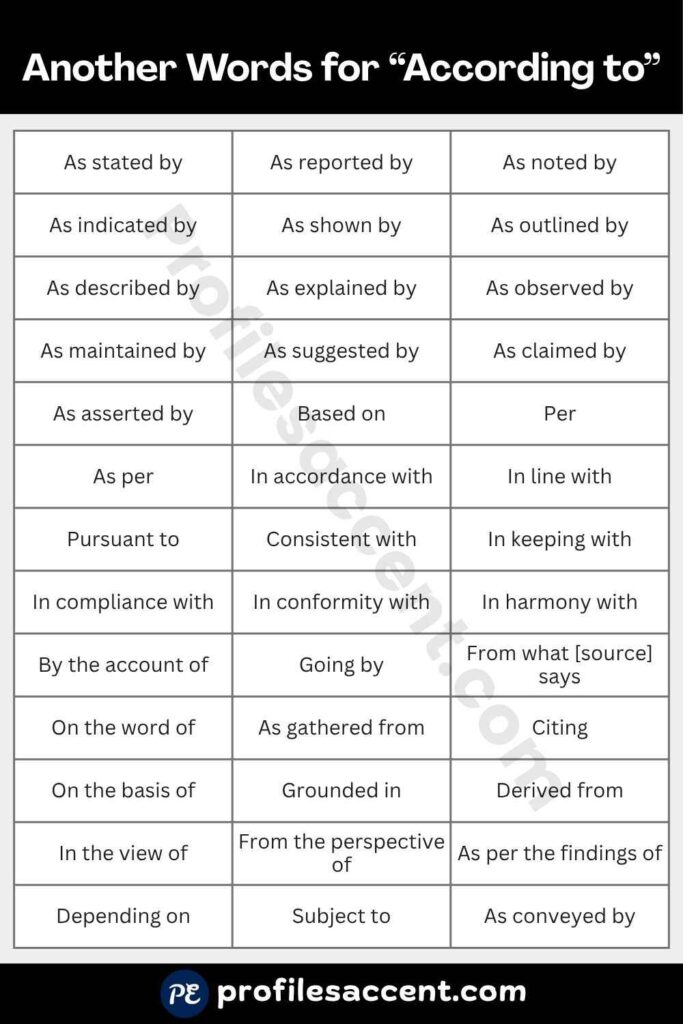
Another Word for “According to”: 45+ Quick Synonym Table
| Word / Phrase | Tone | Best Used When | Short Example |
| As stated by | Neutral/Formal | Citing a person or text directly | As stated by the author, trust takes time. |
| As reported by | Journalistic | Referencing news or research | As reported by the survey team, costs rose. |
| As noted by | Academic | Adding a supporting reference | As noted by researchers, sleep affects mood. |
| As indicated by | Analytical | Pointing to trends or signals | As indicated by the data, growth is slowing. |
| As shown by | Evidence-based | Linking a claim to visible proof | As shown by the results, the method works. |
| As outlined by | Formal/Professional | Following a stated plan or guide | As outlined by the board, changes begin Monday. |
| As described by | Neutral | Referencing a description or account | As described by witnesses, it happened fast. |
| As explained by | Educational | When a source provides reasoning | As explained by the teacher, fractions follow patterns. |
| As observed by | Scientific/Formal | When a source records direct observation | As observed by the team, patterns shifted weekly. |
| As maintained by | Academic | When a source holds a firm position | As maintained by the author, the theory stands. |
| As suggested by | Cautious/Neutral | When evidence points toward, not proves | As suggested by early data, recovery is likely. |
| As claimed by | Skeptical | When the claim may be disputed | As claimed by the spokesperson, no rules were broken. |
| As asserted by | Confident/Formal | When a source makes a strong declaration | As asserted by the lead researcher, the link is clear. |
| Based on | General | Drawing a conclusion from information | Based on current trends, demand will grow. |
| Per | Workplace/Administrative | Referencing a request or directive | Per the client brief, all fonts must be sans-serif. |
| As per | Commercial/Formal | Following operational instructions | As per the manual, restart the device first. |
| In accordance with | Legal/High Formal | Strict compliance with rules or law | Funds were released in accordance with the agreement. |
| In line with | Strategy/Corporate | General alignment with a plan or policy | Changes were made in line with the new guidelines. |
| Pursuant to | Legal/Official | Acting on a formal directive | Pursuant to the court order, assets were frozen. |
| Consistent with | Scientific | Data matching previous models or patterns | Results are consistent with earlier findings. |
| In keeping with | Formal/Traditional | Staying true to a standard or expectation | In keeping with tradition, the event began at noon. |
| In compliance with | Legal/Regulatory | Following required rules or standards | The audit was done in compliance with tax law. |
| In conformity with | High Formal/Legal | Adhering to a set structure or rule | All documents were filed in conformity with regulations. |
| In harmony with | Soft Formal | Fitting naturally within a larger context | The design is in harmony with surrounding architecture. |
| By the account of | Narrative/Storytelling | Sharing someone’s personal experience | By the account of early settlers, winters were brutal. |
| Going by | Informal/Casual | Making everyday deductions | Going by the forecast, we should leave early. |
| From what [source] says | Conversational | Passing along someone’s informal word | From what the team says, launch is on track. |
| On the word of | Narrative/Formal | Placing trust in a specific person’s testimony | On the word of the inspector, the building was safe. |
| As gathered from | Research/Analytical | Drawing conclusions from collected sources | As gathered from multiple studies, results vary widely. |
| Citing | Academic/Journalistic | Directly referencing a source | Citing recent polls, the analyst predicted a shift. |
| On the basis of | Analytical/Formal | Using evidence as a foundation for reasoning | On the basis of the audit, three departments were reviewed. |
| Grounded in | Research/Formal | When something is deeply rooted in evidence | Her argument is grounded in decades of field research. |
| Derived from | Technical/Academic | When conclusions come out of data or text | The model was derived from population census data. |
| In the view of | Opinion-based | Presenting someone’s perspective | In the view of the committee, the proposal needs revision. |
| From the perspective of | Analytical/Opinion | Looking at something through someone’s lens | From the perspective of the patient, recovery felt slow. |
| As per the findings of | Research/Formal | Citing study outcomes specifically | As per the findings of the trial, the drug reduced symptoms. |
| Depending on | Conditional | When outcome varies by circumstance | Pay is adjusted depending on hours worked. |
| Subject to | Legal/Conditional | When something changes based on conditions | Approval is subject to committee review. |
| As conveyed by | Formal/Neutral | Passing along someone’s communicated message | As conveyed by the director, the timeline has shifted. |
Two Synonym Groups You Should Never Mix Up
Synonyms for “According to” When You Are Crediting a Source
This is the attribution sense. You are saying: this information comes from somewhere specific. Here, words like “as reported by,” “as noted by,” and “as stated by” work well. They credit without commentary.
But tone shifts depending on your trust level. “As demonstrated by” says you believe the source fully. “As suggested by” says the evidence points a direction but isn’t final. “As claimed by” introduces quiet doubt. You didn’t say the claim is wrong, but you didn’t say it’s right either.
This difference matters a lot in academic and journalistic writing. Choosing “as demonstrated by” for an unverified claim can look sloppy. Choosing “as claimed by” for a proven fact can seem unfair to the source.
“According to” Alternatives When You Are Following a Rule
Here, attribution words break down.
- “As stated by the contract” sounds odd.
- “In accordance with the contract” is exactly right.
For rules, laws, policies, and agreements, the compliance group is your zone: in accordance with, pursuant to, consistent with, in compliance with.
These aren’t interchangeable with the attribution group. Use them only when the meaning involves following or matching a structure that already exists.
Drop “According to” Completely With This One Sentence Trick
One of the most overlooked writing moves is dropping “according to” entirely by turning the source into the subject of the sentence. This makes writing cleaner and more confident.
Instead of: “According to Martinez (2023), sleep deprivation affects decision-making.”
Try: “Martinez (2023) argues that sleep deprivation affects decision-making.”
Here’s how to match the verb to the source’s intent:
- When the source presents hard proof: use demonstrates, shows, confirms, validates
- When the source makes a strong argument: use argues, contends, asserts, insists
- When the source observes or records: use notes, records, observes, reports
- When the source offers a theory: use proposes, suggests, theorizes, posits
This approach works especially well in essays and research papers. It signals that you understand the source’s purpose, not just its content.
How Strong Is Your Word? A Tone Scale for “According to” Synonyms
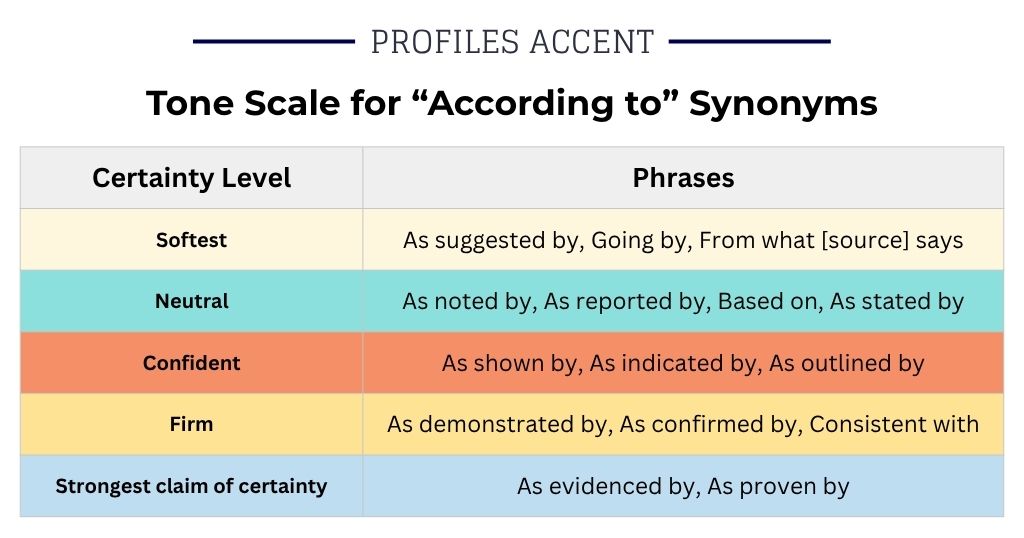
Not all synonyms carry the same weight. Here’s a rough scale from gentle to forceful, specifically for the attribution sense:
- Softest: As suggested by / Going by / From what [source] says
- Neutral: As noted by / As reported by / Based on / As stated by
- Confident: As shown by / As indicated by / As outlined by
- Firm: As demonstrated by / As confirmed by / Consistent with
- Strongest claim of certainty: As evidenced by / As proven by
Moving up this scale changes your stance. In formal academic writing, stronger words carry more responsibility. Only use “as evidenced by” if the evidence is genuinely solid.
See the Difference: Real Sentence Rewrites Using “According to” Alternatives
Original: According to the manager, the deadline has been moved.
- Formal: “As communicated by the manager, the deadline has been revised.”
- Casual: “Going by what the manager said, the deadline changed.”
- Academic: “The manager has indicated that the submission deadline will be extended.”
- Narrative: “By the manager’s account, the team now has more time.”
Original: According to the rules, no phones are allowed.
- Legal: “In accordance with facility regulations, mobile devices are prohibited.”
- Professional: “Per the policy, phones must be stored during sessions.”
- Casual: “Going by the rules, you can’t have your phone in there.”
Notice how the compliance synonyms don’t fit the attribution rewrite, and vice versa. That’s the split working in real sentences.
Other Ways to Say “According to” When You Mean “Depending On”
This version of “according to” gets ignored in most synonym lists. But it appears often:
“Pay varies according to experience.” Here, you’re describing a condition, not citing a source.
Alternatives that actually work here: depending on, based on, subject to, proportional to, in relation to, relative to.
- “Pay varies depending on experience” is clean and natural.
- “Pay varies as reported by experience” makes no sense at all.
This is exactly why context matters before you swap any word.
Mistakes Writers Make When Replacing “According to”
“According by” is not a phrase. It’s a frequent error, especially among non-native English speakers. It’s always “according to,” never “according by.”
Mixing compliance and attribution words. “As stated by the regulations” sounds off. Regulations don’t “state” to you the way a person does. They set rules. Use “in accordance with” or “under the regulations.”
Using “as claimed by” for accepted facts. If something is widely proven, “as claimed by” implies you’re doubting it. Save this phrase for contested or unverified statements.
Overusing “based on.” It’s general and flexible, which makes it tempting to use everywhere. But “based on the scientist” reads awkwardly. It works better with data, evidence, or conditions, not people.
Using formal compliance phrases in casual writing. “Pursuant to what my friend said” is technically correct and completely bizarre in conversation. Match your synonym to your register.
The Best “According to” Synonym for Each Writing Context
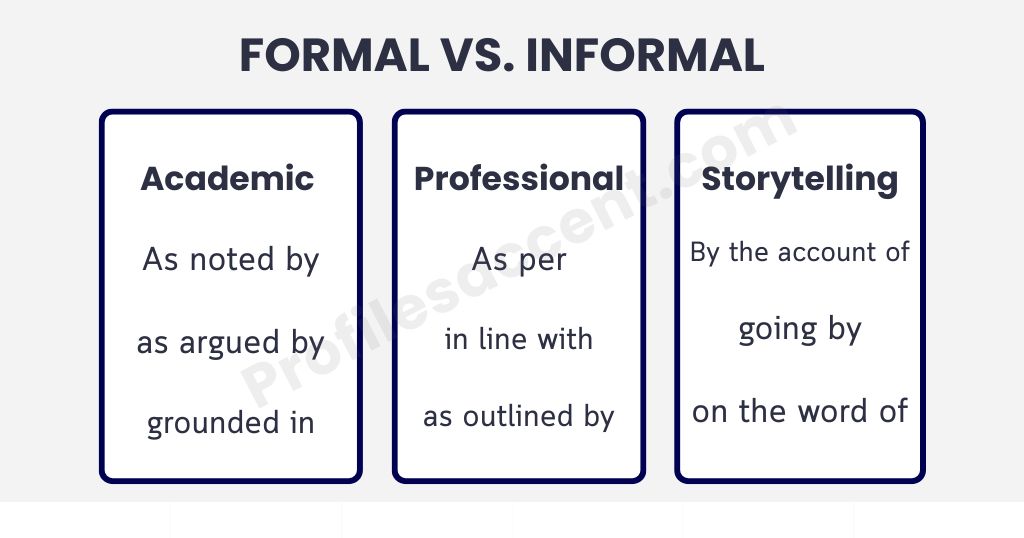
- In essays: “As noted by,” “as argued by,” “as demonstrated by,” and “grounded in” give your writing a polished, academic feel without sounding stiff.
- In professional emails: “As per,” “in line with,” and “as outlined by” fit naturally. Avoid “pursuant to” unless the message has a legal or official tone.
- In storytelling or narrative writing: “By the account of,” “going by,” and “on the word of” add a human, personal texture that academic phrases would kill.
- For informal or spoken style: “From what [person] says,” “going by,” and simply restructuring the sentence without attribution phrasing usually flows best.
Words Close to “According to” That Writers Often Mix Up
Per vs. As per: Both work in professional writing. “Per the brief” is shorter. “As per the brief” feels slightly more formal. Neither is wrong, but “as per” can sound redundant to some editors.
Pursuant to vs. In accordance with: “Pursuant to” often signals action following an order. “In accordance with” signals alignment with an existing standard. Both are legal in tone, but the first implies response to something specific.
Based on vs. Grounded in: “Based on” works for immediate conclusions from data. “Grounded in” suggests something more foundational, built over time and experience.
Choosing the Right “According to” Synonym Without Overthinking It
Before picking a synonym, ask yourself two quick questions.
First: Am I citing a source, or am I describing rule-following? If you are citing, go to the attribution group. If you are describing compliance, go to the formal/legal group.
Second: What is my trust level toward the source? Certain sources earn “as demonstrated by.” Questionable sources get “as claimed by.” Neutral sources get “as noted by” or “as reported by.”
Answer those two questions, and the right word becomes obvious almost every time.
Discover More Articles:

I’m Rowan, a language addict who loves exploring how words work in everyday communication. I’ve spent years studying English vocabulary and helping others express themselves more clearly. My goal is simple: make learning new words easy and practical. I focus on real-life examples that show when and how to use different terms. Through clear explanations and honest guidance, I help readers choose the right words for any situation with confidence.