You’ve written the word like three times in one paragraph. You notice it. You want to change at least two of them. But what do you replace it with?
That’s the real problem. It’s not that writers don’t know like has synonyms. It’s that they’re not sure which synonym fits without changing the meaning or making the sentence sound stiff.
This guide fixes that. Not just a list, but actual guidance on when to use each word, why it works, and when it might backfire.
What “Like” Is Really Doing in Your Sentence
“Like” is a shape-shifter. It can mean you enjoy something. It can show similarity. It can introduce an example. It can even show affection toward a person.
That’s why one synonym rarely covers all uses. You need to match the replacement to the function of the word in that specific sentence.
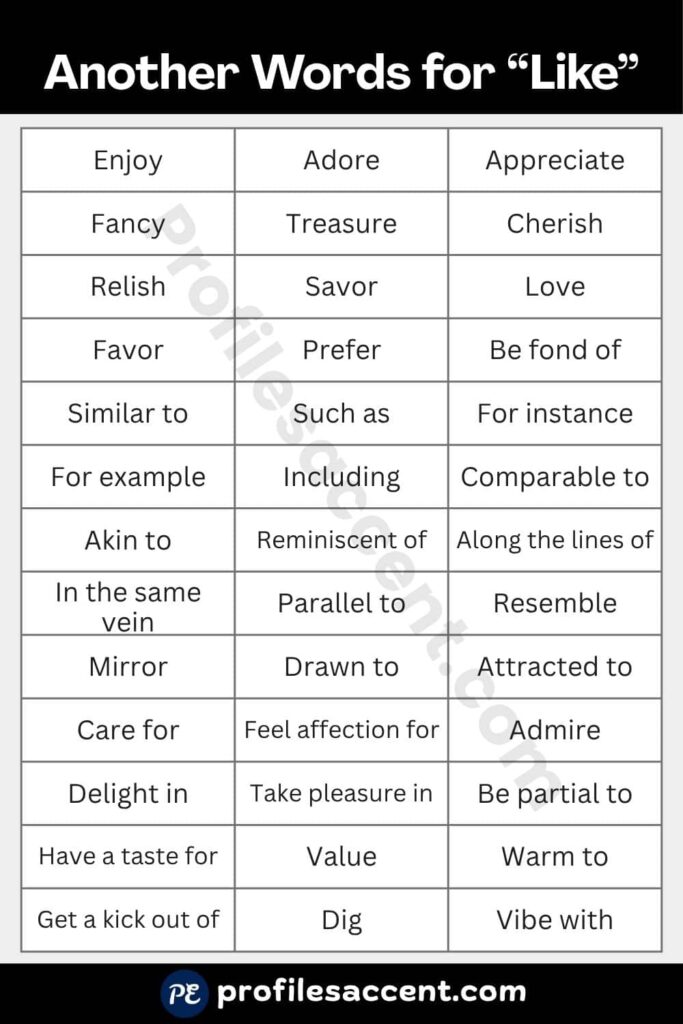
35+ Quick “Like” Synonym Table
| Word | Tone | Use It When | Example |
| Enjoy | Neutral | Talking about preferences | “I enjoy reading at night.” |
| Adore | Warm | Expressing deep fondness | “She adores old films.” |
| Appreciate | Formal | Showing measured value | “He appreciates quiet mornings.” |
| Fancy | Casual/British | Light preference or attraction | “Do you fancy a walk?” |
| Treasure | Emotional | Something deeply valued | “I treasure those conversations.” |
| Cherish | Warm | People or memories | “She cherishes her friendships.” |
| Relish | Enthusiastic | Genuine excitement | “He relishes a good challenge.” |
| Savor | Sensory | Slow, deep enjoyment | “She savors every bite.” |
| Love | Strong | Deep positive feeling | “I love this neighborhood.” |
| Favor | Neutral/Formal | Preference between options | “She favors the second draft.” |
| Prefer | Formal | Choosing one over another | “I prefer morning meetings.” |
| Be fond of | Soft | Gentle, lasting affection | “He is fond of old jazz.” |
| Similar to | Neutral | Showing resemblance | “This works similar to that one.” |
| Such as | Formal | Giving examples | “Activities such as hiking…” |
| For instance | Formal | Example introduction | “For instance, consider this case.” |
| For example | Neutral | Clarifying with examples | “For example, dogs need walks.” |
| Including | Neutral | Listing items | “Things including books and maps…” |
| Comparable to | Formal | Academic comparison | “Results comparable to last year.” |
| Akin to | Formal/Literary | Abstract resemblance | “A feeling akin to relief.” |
| Reminiscent of | Reflective | Evoking memory or similarity | “A style reminiscent of the 70s.” |
| Along the lines of | Casual | Loose comparison | “Something along the lines of jazz.” |
| In the same vein | Formal | Stylistic similarity | “Works in the same vein as…” |
| Parallel to | Academic | Structural comparison | “Findings parallel to prior studies.” |
| Resemble | Neutral | Physical or abstract likeness | “This approach resembles his earlier work.” |
| Mirror | Vivid | Very close match | “Her words mirror his exactly.” |
| Drawn to | Emotional | Attraction to a person or idea | “He is drawn to creative work.” |
| Attracted to | Direct | Interest or affection | “She is attracted to kindness.” |
| Care for | Gentle | Affection for a person | “Do you care for him?” |
| Feel affection for | Soft/Formal | Measured emotional language | “She feels affection for her mentor.” |
| Admire | Respectful | Positive regard | “I admire her discipline.” |
| Delight in | Expressive | Active, joyful enjoyment | “He delights in solving puzzles.” |
| Take pleasure in | Formal | Deliberate enjoyment | “She takes pleasure in her craft.” |
| Be partial to | Light | Mild preference | “I’m partial to window seats.” |
| Have a taste for | Casual | Personal preference | “He has a taste for bold colors.” |
| Value | Measured | Holding something in regard | “She values honesty in friendships.” |
| Warm to | Gradual | Slowly beginning to like | “I’m warming to the idea.” |
| Get a kick out of | Slang | Fun, informal enjoyment | “She gets a kick out of trivia nights.” |
| Dig | Slang | Enthusiastic liking | “I really dig this track.” |
| Vibe with | Slang | Feeling in sync | “I vibe with his energy.” |
| Be into | Informal | Current interest or attraction | “He’s really into cooking lately.” |
| Feel for | Empathetic | Sympathy or emotional pull | “I feel for anyone going through that.” |
The Four Ways Writers Use Like (And Which Words Replace Each One)
1. When “Like” Means Enjoyment or Preference
This is the most common use. “I like coffee.” “She likes quiet evenings.”
Here, words like enjoy, relish, savor, and appreciate do the work cleanly. The difference between them comes down to intensity and depth.
- Enjoy is calm and neutral.
- Relish carries excitement.
- Savor suggests slowness and full attention.
- Appreciate adds a layer of awareness, as if the person truly understands the value of what they’re experiencing.
2. When “Like” Means Similarity Between Two Things
“This software works like the old one.” “The texture is like velvet.”
Replace with: similar to, comparable to, akin to, reminiscent of, parallel to, or along the lines of.
- Akin to suits more abstract comparisons.
- Reminiscent of pulls in memory and emotion.
- Comparable to is your safest pick for academic or formal writing.
3. When “Like” Introduces an Example
“Fruits like mangoes and papayas are tropical.” “Skills like patience matter most.”
- The best replacements: such as, for instance, for example, including.
One important note: such as and like are not always interchangeable. Such as specifically introduces examples that are part of a larger group. Like can sometimes suggest similarity instead. In formal or edited writing, such as is the stronger choice.
4. When “Like” Expresses Feelings Toward a Person
“I really like her.” “He seems to like everyone he meets.”
This is where writers often get stuck. You want warmth without overdoing it. Try be fond of, care for, feel drawn to, admire, or feel affection for.
- Care for is gentle and suits platonic or early-stage feelings.
- Admire adds respect. Be drawn to suggests magnetic pull without being heavy.
- Feel affection for works in formal writing when you need emotional language that doesn’t feel casual.
How Strong Is Your Word? A Tone Scale for Like Synonyms
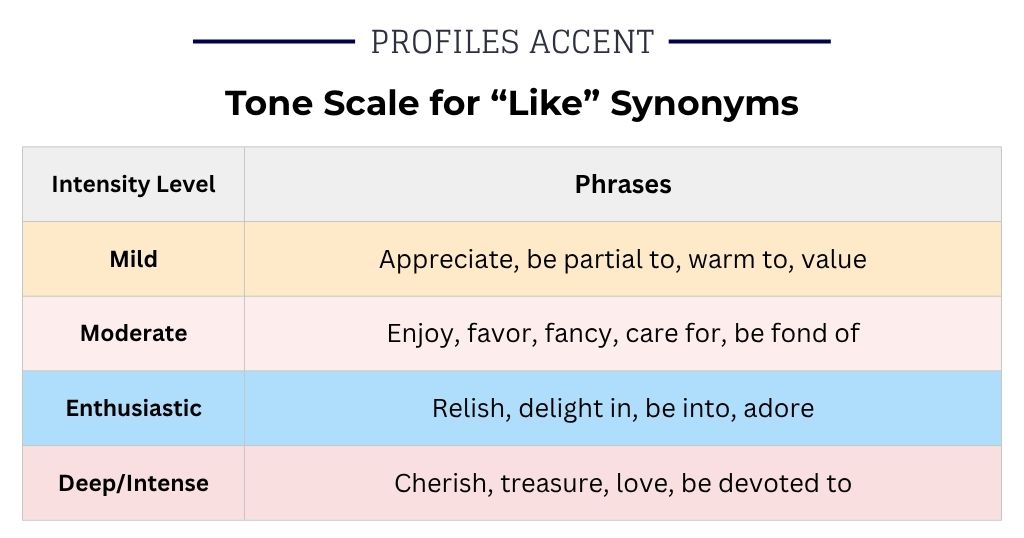
Not every synonym carries the same emotional weight. Here’s how the scale works when expressing positive feeling or preference:
- Mild: appreciate, be partial to, warm to, value
- Moderate: enjoy, favor, fancy, care for, be fond of
- Enthusiastic: relish, delight in, be into, adore
- Deep/Intense: cherish, treasure, love, be devoted to
Choosing from the wrong level can make writing feel off. Saying someone treasures a parking spot is odd. Saying they prefer their lifelong friend sounds cold. Context controls everything.
Sentence Rewrites: Before and After
Original: “She likes the way he explains things.”
- Formal: “She appreciates his clarity of explanation.”
- Casual: “She’s really into how he breaks things down.”
- Academic: “She responds favorably to his explanatory approach.”
- Creative: “Something in the way he explains things draws her in every time.”
Original: “I like working early in the morning.”
- Formal: “I prefer to work during the early morning hours.”
- Casual: “I’m a big fan of early morning work sessions.”
- Academic: “Early morning work aligns with my optimal productivity window.”
- Creative: “Morning hours, quiet and cool, are when I do my best thinking.”
Original: “This painting looks like something from the 1800s.”
- Formal: “This painting is reminiscent of 19th-century artistic style.”
- Casual: “It feels like it came straight out of the 1800s.”
- Academic: “The work bears stylistic similarities to 19th-century painting traditions.”
- Creative: “Standing before it, you’d almost believe it aged alongside the century.”
Notice how the rewrites don’t just swap a word. They reshape the sentence to carry the right tone throughout.
Words That Seem Right But Can Mislead
Fancy works in British English but can confuse American readers or sound playful when you mean something sincere.
Dig and vibe with belong in casual speech or dialogue. Drop them into a professional email and the tone falls apart fast.
Love is sometimes used casually, but in formal writing it reads as exaggerated. “I love this solution” in a business report may undermine credibility. Use value or strongly favor instead.
Similar to and like overlap, but similar to is more precise. It sets up a direct comparison. Like can feel vague in technical writing.
Feel for carries empathy, not preference. “I feel for people who struggle with this” means sympathy, not enjoyment. Using it where you mean enjoy creates real confusion.
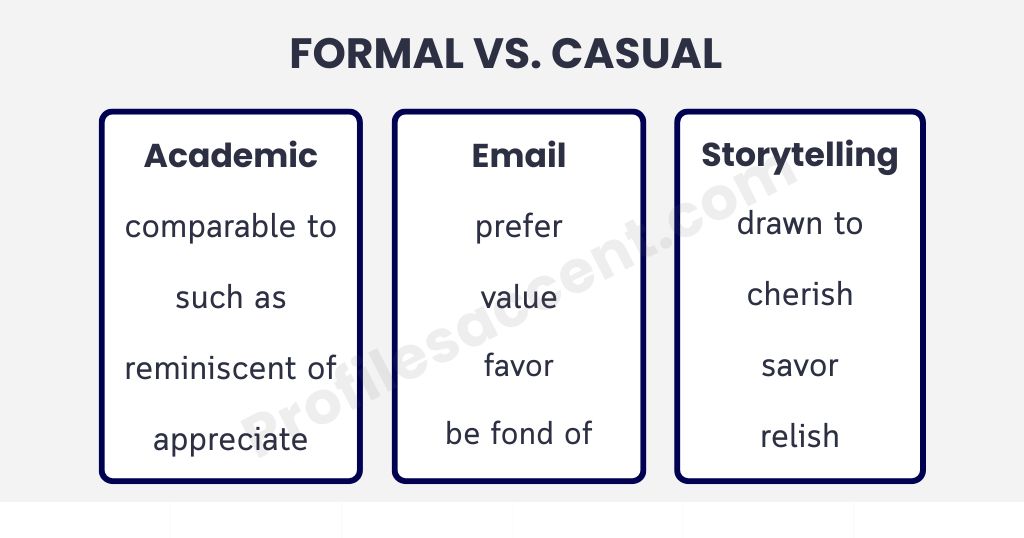
Formal vs. Casual Alternatives for Like: Know Where Each One Belongs
For essays and academic writing:
- comparable to, such as, reminiscent of, appreciate, favor, parallel to, in the same vein as
For professional emails:
- prefer, value, appreciate, favor, be fond of, take pleasure in
For storytelling and creative writing:
- drawn to, cherish, savor, relish, akin to, mirror, warm to
Avoid in formal writing:
- dig, vibe with, be into, get a kick out of, fancy (unless intentional British register)
A Few Related Words Worth Keeping Nearby
- Enjoy is close to like but implies active participation. You enjoy a concert. You like a song.
- Prefer implies comparison. You can’t prefer something in isolation; there must be an alternative involved.
- Admire adds a layer of respect. It’s not just positive feeling but something earned by the other person or thing.
- Value suggests rational appreciation rather than emotional warmth. It’s more measured.
- Fancy (as attraction) works when you want playfulness. It lightens a sentence that might otherwise feel heavy.
Choosing the Right Word for “Like” Comes Down to This
The best synonym is the one that fits the sentence’s job, not just the word it’s replacing.
Ask yourself:
Am I expressing enjoyment, showing similarity, giving an example, or describing affection?
Once you know the job, the right word becomes much easier to spot. And if a word makes the sentence sound stiff when you read it aloud, that’s your signal to try another.
Language works best when it disappears into meaning.
Discover More Articles:

I’m Rowan, a language addict who loves exploring how words work in everyday communication. I’ve spent years studying English vocabulary and helping others express themselves more clearly. My goal is simple: make learning new words easy and practical. I focus on real-life examples that show when and how to use different terms. Through clear explanations and honest guidance, I help readers choose the right words for any situation with confidence.