There’s a real difference between writing about someone and writing for them. When writers reach for the word “marginalized” over and over, the message starts to feel flat, even clinical. The people being described deserve more precise language, not a recycled term that has slowly lost its edge through overuse.
Whether you’re writing a research paper, a community report, a news article, or a personal essay, choosing the right synonym here is not just a style choice. It’s a matter of accuracy and respect.
What Does Marginalized Really Mean?
At its core, marginalized describes people or groups who have been pushed to the edges of society, denied fair access to power, resources, or recognition. It carries weight. It implies a system at work, not just personal bad luck. The emotional tone is serious and the context is almost always social or political.
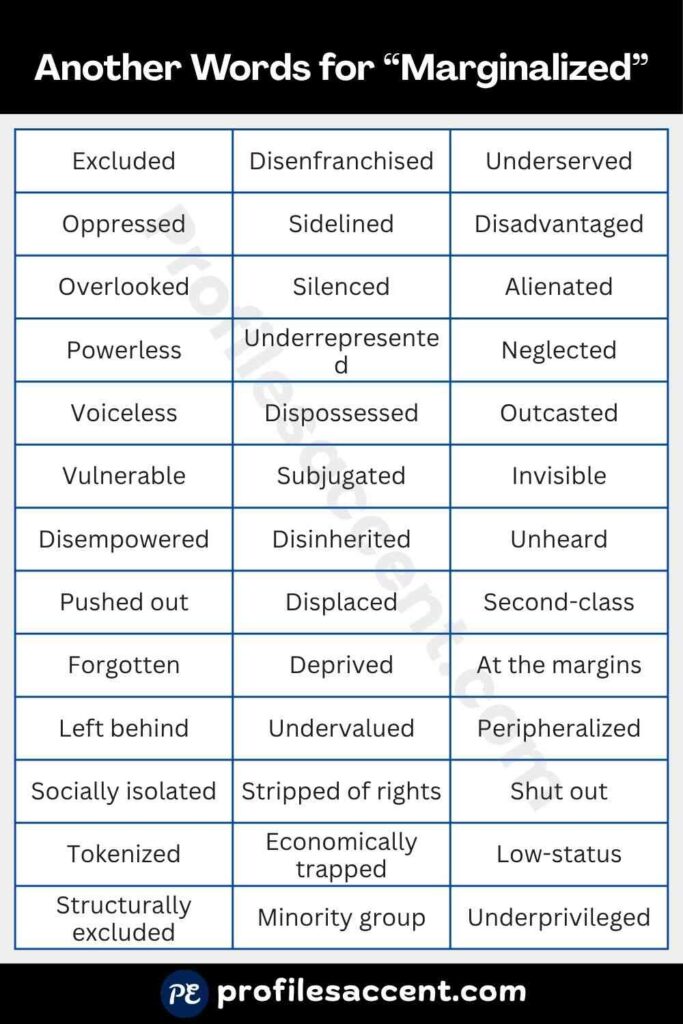
Another Word for Marginalized: Quick-Reference Table
This table is organized by tone so you can match the right word to your writing context quickly.
| Word | Tone | Best Used When | Short Example |
| Excluded | Neutral/Direct | Someone is left out of a system | Excluded students need better support |
| Disenfranchised | Formal | Rights or voting power is denied | Disenfranchised voters rally for change |
| Underserved | Policy/Social Work | Services have not reached a group | Underserved neighborhoods lack clinics |
| Oppressed | Strong/Political | Active, ongoing suppression exists | Oppressed workers organized together |
| Sidelined | Mild/Conversational | Someone is ignored or overlooked | Sidelined voices deserve a platform |
| Disadvantaged | Neutral | Unfair social or economic conditions | Disadvantaged youth face more barriers |
| Overlooked | Soft/Human | A group is simply not seen | Overlooked communities rarely make headlines |
| Silenced | Emotional | Someone’s speech or identity is suppressed | Silenced voices are slowly returning |
| Alienated | Psychological | A sense of not belonging | Alienated students drop out at higher rates |
| Powerless | Emotional/Direct | Lack of agency or control | Powerless groups often turn to organizing |
| Underrepresented | Academic/Formal | Low numbers in positions of influence | Underrepresented groups in STEM fields |
| Neglected | Soft/Emotional | Ignored by systems or caregivers | Neglected communities rebuilt themselves |
| Voiceless | Advocacy/Creative | No access to speak or be heard | The voiceless need advocates |
| Dispossessed | Historical/Strong | Stripped of land, rights, or identity | Dispossessed communities reclaim their history |
| Outcasted | Informal | Rejected from a social group | Outcasted teens form their own communities |
| Vulnerable | Social Work/Policy | At risk due to circumstances | Vulnerable populations need immediate aid |
| Subjugated | Academic/Historical | Controlled or dominated by force | Subjugated peoples resisted quietly |
| Invisible | Creative/Journalistic | Treated as if they do not exist | Invisible workers keep the city running |
| Disempowered | Formal | Stripped of influence or capacity | Disempowered groups rebuild through organizing |
| Economically excluded | Policy | Locked out of financial systems | Economically excluded households skip meals |
| Unheard | Conversational | No one is listening | Unheard communities vote in record numbers |
| Pushed out | Informal | Forced away from spaces | Pushed out residents find new networks |
| Displaced | Specific/Social | Removed from home or community | Displaced families struggle to rebuild |
| Second-class | Direct/Critical | Treated as less important | Second-class citizens fight for equal rights |
| Forgotten | Emotional | Abandoned by society or government | Forgotten towns rebuilt from within |
| Deprived | Policy/Factual | Lacking basic resources | Deprived neighborhoods show high stress levels |
| At the margins | Creative/Journalistic | Positioned at the edges of society | At the margins, people still build lives |
| Left behind | Accessible/Human | Progress skipped this group | Left behind communities lose young people |
| Undervalued | Workplace/Social | Contributions are not recognized | Undervalued workers leave for better options |
| Peripheralized | Academic | Structurally moved to the outside | Peripheralized groups rarely shape policy |
| Socially isolated | Clinical/Academic | Cut off from community | Socially isolated individuals face health risks |
| Stripped of rights | Strong/Advocacy | Rights have been removed | Stripped of rights communities rebuild slowly |
| Shut out | Informal/Direct | Kept away from opportunity | Shut out applicants form support groups |
| Tokenized | Critical/Modern | Included superficially, not genuinely | Tokenized employees speak out publicly |
| Economically trapped | Direct | Cannot move up financially | Economically trapped families rely on networks |
| Low-status | Sociological | Given low rank in a social hierarchy | Low-status groups receive fewer resources |
| Structurally excluded | Academic/Policy | Systems block entry deliberately | Structurally excluded groups organize legally |
| Minority group | Broad/General | Any numerically or politically smaller group | Minority groups gain more representation |
| Underprivileged | Common/General | Fewer privileges or advantages | Underprivileged students excel with support |
| Disinherited | Historical | Cut off from inheritance or legacy | Disinherited communities reclaim their culture |
Same Idea, Different Weight: How Synonyms for Marginalized Shift Meaning
Not all of these words say the same thing. Picking the wrong one changes what your sentence actually accuses or describes.
“Underserved” vs. “Oppressed”
These two feel similar but they point in different directions.
Underserved is a softer word used in policy writing. It says: a group did not receive enough services. It puts the fault on a gap in delivery. Oppressed is stronger. It says: a group was actively kept down. It puts the fault on power. If you write “underserved communities” in a social justice essay, some readers will feel you are understating the problem.
“Overlooked” vs. “Invisible”
Overlooked is gentle and slightly accidental. It suggests nobody noticed. Invisible is more deliberate and more powerful. It says: the system saw this group and chose not to acknowledge them. Invisible is better for advocacy writing. Overlooked works better in a feature story where the tone is more exploratory.
“Disadvantaged” vs. “Disenfranchised”
Disadvantaged is widely used and widely accepted. It covers economic, educational, and social conditions broadly. Disenfranchised has a specific root in voting rights, though it has expanded to mean any loss of power or belonging. In academic writing, disenfranchised carries more political weight. In a community report, disadvantaged may feel more accessible to general readers.
From Gentle to Severe: A Tone Scale for Marginalized Synonyms
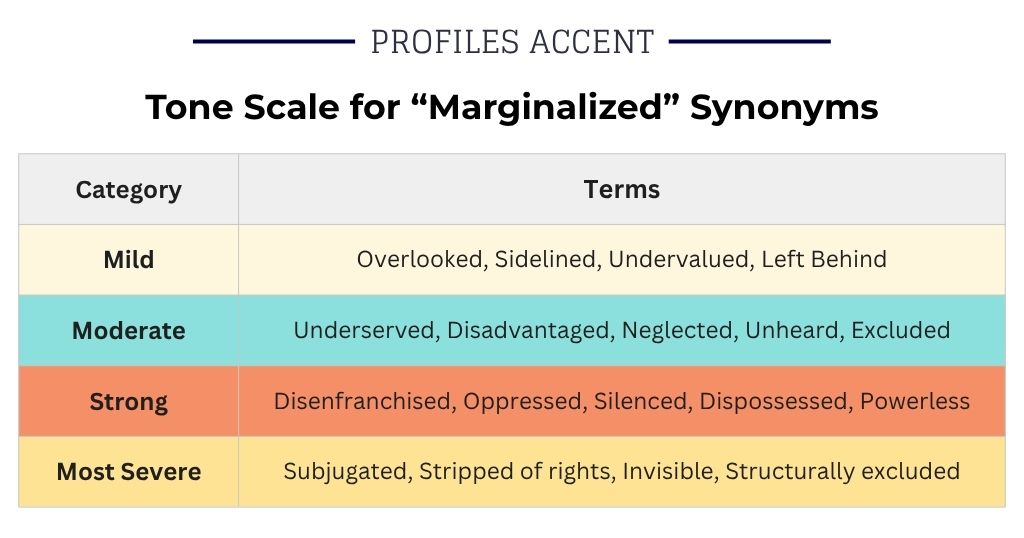
Some situations call for a word that acknowledges difficulty without alarm. Others need a word that tells the full truth of what happened. Here is how common synonyms stack up from mild to severe:
- Mild: Overlooked, Sidelined, Undervalued, Left Behind
- Moderate: Underserved, Disadvantaged, Neglected, Unheard, Excluded
- Strong: Disenfranchised, Oppressed, Silenced, Dispossessed, Powerless
- Most Severe: Subjugated, Stripped of rights, Invisible (in its sharpest usage), Structurally excluded
If you are writing for a general audience, words in the mild to moderate range will land without resistance. If you are writing for an informed audience that already understands systemic issues, the stronger terms will feel honest, not inflammatory.
Watch What Changes: Rewriting Sentences Without the Word “Marginalized”
Original: “The program helps marginalized youth.”
- Formal: “The program provides structured support for disenfranchised young people who lack access to institutional resources.”
- Conversational: “These kids have been overlooked for too long, and this program is finally changing that.”
- Academic: “The initiative targets structurally excluded youth populations facing compounding systemic disadvantages.”
- Creative: “Somewhere between the headlines and the funding reports, there are teenagers the city forgot. This program goes looking for them.”
Each version is honest. But each one says something slightly different about why these young people need help and who is responsible for the gap.
Original: “Marginalized communities often struggle to access healthcare.”
- Policy tone: “Underserved communities continue to experience disproportionate barriers to basic healthcare access.”
- Journalistic tone: “Millions of people are quietly being shut out of the healthcare system, and it rarely makes the news.”
- Direct/Advocacy: “Oppressed and deprived communities are not failing to access healthcare. Healthcare is failing them.”
Notice how the final rewrite shifts the subject entirely. That is not just word choice. It is a fundamental shift in who carries responsibility in the sentence.
A Few Words on the List That Deserve a Warning
Some words in this list carry risks worth knowing.
“Underprivileged” is widely used but some communities reject it. The word implies their situation is about lacking privilege rather than being denied rights. In advocacy contexts, more precise words like “disenfranchised” or “excluded” are often preferred.
“Vulnerable” is useful in social work and policy, but calling people vulnerable without context can feel like it removes their agency. Always pair this word with context about what created the vulnerability, not just who has it.
“Minority group” is not a direct synonym for marginalized. A minority can be marginalized, but not all minorities are. And in some countries, a numeric majority can still be politically marginalized. Use this term with care.
“Second-class” is powerful and pointed. It is good for opinion writing and advocacy, but it can feel jarring in a neutral report or academic paper.
Mistakes Writers Make When Replacing “Marginalized”
Reaching for “disadvantaged” when the situation is actually about deliberate exclusion waters down the message. These are not the same condition, and your readers will notice.
Using “vulnerable populations” repeatedly in a policy document erases individuality. If you mean elders, say elders. If you mean undocumented workers, say that. Specificity respects the people you are writing about.
Switching between “marginalized” and “oppressed” in the same piece without purpose creates confusion about severity. Decide what you are arguing and let your word choice stay consistent with that argument.
Treating “voiceless” as a fact rather than a condition is also a trap. People are not born voiceless. Systems make them voiceless. That distinction matters in how you write about it.
Words That Orbit “Marginalized” Without Meaning the Same Thing
Systemic inequality does not describe a group but the structure that creates marginalization. Useful when you want to name the cause rather than the affected group.
Social exclusion is a broader academic phrase that captures how people are cut off from economic, cultural, and social participation.
Othered describes the psychological and social process of treating someone as fundamentally different or lesser. It is newer in mainstream writing but widely used in academic and cultural criticism.
Disproportionately affected is not a direct synonym but works well in data-driven writing when a group is harmed more than others by a policy or condition.
Intersectional describes people who face multiple layers of exclusion at once, not just one. This word is often used alongside marginalized in academic writing.
The Right Synonym for Marginalized Is Closer Than You Think
The goal is never to find a fancier replacement. The goal is to match the word to what actually happened, and to who your reader is.
If you are writing for a school report, overlooked, excluded, or disadvantaged will communicate clearly. If you are writing for a community organization or advocacy group, silenced, disenfranchised, or oppressed will feel more honest. If you are writing a creative essay, invisible or forgotten often hit harder than any clinical term.
The right word is the one that tells the truth precisely, respects the people it describes, and matches the tone your reader came to find.
Discover More Articles:

I’m Rowan, a language addict who loves exploring how words work in everyday communication. I’ve spent years studying English vocabulary and helping others express themselves more clearly. My goal is simple: make learning new words easy and practical. I focus on real-life examples that show when and how to use different terms. Through clear explanations and honest guidance, I help readers choose the right words for any situation with confidence.