You just wrote a sentence. It made sense. But something felt off. You read it again, and there it is: the word while, doing too much work. Is it showing time? Contrast? Concession? Even you are not sure.
That is the real problem with “while.” It is a shape-shifter. Writers use it for three completely different purposes, and readers sometimes have to guess which meaning was intended. In professional writing, that guess is a failure.
This guide cuts through the confusion. You will find the right replacement for every situation, understand why the swap works, and walk away with sharper sentences.
Why “While” Keeps Confusing Writers (And What It Really Does)
“While” is not one word. It behaves like three.
It marks time (“she sang while cooking”). It draws contrast (“he passed, while she failed”). It makes a concession (“while I agree, I have concerns”). Each version carries a different logic. Replacing it without knowing which version you are using leads to sentences that feel clumsy or mean something unintended.
Once you identify the function, the right synonym becomes obvious.
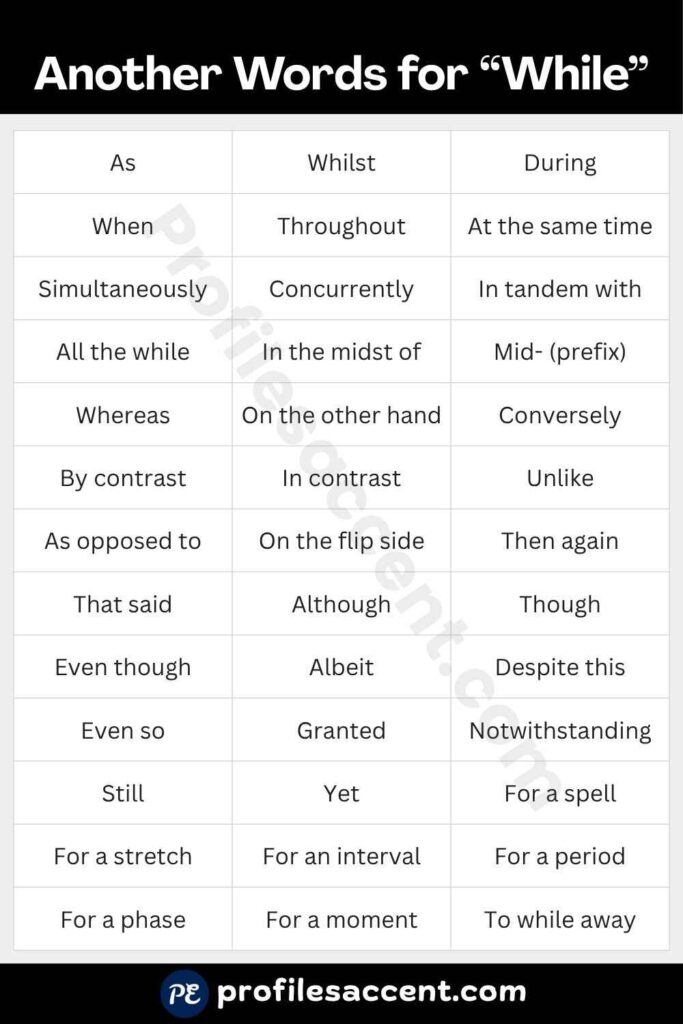
40+ Synonyms for While: Quick-Reference Table for Every Context
| Synonym | Function | Tone | Best For |
| As | Time | Neutral | Everyday writing |
| Whilst | Time | Formal | British English, essays |
| During | Time | Neutral | Formal and informal |
| When | Time | Casual | Speech, storytelling |
| Throughout | Time | Neutral | Reports, descriptions |
| At the same time | Time | Neutral | Clear emphasis |
| Simultaneously | Time | Formal | Academic, professional |
| Concurrently | Time | Formal | Reports, research |
| In tandem with | Time | Formal | Business writing |
| All the while | Time | Reflective | Narratives, creative writing |
| In the midst of | Time | Descriptive | Storytelling |
| Mid- (prefix) | Time | Compact | Creative, casual |
| Whereas | Contrast | Formal | Essays, research, reports |
| On the other hand | Contrast | Neutral | Discussions, comparisons |
| Conversely | Contrast | Formal | Academic writing |
| By contrast | Contrast | Formal | Analysis, reports |
| In contrast | Contrast | Neutral | Any writing level |
| Unlike | Contrast | Neutral | Comparisons |
| As opposed to | Contrast | Semi-formal | Professional writing |
| On the flip side | Contrast | Casual | Blogs, conversations |
| Then again | Contrast | Casual | Informal, storytelling |
| That said | Contrast | Conversational | Blogs, emails |
| Although | Concession | Neutral | Essays, reports |
| Though | Concession | Casual | Informal and semi-formal |
| Even though | Concession | Emphatic | Emotional weight needed |
| Albeit | Concession | Formal | Academic, legal writing |
| Despite this | Concession | Neutral | Reports, analysis |
| Even so | Concession | Conversational | Casual and semi-formal |
| Granted | Concession | Conversational | Debates, opinion pieces |
| Notwithstanding | Concession | Very formal | Legal, academic |
| Still | Concession | Casual | Spoken English, blogs |
| Yet | Concession | Literary | Creative writing |
| For a spell | Noun | Informal | Storytelling, casual speech |
| For a stretch | Noun | Neutral | General writing |
| For an interval | Noun | Formal | Technical, formal text |
| For a period | Noun | Neutral | Reports, general use |
| For a phase | Noun | Neutral | Business, project writing |
| For a moment | Noun | Light | Casual, conversational |
| To while away | Verb | Casual | Describing idle time |
| To pass the time | Verb | Neutral | Casual writing, narratives |
Other Words for While, Sorted by What You Actually Mean
1. Time-Based Synonyms for While: Two Actions, One Moment
This is the most common use. You want to show two actions running at the same moment.
Example: “She scrolled through her phone while waiting.”
The fix here is straightforward. Use as for clean, simple sentences. Use throughout when one action lasts the full duration of another. Use in the midst of when you want a more vivid, narrative tone.
“She scrolled through her phone as she waited.”
“Throughout the wait, she scrolled through her phone.”
“In the midst of waiting, she scrolled through her phone.”
Each one works. Each one feels slightly different. Pick based on tone.
2. While Contrast Synonyms: When Two Ideas Push Against Each Other
Here, “while” acts like a pivot. It signals that what follows contradicts what came before.
Example: “City spending increased while rural areas saw budget cuts.”
This is where most writers go wrong. They replace “while” with “meanwhile” and create a grammar error. Meanwhile is not a conjunction. It cannot join two clauses with just a comma.
Correct swap: whereas.
“City spending increased, whereas rural areas saw budget cuts.”
For casual writing: on the flip side, then again, that said.
For formal writing: conversely, by contrast, as opposed to.
3. Another Word for While in Concession: Admit First, Push Back Second
This is the most overlooked use. “While I respect your opinion, I disagree.” Here, “while” means “I accept this, but here is the other side.”
Although is the cleanest replacement. Albeit works when what follows is a phrase, not a full sentence. Granted gives a conversational, almost debate-like tone.
“Although I respect your opinion, I disagree.”
“The plan was effective, albeit costly.”
“Granted, the approach worked last time. This situation is different.”
The Punctuation Trap Hidden Inside “While” Synonyms
This is the gap most synonym guides skip entirely, and it causes real writing errors.
“While” is a subordinating conjunction. It glues two clauses together using only a comma.
Words like meanwhile, however, and conversely are not conjunctions. They are transition adverbs. When you use them between two independent clauses, you need a semicolon before them and a comma after.
Wrong: “The first test failed while the second passed.” Changed to: “The first test failed, meanwhile the second passed.” (This is a run-on.)
Right: “The first test failed; meanwhile, the second passed.”
If you skip this rule, even a perfect synonym choice produces a broken sentence.
See It in Action: Sentence Rewrites Using Other Words for While
Original: “She worked while feeling exhausted.”
- Formal: “She continued working despite her exhaustion.”
- Casual: “She pushed through, even though she was wiped out.”
- Academic: “She maintained productivity notwithstanding significant fatigue.”
- Creative: “All the while bone-tired, she kept her hands moving.”
Original: “Sales improved while customer complaints rose.”
- Formal: “Sales improved; however, customer complaints also rose.”
- Neutral: “Sales improved, whereas customer complaints rose simultaneously.”
- Report style: “An upward sales trend was observed concurrently with rising customer complaints.”
Original: “While I understand your point, I cannot agree.”
- Direct: “Although I understand your point, I cannot agree.”
- Conversational: “That said, I still cannot agree.”
- Emphatic: “Even though I see where you are coming from, I have to disagree.”
Notice how each version shifts the weight of the sentence slightly. Choosing the right word controls what the reader feels.
Another Word for While in Essays vs. Everyday Writing
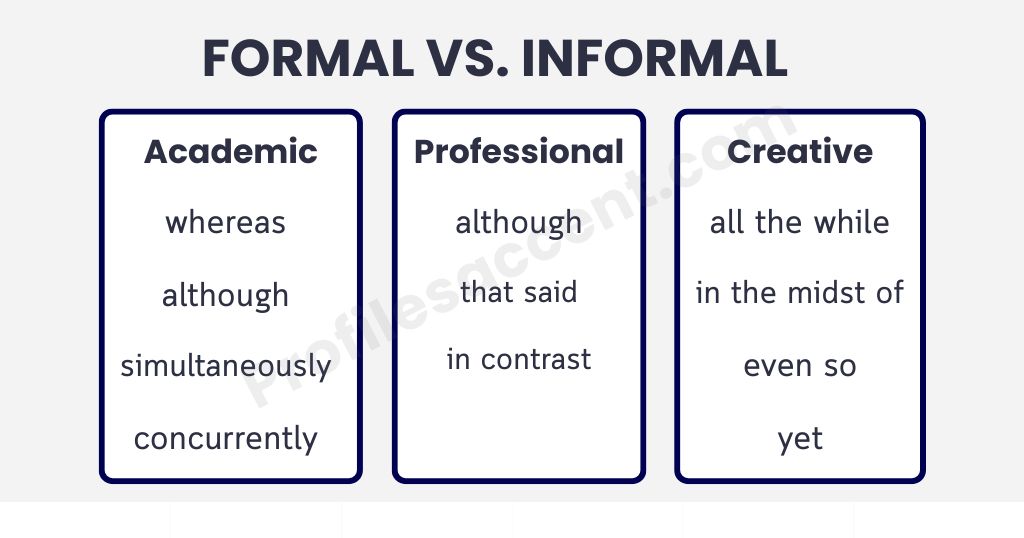
For essays and academic writing: Use whereas for contrast, although for concession, simultaneously or concurrently for time. Avoid whilst in American academic writing. It reads as archaic to many US professors.
For professional emails: Use although, that said, in contrast. Avoid on the flip side or then again. They feel too breezy for workplace tone.
For storytelling and creative writing: Use all the while, in the midst of, even so, yet. These carry atmosphere. They do not just replace a word; they add texture.
Words to avoid in formal contexts: Still, then again, on the flip side, kind of like. These belong in conversation, not in reports or research.
When the Synonym Breaks the Sentence: Mistakes to Stop Making
“Despite” needs a noun, not a clause.
- Wrong: “Despite she was tired, she finished.”
- Right: “Despite her tiredness, she finished.” / “Although she was tired, she finished.”
“Whereas” needs two contrasting clauses.
- Wrong: “Whereas it was raining.” (incomplete)
- Right: “Whereas yesterday was sunny, today brought heavy rain.”
“During” needs a noun after it.
- Wrong: “During she was studying.”
- Right: “During her study session.” / “As she was studying.”
“Albeit” works with phrases, not full clauses.
- Wrong: “Albeit the results were positive.”
- Right: “The results were positive, albeit unexpected.”
These are not small errors. They change sentence structure and can confuse readers completely.
Another Word for While as a Noun: The Forgotten Form
“I waited for a while.” Here, “while” is a noun meaning a span of time. Most synonym guides ignore this use entirely.
Replacements: a spell, a stretch, a period, a phase, an interval, a moment.
“I waited for a stretch.” (Casual)
“The team monitored the system for an interval.” (Formal)
“She paused for a moment.” (Light, conversational)
Choose based on how long and how significant the time span feels in context.
While as a Verb: A Synonym Gap Nobody Fills
“To while away the hours” is a phrase meaning to spend time lazily or without purpose. This is the verb form of while.
Alternatives: to pass the time, to idle away, to drift through, to fill the hours.
“He idled away the afternoon.”
“She passed the time reading old letters.”
This meaning is almost never covered in synonym lists. Now you know it.
Related Words Worth Knowing Alongside While Synonyms
Meanwhile carries a storytelling quality. It signals a scene shift. “Meanwhile, back at the office…” It works for narratives but needs a semicolon in formal structure.
Nevertheless steps in when the concession is stronger. “The evidence was thin; nevertheless, the case proceeded.” It punches harder than “although.”
Simultaneously strips away all ambiguity for time. No contrast, no concession. Just two things happening at once.
Notwithstanding is “while” dressed in a suit. Mostly legal and academic. Never use it in casual writing unless you want to sound like a contract.
Choosing the Right Synonym for While: A Fast Decision Guide
Here is a fast decision path:
- Are you showing two things happening at once? Use as, simultaneously, or throughout.
- Are you contrasting two opposite ideas? Use whereas in formal writing, on the other hand in general writing, on the flip side in casual writing.
- Are you admitting something before disagreeing? Use although, even though, or albeit.
- Is “while” acting as a noun? Use a spell, a stretch, a period.
That is it. Four questions. Four clear answers. The right synonym is never far once you know which job the word is doing.
Discover More Articles:

I’m Rowan, a language addict who loves exploring how words work in everyday communication. I’ve spent years studying English vocabulary and helping others express themselves more clearly. My goal is simple: make learning new words easy and practical. I focus on real-life examples that show when and how to use different terms. Through clear explanations and honest guidance, I help readers choose the right words for any situation with confidence.