There’s a moment every writer knows. You type the word destiny and something feels off. Not wrong, exactly. Just… worn out. Like a coin that’s been passed through too many hands.
Why “Destiny” Starts Feeling Overworked
The word still works. But it carries so much weight from fantasy novels, motivational speeches, and movie trailers that it can feel borrowed rather than chosen. If you’re a student, a storyteller, or someone writing something personal, that feeling matters.
Choosing a different word isn’t about being fancy. It’s about being precise. The right synonym can shift a sentence from dramatic to tender, from vague to clear, from cliché to memorable.
This guide gives you more than a list. It shows you what each word actually feels like, and when to use it.
So What Does Destiny Actually Carry With It?
Destiny points to what someone is meant to experience or become. It carries the idea that life has a shape to it, that events are moving toward something. It sits between hope and inevitability. That’s why it works in heroic stories but feels heavy in everyday conversation.
It also suggests forward motion. Unlike fate, which often feels like a locked door, destiny feels like a path still being walked.
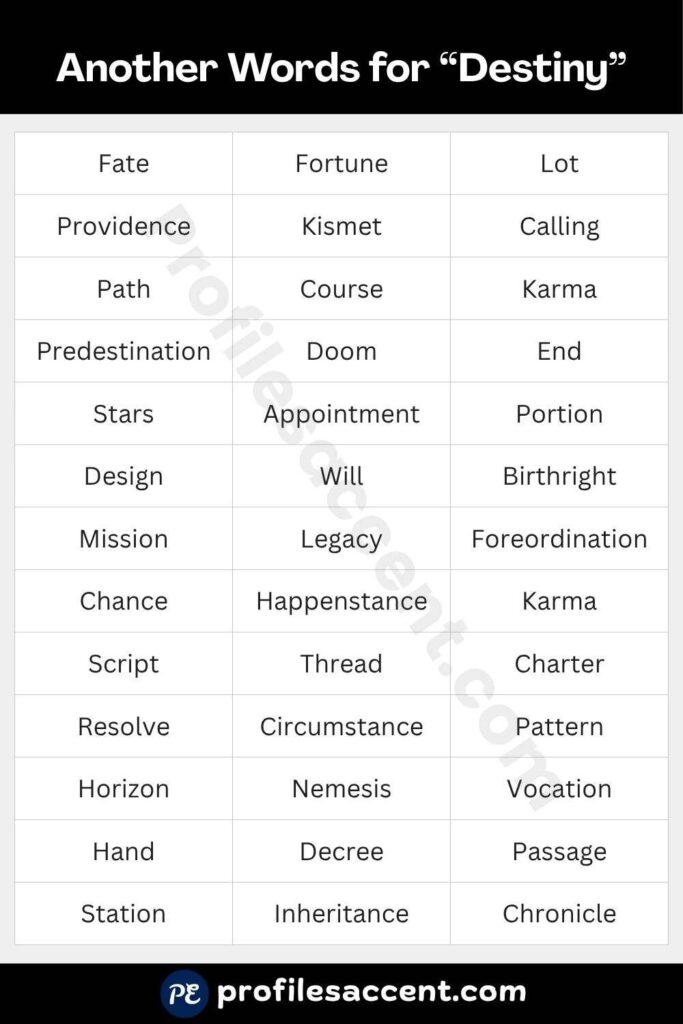
40+ Destiny Synonyms at a Glance: Quick-Reference Table
This table organizes the best alternatives by tone so you can find what fits without scrolling endlessly.
| Word | Tone | Best Used When | Example |
| Fate | Serious, fixed | Writing about unavoidable outcomes | “He could not escape his fate.” |
| Fortune | Warm, open | Outcomes shaped by luck or blessing | “Her fortune changed that summer.” |
| Lot | Quiet, resigned | Accepting one’s life conditions | “She made peace with her lot.” |
| Providence | Spiritual, hopeful | A divine or protective force guides events | “By providence, they survived.” |
| Kismet | Gentle, romantic | Meant-to-be moments or surprise meetings | “Finding him felt like kismet.” |
| Calling | Personal, purposeful | Career, vocation, or life mission | “Teaching was her true calling.” |
| Path | Neutral, grounded | Any life journey, formal or informal | “He trusted the path ahead.” |
| Course | Formal, neutral | Direction of a life or situation | “The course of her life shifted.” |
| Karma | Moral, cyclical | Outcomes tied to past actions | “What comes around is karma.” |
| Predestination | Theological, heavy | Religious writing or philosophical debate | “He believed in predestination.” |
| Doom | Dark, final | Tragic or negative outcomes | “The village met its doom.” |
| End | Plain, direct | The final result or conclusion | “This was the end written for him.” |
| Stars | Poetic, romantic | Love, dreams, or celestial references | “It was written in their stars.” |
| Appointment | Formal, divine | A role or outcome assigned by a higher power | “It was her appointment to lead.” |
| Portion | Literary, melancholy | The share of life given to someone | “Grief was his portion.” |
| Design | Thoughtful, intentional | A plan with clear purpose | “She felt part of a larger design.” |
| Will | Spiritual, authoritative | Divine or cosmic intention | “It was God’s will.” |
| Birthright | Personal, inherited | Something owed since birth | “Leadership was his birthright.” |
| Mission | Active, purposeful | A task a person is meant to complete | “She completed her mission.” |
| Legacy | Reflective, lasting | What someone leaves behind | “She built a remarkable legacy.” |
| Foreordination | Theological, rare | Pre-arranged spiritual outcomes | “Foreordination guided their faith.” |
| Chance | Neutral, open | When no design is implied | “By chance, everything changed.” |
| Happenstance | Light, informal | Casual coincidence or lucky accident | “It was pure happenstance.” |
| Karma | Moral, karmic | Actions meeting their consequences | “Her kindness returned as karma.” |
| Script | Creative, theatrical | Life viewed as a story or performance | “This wasn’t in his script.” |
| Thread | Poetic, delicate | A continuous line connecting life events | “She followed the thread of her life.” |
| Charter | Formal, structural | An official or assigned purpose | “Education was his charter.” |
| Resolve | Active, determined | A personal decision that shapes outcomes | “Her resolve wrote her story.” |
| Circumstance | Detached, analytical | Conditions that shape an outcome neutrally | “Circumstance decided his role.” |
| Pattern | Reflective, abstract | Recurring events that form a larger picture | “She saw a pattern in her losses.” |
| Horizon | Forward-looking, hopeful | What lies ahead, full of possibility | “A new horizon waited for her.” |
| Nemesis | Tense, confrontational | An unavoidable downfall or challenge | “Pride became her nemesis.” |
| Vocation | Purposeful, sincere | A deep sense of what one is meant to do | “Medicine was his vocation.” |
| Hand | Conversational, humble | The “hand you’re dealt” in life | “He played the hand life gave him.” |
| Decree | Formal, commanding | An authoritative decision about someone’s future | “The decree of fate was final.” |
| Passage | Narrative, quiet | A journey through time or change | “It was a difficult passage.” |
| Station | Social, traditional | One’s place or rank in life | “She rose above her station.” |
| Inheritance | Personal, cultural | What is carried forward from before | “His inheritance included their strength.” |
| Chronicle | Storytelling, literary | A life seen as a recorded story | “Her chronicle was just beginning.” |
Not All Synonyms for Destiny Mean the Same Thing
Here’s where most guides miss the point. They list synonyms like they’re all the same. They’re not.
Agency matters. Words like calling, vocation, and mission suggest you have a role to play and you can step into it. Words like doom, lot, and decree suggest the outcome is already sealed, with or without you.
Tone carries meaning. Kismet feels light. You’d use it when talking about a happy surprise, not a funeral. Doom is the opposite. It belongs to tragedy. Swapping them in the wrong context creates tonal confusion that pulls readers out of the story.
Source matters too. Providence implies a caring, divine hand. Circumstance implies no one was in charge at all. Both can describe why something happened, but they leave very different feelings behind.
Intensity Scale: How Heavy Do You Want the Word to Feel?
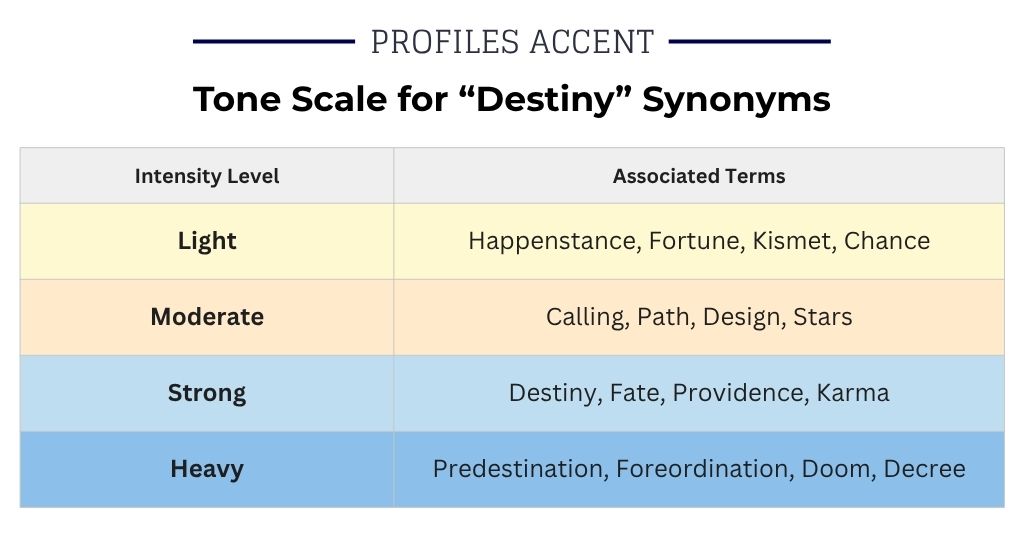
Sometimes the question isn’t just which word to use. It’s how much weight you want it to carry.
Here’s how these words feel on a scale from light to heavy:
- Light: Happenstance · Fortune · Kismet · Chance
- Moderate: Calling · Path · Design · Stars
- Strong: Destiny · Fate · Providence · Karma
- Heavy: Predestination · Foreordination · Doom · Decree
Use lighter words in personal, warm, or casual writing. Reach for the heavier ones in formal, spiritual, or dramatic work. Misplacing a heavy word in a light context makes the writing feel stiff. Misplacing a light word in a serious context makes it feel dismissive.
Watch What Happens When You Swap the Word Out: Sentence Rewrites
Original: “It was his destiny to become a doctor.”
- Formal: “Medicine was his appointed vocation from an early age.”
- Casual: “He always had a feeling he’d end up in medicine somehow.”
- Creative: “The white coat had been waiting for him long before he found it.”
- Spiritual: “By providence, his hands were made to heal.”
Each version says roughly the same thing. But each one creates a completely different reader experience. Notice how the creative version never even uses a synonym. Sometimes the best rewrite avoids the word entirely.
Original: “She believed in destiny.”
- Formal: “She held firm to the belief that her life had a designed course.”
- Casual: “She figured things happen for a reason.”
- Academic: “Her worldview reflected a deterministic understanding of personal outcome.”
- Reflective: “She trusted the pattern of things, even when it hurt.”
When to Go Formal, When to Stay Casual
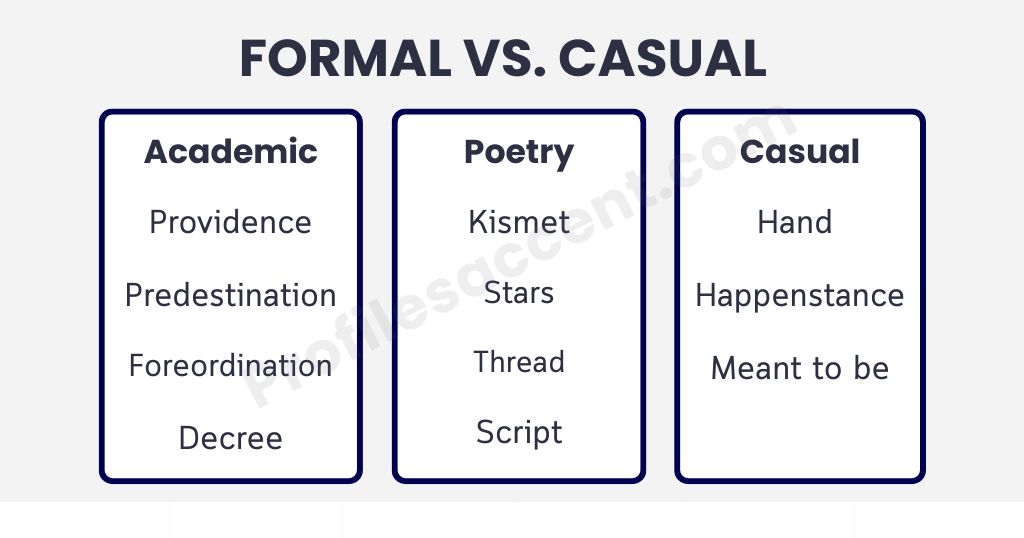
- Use these in essays, academic papers, or professional writing: Providence, Predestination, Foreordination, Decree, Vocation, Circumstance, Design
- Use these in storytelling, poetry, or personal writing: Kismet, Stars, Thread, Script, Horizon, Calling, Path
- Keep these in casual speech or dialogue only: Hand (as in “the hand you’re dealt”), Happenstance, Meant to be
Doom deserves a special note. It’s powerful in creative writing but sounds theatrical in formal or professional contexts. Use it carefully.
Destiny vs. Fate: They Are Not the Same Word
Most people treat these words as identical. They’re close, but not the same.
- Fate tends to focus on what happens, the outcome, the endpoint. It doesn’t care much about how you feel about it.
- Destiny tends to focus on what you’re meant to become. It carries a sense of growth, of something unfolding with meaning.
Someone might say, “It was his fate to die young,” because fate accepts that as a closed event. But “It was her destiny to lead” feels different because it implies movement, potential, a future still arriving.
This difference matters most in storytelling. The wrong choice flattens a character’s arc. Choose fate when the outcome feels sealed. Choose destiny when the journey still has air in it.
Another Word for Destiny Starting With “A”
If you’ve searched for “another word for destiny starting with A,” here are the most usable options:
Appointment works when something feels pre-assigned, especially in spiritual or formal writing.
Allotment works in reflective or melancholy writing, referring to what life has measured out to someone.
Aspiration works when the focus is forward-looking and self-directed, though it implies personal choice more than fate.
Need a Short Word? Four-Letter Destiny Synonyms
If you’re working in a context that needs shorter or more direct language:
- Fate is the most natural four-letter replacement.
- Doom carries a dark or tragic weight.
- Lot works in quiet, philosophical moments.
A Few Words on This List Deserve Extra Care
A few words in this list need extra care.
Karma is rooted in Hindu and Buddhist traditions. Using it casually to mean “getting what you deserve” strips it of its spiritual meaning. In some communities, that’s considered disrespectful. Be thoughtful if your writing includes cultural context.
Providence carries strong religious weight. It implies a God-like force watching over events. Using it in a secular context can unintentionally signal a belief you may not hold or imply one for your character.
Doom carries gothic or dark associations. In casual writing or dialogue, it can sound unintentionally funny rather than serious.
Mistakes Writers Make With Destiny Synonyms
Treating all synonyms as perfect swaps. They’re not. Each word has a lane. Putting kismet in a war scene or doom in a wedding toast creates unintentional comedy.
Overusing fate when they mean destiny. Fate sounds final. If you’re writing about someone still growing, still becoming, fate closes the door too early.
Using predestination outside its natural home. This word belongs in theological or philosophical writing. In everyday sentences, it sounds stilted and heavy.
Picking poetic words in analytical writing. If you’re writing a research paper or professional memo, words like stars, thread, or chronicle stick out awkwardly.
Words That Live Near This Idea But Work Differently
- Serendipity: A happy, accidental discovery with no plan behind it. Different from destiny because it emphasizes surprise, not design.
- Foreshadowing: A storytelling technique, not a synonym, but deeply connected to how destiny appears in narrative writing.
- Inevitability: The quality of something that cannot be avoided. More abstract than fate, more useful in arguments than stories.
- Agency: The direct opposite in spirit. Agency is the power to shape your own outcome. When you want contrast, this word earns its place.
- Will: Can mean personal determination or divine intention, depending on context. A small but flexible word.
Picking the Right Synonyms for Destiny in Your Writing
Here’s a simple decision path before you write:
- Is the outcome positive or hopeful? Reach for calling, fortune, horizon, or design.
- Is the outcome dark or final? Consider doom, fate, or decree.
- Is the moment spiritual or sacred? Try providence or foreordination.
- Is the writing casual or warm? Use kismet, meant to be, or path.
- Is someone choosing their direction, not just receiving it? Use vocation, mission, or calling.
The word you choose does more than fill a blank. It quietly tells the reader what kind of universe your writing lives in. Take that choice seriously and your readers will feel the difference, even if they never know exactly why.
Discover More Articles:

I’m Rowan, a language addict who loves exploring how words work in everyday communication. I’ve spent years studying English vocabulary and helping others express themselves more clearly. My goal is simple: make learning new words easy and practical. I focus on real-life examples that show when and how to use different terms. Through clear explanations and honest guidance, I help readers choose the right words for any situation with confidence.