You wrote “took the initiative” in your resume. Then again in your cover letter. Then once more in your essay intro. It happens to every writer. The word starts feeling stale, almost meaningless, the more you repeat it.
But here is the real problem. “Initiative” carries different meaning depending on where you use it. The word you need in a business report is not the same one that fits a personal statement. Swapping them without thinking can quietly shift your tone in the wrong direction.
This guide helps you find the right replacement, not just any replacement.
So What Does “Initiative” Really Mean?
At its core, initiative means two things. First, it describes a personal quality: the ability to act without being told. Second, it refers to a specific plan or project, like a government health initiative or a company-wide training program.
The emotional weight is positive. It suggests confidence, ownership, and forward movement. The tone sits somewhere between formal and professional.
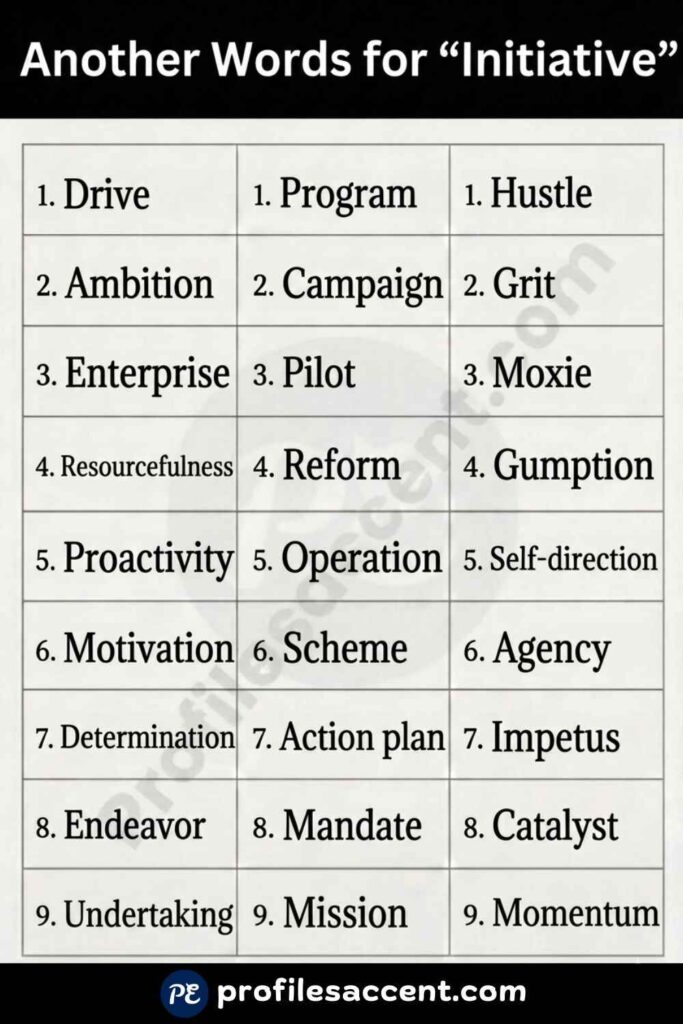
40+ Quick Table: Synonyms for Initiative at a Glance
| Word | Tone | Best Used When | Example |
| Drive | Energetic | Describing personal ambition | “Her drive pushed the team forward.” |
| Ambition | Aspirational | Career or goal-focused writing | “His ambition shaped the project.” |
| Enterprise | Bold, professional | Business or resume writing | “She showed real enterprise.” |
| Resourcefulness | Clever, practical | Problem-solving contexts | “His resourcefulness saved the launch.” |
| Proactivity | Modern, corporate | Workplace behavior descriptions | “Proactivity is valued here.” |
| Motivation | Warm, general | Casual or inspirational writing | “Her motivation was obvious.” |
| Determination | Strong, resolute | Overcoming challenges | “His determination drove results.” |
| Endeavor | Formal, earnest | Academic or literary tone | “A noble endeavor from the start.” |
| Undertaking | Neutral, structured | Describing a project or plan | “A major undertaking for the team.” |
| Venture | Risk-aware | Business expansion or new ideas | “A bold venture into new markets.” |
| Program | Neutral, official | Structured plans or policies | “A wellness program for staff.” |
| Campaign | Action-focused | Social or marketing efforts | “A public safety campaign.” |
| Pilot | Experimental | First-time or test projects | “A pilot launched in Q1.” |
| Reform | Political, systemic | Government or institutional change | “An education reform bill.” |
| Operation | Strategic, large-scale | Organized group effort | “A relief operation overseas.” |
| Scheme | Formal, planned | Official large-scale planning | “A housing scheme in the city.” |
| Action plan | Clear, practical | Step-by-step professional context | “A solid action plan was drafted.” |
| Mandate | Authority-driven | Leadership or policy direction | “The board issued a new mandate.” |
| Mission | Purpose-led | Nonprofit or cause-driven writing | “Their mission was clear.” |
| Effort | Simple, general | Everyday writing or summaries | “A team effort paid off.” |
| Hustle | Informal, energetic | Casual storytelling or profiles | “Her hustle never stopped.” |
| Grit | Raw, resilient | Personality descriptions | “He had the grit to keep going.” |
| Moxie | Bold, spirited | Creative or biographical writing | “She had the moxie to speak up.” |
| Gumption | Folksy, practical | Informal or narrative writing | “It took real gumption.” |
| Self-direction | Formal, behavioral | Academic or HR writing | “She showed strong self-direction.” |
| Agency | Sociological, precise | Essays or research writing | “They exercised full agency.” |
| Impetus | Formal, causal | Academic or analytical writing | “Economic need was the impetus.” |
| Catalyst | Triggering force | When something caused change | “The crisis was a catalyst.” |
| Momentum | Building energy | Progress-based writing | “The team gained momentum fast.” |
| Foresight | Predictive, wise | Leadership or planning contexts | “His foresight prevented delays.” |
| Zeal | Passionate, earnest | Personality or cause-driven tone | “Her zeal was contagious.” |
| Tenacity | Persistent | Long-term challenge writing | “His tenacity made the difference.” |
One Word, Two Jobs: Why “Another Word for Initiative” Depends on Context
Most synonym lists fail here. They treat “initiative” as one word with one meaning. It is not.
When it describes a person: You mean their inner drive, their willingness to act without being asked. Words like grit, enterprise, and drive fit here. These speak to character.
When it describes a project or plan: You mean something launched, funded, or organized. Words like program, campaign, or undertaking work better. These speak to structure.
If you mix these up, your writing sounds off. Saying someone “launched their grit” or “has a lot of campaign” makes no sense. Always check which face of the word you are replacing before picking a synonym.
How Strong Is Your Word? An Intensity Scale for Initiative Synonyms
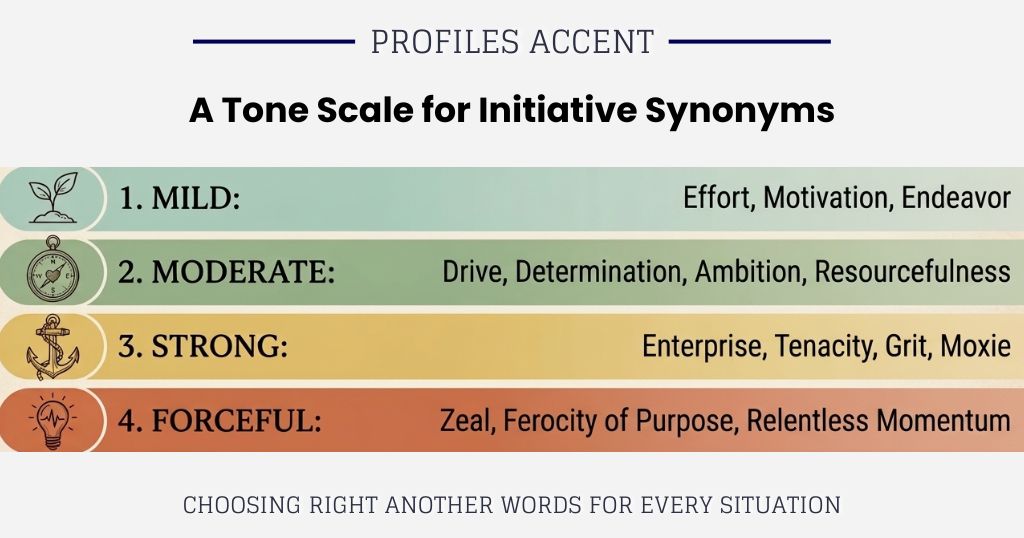
Not every synonym carries equal weight. Some feel calm. Others feel urgent. Here is how they line up from softest to strongest:
- Mild: Effort, motivation, endeavor
- Moderate: Drive, determination, ambition, resourcefulness
- Strong: Enterprise, tenacity, grit, moxie
- Forceful: Zeal, ferocity of purpose, relentless momentum
If you are writing a gentle profile of someone, “effort” or “motivation” feels natural. If you are writing about a founder who built something against all odds, “grit” or “moxie” carries the right punch.
Choosing based on intensity is just as important as choosing based on meaning.
Sentence Rewrites Using Initiative Synonyms
Sometimes the best way to replace “initiative” is not to swap one word. It is to rethink the whole sentence.
Original: “She took the initiative to improve the process.”
- Formal: “She identified inefficiencies and independently restructured the workflow.”
- Casual: “She just fixed it without being asked.”
- Academic: “Her autonomous intervention led to a measurable process improvement.”
- Creative: “Nobody told her to. She simply saw what needed doing and did it.”
Original: “The company launched a new initiative.”
- Business report: “The company rolled out a structured pilot program targeting onboarding.”
- Email: “We are kicking off a new effort to improve how we welcome new hires.”
- Academic: “The organization introduced a systemic reform aimed at operational efficiency.”
Original: “He showed initiative during the crisis.”
- Resume: “He proactively stabilized operations during the supply disruption.”
- Story: “When everything fell apart, he was already three steps ahead.”
- Essay: “His capacity for independent action proved critical under pressure.”
Notice something? The synonym never just drops in. The sentence reshapes around the idea. That is how good paraphrasing works.
Formal vs. Informal Another Words for Initiative
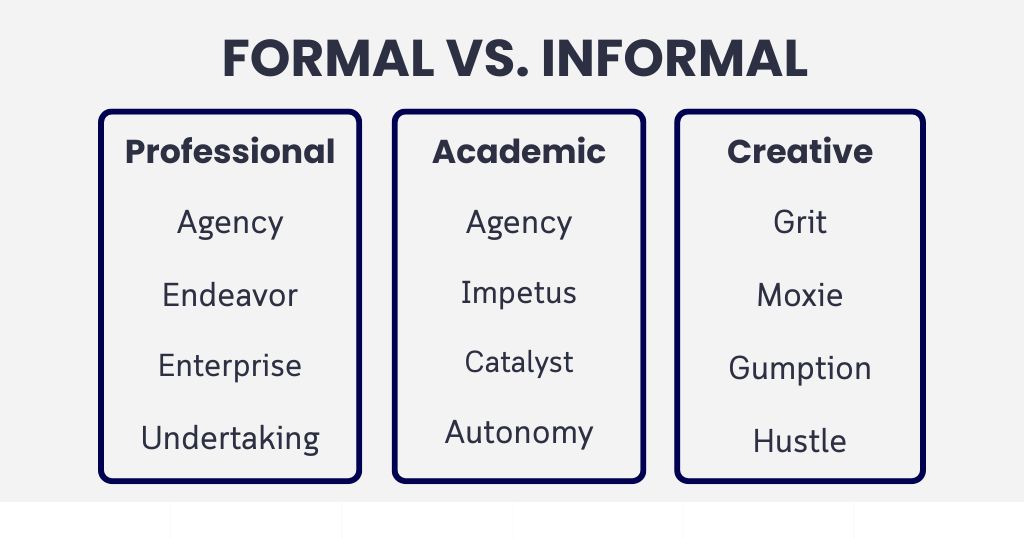
Best for professional emails and reports:
- Agency, endeavor, enterprise, undertaking, mandate, proactivity
Best for essays and academic writing:
- Agency, impetus, catalyst, self-direction, autonomy, reform
Best for storytelling and creative writing:
- Grit, moxie, gumption, hustle, zeal, momentum
Words to avoid in formal contexts:
- Hustle (too casual), moxie (too playful), gumption (too folksy)
If you are writing a university application and you describe yourself as having “loads of hustle,” the tone undercuts the message. The word is not wrong in every setting. It is just wrong in that one.
When Certain Synonyms for Initiative Backfire
A few synonyms come with hidden risks.
Scheme sounds formal, but in British English it simply means “plan.” In American English, it often implies something sneaky or underhanded. Know your audience before using it.
Ambition is positive in professional writing. But in some creative or literary contexts, it can suggest ruthlessness. Shakespeare’s Macbeth is full of ambition. That is not a compliment.
Agency is precise in academic writing, especially in sociology or psychology. Outside those fields, readers may find it abstract or confusing.
Mandate carries authority. It works for leadership writing. But in political contexts it sometimes signals controversy, since political mandates are often debated.
None of these are wrong words. They just carry extra weight in certain rooms.
Mistakes Writers Make When Replacing “Initiative”
Mistake 1: Treating all synonyms as equal
“She had great enterprise” and “she had great effort” do not mean the same thing. Enterprise implies boldness and risk. Effort simply implies work. These are not interchangeable.
Mistake 2: Swapping the word but keeping the wrong sentence structure
“She took the resourcefulness to fix it” sounds wrong. Some synonyms only work as nouns, some as verbs. Always check the grammar fits.
Mistake 3: Using informal words in formal writing
“Gumption” in a board presentation reads as out of place. Context always wins.
Mistake 4: Over-correcting into stiffness
Some writers replace “initiative” and end up with something like “autonomous self-directed behavioral activation.” That is worse. Clarity beats complexity every time.
Close Relatives: Words Near “Initiative” That Mean Something Different
These words orbit “initiative” but they are not the same thing. Knowing the difference helps you write with precision.
Assertiveness: The confidence to express your views. Initiative is about starting; assertiveness is about speaking up.
Leadership: Leading others. Initiative can happen alone. Leadership requires people to follow.
Creativity: Generating new ideas. You can have initiative without creativity, like following through on someone else’s plan but without being asked.
Discipline: Maintaining effort over time. Initiative is the spark; discipline keeps the fire going.
Innovation: Creating something genuinely new. Initiative is the act of beginning; innovation is about what you build.
The Three Questions That Lead You to the Right Synonym for Initiative
Ask yourself three things before picking a synonym:
- Am I describing a person’s quality or a project that exists?
- What tone does this piece of writing need: formal, casual, warm, precise?
- How intense is the idea I am conveying: mild effort or fierce determination?
Answer those three questions and the right word will usually become obvious. The synonym list above is a toolkit. These three questions are the manual for using it.
The goal is not to sound smarter by using a bigger word. It is to say exactly what you mean, in the right voice, for the right reader.
Discover More Articles:

I’m Rowan, a language addict who loves exploring how words work in everyday communication. I’ve spent years studying English vocabulary and helping others express themselves more clearly. My goal is simple: make learning new words easy and practical. I focus on real-life examples that show when and how to use different terms. Through clear explanations and honest guidance, I help readers choose the right words for any situation with confidence.