Picture this. You’re writing an email to a client and you type: “We always deliver on time.” It works. But something feels flat. Overused. A little too casual for the message you want to send.
That one word, “always,” carries a lot of weight. Yet it often gets stuck in sentences like gum on a shoe. The good news? English gives you dozens of ways to say the same thing, each with its own texture and tone. Choosing the right one doesn’t just sharpen your writing. It shapes how the reader feels.
This guide breaks down 35+ alternatives with real clarity on when to use each one.
Why “Always” Loses Its Power (And What to Use Instead)
“Always” is a time adverb. It signals that something happens every single time, continues without end, or never stops. Simple enough.
But here’s the catch most writers miss. “Always” actually covers three different ideas, and picking a synonym without knowing which one you mean leads to awkward, mismatched sentences.
The three meanings:
- Frequency = every time something happens (“She always checks her work”)
- Duration = lasting forever, into the future (“I will always love this place”)
- Continuity = happening right now, without pause (“The machine is always running”)
Keep this in mind as you scan the synonyms below. It matters more than most guides admit.
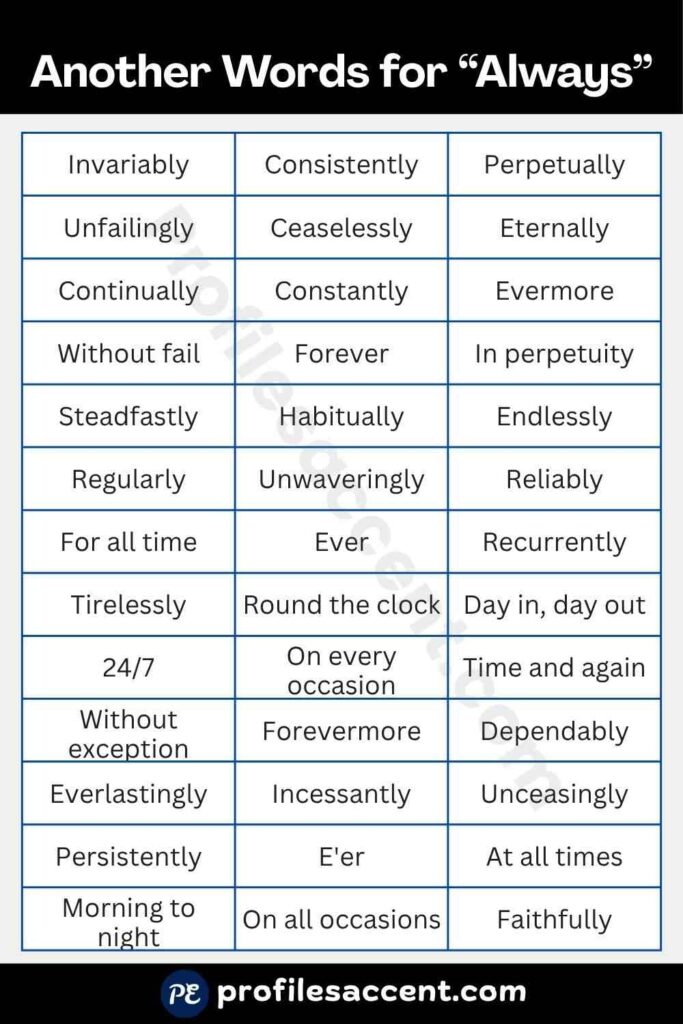
Always Synonyms at a Glance: Quick 35+ Aother Words Table
| Word / Phrase | Tone | Best For | Quick Example |
| Invariably | Formal | Essays, reports | “Results are invariably consistent.” |
| Consistently | Neutral | Work, CVs, essays | “She consistently meets targets.” |
| Perpetually | Formal/Poetic | Fiction, formal writing | “He was perpetually restless.” |
| Unfailingly | Warm + Formal | Praise, professional | “He is unfailingly kind.” |
| Ceaselessly | Literary | Strong emphasis | “The wind blew ceaselessly.” |
| Eternally | Poetic | Romance, deep emotion | “I am eternally grateful.” |
| Continually | Neutral | Repeated actions | “They continually improve.” |
| Constantly | Everyday | Casual speech | “She is constantly reading.” |
| Evermore | Poetic | Literature, vows | “This truth stands evermore.” |
| Without fail | Conversational | Habits, promises | “He calls without fail.” |
| Forever | Universal | Informal + emotional | “I’ll remember this forever.” |
| In perpetuity | Legal/Formal | Contracts, formal docs | “Rights granted in perpetuity.” |
| Steadfastly | Warm | Loyalty, character | “She steadfastly stood by him.” |
| Habitually | Neutral | Routine behavior | “He habitually arrives early.” |
| Endlessly | Expressive | Frustration or awe | “She endlessly questioned why.” |
| Regularly | Neutral | Schedules, habits | “They regularly update the system.” |
| Unwaveringly | Formal/Strong | Character, loyalty | “He unwaveringly defended her.” |
| Reliably | Practical | Trust, performance | “The tool reliably performs.” |
| For all time | Poetic/Emphatic | Declarations | “This will stand for all time.” |
| Ever | Poetic/Classic | Literature, verse | “Ever the voice of reason.” |
| Recurrently | Academic | Patterns, research | “The issue recurrently surfaces.” |
| Tirelessly | Positive | Effort, dedication | “She tirelessly supported them.” |
| Round the clock | Casual/Slang | Effort, availability | “They worked round the clock.” |
| Day in, day out | Casual | Frustration or routine | “He complained day in, day out.” |
| 24/7 | Slang | Modern casual speech | “She’s 24/7 on her phone.” |
| On every occasion | Formal phrase | Speeches, essays | “On every occasion, he led well.” |
| Time and again | Conversational | Pattern of behavior | “Time and again, they proved it.” |
| Without exception | Strong/Formal | Rules, policies | “This rule applies without exception.” |
| Forevermore | Poetic | Vows, literature | “Their names live forevermore.” |
| Dependably | Warm/Practical | Reliability | “She dependably shows up.” |
| Everlastingly | Poetic/Religious | Vows, deep writing | “Everlastingly devoted.” |
| Incessantly | Strong | Annoyance or emphasis | “He incessantly interrupted.” |
| Unceasingly | Formal/Literary | Effort, devotion | “She worked unceasingly.” |
| Persistently | Neutral/Practical | Effort or problems | “The issue persistently returns.” |
| E’er | Poetic (archaic) | Verse, literary fiction | “E’er a wandering soul.” |
| At all times | Formal phrase | Rules, guidance | “At all times, stay alert.” |
| Morning to night | Vivid/Casual | Effort, daily life | “She worked morning to night.” |
| On all occasions | Formal phrase | Policy, formal tone | “On all occasions, be respectful.” |
| Faithfully | Warm | Loyalty, devotion | “He faithfully kept his promise.” |
Three Ways “Always” Thinks: Synonyms Sorted by Real Meaning
Every Single Time: Frequency Synonyms for Always
These words belong in sentences where something happens each time without exception.
Best choices: invariably, consistently, without fail, unfailingly, reliably
“Invariably” is the standout here. It’s precise and formal. It tells the reader there are no exceptions. Compare these two:
- “The plan always works.”
- “The plan invariably works.”
The second sounds more confident and measured. It earns trust.
“Without fail” works well in spoken language or informal writing. It carries a personal guarantee feeling.
Lasting Forever: Duration-Based Alternatives
These words describe something that stretches into infinite time. Use them for promises, love, legacy, or deep emotional statements.
Best choices: eternally, forever, evermore, forevermore, for all time, everlastingly
Don’t swap these into frequency sentences. Writing “She eternally checks her email” sounds strange because “eternally” belongs to time, not habit.
Non-Stop and Ongoing: Continuity Synonyms
These describe something happening without pause, often with emotional weight attached.
Best choices: ceaselessly, incessantly, perpetually, endlessly, unceasingly, constantly
One important note here. Many of these carry a slightly negative or exhausted feeling.
Example: “He is incessantly talking” sounds like a complaint. “He is constantly talking” feels a bit softer. Choose based on how much friction you want in the sentence.
From Gentle to Powerful: How Strong Is Your Always Synonym?
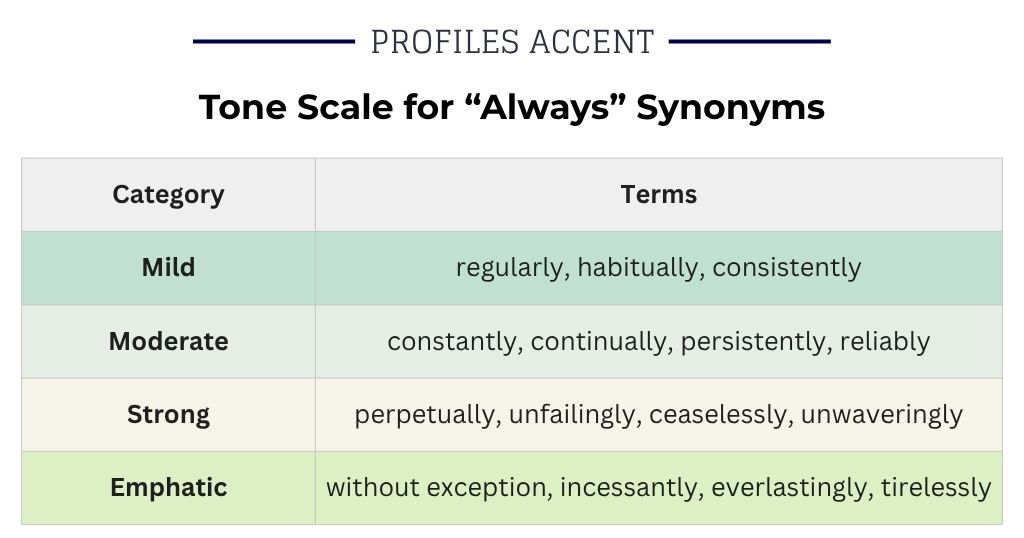
Not every synonym hits with the same force. Here’s how they line up from gentle to powerful:
- Mild → regularly, habitually, consistently
- Moderate → constantly, continually, persistently, reliably
- Strong → perpetually, unfailingly, ceaselessly, unwaveringly
- Emphatic → without exception, incessantly, everlastingly, tirelessly
This scale matters in professional and academic writing especially. “The team regularly meets deadlines” reads as calm and factual. “The team unfailingly meets deadlines” reads as a strong endorsement. Same idea, very different signal.
Same Sentence, Different Synonym: See the Difference
Original: “She always helps her team.”
- Formal: “She unfailingly supports her colleagues.”
- Academic: “She consistently demonstrates cooperative behavior within her team.”
- Casual: “She’s always there for her team, no question.”
- Creative: “Morning or midnight, her team knew she’d show up.”
Original: “He always worries about money.”
- Formal: “He perpetually concerns himself with financial matters.”
- Casual: “He’s constantly stressing about money.”
- Empathetic: “He endlessly carries the weight of financial worry.”
Original: “This road always floods in winter.”
- Formal: “This road invariably floods during winter months.”
- Academic: “Seasonal flooding recurrently affects this road.”
- Vivid: “Come winter, this road disappears under water without fail.”
Notice how each rewrite doesn’t just swap words. It shifts the entire feeling of the sentence.
Another Word for Always in Professional vs. Everyday Writing
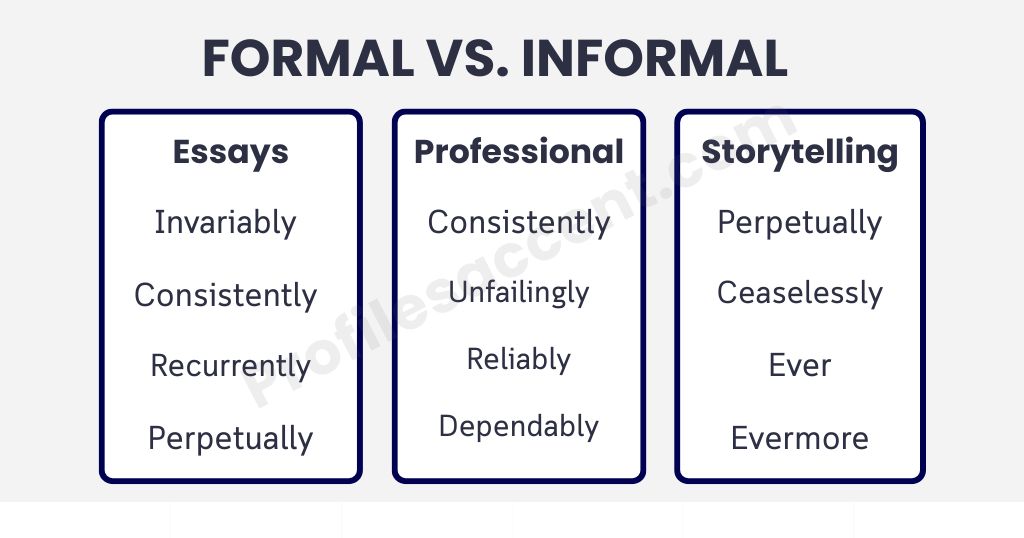
- For essays and academic writing: Invariably, consistently, recurrently, without exception, perpetually. These feel measured and credible.
- For professional emails and CVs: Consistently, unfailingly, reliably, dependably. These show competence without overdoing it.
- For fiction and storytelling: Perpetually, ceaselessly, ever, evermore, tirelessly. These have texture and rhythm.
- For casual speech and texting: Constantly, 24/7, round the clock, day in day out, time and again.
- Words to avoid in formal writing: 24/7, day in day out, round the clock. These work in conversation but they lower the register immediately in any professional document.
The Conversation Trap Hidden Inside “Always”
Here’s something most synonym guides skip entirely.
In arguments or difficult conversations, “always” and its strong synonyms like “constantly,” “incessantly,” and “without fail” can do real damage. Saying “You constantly ignore me” or “You are incessantly late” puts someone on the defensive immediately. Even if your frustration is valid.
Therapists and communication coaches actually advise people to remove frequency absolutes from conflict conversations because they feel like accusations rather than observations.
If you are writing about real relationships, coaching content, or communication advice, soften the word. “Often” or “frequently” keeps the door open. The always-family of words slams it shut.
Synonyms That Look Alike But Don’t Work the Same Way
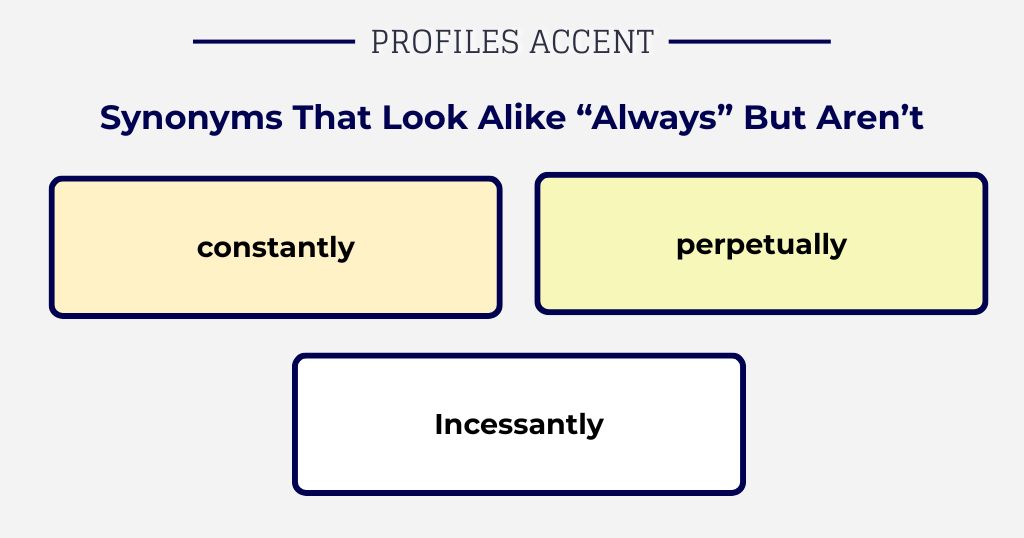
Mixing duration and frequency synonyms. “I will consistently love you” does not mean the same as “I will forever love you.” One is a habit claim. The other is a time claim. They are not interchangeable.
Overusing “constantly” in positive contexts. It tends to pull toward negative or exhausted feelings. In a performance review, writing “She is constantly working hard” sounds slightly backhanded compared to “She tirelessly works hard.”
Using “perpetually” in casual conversation. It reads fine on paper. Out loud it can sound stiff. Match your medium.
Assuming all formal synonyms sound polished. “Incessantly” in a professional email can read as passive-aggressive. Read the full sentence before you commit.
Words That Live Near “Always” (But Mean Something Slightly Different)
- Often = happens frequently but not every single time. A softer version of always.
- Regularly = at expected intervals. More structured than “often.”
- Typically = what usually happens, but with room for exceptions.
- Continuously = without any pause at all. Closer to “non-stop” than “every time.”
- Seldom = the near opposite. Worth having ready when you want contrast.
Choosing the Right Always Synonym: A Quick Final Guide
The word “always” isn’t broken. It just gets overworked. When you know whether you mean every time, forever, or without stopping, the right synonym almost picks itself.
- Use “invariably” when you want precise and formal.
- Use “eternally” when you want emotional depth.
- Use “without fail” when you want a personal, grounded tone.
- And use “consistently” when you want to sound credible and professional without sounding cold.
That’s the real skill. Not just knowing more words. Knowing which one fits the exact space you need to fill.
Discover More Articles:

I’m Rowan, a language addict who loves exploring how words work in everyday communication. I’ve spent years studying English vocabulary and helping others express themselves more clearly. My goal is simple: make learning new words easy and practical. I focus on real-life examples that show when and how to use different terms. Through clear explanations and honest guidance, I help readers choose the right words for any situation with confidence.