You just typed the word “unlike” for the third time in two paragraphs, and now it’s staring back at you. It’s not wrong. It’s just tired. That’s the moment most writers either hit backspace or leave it there and move on.
This guide won’t just hand you a list and disappear. It’ll show you which word fits where, how tone shifts depending on your choice, and where writers most often go wrong when swapping “unlike” for something else.
What “Unlike” Actually Does
“Unlike” is one of those small words that carries real weight. At its core, it signals contrast. But it does two different jobs depending on context:
It works as a preposition when you’re drawing a comparison between two things. “Unlike her sister, she preferred quiet evenings.” It also works as an adjective when you’re describing things that simply don’t resemble each other. “The two proposals are unlike in almost every way.”
There’s a third meaning that most synonym lists skip entirely. “Unlike” can also describe behavior that doesn’t fit someone’s character. “It was unlike him to cancel.” That nuance needs different replacement words than the other two uses, and this guide covers all three.
35+ Unlike Synonyms Quick Table
| Word / Phrase | Type | Tone | Best For | Quick Example |
| In contrast to | Prepositional | Formal | Essays, analysis | In contrast to the old model, this one is faster. |
| As opposed to | Prepositional | Neutral | Sharp comparisons | She chose kindness, as opposed to silence. |
| Contrary to | Prepositional | Formal | Challenging assumptions | Contrary to expectations, it worked perfectly. |
| Far from | Prepositional | Neutral | Dramatic contrast | His tone was far from welcoming. |
| Distinct from | Prepositional | Formal | Classification writing | This plan is distinct from the original draft. |
| Different from | Prepositional | Neutral | Everyday writing | Her view is different from mine. |
| At odds with | Prepositional | Neutral | Conflict or tension | His words were at odds with his actions. |
| In opposition to | Prepositional | Formal | Debates, politics | The motion passed in opposition to tradition. |
| Set apart from | Prepositional | Neutral | Highlighting uniqueness | Her skill sets her apart from the rest. |
| Separate from | Prepositional | Neutral | Logical distinction | This issue is separate from the budget problem. |
| Removed from | Prepositional | Literary | Emotional distance | His childhood felt removed from everything he knew. |
| In stark contrast to | Prepositional | Formal | Strong academic points | In stark contrast to the first report, this one shows growth. |
| Compared to | Prepositional | Neutral | General comparison | Compared to last year, results improved. |
| Varying from | Prepositional | Formal | Data or science writing | These readings are varying from the baseline. |
| Dissimilar | Adjective | Formal | Academic writing | The two structures are completely dissimilar. |
| Divergent | Adjective | Formal | Views, trends, paths | Their approaches became divergent over time. |
| Disparate | Adjective | Formal | Fundamental difference | The two datasets are entirely disparate. |
| Mismatched | Adjective | Informal | Everyday storytelling | They were a mismatched pair from the start. |
| Contrasting | Adjective | Neutral | Paired comparisons | The two murals have contrasting styles. |
| Unalike | Adjective | Neutral | Simple adjective use | Though twins, they are very unalike. |
| Opposite | Adjective | Neutral | Total difference | Their personalities are practically opposite. |
| Inconsistent with | Adjective | Formal | Logic, law, science | That claim is inconsistent with the data. |
| Incompatible | Adjective | Neutral | Things that cannot mix | The two systems are incompatible. |
| Heterogeneous | Adjective | Formal | Science, demographics | The sample was highly heterogeneous. |
| At variance with | Adjective | Formal | Legal or academic tone | Her account is at variance with the records. |
| Discordant | Adjective | Literary | Music, tone, mood | The ending felt discordant with the rest. |
| Alien to | Adjective | Literary | Emotional strangeness | That lifestyle was alien to him. |
| Nonidentical | Adjective | Formal | Science, technical | The twins are nonidentical genetically. |
| Uncharacteristic of | Behavior phrase | Neutral | Behavior description | It was uncharacteristic of him to shout. |
| Out of character for | Behavior phrase | Informal | Personal behavior | Being late is out of character for her. |
| Atypical of | Behavior phrase | Neutral | Pattern deviation | This result is atypical of the usual trend. |
| Unusual for | Behavior phrase | Informal | Everyday speech | It was unusual for him to stay quiet. |
| Not in keeping with | Behavior phrase | Neutral | Tone or style mismatch | That joke was not in keeping with the moment. |
| Untypical of | Behavior phrase | Neutral | Slightly formal contexts | This response is untypical of the committee. |
| Contrary to | Sentence starter | Formal | Opening an argument | Contrary to public opinion, the bill passed. |
| In a departure from | Sentence starter | Formal | Showing a shift | In a departure from tradition, the award was shared. |
| Where others… | Sentence starter | Literary | Narrative contrast | Where others hesitated, she moved forward. |
| Standing apart from | Sentence starter | Neutral | Emphasis on uniqueness | Standing apart from its peers, the company thrived. |
| Breaking from | Sentence starter | Neutral | Change or rebellion | Breaking from precedent, the court ruled differently. |
| Deviating from | Sentence starter | Formal | Technical writing | Deviating from the norm, the group chose silence. |
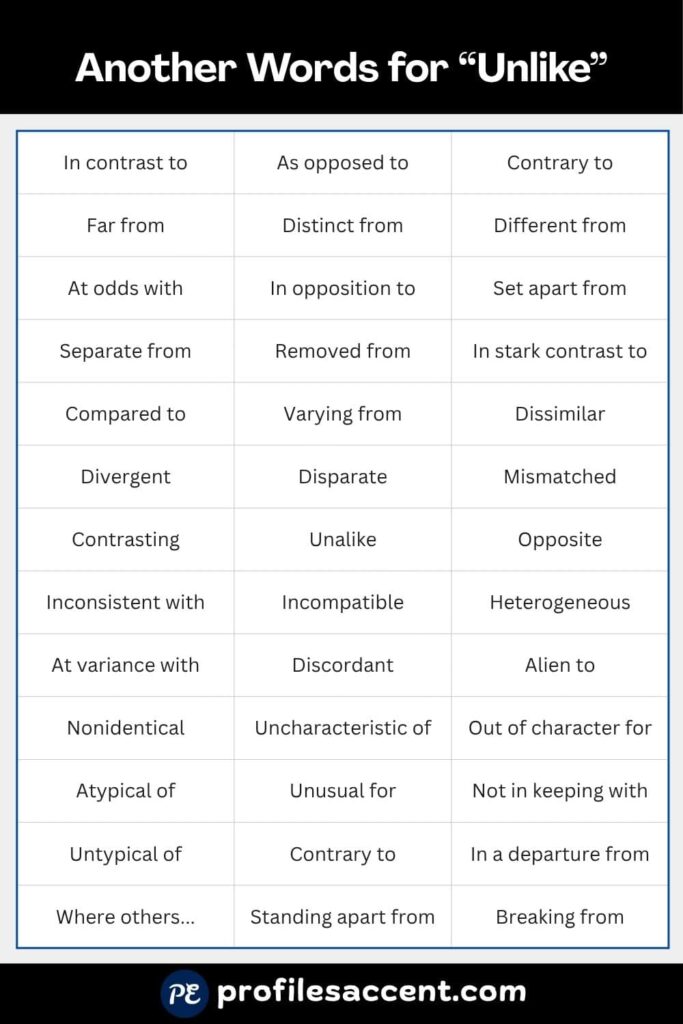
Not All Synonyms for Unlike Mean the Same Thing
Here’s where most synonym lists fail writers. They pile every alternative into one heap, as if “disparate,” “different,” and “mismatched” are interchangeable. They are not.
When difference is total and fundamental, use “disparate.” Two things that are disparate don’t just look different — they come from completely unrelated places. Think two datasets from opposite fields, or two communities with nothing in common. “Dissimilar” is milder. It just means things don’t look alike.
When things are moving away from each other, “divergent” is your word. Views that start the same but drift apart are divergent. Two roads splitting at a fork are divergent. It implies direction, not just difference.
When difference creates tension or conflict, “at odds with” or “discordant” fits better than “unlike.” A statement that is at odds with the evidence is doing more than just being different — it’s clashing against it.
When something feels out of place for a specific person, the right phrase is not “unlike” at all. It’s “uncharacteristic of” or “out of character for.” These phrases are doing personal, behavioral work that simple contrast words cannot.
How Strong Is Your Unlike Synonym? A Tone Scale
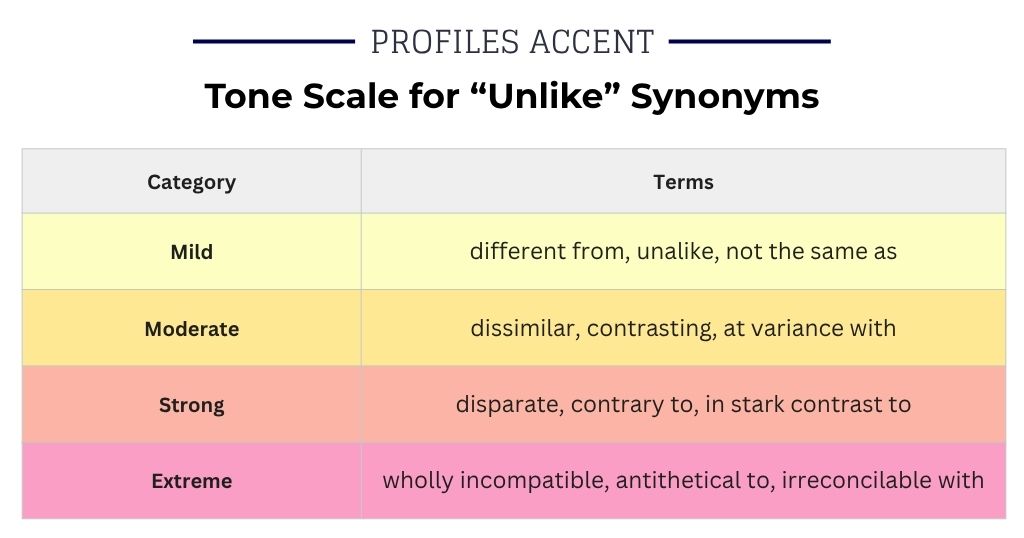
Not every synonym hits with the same force. Here’s how several of them stack up from softest to strongest:
- Mild: different from, unalike, not the same as
- Moderate: dissimilar, contrasting, at variance with
- Strong: disparate, contrary to, in stark contrast to
- Extreme: wholly incompatible, antithetical to, irreconcilable with
If you’re writing a casual blog post, “different from” lands smoothly. If you’re writing a research paper pushing back against a prior study, “contrary to” or “in stark contrast to” signals that you mean business. Picking a word from the wrong end of this scale makes your writing either too aggressive or too limp for the moment.
Seeing Unlike Synonyms in Action: Real Sentence Rewrites
Take this sentence: “Unlike other companies, they focus on quality.”
That sentence works, but it’s flat. Here’s how different word choices shift the feel:
- Formal tone: “In contrast to industry norms, the company maintains a quality-first approach across every production stage.”
- Casual tone: “Most companies chase volume. These folks still care about making something good.”
- Academic tone: “Contrary to prevailing market behavior, this organization prioritizes product integrity over output metrics.”
- Creative tone: “Where others count units, they count craftsmanship.”
Each version says roughly the same thing, but the relationship between writer and reader changes completely. The casual version builds warmth. The academic version signals precision. The creative version builds character. None of them are wrong — they just serve different rooms.
Formal vs. Informal: Choosing the Right Unlike Alternative
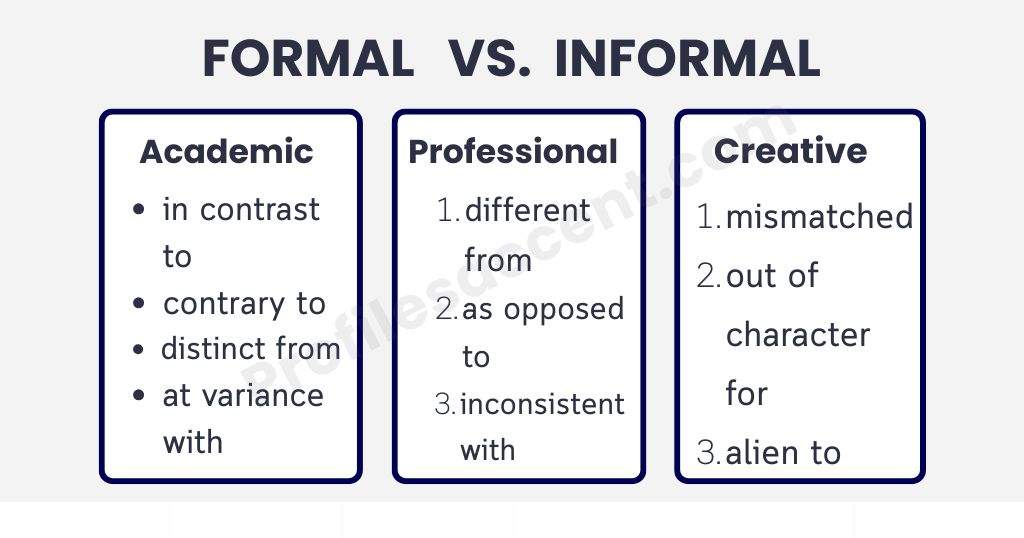
For essays and academic writing, your best options are “in contrast to,” “contrary to,” “distinct from,” “at variance with,” and “in a departure from.” These phrases carry the weight of argument without sounding stiff or dramatic.
For professional emails and reports, stick to “different from,” “as opposed to,” and “inconsistent with.” They’re clear and direct without sounding like a textbook.
For storytelling and personal writing, “mismatched,” “out of character for,” “alien to,” and “where others…” give you texture and voice. These phrases let personality breathe.
Avoid “heterogeneous” outside of scientific or demographic writing. Avoid “discordant” unless you’re writing about sound, emotion, or a deliberately literary moment. Using either word in casual writing feels like wearing a suit to the beach — technically fine, but noticeably off.
Unlike vs. Unlikely: The Mix-Up That Trips Writers Up
This one trips up more people than you’d expect, especially when searching for synonyms online.
“Unlike” means not similar, or not characteristic of. “Unlikely” means not probable. These two words are completely unrelated in function. An unlikely event has nothing to do with resemblance. Synonyms for “unlikely” include improbable, doubtful, and remote. None of those work as replacements for “unlike.”
If you search “another word for unlike” and a list gives you “improbable” or “slim chance,” that list confused the two.
Common Mistakes When Using Another Word for Unlike
The part-of-speech trap catches a lot of writers. If “unlike” is being used as a preposition in your sentence, you need a replacement that also functions as a preposition. You cannot swap in “dissimilar” or “disparate” because those are adjectives. Doing so breaks the sentence structure.
- Wrong: “Dissimilar her brother, she loved crowds.”
- Right: “In contrast to her brother, she loved crowds.”
The dangling modifier problem shows up specifically when you start a sentence with “unlike” or any substitute phrase. That opening phrase must connect directly to the subject of the main clause.
- Wrong: “Contrary to the old policy, meetings were shortened.” (What shortened meetings? The policy? This is unclear.)
- Right: “Contrary to the old policy, the team shortened meetings by half.”
The subject of the main clause needs to be the thing you’re comparing. If it isn’t, the sentence dangles.
Related Words Worth Knowing Beyond Basic Unlike Synonyms
“Antithetical” means directly and completely opposite, often in a philosophical sense. It’s stronger than “unlike” and implies deep contradiction, not just surface difference.
“Incongruent” suggests that two things don’t belong together — there’s a mismatch in fit or proportion. Useful in therapy, design, and logic.
“Aberrant” describes something that deviates from what is expected or normal. It carries a slightly negative edge, often used in medical or behavioral writing.
“Nonconforming” works when someone or something deliberately does not follow a standard. It has a social and sometimes political weight that “unlike” does not carry.
Which Unlike Synonym Should You Actually Use?
- If you’re mid-essay and “unlike” feels repetitive: reach for “in contrast to” or “contrary to.” They’re the safest formal swaps.
- If you’re describing someone doing something unexpected: “out of character for” or “uncharacteristic of” is always cleaner than “unlike him/her.”
- If you want contrast with emotional weight: try “far from,” “alien to,” or “where others…” for a more human, literary feel.
- If you’re in academic writing and comparing data or research: “disparate,” “divergent,” or “at variance with” will serve you well.
The best synonym isn’t the smartest-sounding one. It’s the one that fits the sentence without drawing attention to itself.
Discover More Articles:

I’m Rowan, a language addict who loves exploring how words work in everyday communication. I’ve spent years studying English vocabulary and helping others express themselves more clearly. My goal is simple: make learning new words easy and practical. I focus on real-life examples that show when and how to use different terms. Through clear explanations and honest guidance, I help readers choose the right words for any situation with confidence.