You typed “journey” and then stared at it. Something felt off. Maybe it was too plain. Maybe it didn’t match the weight of what you were describing. Or maybe you’ve used it three times in the same paragraph and your writing is starting to sound like a travel brochure.
The problem with “journey” isn’t that it’s a bad word. It’s that it carries a very neutral energy. It doesn’t tell the reader whether the trip was exhausting, spiritual, brief, or life-changing. The synonym you choose does that work for you.
This guide helps you pick the word that actually fits.
What Does “Journey” Actually Mean?
At its core, a journey means moving from one point to another, physically or in life. But its emotional weight is deliberately vague. It doesn’t tell us how long, how hard, or why. That’s both its strength and its weakness as a word. Choosing a more specific alternative gives your reader an instant, clearer picture.
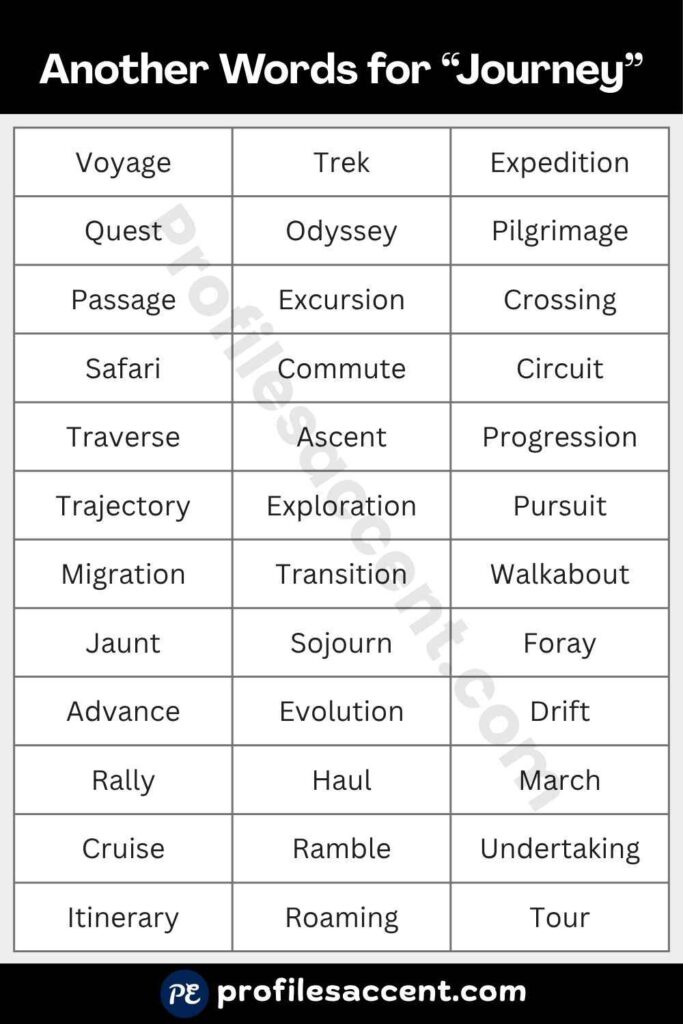
35+ Another Word for Journey: Quick Synonym Table
| Word | Tone | Best Situation | Quick Example |
| Voyage | Formal, grand | Sea travel or long life paths | Her voyage across three continents changed her |
| Trek | Gritty, effortful | Hard physical or career climb | The trek up the mountain took everything |
| Expedition | Purposeful | Organized mission or research | The sales expedition to Europe paid off |
| Quest | Determined | Chasing one specific goal | His quest for the truth never stopped |
| Odyssey | Epic, transformative | Long life story or brand narrative | Building the school was a ten-year odyssey |
| Pilgrimage | Meaningful, sacred | Spiritual or deeply personal travel | She made a pilgrimage to her hometown |
| Passage | Transitional | Moving from one life stage to another | The passage from student to professional is hard |
| Excursion | Light, fun | Short leisure trip | A quick excursion to the coast cleared her mind |
| Crossing | Tense, significant | Moving between two very different places | The crossing into the new country felt surreal |
| Safari | Adventurous | Wildlife or exploration travel | The safari through the reserve was unforgettable |
| Commute | Routine, neutral | Regular daily travel | His daily commute takes forty-five minutes |
| Circuit | Methodical | A planned route or tour | The band completed its national circuit |
| Traverse | Technical, physical | Crossing terrain or a topic in depth | The traverse across the valley took two days |
| Ascent | Upward, ambitious | Career growth or mountain climbing | Her ascent to director surprised everyone |
| Progression | Step-by-step | Development over time | The progression from beginner to expert took years |
| Trajectory | Analytical | Predicting a path or career direction | His academic trajectory was impressive |
| Exploration | Curious, open | Discovery with no fixed goal | The exploration of that neighborhood was rewarding |
| Pursuit | Active, driven | Chasing a goal or dream | Her pursuit of medicine began at age twelve |
| Migration | Mass or cultural | Moving groups or life phase shifts | The migration of families to the city grew rapidly |
| Transition | Structural | Major life or organizational change | The career transition took eighteen months |
| Walkabout | Spiritual, wandering | Self-discovery travel (Australian origin) | He went on a walkabout to find clarity |
| Jaunt | Playful, short | Fun quick trip with no serious purpose | A jaunt to the bookshop turned into three hours |
| Sojourn | Temporary stay | Living briefly somewhere new | Her sojourn in Vienna shaped her taste in music |
| Foray | Bold, first attempt | Entering unfamiliar territory | His foray into cooking started with one recipe |
| Advance | Forward movement | Military, career, or project progress | The team’s advance through the project was steady |
| Evolution | Gradual change | Business, personal, or product development | The brand’s evolution over a decade was striking |
| Drift | Aimless, passive | Wandering with no real direction | His drift through low-paying jobs lasted five years |
| Rally | Recovery-focused | Bouncing back after difficulty | Her rally from illness was slow but steady |
| Haul | Long, effortful | Tiring stretch of work or distance | The long haul to the finish line tested everyone |
| March | Deliberate, forceful | Political, social, or purposeful movement | The march toward equality continues today |
| Cruise | Relaxed, smooth | Comfortable sea or road travel | The cruise down the coastline was perfect |
| Ramble | Casual, slow | Unplanned walking or storytelling | An afternoon ramble through the old streets |
| Undertaking | Serious, formal | A major project or difficult endeavor | The renovation was a massive undertaking |
| Itinerary | Structured, planned | The plan of a trip, not the trip itself | She printed the itinerary the night before |
| Roaming | Free, open-ended | Wandering with loose purpose | Months of roaming through Southeast Asia |
| Tour | Scheduled, structured | Organized travel through multiple stops | The university tour covered four campuses |
| Path | Simple, directional | Life direction or career route | She chose a different path than her parents expected |
| Wayfaring | Poetic, old-fashioned | Long travel on foot or literary writing | The wayfaring stranger rested at the inn |
Journey Synonyms Grouped by Meaning
Not all synonyms are created equal. Some of them look similar on a list but behave very differently in a sentence.
Physical vs. Metaphorical
Words like “trek,” “cruise,” and “crossing” belong to the physical world first. If you use them metaphorically, they create a visual contrast, which can be powerful in creative writing but awkward in a business report.
“Odyssey,” “passage,” and “ascent” live comfortably in both worlds. You can use “ascent” to describe climbing a hill or climbing a career ladder, and neither use feels out of place.
Short vs. Long
A “jaunt” is never a six-month adventure. A “pilgrimage” is never a quick errand. Word length in real life often mirrors the scale of the word. Match that.
- Short trip words: jaunt, excursion, outing, foray, cruise, run
- Long journey words: odyssey, expedition, trek, pilgrimage, migration, haul
Planned vs. Unplanned
This distinction is almost never mentioned in synonym lists, but it matters a lot for accuracy.
- Planned: expedition, circuit, itinerary, tour, mission
- Unplanned or wandering: ramble, drift, roaming, walkabout, meander
If you’re writing about a structured corporate rollout, using “drift” is not just wrong tonally. It sends the wrong message about intention.
How Strong Is Your Synonym? A Tone Scale for Journey
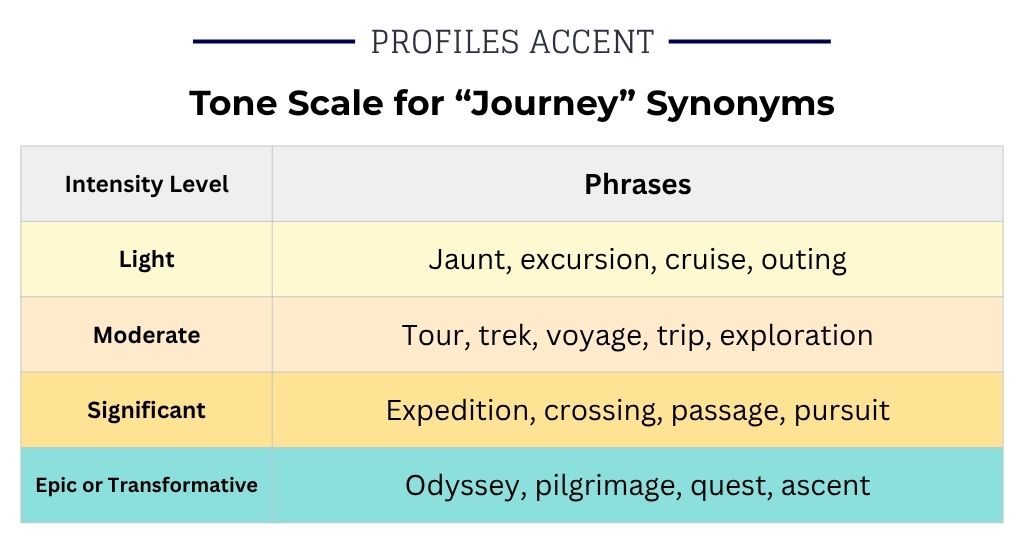
Some words feel soft. Others feel like they carry the weight of years. Here’s how they stack up emotionally:
- Light → jaunt, excursion, cruise, outing
- Moderate → tour, trek, voyage, trip, exploration
- Significant → expedition, crossing, passage, pursuit
- Epic or Transformative → odyssey, pilgrimage, quest, ascent
If you’re writing a company newsletter about a fun team outing, “odyssey” is too heavy. If you’re describing a founder’s decade-long effort to build a school in a remote region, “trip” feels dismissive. The emotional weight of your synonym should match the actual weight of the story.
Watch the Swap in Action: Same Sentence, Different Words
The word “journey” can be swapped in many directions. Here’s what changes when you change it.
Original (weak): “Starting a business was a long journey.”
- Formal: “Founding and scaling the company required a sustained evolution over seven years.”
- Creative: “Building that business felt less like a sprint and more like an odyssey with no clear map.”
- Academic: “The progression from concept to commercialization reflected a complex trajectory shaped by market constraints.”
- Casual: “Starting that business was one long, exhausting trek I almost didn’t finish.”
Each rewrite signals something different. The word you pick is not just decoration. It shapes how the reader feels about the whole experience being described.
Original (weak): “She went on a journey to find herself.”
- Formal: “She undertook a period of personal transition following her resignation.”
- Creative: “She went on a quiet pilgrimage, one with no destination and no deadline.”
- Casual: “She needed a walkabout. No plans. Just movement.”
Notice how the creative version adds spiritual weight. The casual version adds personality. The formal version removes emotion entirely and focuses on action.
Which Journey Synonym Fits Your Writing Context?
In school essays, stay away from “trip” and “jaunt.” They read too casually. Better choices are “passage,” “progression,” “exploration,” or “pursuit.” These words feel academic without being stiff.
In business writing, “journey” is used so often in customer experience frameworks that it has become nearly invisible. Words like “progression,” “trajectory,” “evolution,” and “roadmap” signal forward thinking and strategic awareness. Use “odyssey” only when the achievement truly was monumental.
In creative or personal writing, this is where you have the most freedom. “Pilgrimage,” “crossing,” “drift,” and “sojourn” all carry layers of meaning that “journey” alone cannot offer.
For titles and headlines, short power words win. “Quest,” “ascent,” “trek,” and “odyssey” all work well because they carry emotional impact in one word.
Journey Words That Look Alike But Are Not
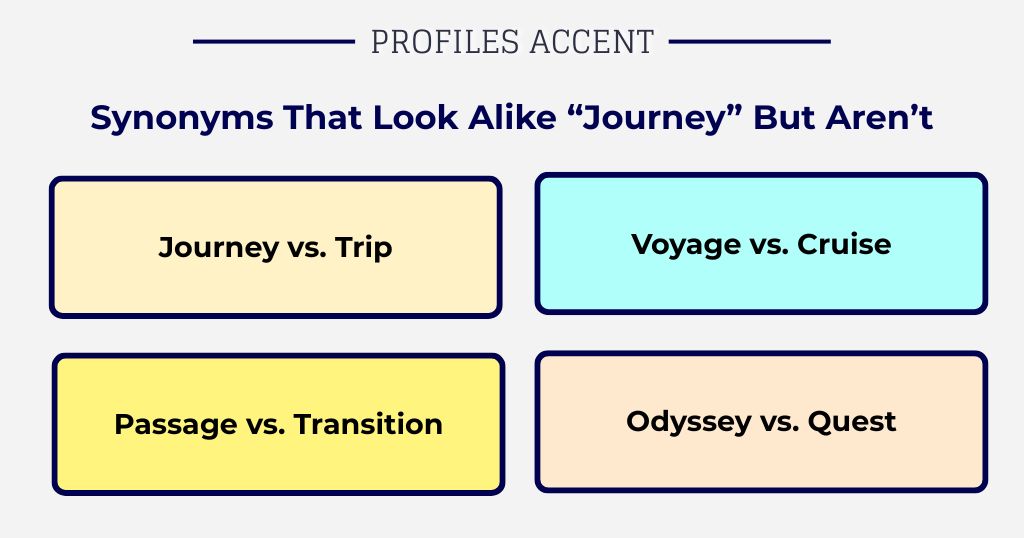
Journey vs. Trip: A trip can be as short as going to the store. A journey implies something more meaningful or longer in scope. Using “trip” where you mean something significant weakens the writing.
Voyage vs. Cruise: Voyage implies purpose and sometimes hardship. A cruise implies leisure and comfort. These two should not be swapped in formal writing.
Passage vs. Transition: Both describe moving from one state to another. “Passage” is more poetic and often used for life stages. “Transition” is neutral and suits professional or structural contexts better.
Odyssey vs. Quest: An odyssey tends to be long, winding, and full of unexpected turns. A quest is focused. It has a singular target. If your story has one goal being chased, “quest” is the tighter word.
Excursion vs. Expedition: An excursion is casual, short, and usually for fun. An expedition is organized, serious, and has a clear objective. These are not interchangeable, even though both involve leaving somewhere and going somewhere else.
Underused Synonyms for Journey Worth Keeping Handy
These don’t always appear in synonym lists, but they’re useful for writers who want to be precise.
- Sojourn is a temporary stay somewhere, not just movement. It implies settling briefly in a place before continuing.
- Foray means entering something unfamiliar for the first time, often briefly. A foray into cooking, or into a new market.
- Undertaking works when the journey itself is not the point but the difficulty and seriousness of it are.
- Haul works well when the journey was long and tiring, especially when paired with “long.” It fits physical distance and metaphorical endurance equally well.
Pick the Right Word and Move Forward
If you’re writing something formal, reach for “passage,” “progression,” or “trajectory.” If you’re writing something emotional or personal, “odyssey,” “pilgrimage,” or “crossing” will carry more weight.
- For light content, “jaunt” or “excursion” keeps things friendly.
- For creative work, pick the word that matches the feeling of the experience, not just the movement.
The right synonym doesn’t just replace “journey.” It tells the reader how hard the road was, how long it took, and whether it was worth it. That’s the difference one word can make.
Discover More Articles:

I’m Rowan, a language addict who loves exploring how words work in everyday communication. I’ve spent years studying English vocabulary and helping others express themselves more clearly. My goal is simple: make learning new words easy and practical. I focus on real-life examples that show when and how to use different terms. Through clear explanations and honest guidance, I help readers choose the right words for any situation with confidence.